Blog
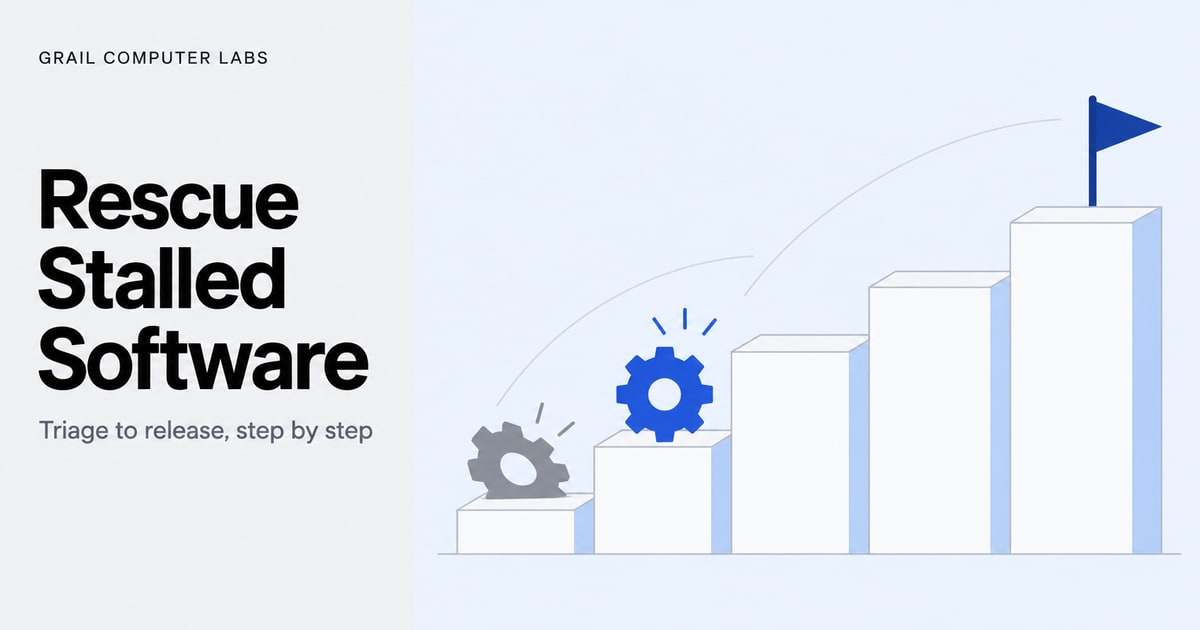
Software Development Project Rescue: What the First 30 Days Involve
How software development project rescue works: triage, codebase inheritance, outcome agreement, stabilisation and release, anchored in a real 30-day case.

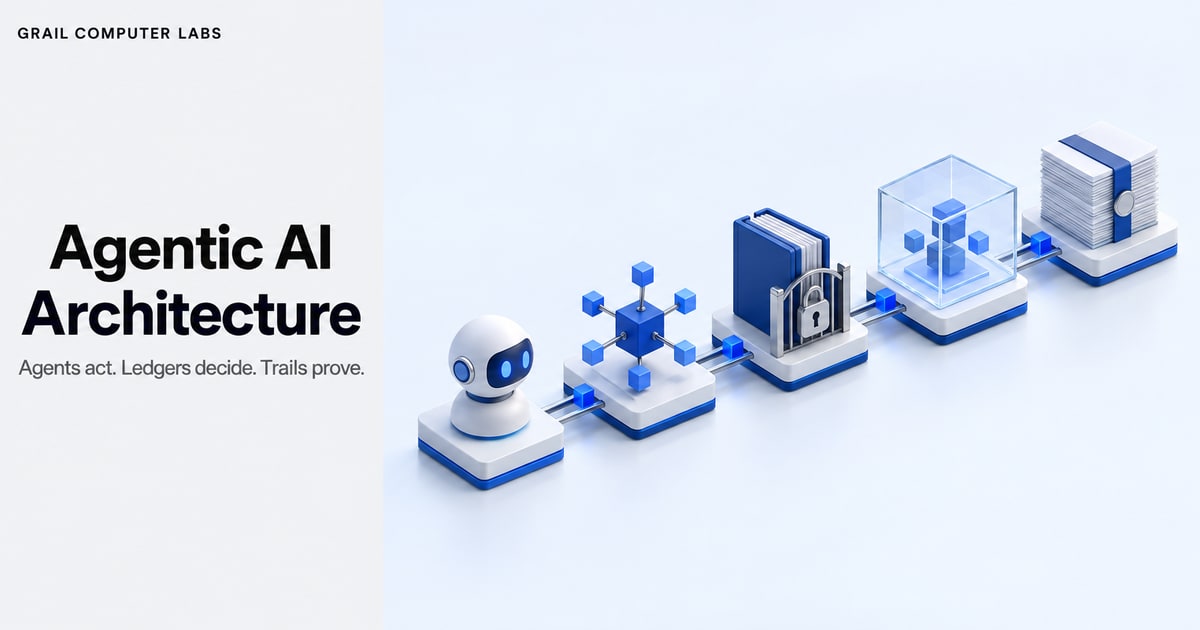
Agentic AI platform architecture defined: agent, orchestrator, permission ledger, sandboxed runner and audit trail, plus a six-stage reference loop.
How software development project rescue works: triage, codebase inheritance, outcome agreement, stabilisation and release, anchored in a real 30-day case.
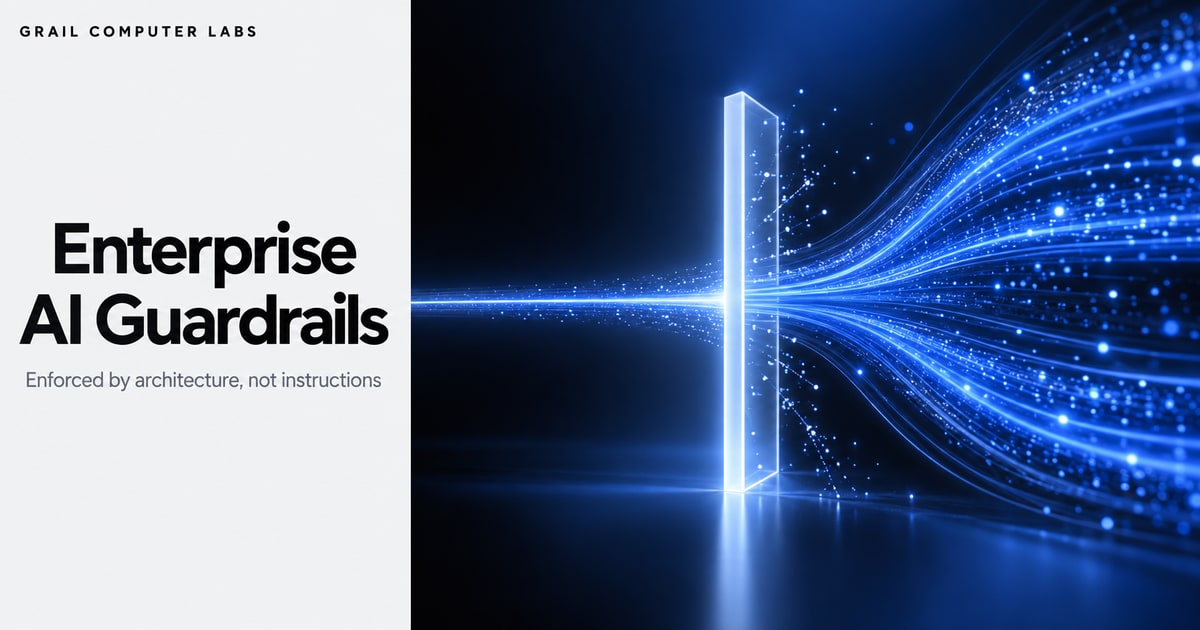
Enterprise AI guardrails explained: instruction-based vs architecture-based controls, plus a go-live checklist for data access, action scope and fallback.
A legacy system is software that is hard to change safely. See the warning signs, the improve-or-rebuild test and a phased migration plan for real platforms.
Request a quote and our experts will contact you within 24 hours with tailored solutions and pricing.
You can also send us a quick email at [email protected].
Last updated: Nov 23, 2026
By Shiva Mangal, Grail Computer Labs
Agentic AI platform architecture is the set of components that lets AI agents plan and act on real systems while a separate layer controls their permissions, records every action and keeps humans in charge of risky decisions. Forbes (2026) revisits Gartner's forecast that over 40% of agentic AI projects will be cancelled by the end of 2027 and argues failures stem from missing governance, ownership and rollback controls. This guide defines each part and shows what a production system must record and enforce. We use the Software Factory from Grail Computer Labs (GC Labs) as the worked example.
Key Takeaways
- Agentic AI platform architecture has five parts: agent, orchestrator, permission ledger, sandboxed runner and audit trail.
- An agentic AI platform differs from an automation tool because the agent chooses the steps, so the platform must control and record them.
- An agentic AI audit trail is evidence of each action, with identity, authority, policy decision and approver. An application log is a debugging aid.
- A useful architecture diagram shows trust boundaries, permission checks, evidence writes, human gates and the rollback path.
- Software rescue applies when a project has already stalled and a new team must get it to production.
Agentic AI platform architecture is the arrangement of five parts: an agent that reasons and proposes actions, an orchestrator that sequences work, a permission ledger that decides what is allowed, a sandboxed runner that executes approved actions, and an audit trail that records the evidence. A scripted automation tool has none of the reasoning; a bare agent has none of the control.
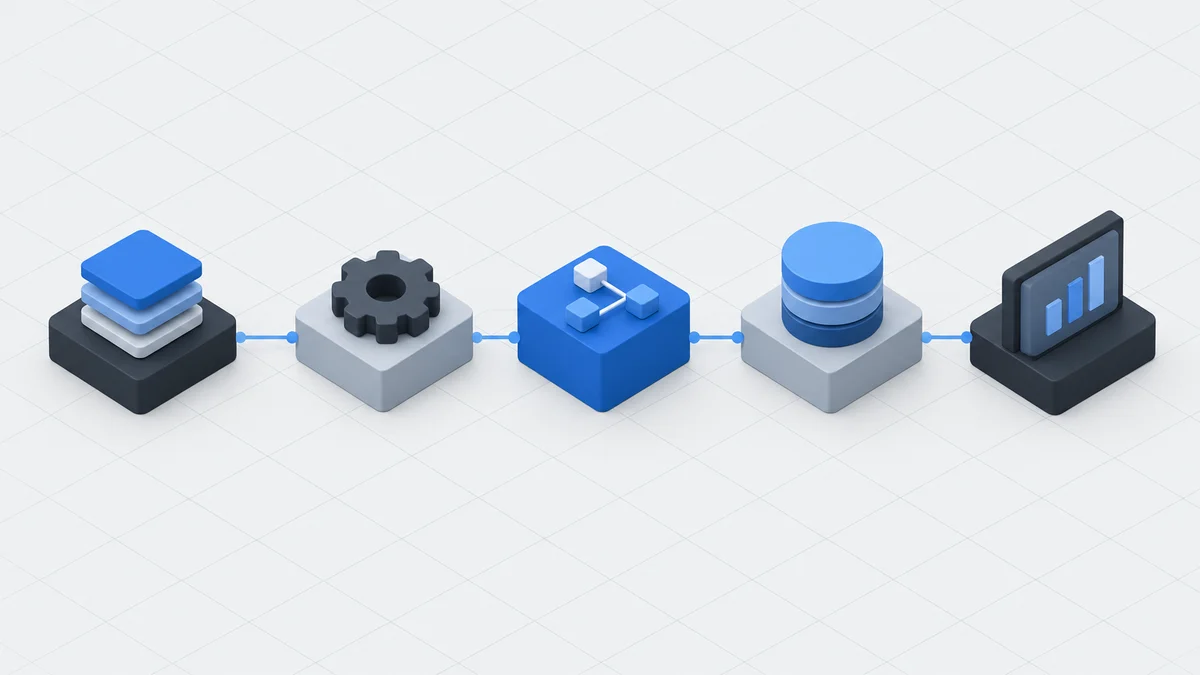
Buyers meeting the category for the first time often fold these parts into one word. They are different jobs, and each one fails differently. We define them here in the form we use when we design systems.
The difference is who chooses the steps. In a scripted workflow tool, a person writes every step in advance and the tool repeats it. In an agentic platform, the agent picks steps at run time. That is why the control parts exist. A fixed script cannot reason its way around a rule. An agent can.
| Item | Who chooses the steps | Typical failure | What must surround it |
|---|---|---|---|
| Scripted automation tool | A person, in advance | Breaks when the input changes | Error alerts, retries |
| AI agent alone | The model, at run time | Takes an unapproved route to the goal | Permission ledger, sandboxed runner |
| Orchestrator | Rules plus agent proposals | Loses state between steps | Audit trail, human gates |
| Agentic AI platform | Agent within enforced limits | Controls exist only as instructions | All five parts, verified |
The category is still early. KPMG's Global AI Pulse found that 11 percent of organizations were deploying agents, scaling across functions and beginning to coordinate them (KPMG International, 2026). Many products sold as agentic are scripted workflows with a model attached.
An agentic AI platform works as a loop: a request enters, the orchestrator splits it into steps, an agent proposes an action, the permission ledger approves or refuses it, a sandboxed runner executes it, and the system verifies and records the result. GC Labs' Software Factory runs this loop as Triage → Specify → Implement → Review → Verify → Release.
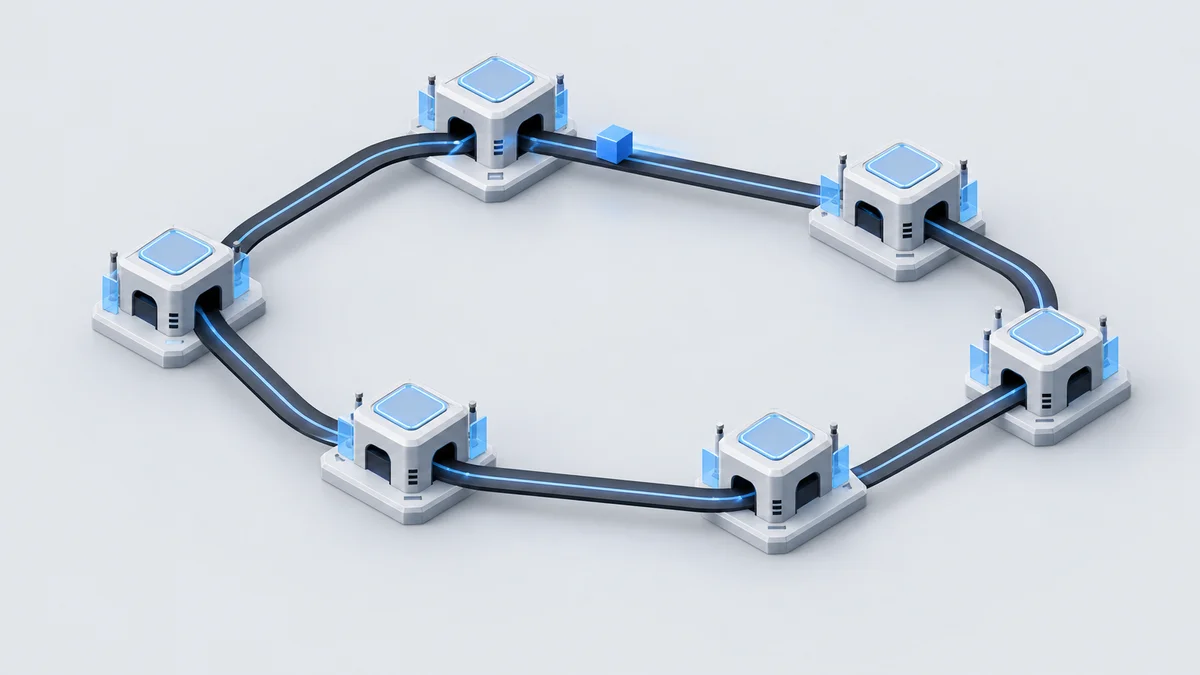
The principle behind the Software Factory is short: agents execute, humans decide, customers see progress. The table shows what each stage of a production loop must record and which gate it enforces. It is the reference we design to.
| Stage | What happens | What the system must record | Gate it enforces |
|---|---|---|---|
| Triage | A request is classified and scoped | The request, requester and status | A named owner accepts the scope |
| Specify | The outcome and acceptance checks are written | The agreed outcome and criteria | Humans sign off the specification |
| Implement | An agent drafts the change inside a sandbox | Agent trace, tool calls, masked secrets | The permission ledger checks every action |
| Review | An engineer reads the change | Reviewer identity and decision | No change moves on without approval |
| Verify | Tests run against the change | Test results | Tests reject incomplete work |
| Release | The change ships | Release history and rollback point | Only approved, verified changes ship |
In the Software Factory, GC Labs engineers review every change, tests reject incomplete work, and agent traces are recorded. Likely secrets are masked before they reach an agent. The customer dashboard shows requests, status, communication and release history.
The verify stage is not optional. Carnegie Mellon and Salesforce research, reported by The Register (2025), measured AI agent task completion at about 30 to 35 percent for multi-step tasks. That is trade-press reporting of research we have not read in full, and models have improved since mid-2025, so treat it as a historical baseline. The conclusion still holds: a system that trusts agent output without a gate will ship errors.
Orchestration is also where enterprise use is heading. KPMG's Q2 2026 survey of 204 US leaders at organisations with $1B+ revenue found agents used to align shared goals and metrics (64%), support joint decision-making (49%) and automate cross-functional workflows (48%) (KPMG US, 2026).
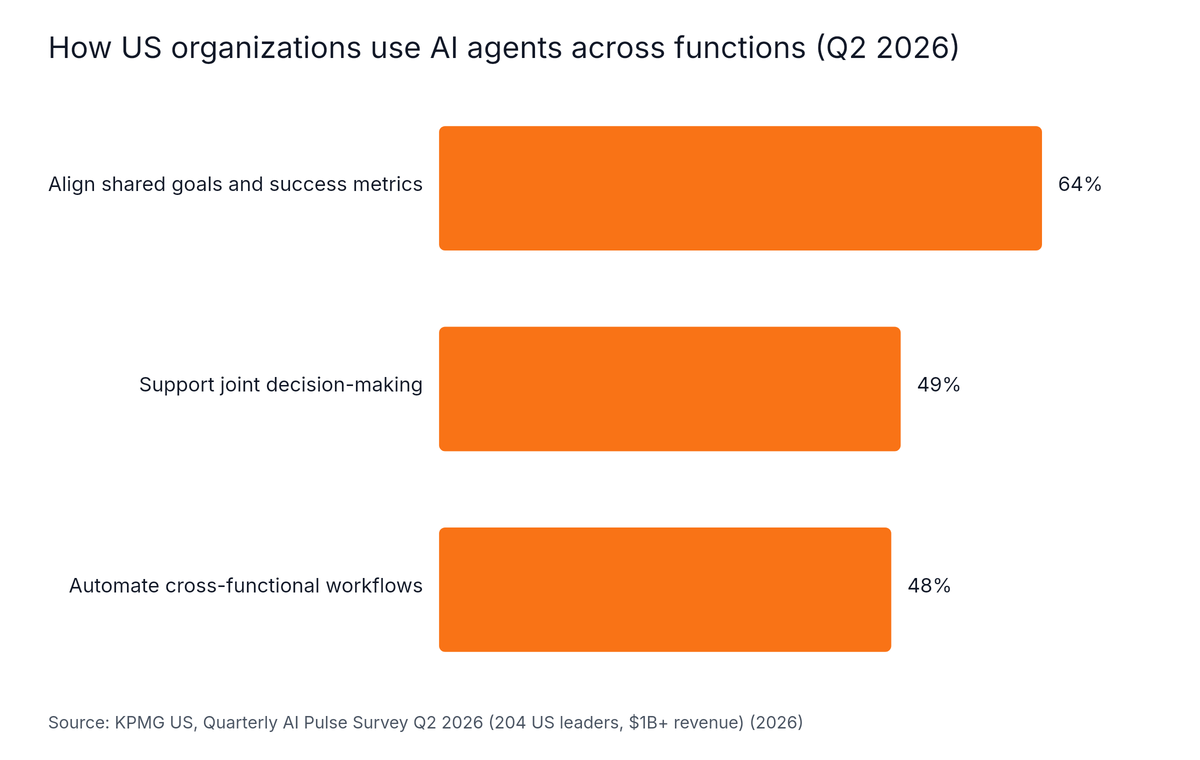
Source: KPMG US, Quarterly AI Pulse Survey Q2 2026 (204 US leaders, $1B+ revenue), 2026
A production-ready agentic AI system platform has seven components: agents, an orchestrator, a permission ledger, a sandboxed runner, a verification gate, human review points and an audit trail. Deloitte's 2026 survey found 74% of companies plan to deploy agentic AI within two years, yet only 21% report a mature governance model for autonomous agents (Deloitte, 2026).
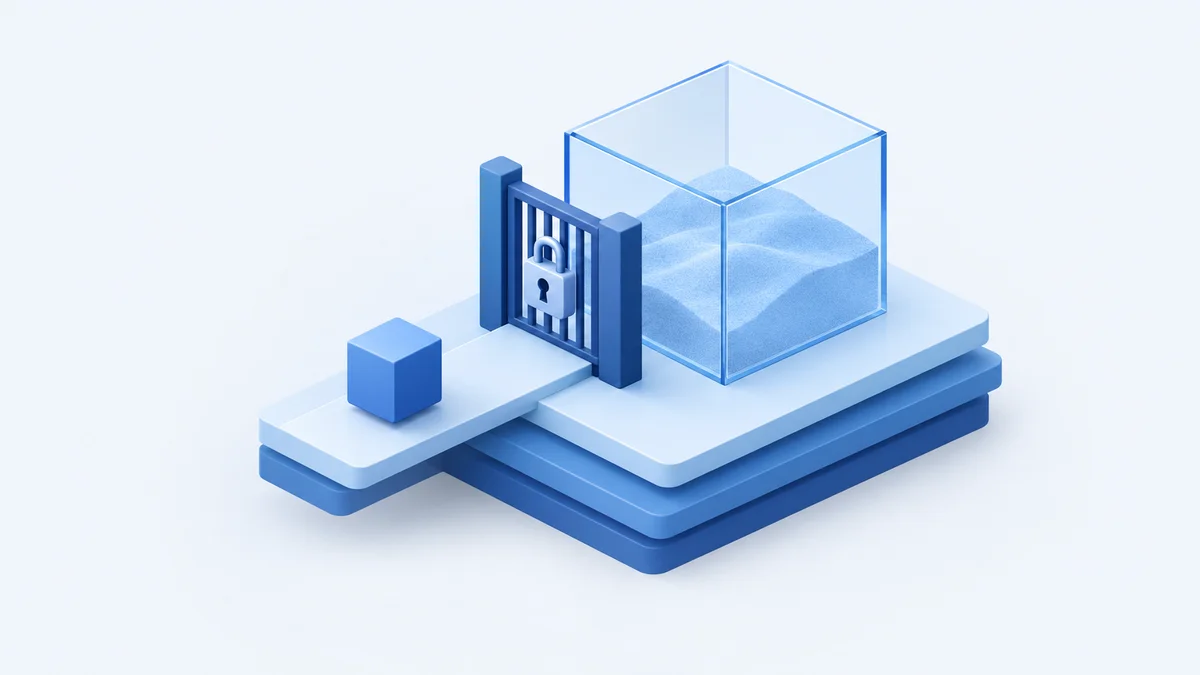
That gap between plan and governance is where projects stall. Deloitte's publisher statement puts the point this way: "governance is more than guardrails" (Deloitte, 2026). A guardrail is a rule the agent reads. A boundary is something the agent cannot cross. We design for boundaries.
| Component | What it does | What it must enforce | What breaks without it |
|---|---|---|---|
| Agent | Proposes the next action | Works only inside its assigned task | Goal drift |
| Orchestrator | Sequences steps and holds state | One owner per workflow run | Lost context between steps |
| Permission ledger | Stores allowed actions per agent | Check before every action | Agents grant themselves access |
| Sandboxed runner | Executes approved actions | No direct production access | A bad action reaches live data |
| Verification gate | Runs tests on output | Rejects incomplete work | Errors ship |
| Human review | Approves risky decisions | A named approver per gate | No accountable owner |
| Audit trail | Writes evidence | Tamper-evident record | Nothing to investigate after a failure |
The only reliable way to prevent an AI agent from doing something is to make it physically impossible. Rules placed in the agent's context are instructions, not boundaries.
Human review is a design choice, not a concession. A person still reviews what the automation cannot settle.
Our results: In a human-reviewed KYT (know-your-transaction) workflow for a Singapore-based neobank, a one-week build raised automated approvals from approximately 44% to approximately 90% in testing.
A useful diagram shows five things, and a list of layers does not:
If a diagram cannot answer "where is permission checked?", it describes a concept, not a system.
An agentic AI audit trail is a tamper-evident record of each action an agent takes: who acted, under what authority, what the policy decided, what went in and out, and who approved it. A standard application log records events for debugging. An audit trail records evidence that a reviewer or regulator can use to judge the action later.

The distinction matters because agents act with delegated authority. The Cloud Security Alliance, summarising a NIST National Cybersecurity Center of Excellence concept paper, notes that "existing identity and access management (IAM) frameworks were designed for human users and static software services" (CSA, 2026). IAM is identity and access management, the system that answers who may log in. It does not answer which agent did what, on whose behalf.
| Property | Application log | Agentic AI audit trail |
|---|---|---|
| Purpose | Debugging and monitoring | Evidence for review and regulators |
| Written by | Whatever the code emits | A defined schema, every action |
| Identity | Often a service account | A distinct agent identity plus the delegating human |
| Integrity | Can be edited or rotated away | Tamper-evident |
| Decision content | Rarely recorded | Policy decision and approver recorded |
A per-action record should hold these fields:
Singapore's Infocomm Media Development Authority (IMDA) launched its Model AI Governance Framework for Agentic AI on 22 January 2026, built on four dimensions: bound risks upfront, meaningful human accountability, technical controls across the lifecycle, and end-user responsibility (MDDI, 2026). The 20 May 2026 update lists access controls, guardrails, human approvals, and logging and monitoring as core components of an AI agent (Baker McKenzie, 2026). It also separates platform-provider duties from app-developer duties.
In the US, NIST launched its AI Agent Standards Initiative on 17 February 2026, covering agent security, identity and authorisation, and interoperability. As of late September 2026, no final standard had been published (CASRAI, 2026). Buyers in the EU should map the EU AI Act's record-keeping duties onto the same schema. We have not covered that mapping here, nor Australian or Gulf rules.
A CTO evaluating agentic AI platforms for the first time should start with one real workflow, not a feature list, because only 21% of companies report a mature governance model for autonomous agents (Deloitte, 2026). Ask the vendor what happens when step three fails, who can see the record, and what the agent cannot touch. Mechanisms, not policy statements, mark a vendor ready for a deeper test.
Governance is the weakest point in the market, so most vendors and most buyers are still working out the answers. A vendor that has built the controls can show them on one workflow.
Agent washing is selling scripted workflow software as an autonomous AI agent. Gartner warned in May 2026 that vendors claiming end-to-end autonomous planning before 2027 are overstating what is possible (Gartner, 2026). Three checks expose it:
If all three apply, the product is a workflow tool. That can be a fair purchase, but it is a different one.
Software rescue is the work of taking over a stalled software or AI project from an underperforming vendor and getting it to production. The need is real: Gartner forecasts over 40% of agentic AI projects will be cancelled by the end of 2027, as Forbes reported in 2026. A project needs rescue when a launch date is missed or a platform has been stuck for six months or more.
Rescue differs from a fresh build because the code, context and people are already in a bad state. The usual symptom is that small fixes take days and fixing one problem breaks something else. A rescue team therefore starts by recovering context and setting one agreed outcome, then applies the improve-or-rebuild decision: keep what can support reliable releases and migrate the rest in phases.
Our data: An Australian healthcare platform was stuck in development for 8 months. GC Labs inherited 1.5 million lines of code and the platform was live in production within 30 days. By day 40, 100 business customers had been onboarded.
We agree the outcome first, deliver it in 4 to 8 weeks, then keep shipping. A 15-day trial comes first, with no payment commitment, so a buyer can judge on results.
Agentic AI platform architecture is not the right choice for teams with fixed, predictable workflows, for buyers who need a certified vendor today, or for anyone expecting a self-serve product. GC Labs' Software Factory is reached through a call, not a sign-up, and GC Labs holds no SOC 2, ISO 27001 or HIPAA certification.
Three limits are worth stating directly.
There is also a people cost. KPMG's Q2 2026 survey found US employee resistance to AI agents rose to 20% from 5% the previous quarter, and concern about added workload or complexity rose to 51% from 28% (KPMG US, 2026). Human review gates only work if the people behind them trust the system.
An agentic AI platform lets AI agents decide which steps to take toward a goal, then controls, executes and records those steps. A regular automation tool runs fixed steps written in advance. The platform adds reasoning, so it also needs a permission ledger, a sandboxed runner and an audit trail to stay safe in production.
An agentic AI platform works as a loop in which an orchestrator splits a request into steps, an agent proposes each action, a permission ledger approves or refuses it, a sandboxed runner executes it, and the system verifies and records the result. GC Labs' Software Factory runs the loop as Triage → Specify → Implement → Review → Verify → Release.
A reference architecture diagram for an agentic AI platform must show five things: trust boundaries, the points where permissions are checked, the points where evidence is written, the human approval gates, and the rollback path. A diagram that only lists layers such as orchestration and data hides the controls that make the system safe.
Software rescue is taking over a stalled software or AI project from an underperforming vendor and getting it to production. A project needs it when a launch date has been missed, small fixes take days and break other things, or the platform has been stuck for six months or more with no release date.
A CTO should start with one real workflow and four questions: what the agent can access, who approves risky actions, what the record shows after a failure, and how a change is rolled back. A vendor that cannot answer each with a mechanism, not a policy statement, is not ready for production.
An agentic AI audit trail should record agent identity, delegated authority, the policy decision, tool inputs and outputs, the human approver and a tamper-evidence marker for every action. A standard application log captures events for debugging and can be edited or lost. An audit trail is evidence that a reviewer can rely on.
Agent washing is the practice of selling scripted workflow software as an autonomous AI agent. Gartner warned about it in May 2026. A simple test is to ask a vendor what happens when step three fails unexpectedly: a real agent chooses a new route within enforced limits, while a script stops or breaks.
Agentic AI platform architecture is a control problem as much as an AI problem. The model proposes. The architecture decides what happens next. Five points carry the argument:
Teams with a stalled project, or teams that want to test an architecture against a real workflow, can Book a call ↗.