Blog
ML Development Services: When Off-the-Shelf Models Fail
ML development services explained: the five-stage custom model lifecycle, a partner scorecard, and healthcare and fintech checks, anchored in a measured SGH result.

A buyer's framework for choosing an agentic AI platform: what to compare, a side-by-side test protocol, and the controls to verify before production.
ML development services explained: the five-stage custom model lifecycle, a partner scorecard, and healthcare and fintech checks, anchored in a measured SGH result.
Software project rescue services explained: what a 4 to 8 week outcome delivers, which firms specialise, and seven tests that separate firms that ship.
Choose a reliable software development partner with five criteria: defined outcomes, code ownership, team continuity, verified AI delivery and red flags.
Request a quote and our experts will contact you within 24 hours with tailored solutions and pricing.
You can also send us a quick email at [email protected].
Grail Computer
Last updated: Oct 31, 2026
By Shiva Mangal, Grail Computer Labs. Published 28 October 2026.
An agentic AI platform is software that lets AI agents plan and carry out multi-step work across business systems, under permissions, human approvals and audit trails that buyers can verify, not just watch in a demo. Most buyers cannot tell platforms apart, because every demo shows the same happy path. The cost of a bad pick is high: Gartner expects over 40% of agentic AI projects to be cancelled by end of 2027 (Forbes, 2026). This guide gives a comparison table, a side-by-side test protocol and a list of controls to demand. It also covers banks, stalled projects and insurers, where requirements are tightest. We wrote it for CTOs and technical evaluators who must defend a shortlist to security, compliance and the board.
Key Takeaways
- An agentic AI platform should finish whole workflows in production, with enforced permissions, human approval points and a replayable record of every action.
- Demos hide the differences, so run one shared test set against every shortlisted agentic AI platform, with pass or fail thresholds and saved evidence.
- Governance claims count only when buyers can verify them: model location, data retention, agent permissions, a working stop mechanism and exportable logs.
- In banking, only 18% of surveyed banks had fully operational, embedded AI governance (SAS / FT Longitude, 2026), so buyers must ask for evidence, not assurances.
- Lock-in is a contract and ownership question: require ownership of code, prompts, policies, models and documentation before signing.
An agentic AI platform in production runs agents that complete whole workflows across business systems, inside enforced permissions, with human approval at defined risk points and a recorded trace of every action. Gartner expects over 40% of agentic AI projects to be cancelled by end of 2027 (Forbes, 2026), so production behaviour matters more than demo polish.
Forbes argues the cause of those cancellations is governance, data access, ownership and return on investment, not model capability. That framing is useful. It tells buyers to judge a platform on what surrounds the model.
Agentic AI platform demos look the same because they show the happy path. Compare platforms on five things demos skip: deployment location, enforced permissions, human override, audit evidence and exit terms. Then run every shortlisted platform against one shared test set built from the buyer's own workflow, with the same pass or fail thresholds and saved evidence.
A feature checklist rewards whoever ticks the most boxes. An evidence table rewards whoever can prove the box.
| Dimension | What to ask | Evidence to demand |
|---|---|---|
| Deployment | Can agents and models run in our cloud or on premises? | Architecture diagram, model-hosting location, key custody |
| Permissions | What can each agent read, write or delete? | A permission list per agent, with a read-only start option |
| Human control | Where can a person approve, override or stop an action? | Approval log, override rates and response times |
| Audit | Can we replay any action after the fact? | An exported trace of a real run |
| Exit | Who owns the code, prompts, policies and models? | Contract clause and a handover checklist |
| Scope | Does it finish a whole workflow or one task? | A live end-to-end run on our data |
Use one workflow, one data set and one evaluator. Record each result as a screenshot, log export or signed note.
| Test | How to run it | Pass condition |
|---|---|---|
| Network egress | Block outbound traffic except approved endpoints, then run a full workflow | Zero unapproved outbound connections in the network logs |
| Permission boundary | Instruct an agent to touch a system outside its scope | The runner refuses the action, not the prompt |
| Override | Stop a running agent mid-task | The agent halts, state is preserved and the stop is logged |
| Trace replay | Pick a random action and rebuild it from the trace | Inputs, decision, output and approver are all recoverable |
| Review gate | Submit a change that fails the tests | The change is blocked from release |
| Exit export | Export code, prompts, policies and evaluation sets | Another team can run them without the vendor |
If an agent writes code, add a review gate to the protocol. In the 2025 DORA survey of nearly 5,000 technology professionals, 90% reported using AI at work and more than 80% believed it had increased their productivity (Google Cloud / DORA, 2025). Trust lags behind use: a notable 30% report little to no trust in AI-generated code (IT Revolution, 2025). The DORA authors put the risk plainly: "AI accelerates software development, but that acceleration can expose weaknesses downstream." (DORA, Google Cloud, 2025)
That is why we keep engineers on every change. Agents execute. Engineers make the decisions. Tests reject incomplete work.
Teams that want to adapt this test table can bring it to a call: Book a call ↗
Before deploying AI agents, buyers should be able to verify five controls themselves: where the model runs, what data is retained, what each agent can touch, how a person can stop it, and what record survives. A vendor's statement that governance is built in counts for nothing until each control has been tested.

Zero data retention is an arrangement where the AI provider stores no prompts or outputs after it processes a request. A policy page cannot prove it. Check these instead:
Secrets deserve their own check. Ask whether likely credentials are masked before they reach an agent.
A kill switch is a defined mechanism that deactivates an AI model or agent when it crosses preset boundaries. In a global survey of 300 banking leaders, 42% lacked defined kill switches (SAS / FT Longitude, 2026). Researchers at UC Berkeley's Center for Long-Term Cybersecurity note that "the ability of AI agents to operate with increased autonomy also introduces significant risks" (UC Berkeley CLTC, 2026). Test the stop in the buyer's own environment, then measure how people use it.
Singapore's IMDA updated its Model AI Governance Framework for Agentic AI to v1.5 on 20 May 2026. It adds monitoring of human override rates and response times to guard against automation bias (Baker McKenzie, 2026). Ask each vendor to report both numbers for a live deployment.
No agentic AI platform is built for banking operations by default, so test each one against the controls regulators now expect: an AI inventory, interruptibility, human review of decisions and accountability for third-party AI. In a 2026 survey of 300 banking leaders, only 18% had fully operational, embedded AI governance (SAS / FT Longitude, 2026).
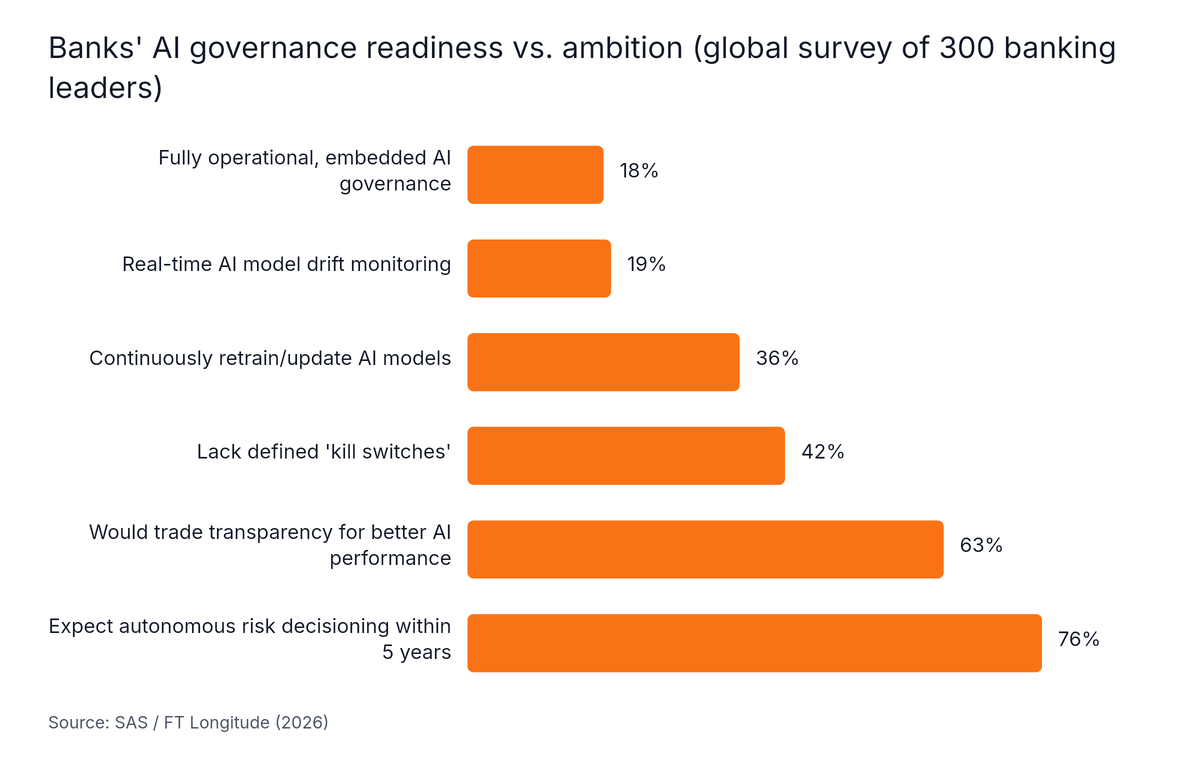
Source: SAS / FT Longitude, 2026
The same survey shows the gap between ambition and readiness. 76% of banks expect autonomous risk decisioning within five years, 63% would trade transparency for better AI performance, and 42% lack kill switches (SAS / FT Longitude, 2026). A platform that closes that gap is worth more than one that adds features.
The Monetary Authority of Singapore (MAS) issued its final Guidelines on Artificial Intelligence Risk Management on 7 October 2026. They cover generative AI and AI agents, require an AI inventory and keep banks accountable for third-party AI. Sections 3 and 4 apply from 7 October 2027, and Sections 5 and 6 from 7 October 2028 (LeapRate, 2026). One line eases the burden: firms "need not establish a dedicated AI committee solely to meet this expectation." (MAS, via LeapRate, 2026)
A platform for transaction review and compliance should cover:
Our data: Grail Computer Labs built a human-reviewed KYT (know-your-transaction) workflow for a Singapore-based neobank whose manual reviews took 30+ minutes each. In a one-week build, automated approvals rose from approximately 44% to approximately 90% in testing. The same neobank also had eight transaction checks live in under 30 days.
That result is from testing, not a production audit, and it came from one neobank. Treat it as a benchmark for what a one-week build should show, not as a promise for any other data set.
An investment bank with a six-month-old AI project and no launch date should move to whichever agentic AI platform can name a pre-defined outcome, a date and exit terms before work starts. Salvage first: export code, prompts, evaluations and logs, then migrate in phases. Gartner expects over 40% of agentic AI projects to be cancelled by end of 2027 (Forbes, 2026).

For scale, an Australian healthcare platform began with a project stuck in development for 8 months. We inherited 1.5 million lines of code, and the platform was live in production within 30 days. By day 40, 100 business customers had been onboarded. It is a healthcare case, not a bank, but the pattern of salvage, phase and ship applies.
Lock-in worries are close to universal. In a 2026 survey, 94% of organisations were concerned about vendor lock-in, with 57% fearing future support problems and 46% uncertain product roadmaps (Parallels, 2026). The sample covers end-user computing, so read it cautiously.
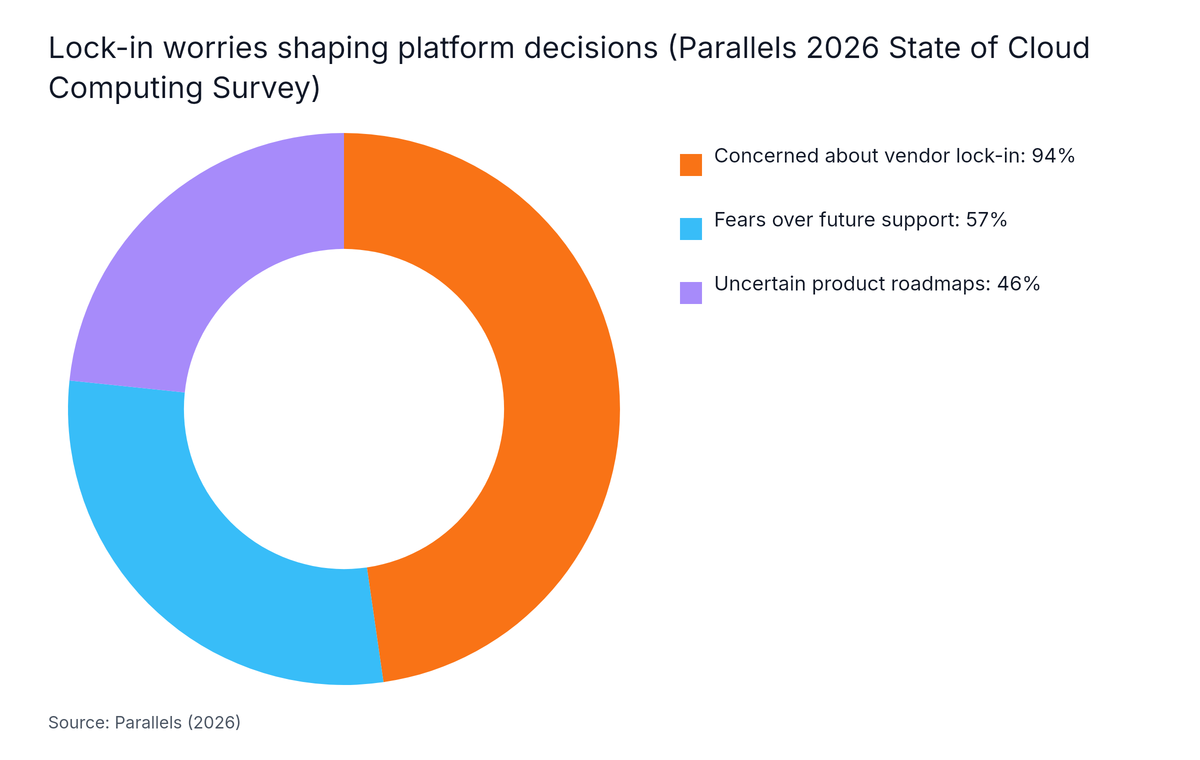
Source: Parallels, 2026
MAS's final text also adds board-level metrics on concentration risk, meaning material use cases that depend on a single provider (Genesis Human Experience, 2026). Exit terms should state that the client owns the code, cloud, models and documentation, and should include a written handover checklist.
To evaluate an agentic AI partner for insurance, test claims and underwriting separately, because carriers deploy them at different rates: 56% had underwriting AI live versus 50% for claims, and production AI overall rose from 37% to 61% (Datos Insights, via actuary.info, 2026). Ask for referral rules, human review points and bias-testing evidence for each workflow.
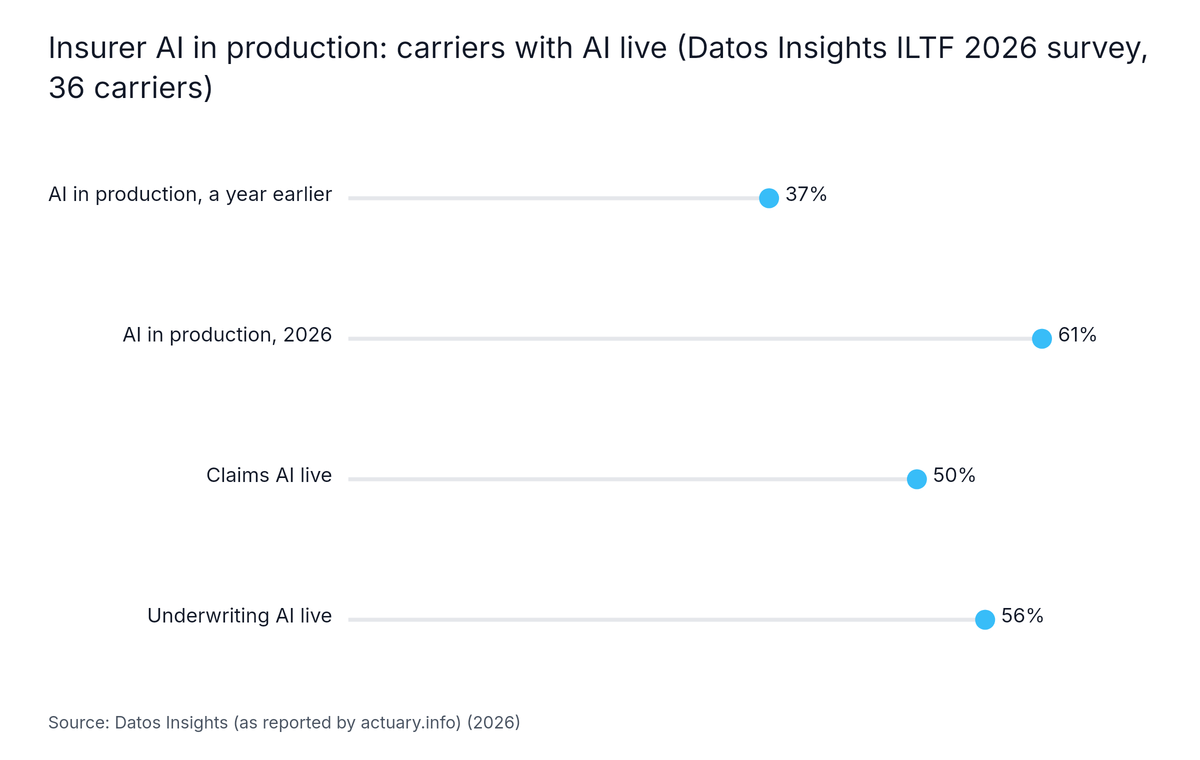
Source: Datos Insights (as reported by actuary.info), 2026
The Datos Insights survey covered 36 senior carrier technology leaders, so treat the percentages as directional.
Straight-through processing is the automatic handling of a claim from intake to decision with no manual step. In a 2026 WTW survey of property and casualty insurers, 14% used it in claims workflow automation and another 36% planned to introduce it (WTW, via CloudFactory, 2026). Most claims still need a person. A partner should show which claim types can go straight through and which route to a handler.
For underwriting, require these from any partner:
The agentic AI platform evaluation framework in this guide is not for teams that want a ready-made scorecard without running tests, or for buyers who need a certified vendor today. Grail Computer Labs (GC Labs) holds no SOC 2, ISO 27001 or HIPAA certification, which rules it out for some security teams. Gartner expects over 40% of agentic AI projects to be cancelled by end of 2027 (Forbes, 2026).

State the limits before starting:
GC Labs completes vendor security and compliance assessments as part of onboarding. Those assessments do not substitute for certification.
A platform supports on-premises AI with zero data retention only if it can run inside the buyer's infrastructure or private cloud and the buyer can verify that no prompts or outputs persist outside it. Ask for a network egress test, the model-hosting location and a log-contents review. GC Labs deploys on client infrastructure or private cloud, with zero data retention where required, and records agent traces.
An agentic AI development platform is a system for building, testing and releasing AI agents that carry out multi-step work, including the tooling for permissions, evaluation, human approvals and deployment. It differs from a chat assistant because agents take actions in business systems, so the platform must also control and record those actions.
A compliant agentic platform limits what each agent can access, requires human approval at risk points, records every action and gives the organisation a way to stop the agent. Only 18% of surveyed banks had fully operational, embedded AI governance (SAS / FT Longitude, 2026), so expect to ask vendors for evidence and build part of it in-house.
Platforms built to accelerate engineers keep people as the decision makers: agents execute tasks, engineers review every change, and tests reject incomplete work. In the 2025 DORA survey, 90% of respondents reported using AI at work and more than 80% believed it had increased their productivity (Google Cloud / DORA, 2025).
Agentic AI platforms keep human oversight in customer service by routing low-confidence or high-risk cases to a person, limiting what an agent can do alone and logging each action for review. Teams should monitor human override rates and response times, as the IMDA v1.5 agentic AI framework advises (Baker McKenzie, 2026).
Choosing an agentic AI platform comes down to evidence that buyers collect themselves, because Gartner expects over 40% of agentic AI projects to be cancelled by end of 2027 (Forbes, 2026). Teams that run the same tests on every shortlisted platform, and keep the artefacts, can defend a decision to security, compliance and the board.
We agree the outcome first, deliver it in 4 to 8 weeks, then keep shipping. Teams with a shortlist and a workflow can take both to a call to design the test.
© 2026 Grail Computer All rights reserved.