Blog
Software Development Project Rescue: What the First 30 Days Involve
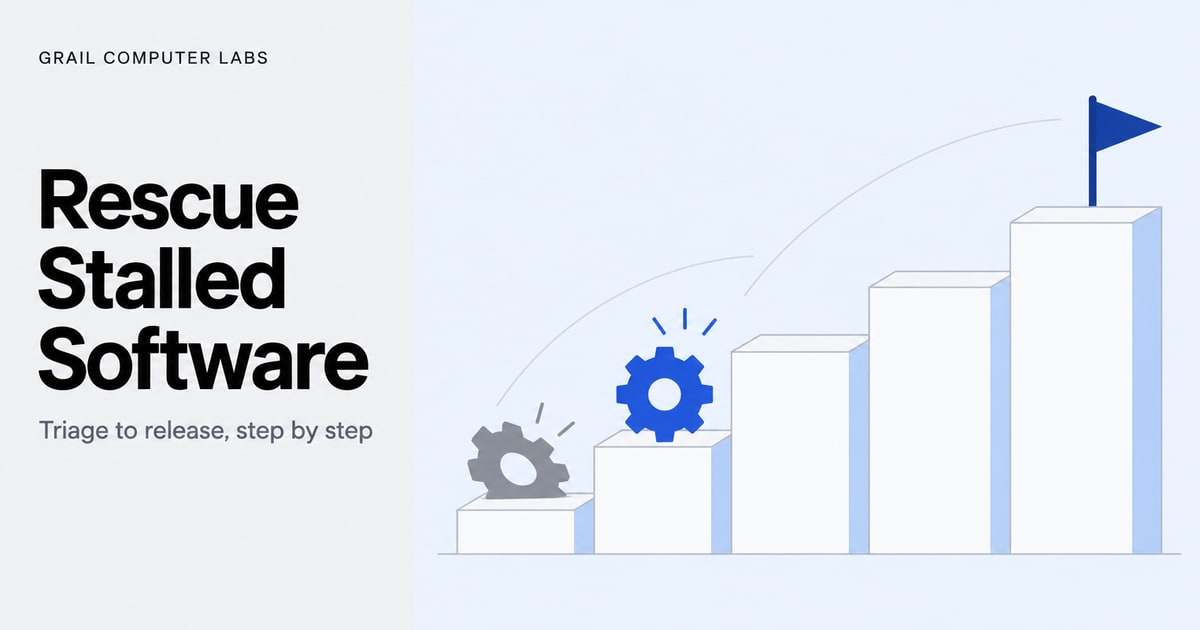
How software development project rescue works: triage, codebase inheritance, outcome agreement, stabilisation and release, anchored in a real 30-day case.

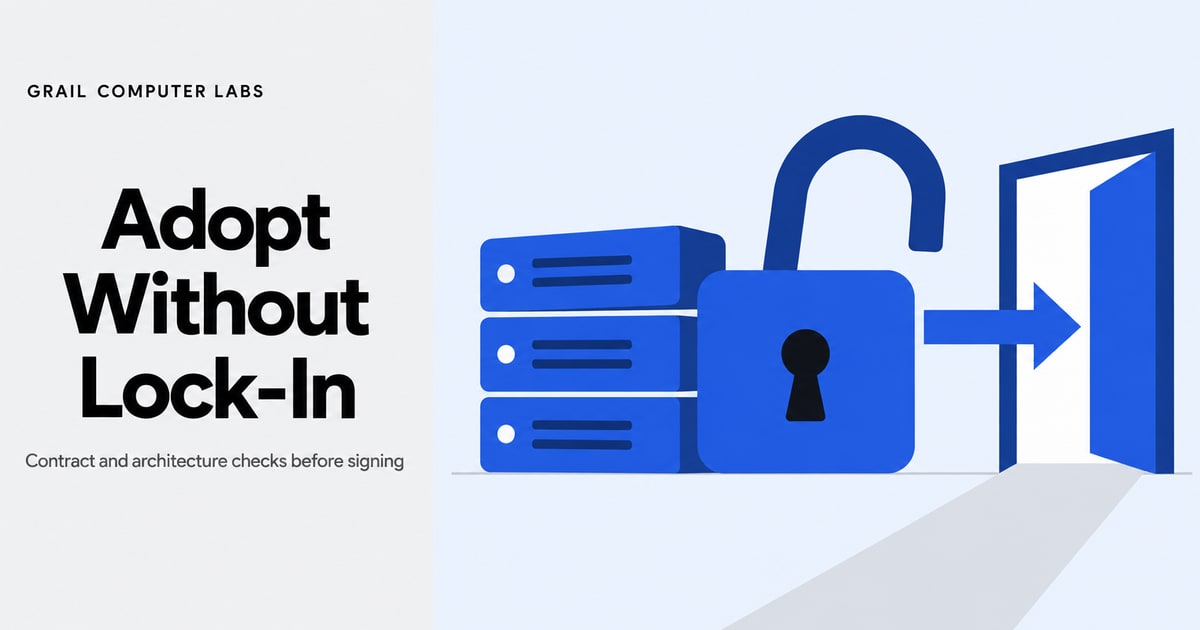
Contract terms, architecture choices and exit tests that let a buyer adopt an agentic AI platform without vendor lock-in, even after a past vendor left them stuck.
How software development project rescue works: triage, codebase inheritance, outcome agreement, stabilisation and release, anchored in a real 30-day case.
Enterprise AI guardrails explained: instruction-based vs architecture-based controls, plus a go-live checklist for data access, action scope and fallback.
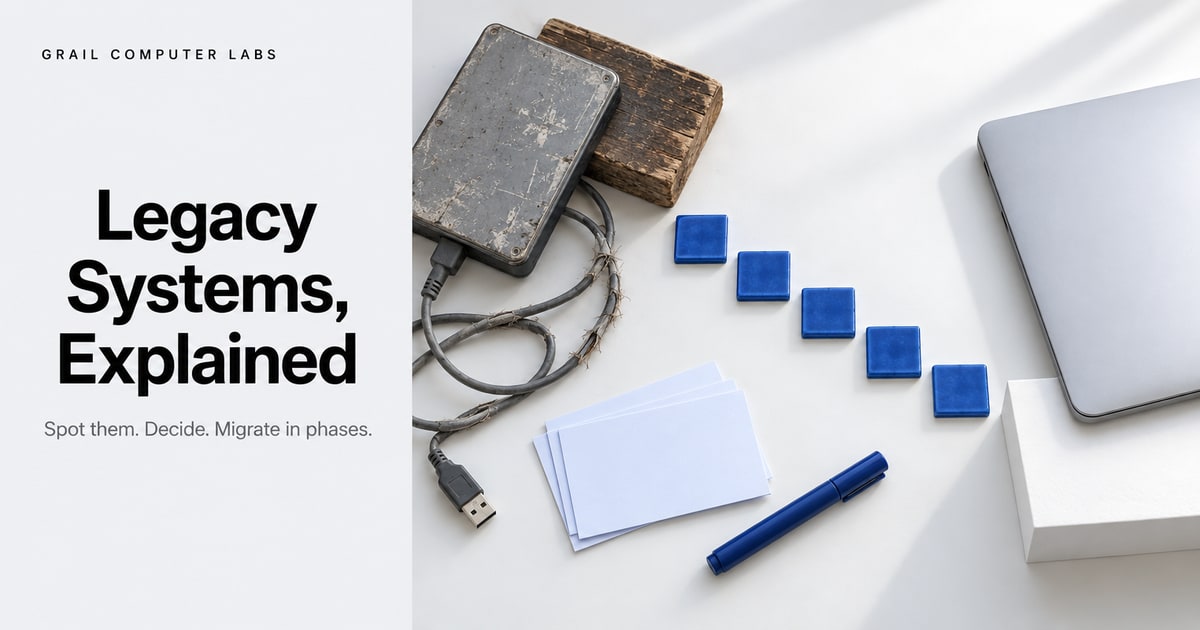
A legacy system is software that is hard to change safely. See the warning signs, the improve-or-rebuild test and a phased migration plan for real platforms.
Request a quote and our experts will contact you within 24 hours with tailored solutions and pricing.
You can also send us a quick email at [email protected].
Last updated: Nov 23, 2026
By Shiva Mangal, Grail Computer Labs
Adopting an agentic AI platform without vendor lock-in means securing code ownership, documented handover and client-controlled infrastructure in the contract and the architecture before work starts, then testing the exit before final payment. In Docker's survey of more than 800 technical decision-makers, 76% of global respondents reported active concerns about vendor lock-in (Docker, 2026). A buyer whose last vendor missed a launch date or left a codebase nobody understood holds that concern with evidence. Gartner now predicts that 70% of enterprises will abandon agentic AI built by vendor forward-deployed engineering by 2028 (Gartner, 2026). This guide maps the contract terms, architecture choices and exit tests that decide whether a new engagement repeats the old problem or breaks it.
Key Takeaways
- Vendor lock-in in agentic AI forms in code, hosting, orchestration, data and people, so each layer needs its own exit test.
- Five contract terms matter most: assignment of code and prompts, repositories and cloud accounts in the client's name, paid documentation, acceptance criteria and step-in rights.
- An agentic AI platform is portable when it runs in client-controlled infrastructure and uses open protocols for tool connections.
- An exit rehearsal, run by the client's own engineer before final payment, is the most reliable proof that a handover works.
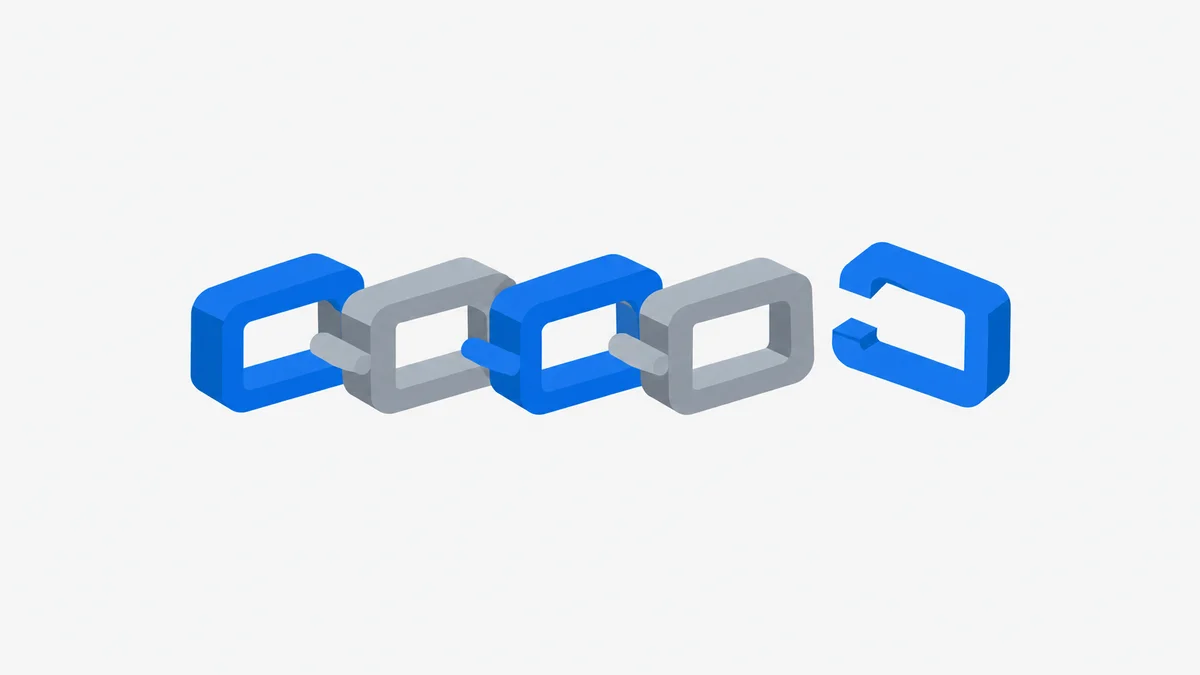
Vendor lock-in in an agentic AI platform is any dependency that makes leaving the platform or its delivery partner slower or costlier than staying. It differs from SaaS lock-in because it also covers prompts, agent memory, evaluation data and the engineers who know the system. In Docker's 2026 survey, 76% of global respondents reported active concerns about vendor lock-in (Docker, 2026).
The table shows where the two differ.
| Dimension | Traditional SaaS | Agentic AI platform or engagement |
|---|---|---|
| What the vendor holds | Customer data and account configuration | Code, prompts, agent configurations, memory and evaluation history |
| Typical exit trigger | Price rise or missing feature | Model change, runtime change or a stalled delivery team |
| Where knowledge sits | In the product's documentation | In the delivery engineers' heads, unless written down |
| What an exit test proves | Data can be exported | The system can be rebuilt and run by someone else |
Each layer fails in its own way. Check them one by one.
The fifth layer is the one burned buyers already know. We hear the same pattern again and again: a small bug fix takes days, and fixing one problem breaks something else. That is a codebase nobody understands, and no model choice fixes it.
Forward-deployed engineering is a delivery model in which a vendor's engineers build and run agents inside the client's business. It gets agents live quickly. It also concentrates knowledge in the vendor's team. Gartner's 2026 prediction of 70% abandonment by 2028 sits on that dependency. Its recommended remedies are contractual: IP ownership, project co-ownership, knowledge transfer and an exit strategy from day one (Gartner, 2026).
The contract terms that prevent a repeat of a failed engagement are assignment of code and prompts at each delivery, repositories and cloud accounts in the client's name, paid documentation, acceptance criteria tied to a reproducible build, and step-in rights. Gartner's September 2026 advice is to secure IP ownership, project co-ownership, knowledge transfer and an exit strategy from day one (Gartner, 2026).

The table maps each clause to the failure it addresses.
| Clause | What to require | Past failure it prevents |
|---|---|---|
| Code and prompt assignment | Ownership passes to the client at each delivery, not at project end | A stalled project where the code is still the vendor's |
| Repository and cloud ownership | Repositories, cloud tenancy and keys opened in the client company's name | Being unable to read or move what was built |
| Documentation as a deliverable | Architecture, runbook and dependency list, paid for and accepted like code | A codebase nobody understands |
| Acceptance criteria | A reproducible build and passing evaluation suite, verified by the client's engineer | A missed launch date with no objective test |
| Step-in and exit assistance | Right to bring in another team, with the vendor obliged to support the transition | Being held hostage during a dispute |
Handover documentation is the set of materials that lets a new team run the system without the old one. The contract should list:
Workforce readiness makes this more pressing. Just 4% of CIOs reported plans in place to revamp roles with a human-agent workforce in mind, according to a Gartner survey of 2,002 CIOs and technology executives (CIO Dive, 2026). Few internal teams are ready to absorb an undocumented system.
An exit clause is only as good as what it lets the client take. Ask for bulk export of data, prompts, agent configurations, memory and traces in documented formats. Add a fixed transition period in which the vendor must keep supporting the system. Check that termination does not trigger a penalty for the client's own data leaving.
Ask counsel whether the assignment clause separates AI-generated output from AI-assisted work. Ownership of purely machine-generated code is a legal question that varies by jurisdiction. It deserves primary legal advice, not a template clause.
An agentic AI platform stays portable when it runs in the client's own cloud account, connects to tools through open protocols such as the Model Context Protocol (MCP), keeps orchestration, memory and evaluation data in stores the client controls, and switches model providers through configuration. Docker's 2026 survey found that 79% of organisations run agents across two or more environments (Docker, 2026).
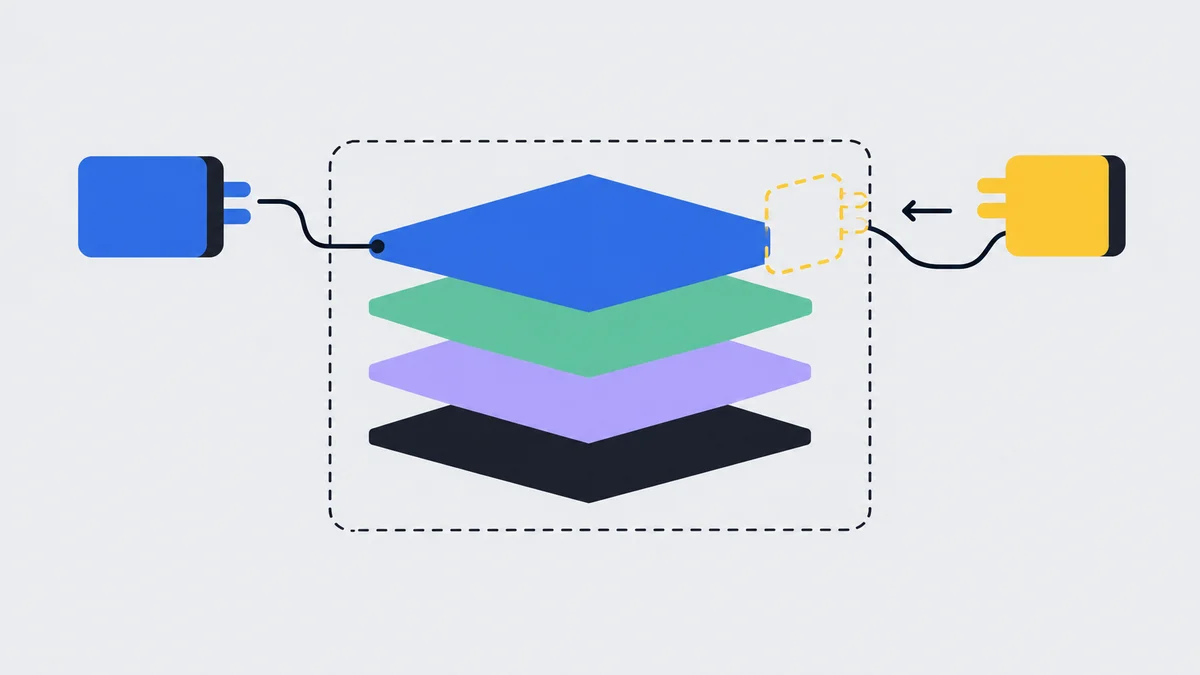
Client-controlled infrastructure means the runtime, keys, logs and identity sit in the client's cloud tenancy or private cloud, under the client's security policies. It also answers the concern buyers raise most. In the same Docker survey, 40% of respondents cited security as the top challenge in scaling agentic AI, and 45% struggled to ensure tools were secure and enterprise-ready (Docker, 2026). We deploy on client infrastructure or private cloud. Where required we apply zero data retention, mask likely secrets before they reach an agent, and record agent traces.
MCP is the open standard for connecting agents to tools. Its governance moved to the Linux Foundation's Agentic AI Foundation, a step the project described as "ensuring vendor-neutral governance for the protocol's future" (Model Context Protocol blog, 2025). The foundation has since reached 305 members in under a year (Linux Foundation, 2026).
Open protocols do not cover the layer above them. One in three organisations (33%) report orchestration difficulties as multi-model, multi-cloud estates grow (Docker, 2026). Owning the orchestration layer is part of the exit plan.
A model-agnostic agent can change LLM provider without a rewrite. Three habits make that real:
A router or abstraction layer helps only if the client can export from it. Otherwise it moves the dependency instead of removing it.
| Layer | What the client controls | Portability test |
|---|---|---|
| Hosting | Cloud account, keys, logs, identity | Redeploy in a second account from the repository alone |
| Model provider | Model name and endpoint held in configuration | Switch provider and rerun the evaluation suite |
| Tool connections | MCP servers the client can inspect and host | Replace one connector without touching agent logic |
| Orchestration and memory | Workflow definitions and memory schema in the client's stores | Export memory and workflows in a documented format |
| Evaluation and traces | Test cases and logs in the client's storage | A new team reads them without vendor tooling |
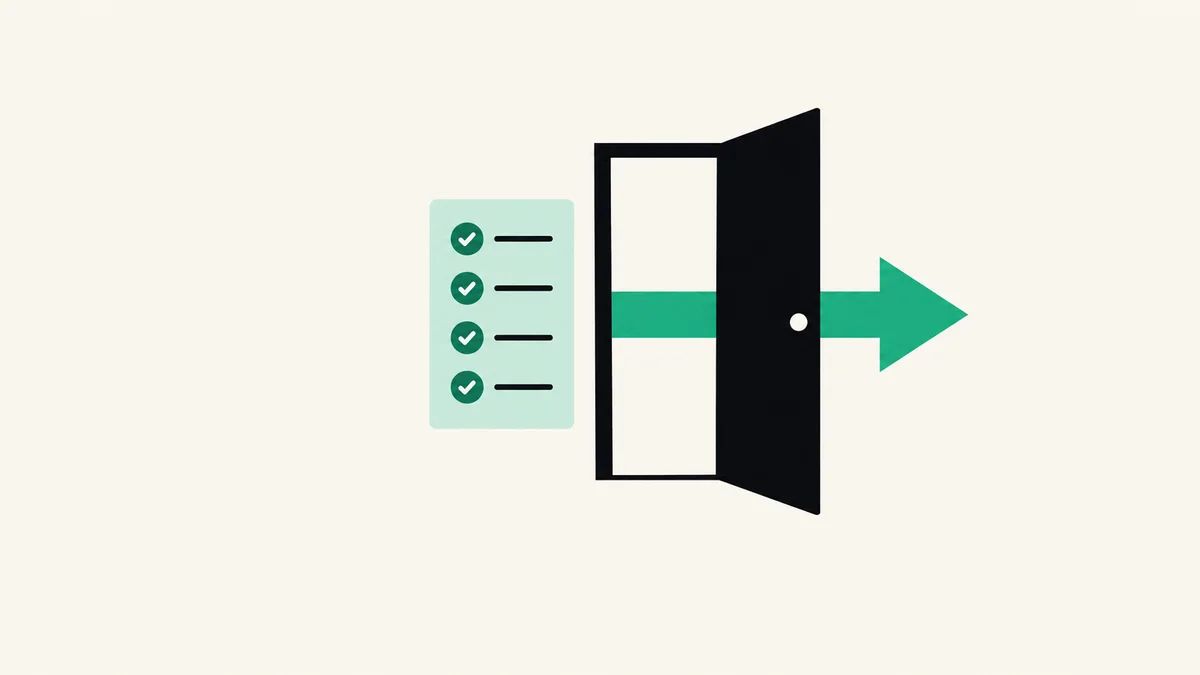
An exit rehearsal is a handover drill run before final payment: the client's own engineer rebuilds and deploys the system from the delivered repository and documentation without the vendor's help, and a second model provider runs the evaluation suite. Readiness is low: just 4% of CIOs reported plans to revamp roles for a human-agent workforce (CIO Dive, 2026).
That 4% figure is why the drill should not rely on in-house habits that do not exist yet. The rehearsal builds the capability while the vendor is still on hand to fix gaps.
Source code escrow is an arrangement in which a third party holds the code against vendor failure. It proves a copy exists. It does not prove anyone can build and run it, and it does not hold prompts, memory or evaluation data unless the agreement names them. Escrow can sit alongside the rehearsal, but it should not replace it.
To adopt an agentic AI platform without repeating a past lock-in, agree one pre-defined outcome first, keep repositories, cloud accounts and documentation in the client's name from day one, run an exit rehearsal at the first release, and extend the engagement only after it passes. Grail Computer Labs delivers a pre-defined outcome in 4 to 8 weeks.

Big-bang adoption is the risk buyers raise with us most often. Staged adoption limits what is lost at each step.
Our engagements begin with a 15-day trial with no payment commitment. The client can stop within the first 15 days without paying.
Our data: An Australian healthcare platform was stuck in development for 8 months. After GC Labs took over and inherited 1.5 million lines of code, the platform was live in production within 30 days. By day 40, 100 business customers had been onboarded, and 500 bug and feature tickets were handled across a 10-day period.
A vendor that cannot accept steps 2 and 5 is showing what its exit will look like. To test our terms against a buyer's own clause list, Book a call ↗.
An agentic AI platform contract, regulation and open protocols reduce lock-in but do not remove it. The EU Data Act bans cloud switching charges from 12 January 2027, yet term commitments and early-termination penalties remain (Nordia Law, 2026). Open protocols cover tool connections, not memory, data gravity or orchestration services, and independent data on the upfront cost of portability is thin.
This approach is not for teams that want a fully managed black box and have no engineer to run the exit rehearsal. It also does not replace certification. Grail Computer Labs holds no SOC 2, ISO 27001 or HIPAA certification, although we complete vendor security and compliance assessments as part of onboarding.
The client should own them. The contract should assign code, prompts, agent configurations and evaluation suites to the client at each delivery, with repositories and cloud accounts opened in the client's name from day one. Ownership that transfers only at the end of a project leaves the client exposed if the project stalls part-way.
An agentic AI platform should run in the client's own cloud account or private cloud wherever data sensitivity or exit risk matters. The client then controls keys, logs, identity and data residency, and a change of vendor does not require a migration. Vendor-hosted setups are acceptable only with tested export of code, data and configuration.
No, the Model Context Protocol (MCP) and the Agent2Agent protocol (A2A) reduce lock-in at the tool-connection layer but do not remove it. Memory stores, orchestration runtimes, evaluation data and the delivery partner's own knowledge can still tie a buyer to one provider, so each of those needs a separate test.
A handover package should include the full repository, architecture and data-flow documentation, a deployment runbook, the evaluation suite with results, a list of every credential and dependency, and a record of agent actions. The client's own engineer should be able to rebuild and run the system from these alone.
Make agents model-agnostic by holding the model name and endpoint in configuration, keeping prompts and tool definitions in the client's repository, and running an evaluation suite against a second provider before go-live. If the score drops sharply on the second provider, the agents are still tied to the first.
Lock-in is a set of specific commitments, and each one can be checked before signing.
The next step is practical. Turn the clause table above into a one-page list and ask every prospective vendor to sign against it. A vendor that hesitates on the exit rehearsal has answered the question before any money moves.
© 2026 Grail Computer All rights reserved.