Agentic AI Platform Pricing: How Outcome-Based Engagements Work
By Shiva Mangal, Grail Computer Labs. Published October 28, 2026.
Agentic AI platform pricing for an outcome engagement means paying for one agreed, measurable result first, then a monthly fee for continuous delivery, rather than paying per seat, per token or per hour. Buyers ready to commit usually want the commercial structure before they book a call. Grail Computer Labs (GC Labs) is an applied-AI and digital product research lab, and this post sets out how its outcome engagement is structured without a published price list. The demand is real: 21.1% of buyers prefer outcome-based pricing, but only 11.2% say their preferred vendor offers it (Futurum Research, 2026). This post covers the pricing models, the sequence, how outcomes are measured, and who the model does not suit.
Key Takeaways
An outcome-based agentic AI engagement is priced in two parts: a scoped fee for one pre-defined outcome, then a monthly fee for continuous delivery.
The GC Labs outcome engagement opens with a 15-day trial with no payment commitment, and the client can stop within the first 15 days without paying.
GC Labs publishes no price list because the fee depends on the outcome agreed after a first call under NDA.
A written outcome definition and measurement rule protect an AI buyer more than the pricing label does.
The GC Labs outcome engagement does not suit buyers who need a rate card or per-result price before any conversation.
How are outcome-based agentic AI platform engagements typically priced?
Outcome-based agentic AI platform engagements are typically priced in two parts: a scoped fee for one pre-defined outcome, then a recurring monthly fee for continuous delivery. Vendors rarely use one model, since AI software companies blend 1.7 pricing models on average (ICONIQ, 2026). Grail Computer Labs (GC Labs) sets its fees after a first call under NDA, so no price list exists.
Flat-lay of a notebook, pen and three coloured blocks representing different pricing models on a pale desk
Outcome-based pricing is a commercial model where the buyer pays for a defined result rather than for access, usage or hours. Gainshare is a variant where the vendor's fee is tied to a measured gain the buyer realises. Both differ from older models, which pay for inputs.
Pricing model
What the buyer pays for
Data point
Per-seat
Access for each user
42.3% prefer it for separately billed AI (Futurum Research, 2026)
Consumption-based
Usage, such as tokens or tasks
36.6% prefer it for separately billed AI (Futurum Research, 2026)
Outcome-based
A defined result
21.1% prefer it for separately billed AI (Futurum Research, 2026)
Seat pricing fits agent work badly. Futurum's 2H 2026 survey of IT decision makers found 42.7% prefer AI delivered mainly through autonomous agents, against 31.2% for copilots (Futurum Research, 2026). An agent does work rather than occupying a seat.
Preferences also shift between survey waves. An earlier Futurum survey found 43% preferred consumption-based models and 27% favoured outcome-based structures (Futurum Research, 2026). Treat any single split as a snapshot.
What happens in the 15-day trial and the rest of the outcome engagement?
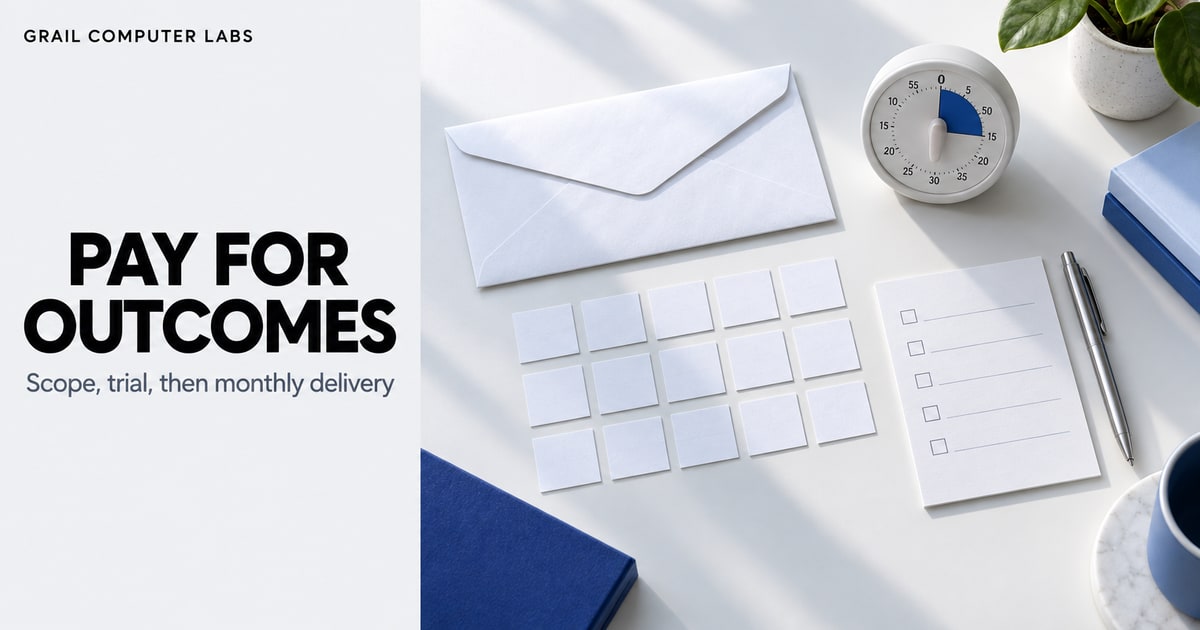
The Grail Computer Labs (GC Labs) outcome engagement runs in five steps: an NDA and first call, one scoped outcome, a 15-day trial with no payment commitment, delivery of the outcome in 4 to 8 weeks, then continuous delivery. The client can stop within the first 15 days without paying. No price list is involved at any step.
Flat-lay of a sealed envelope, a paper calendar strip and a small timer arranged in sequence on a grey surface
The outcome engagement is a GC Labs engagement where one pre-defined, measurable outcome is delivered in 4 to 8 weeks. The 15-day trial is its opening stage, with no payment commitment. A non-disclosure agreement (NDA) keeps the first call confidential.
NDA and first call. The client signs an NDA, then describes the key technology problem.
One scoped outcome. GC Labs proposes the best solution deliverable in 4 to 8 weeks. Outcome and quote are agreed before work starts.
15-day trial. Work begins. The client can stop within the first 15 days without paying.
Outcome delivered. The agreed result goes live, for example a rebuilt platform or a set of automated workflows.
Continuous delivery. The same team keeps shipping for a monthly fee.
Stage
What happens
What the client commits
NDA and first call
Problem described under confidentiality
Time for a conversation
Scoping
One outcome and a quote proposed
Nothing until both are agreed
15-day trial
Delivery work begins
No payment commitment
Outcome delivery
Result goes live within 4 to 8 weeks
The agreed outcome fee
Continuous delivery
Same team ships across the codebase
A monthly fee
The sequence exists because of a gap in the market. HFS Research reported a roughly 15x gap between buyer appetite for outcome-based pricing and contracts that use it (HFS Research, 2026), and attributes it to measurement. Agreeing the outcome before work starts addresses that directly.
Our data: Grail Computer Labs reports two results from its published case studies. An Australian healthcare platform stuck in development for 8 months went live in production within 30 days, and by day 40, 100 business customers had been onboarded. For a Singapore-based neobank, 8 transaction checks went live in under 30 days. These show what one scoped result looks like, not what any engagement costs.
Is there a startup-friendly price for agentic AI platforms?
Grail Computer Labs (GC Labs) publishes no price list, so there is no startup tier to quote. It scopes and prices the outcome engagement after a first call under NDA, sets no minimum commitment, and opens with a 15-day trial with no payment commitment. A small team can therefore judge the work before paying anything.
Demand for this structure is not yet met: 21.1% of buyers prefer outcome-based pricing, yet only 11.2% say their preferred vendor offers it (Futurum Research, 2026).
How much does an agentic AI platform engagement cost?
The cost follows the agreed outcome, so GC Labs states no figure in public. A small team can take the first call under NDA, see one scoped outcome with a quote, and use the 15-day trial before paying anything.
Why no price list is published
A rate card would misstate most quotes, because the fee follows the outcome. HFS Research describes the wider pattern: "The market keeps telling us it wants to pay for results, but it continues to sign contracts that pay for effort." (HFS Research, 2026)
What the quote covers
Item in the quote
What it fixes
Outcome
One measurable, verifiable result
Timeline
Delivery within 4 to 8 weeks
Quote
Agreed before the 15-day trial begins
Ongoing fee
A monthly fee once continuous delivery starts
Why a monthly fee for continuous delivery instead of pay-per-result?
Continuous delivery is the stage after the first outcome, where the same Grail Computer Labs (GC Labs) team keeps shipping across the whole codebase for a monthly fee. The monthly figure is forecastable: Gartner predicts enterprises on uncapped token-linked variable pricing will overrun cost expectations by more than 50% through 2027, versus predictable subscription pricing (Gartner, 2026).
Flat-lay of a monthly desk calendar, a pen and a circle of blue paper tokens suggesting a recurring cycle
Many pages treat outcome pricing and predictability as opposites. They are not. The scoped outcome keeps the vendor accountable for one result. The monthly fee then gives the buyer a recurring figure to plan against. Futurum's Keith Kirkpatrick says buyers feel that "when it comes to AI, they want cost predictability more than they want to chase usage or outcomes" (Futurum Research, 2026). That is an analyst view on AI buying in general. The monthly structure is GC Labs' own design, not a finding of that research.
Is outcome-based pricing lower cost at high volume?
Not by default. A per-result price scales with the count of results, so cost rises with volume unless a cap or band is agreed. Pay-per-result also leaves out work that does not map to a unit, such as monitoring, changed requirements or a new build. Continuous delivery covers what an in-house tech team covers, with no more scoping.
Where is the market heading?
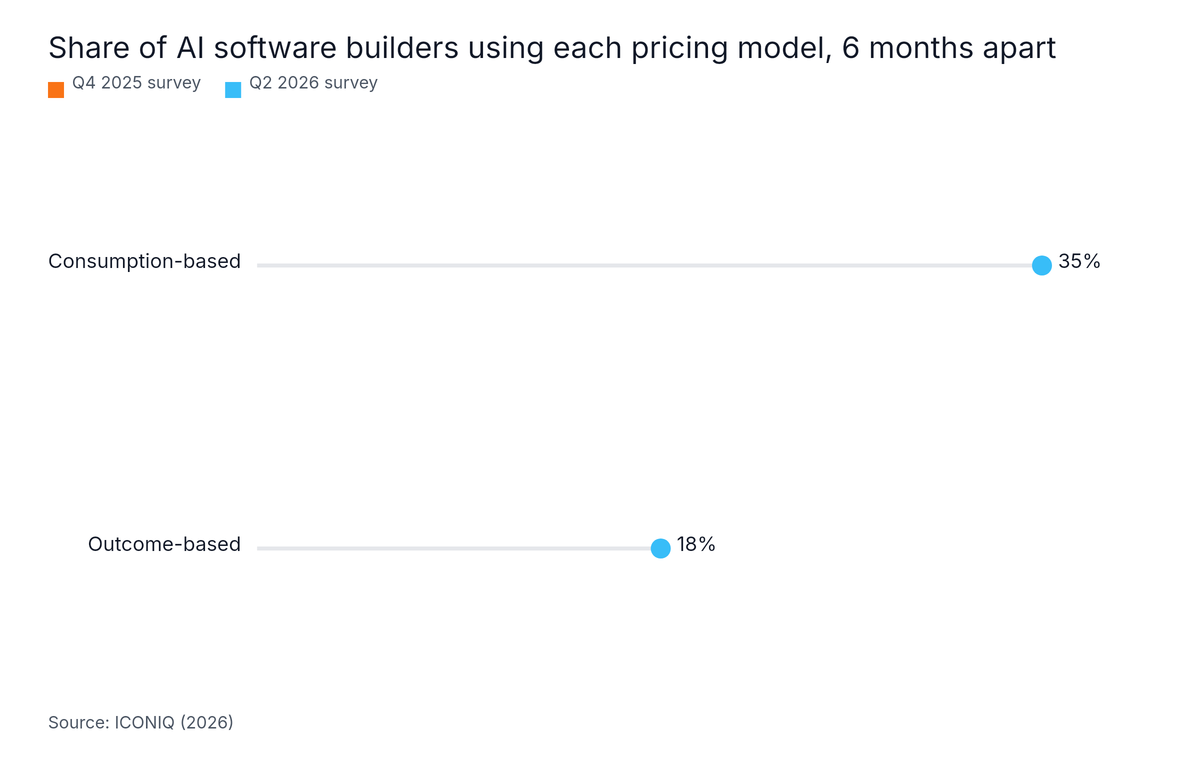
Outcome-based pricing among AI software builders rose from 18% to 23% in six months, while consumption-based pricing rose from 35% to 42% (ICONIQ, 2026). Both grew, which supports a hybrid structure.
Lollipop chart: Share of AI software builders using each pricing model, 6 months apart. Highest: Consumption-based at 35%.
How is an outcome defined and measured in an AI contract?
An outcome in an AI contract is one measurable, verifiable result agreed in writing before work starts, such as a rebuilt platform or a set of automated workflows. Measurement is the hard part: 76% of surveyed CX buyers are open to outcome-based or gainshare pricing, yet only 5% hold such a contract (HFS Research, 2026).
Flat-lay of a blank checklist card with a pen and a ruler on a pale surface, suggesting measurement
Analysts say the same. Craig Durr of The Collab Collective argues "Outcome-based pricing is real, but it is being sold ahead of any agreed way to score it" (TechTarget, 2026). The fix is to write the scoring rule down first.
What should a buyer have in writing?
Item
What it should say
Outcome
A result a third party could verify
Measurement rule
What counts, and who counts it
Scope boundary
Where extra work becomes visible rather than absorbed
Exit terms
When the client can stop and what it owes
Ownership
The client keeps the code, cloud, models and documentation
What stops a vendor from gaming the metric?
A third-party-verifiable outcome and a written counting rule leave little room to game the result. In GC Labs engagements, engineers review every change, tests reject incomplete work and agent traces are recorded. Accountability also stays with the buyer: Singapore's IMDA launched its Model AI Governance Framework for Agentic AI on 22 January 2026, covering organisations that use in-house or third-party agents, with human-accountability checkpoints (MDDI, 2026).
The 15-day trial cannot prove a full 4 to 8 week outcome. It does show whether the team, the access plan and the scoping hold up before any payment is due.
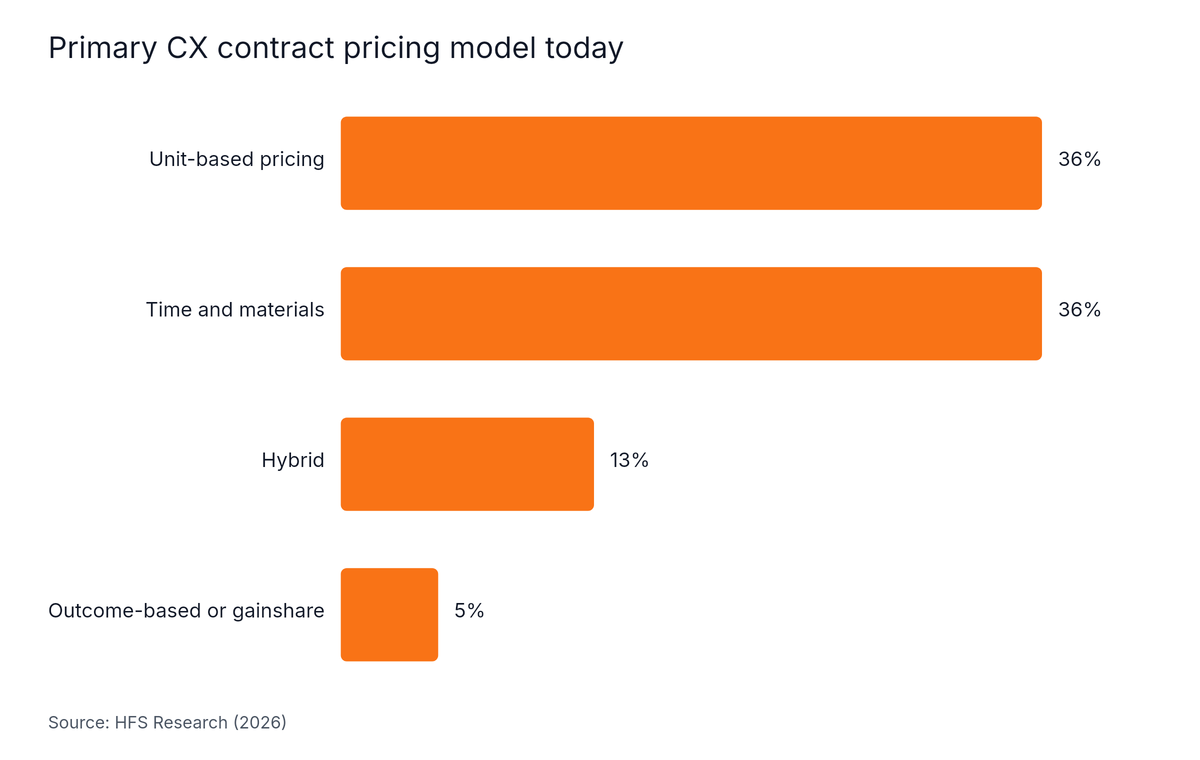
Most contracts today still pay for inputs. HFS Research found current CX contracts are 36% unit-based, 36% time and materials, 13% hybrid and 5% outcome-based or gainshare (HFS Research, 2026).
Horizontal Bar chart: Primary CX contract pricing model today. Highest: Unit-based pricing at 36%.
The Grail Computer Labs (GC Labs) outcome engagement is not for buyers who need a published rate card, a per-seat licence or a per-result price before any conversation. Some buyers simply prefer usage billing: 36.6% favour consumption-based pricing for separately billed AI (Futurum Research, 2026). GC Labs also holds no SOC 2, ISO 27001 or HIPAA certification.
Other limits are worth stating plainly:
No public numbers. A procurement process that requires a list price will not find one.
One outcome at a time. The model scopes a single pre-defined result, not a broad programme.
No fit for ownerless pilots. The model needs one outcome that matters and someone who owns it.
Security assessments. GC Labs completes vendor security and compliance assessments as part of onboarding, but it holds no certification to attach.
Frequently Asked Questions
How is an outcome-based agentic AI engagement priced?
An outcome-based agentic AI engagement is priced in two parts: a scoped fee for one pre-defined outcome, then a monthly fee for continuous delivery. Grail Computer Labs (GC Labs) scopes and prices the outcome after a first call under NDA. It publishes no price list because the fee depends on the agreed outcome.
What happens during the 15-day trial, and is anything paid?
The 15-day trial is the opening stage of the Grail Computer Labs (GC Labs) outcome engagement, and it carries no payment commitment. Work starts once the outcome and quote are agreed. The client can stop within the first 15 days without paying. Continuing leads to delivery of the outcome in 4 to 8 weeks.
Why don't AI vendors publish a price list for outcome engagements?
Outcome engagements are priced against a specific agreed result, so a single rate card would misstate most quotes. Grail Computer Labs (GC Labs) scopes one outcome after a first call under NDA, then prices that scope. Outcome pricing is also hard to score: analysts say it is sold ahead of any agreed measurement method.
What stops an AI vendor from gaming the outcome metric?
A written outcome definition, a measurement rule and exit terms stop an AI vendor from gaming an outcome metric. The outcome should be verifiable by a third party. In Grail Computer Labs (GC Labs) engagements, engineers review every change, tests reject incomplete work and agent traces are recorded.
Is there a startup-friendly price or a minimum commitment at GC Labs?
Grail Computer Labs (GC Labs) publishes no startup price and sets no minimum commitment. The engagement opens with a 15-day trial with no payment commitment, and the client can stop within the first 15 days without paying. The outcome is scoped and priced after the first call under NDA.
Conclusion
Outcome-based pricing for agentic AI is a sequence, not a rate card. We agree the outcome first, deliver it in 4 to 8 weeks, then keep shipping.
The fee has two parts: a scoped outcome, then a monthly fee for continuous delivery.
The 15-day trial carries no payment commitment, and the client can stop within the first 15 days without paying.
No price list exists, because the quote follows the outcome agreed under NDA.
A written outcome definition and measurement rule protect the buyer more than any pricing label.
The model suits buyers with one stalled outcome that matters, not those who need a list price first.
The next step is a conversation. Book a call ↗ to describe the problem under NDA and see one scoped outcome with a quote.