Blog
Software Development Project Rescue: What the First 30 Days Involve
How software development project rescue works: triage, codebase inheritance, outcome agreement, stabilisation and release, anchored in a real 30-day case.

How an agentic AI platform for revenue cycle management routes approvals: what agents decide alone, where humans sign off, and how production data stays safe.

How software development project rescue works: triage, codebase inheritance, outcome agreement, stabilisation and release, anchored in a real 30-day case.

Enterprise AI guardrails explained: instruction-based vs architecture-based controls, plus a go-live checklist for data access, action scope and fallback.

A legacy system is software that is hard to change safely. See the warning signs, the improve-or-rebuild test and a phased migration plan for real platforms.
Request a quote and our experts will contact you within 24 hours with tailored solutions and pricing.
You can also send us a quick email at [email protected].
Last updated: Nov 21, 2026
By Shiva Mangal of Grail Computer Labs, an applied-AI and digital product research lab in Singapore. Shiva reviews and signs off all healthcare and finance content before publication, and previously built Nurture Labs, where one product passed $2M in lifetime revenue. Updated 28 October 2026.
An agentic AI platform for revenue cycle management is software that lets AI agents carry out claims tasks such as validation and approval routing within set limits, while humans keep sign-off on high-risk decisions. Manual routing is where claims queue up. In Experian Health's 2025 survey, 90% of denials were still reworked with at least some human review (Experian Health, 2025). The buyer's real worry is narrower: can an agent route approvals without writing bad data to production? This post sets out what an agent can decide alone, where a named person must sign off, and how production data stays protected. It uses one client-reported neobank case as the closest analogue we have.
Key Takeaways
- An agentic AI platform for revenue cycle management should auto-approve only reversible, low-value steps and send write-offs, appeals and contract adjustments to a named human.
- Production data is protected by architecture: read-only or scoped credentials, a separate write path and recorded audit trails, not by instructions to the agent.
- A Singapore-based neobank raised automated approvals from about 44% to about 90% in testing in a one-week build. The figure is client-reported and covers transaction review, not claims.
- Agentic revenue cycle automation is early in production: KLAS reportedly found one organisation among 3,000+ respondents using it.
An agentic AI platform for revenue cycle management is software in which AI agents complete multi-step claims work, such as checking claim data, routing approvals and following up on denials, using scoped access to billing systems. Agents act inside defined authority limits and people decide everything outside them. In Experian Health's 2025 survey, 67% of providers said AI can improve the claims process (Experian Health, 2025).

Approval routing is the step that decides which person or system must sign off on a claim action before it moves on. In a manual process, that step is a queue, an email thread or a spreadsheet. An agent reads the claim, checks it against payer and policy rules, and then approves it, fixes it or escalates it.
Rule-based automation follows one fixed script and fails when the input changes. An agentic system chooses its next step from context. That flexibility handles messy claims data, such as a missing modifier or an unusual payer response. It is also why access has to be limited: an agent that can decide can also decide wrongly. The sections below cover the limits.
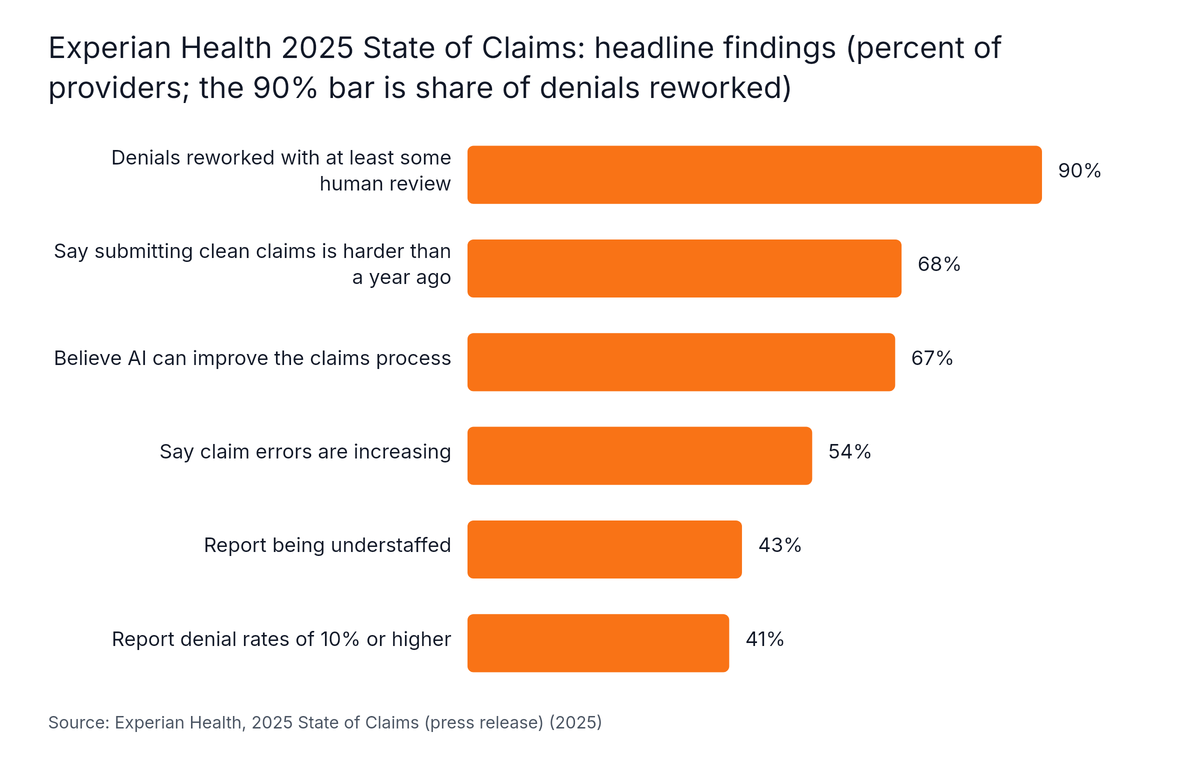
Manual approval routing stalls claims because every exception waits for a person, and exceptions are common. In Experian Health's 2025 survey of 250 US healthcare professionals, 41% of providers reported that at least 10% of their claims are denied, and 90% of denials were reworked with at least some human review (Experian Health, 2025).
Source: Experian Health, 2025 State of Claims (press release), 2025
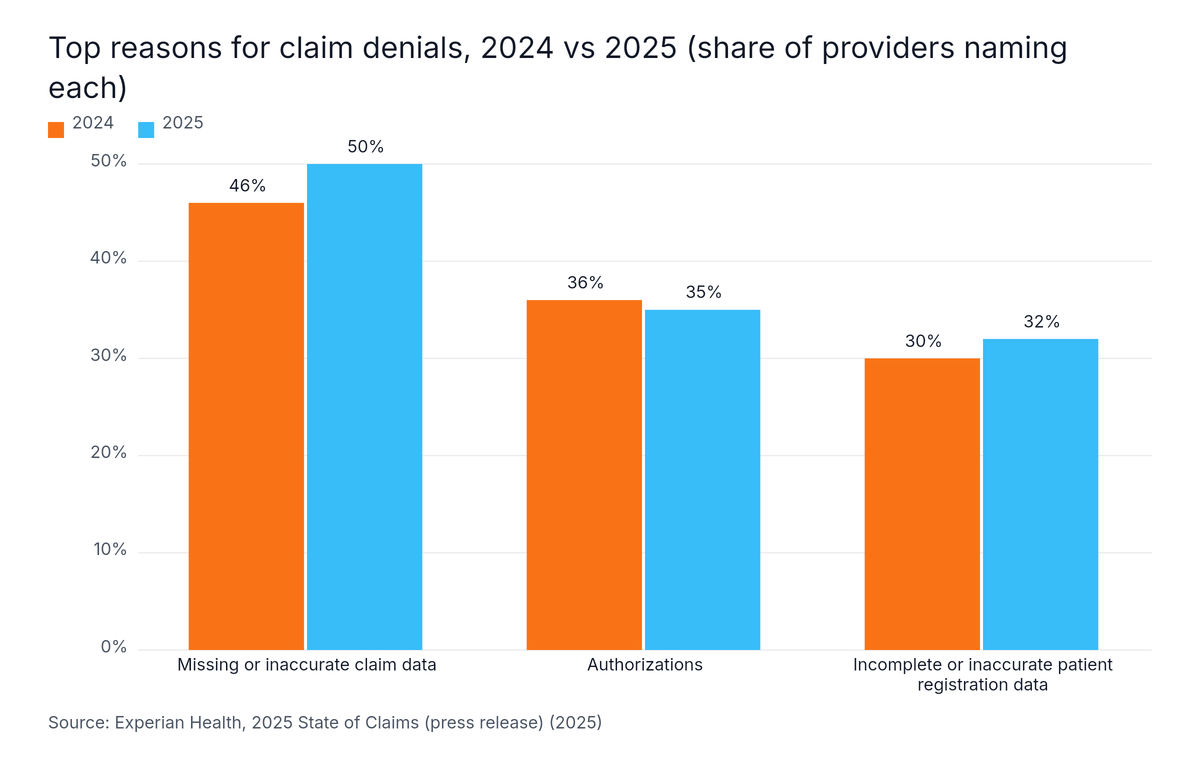
The errors start upstream. Missing or inaccurate claim data was the top driver of denials at 50% in 2025, up from 46% in 2024 (Experian Health, 2025). The same survey lists authorizations at 36% and incomplete or inaccurate patient registration data at 30% (Experian Health, 2025). Each bad claim creates a rework item, and each rework item joins the queue.
The cost shows in the totals:
Payers add pressure. As Kodiak Solutions' Matt Szaflarski put it, "Payor behavior led to denial increases and a slight decline in the rate of overturning initial denials" (TechTarget RevCycleIntelligence, 2026).
Staff cannot simply absorb the load. The Experian survey found 68% of providers say submitting clean claims is harder than a year ago, 54% say claim errors are increasing, and 43% report being understaffed (Experian Health, 2025). As Experian Health's Clarissa Riggins said, "AI is no longer just a theoretical solution" (Experian plc, 2025).
Source: Experian Health, 2025 State of Claims (press release), 2025
An AI agent can approve reversible, low-value steps on its own, such as validating claim data against payer rules and routing clean claims for submission. A named human must approve irreversible or high-value actions, including write-offs, appeals and contract adjustments. Two limits set the boundary: a confidence threshold for how sure the agent is, and a materiality limit for how much money is at stake.

A confidence threshold is the minimum certainty an agent must report before it may act without a human. A materiality limit is the maximum money value an agent may approve on its own. The finance owner sets both, not the vendor.
Data validation is the clearest candidate for autonomy, because missing or inaccurate claim data drives 50% of denials (Experian Health, 2025). The table shows the split we recommend.
| Claim step | Agent decides alone | Named human approves | Reason |
|---|---|---|---|
| Claim data validation and scrubbing | Yes, within the confidence threshold | Only low-confidence cases | Reversible; a wrong fix is caught before submission |
| Routing a clean claim for submission | Yes, under the materiality limit | Claims above the limit | Low value, easy to recall |
| Claim status follow-up | Yes | Unusual payer responses | Read-mostly action |
| Resubmitting a denied claim | Only for known, rule-based fixes | New denial patterns | Wrong resubmissions can trigger payer pushback |
| Appeals | No, agent drafts only | Always | Judgement and payer relationship |
| Write-offs and contract adjustments | No | Always | Irreversible financial effect |
Human-in-the-loop means a person approves each action before it runs. Human-on-the-loop means a person monitors the agent and can step in. Teams should use the first for the bottom three rows of the table, and the second for the top rows once the agent has earned that trust.
The finance owner should set confidence thresholds and materiality limits from evidence gathered in shadow mode, not accept the vendor's defaults. We found no published standard for these values, so the steps below are our recommendation.
CMS-0057-F is a US federal rule that took operational effect on 1 January 2026. Impacted payers must decide standard prior authorization requests within 7 calendar days and expedited ones within 72 hours, and give a specific reason for every denial. FHIR-based prior authorization API requirements follow on 1 January 2027 (Assembly Health, 2026).
Two consequences follow, and both are our reading, not the rule's text. Specific denial reasons give an agent structured input for deciding whether a known, rule-based fix applies. Shorter payer deadlines make slow human queues more costly on the provider side. The rule does not change who should approve appeals or write-offs.
The only reliable way to stop an AI agent writing incorrect data to production is to make it physically impossible: give the agent read-only or scoped credentials, route every write through a separate permissioned runner, and record each action in an audit trail. Instructions alone are not boundaries, because agents can reason around them.

The risk is real. 88% of organisations reported confirmed or suspected AI-agent security incidents in the last year, and healthcare was higher at 92.7% (Gravitee, reported by NeuralTrust, 2026). The reporting page does not state the methodology, so treat the figures as indicative.
Grail Computer Labs applies these controls:
Two terms need precision. Zero data retention is a setting under which the AI model provider does not store prompts or outputs after processing. It applies where required and is agreed per deployment. It does not cover the client's own databases or logs. Deployment on client infrastructure means the agents run in the client's cloud account or private cloud, so the client controls where claims data sits.
GC Labs holds no SOC 2, ISO 27001 or HIPAA certification, and none should be implied. It completes vendor security and compliance assessments during onboarding.
An audit trail for autonomous billing decisions should let a reviewer reconstruct who or what proposed an action, which limit applied, who approved it and what changed in the system. We found no published regulator checklist for this in the research behind this post, so the fields below are our recommendation.
| Audit field | What it records | Why it matters |
|---|---|---|
| Agent identity | Which agent and version acted | Separates agent actions from human ones |
| Input and proposed action | The claim data read and the action suggested | Lets a reviewer test the decision |
| Limit applied | The confidence threshold and materiality limit in force | Shows the action was inside authority |
| Approver | The named human, or "within limits" | Assigns accountability |
| Write result | What changed in the billing system, and when | Supports rollback and reconciliation |
Regulators are watching AI billing. A secondary compliance site reports that Australia's Auditor-General published a report on AI and Medicare benefits integrity on 21 September 2026 (Clinic Comply, 2026). Confirm the details with the Australian National Audit Office before relying on them.
In one client-reported case, a Singapore-based neobank moved automated approvals on transaction reviews from about 44% to about 90% in testing, in a one-week build by Grail Computer Labs. Reviews had taken 30+ minutes each. The case covers transaction review, not claims, and no independent source has verified it, so treat it as an analogue, not a benchmark.
Our data: For a Singapore-based neobank, GC Labs built a human-reviewed know-your-transaction (KYT) workflow. Automated approvals rose from about 44% to about 90% in testing in a one-week build. A separate engagement put eight transaction checks live in under 30 days.
Claims teams start from a similar place. In Experian Health's 2025 survey, 90% of denials were still reworked with at least some human review, yet 67% of providers said AI can improve the claims process (Experian Health, 2025). That gap between belief and practice is where staged autonomy applies.

Transaction review and claims review share a structure: a high volume of routine items, a small share of risky ones, and a person who must own the risky ones. The lesson is not the 90%. The lesson is that the human stayed in the workflow while the share of cases needing them fell.
We recommend granting authority in stages, with evidence at each gate. Shadow mode is a stage in which an agent makes decisions but takes no action, so the team can compare its decisions with human ones.
| Stage | Agent authority | Human role | Gate to the next stage |
|---|---|---|---|
| 1. Shadow mode | None; decisions logged only | Does all the work | Agent decisions match human decisions on real cases |
| 2. Supervised | Proposes; a person approves each action | Approves every action (human-in-the-loop) | Reviewers rarely overturn the agent |
| 3. Bounded autonomy | Approves within confidence and materiality limits | Reviews exceptions and samples (human-on-the-loop) | Audit traces and error review stay clean |
This staging is our design recommendation, not a published standard. The neobank result came from testing, so teams should confirm any approval rate on their own claims before granting authority.
No published source we found gives a standard timeline from shadow mode to autonomous approvals, and none gives a verified share of denials that agents can remove. The neobank build took one week to reach about 90% automated approvals in testing. We would gate each stage on measured agreement and overturn rates, not on a calendar date.
Agentic AI for revenue cycle management is still early in production, so it suits teams that can name approvers and limits and does not suit teams that need a certified vendor today. Oliver Wyman's 2026 survey of more than 200 decision-makers found roughly 20% to 40% of provider organisations report broad use of AI-enabled tools across the revenue cycle (Oliver Wyman, 2026).

That figure covers AI in general, not only agents. The table sets it beside two other readings.
| Source | Finding | Year |
|---|---|---|
| Oliver Wyman | Roughly 20% to 40% of surveyed providers report broad AI use across the revenue cycle | 2026 |
| HFMA survey, as summarised by Advantum Health | 27% of finance professionals deploy AI at scale; 53% run pilots | 2026 |
| KLAS, as reported by accucodeai | 1 of 3,000+ organisations using agentic AI in production | 2025 |
The surveys cover different respondent groups and do not add up to one industry figure. The KLAS and HFMA numbers reach us through vendor pages, and we could not link the original reports, so check them before relying on them. Oliver Wyman is optimistic all the same: "Revenue cycle management (RCM) is emerging as one of the first areas where AI is delivering tangible, repeatable impact at scale" (Oliver Wyman, 2026). Both can be true. Some AI is working, and most agentic claims are still pilots.
This approach is not for teams in these positions:
An AI agent can approve reversible, low-value steps on its own, such as validating claim data against payer rules, checking claim status and routing clean claims for submission. Write-offs, appeals and contract adjustments should stay with a named human. Two limits set the boundary: a confidence threshold and a materiality limit agreed by the finance owner.
Agentic AI chooses its next step from context, while rule-based automation follows one fixed script and fails when the input changes. That flexibility suits messy claims data, but an agent needs scoped credentials, a separate write path and audit records, because instructions alone do not stop an agent from acting.
Shadow mode is a rollout stage in which an AI agent makes decisions but does not act on them. People keep doing the work, and the team compares the agent's decisions with theirs. Shadow mode produces an agreement rate on real cases before the agent receives any authority, so autonomy is granted on evidence.
CMS-0057-F is a US federal rule that took operational effect on 1 January 2026. Impacted payers must decide standard prior authorization requests within 7 calendar days and expedited ones within 72 hours, and give a specific reason for every denial. FHIR-based prior authorization API requirements follow on 1 January 2027.
Yes. Grail Computer Labs deploys on client infrastructure or private cloud, under the client's AI and security policies, with zero data retention where required. Client content is never used to train AI models or shown to other clients, under the Terms of Service. Grail Computer Labs holds no SOC 2, ISO 27001 or HIPAA certification.
Approval routing is where manual revenue cycle work backs up, and it is where agents can help first. Five points to take away:
The next step is to map one approval workflow end to end and name who owns each decision. We agree the outcome first, deliver it in 4 to 8 weeks, then keep shipping. Book a call ↗