Blog
Software Development Project Rescue: What the First 30 Days Involve
How software development project rescue works: triage, codebase inheritance, outcome agreement, stabilisation and release, anchored in a real 30-day case.

AI adoption stalls when pilots lack a production scope, a P&L baseline and vendor accountability. See the data and the three gates that move AI to production.

How software development project rescue works: triage, codebase inheritance, outcome agreement, stabilisation and release, anchored in a real 30-day case.

Enterprise AI guardrails explained: instruction-based vs architecture-based controls, plus a go-live checklist for data access, action scope and fallback.
A legacy system is software that is hard to change safely. See the warning signs, the improve-or-rebuild test and a phased migration plan for real platforms.
Request a quote and our experts will contact you within 24 hours with tailored solutions and pricing.
You can also send us a quick email at [email protected].
Last updated: Nov 19, 2026
By Shiva Mangal, Grail Computer Labs
AI adoption is the process of moving AI from a trial into a production system that changes a business metric, and it stalls when no one has agreed what production, success or vendor accountability mean. The headline number is stark. MIT NANDA's 2025 GenAI Divide report found that 95% of generative-AI pilots delivered no measurable profit-and-loss impact (Legal.io, 2025), and critics call the study preliminary and interview-based (NewMR, 2026). The number is easy to repeat and easy to misread. This post explains what it measures, why pilots stall, and which three gates separate projects that ship from the rest. We stay with mechanisms and case figures.
Key Takeaways
- The MIT NANDA 95% figure counts generative-AI pilots with no measurable P&L impact, not pilots that crashed, and its findings are preliminary (Legal.io, 2025).
- S&P Global Market Intelligence found the average organisation scrapped 46% of its AI proofs of concept before they reached production (CIO Dive, 2025).
- AI pilots stall when production scope, a P&L baseline and vendor accountability are left undefined at the start.
- Singapore leaders in 2026 name data accuracy, data access and trust as the main barriers to scaling AI (ITBrief Asia, 2026).
The MIT NANDA 95% figure measures generative-AI pilots that produced no measurable profit-and-loss (P&L) impact. It does not count pilots that crashed. MIT NANDA's GenAI Divide report found 95% of pilots delivered no measurable P&L impact and only 5% of integrated systems created significant value (Legal.io, 2025).

P&L is the statement of revenue and cost that shows whether a change improved the business. A pilot can run well and still fail this test. A demo that works is not the same as a cost that fell or revenue that rose.
The report drew on 52 executive interviews, surveys of 153 leaders and an analysis of 300 public AI deployments. Its authors describe the findings as preliminary, and they are not peer-reviewed. A 2026 critique from NewMR adds that the work is interview-based and uses a stringent success threshold (NewMR, 2026). We read the figures through the Legal.io report, not the MIT PDF, so the exact wording stays unverified until it is checked against the original.
The same report found a gap between trying and deploying. Over 80% of organisations had piloted tools such as ChatGPT or Copilot, and nearly 40% reported deployment (Legal.io, 2025). Tool adoption is high. Business change is low.
Newer research complicates the picture. Boston Consulting Group's 2026 Applied AI Index reports that "nearly half of companies are already creating real value from it, while many others are still struggling to translate investment into impact" (Nicolas De Bellefonds, BCG, 2026). Both findings can be true. Some companies convert AI into value, and most have not yet.
| Source | Finding | What it measures |
|---|---|---|
| MIT NANDA via Legal.io, 2025 | 95% of pilots, no measurable P&L impact | Financial return from generative-AI pilots |
| S&P Global via CIO Dive, 2025 | 46% of AI proofs of concept scrapped before production | Work that never shipped |
| S&P Global via CIO Dive, 2025 | 42% of companies abandoned most of their AI initiatives, up from 17% | Abandonment, year on year |
| BCG Applied AI Index, 2026 | Nearly half of companies creating real value | Companies reporting AI value |
AI pilots stall before production because they are scoped as experiments, so nobody owns integration, evaluation or release. S&P Global Market Intelligence's 2025 survey of more than 1,000 respondents found the average organisation scrapped 46% of its AI proofs of concept before they reached production (CIO Dive, 2025).
The same survey found 42% of companies abandoned most of their AI initiatives, up from 17% a year earlier (CIO Dive, 2025). That is a rise of 25 percentage points in one year. The survey covered North America and Europe, and cost, data privacy and security risk were the top obstacles it reported.
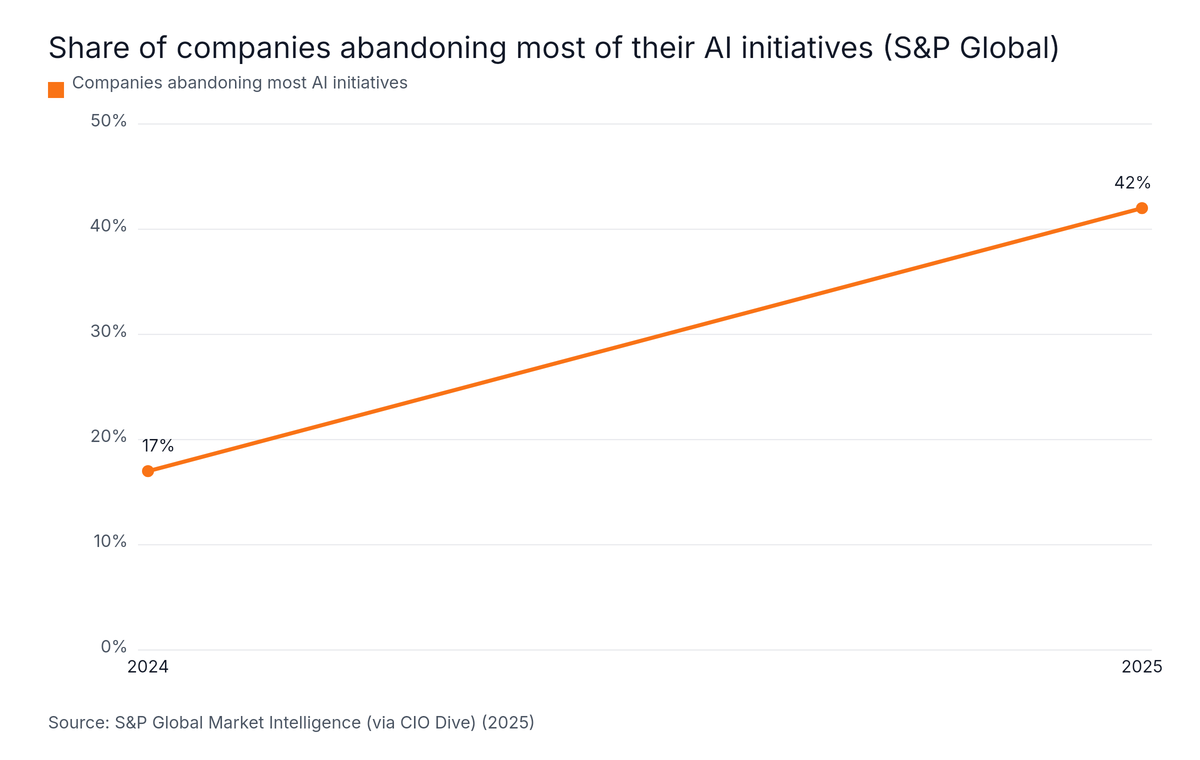
Source: S&P Global Market Intelligence (via CIO Dive), 2025
Forbes (2026) reports Gartner's forecast that over 40% of agentic AI projects will be cancelled by end of 2027, and traces the cause to governance, undefined value and missing ownership, not model quality (Forbes, 2026). Agentic AI is software that plans and carries out multi-step tasks with limited human input. Those three causes map onto three mechanisms. The mapping is our own reading, not a survey finding:
A client of Grail Computer Labs described the third mechanism this way: "Even a small bug fix could take days or a week, and fixing one problem often broke something else." That is what vendor underperformance looks like from the inside.
Passing three gates overcomes the barriers that stop AI delivering measurable business impact: a production scope agreed before the pilot starts, a P&L baseline with a named business owner, and vendor payment tied to a pre-defined outcome. A pilot that fails any one gate is still an experiment, whatever the demo looks like.
Each gate answers one failure mechanism from the previous section. Each can be tested with a yes or no question before money is spent.
Production scope is a written agreement on which system, users, data and release process an AI project must reach before it counts as live. It is written before the first line of code.
Process redesign is where most organisations fall short. ServiceNow's 2026 survey of Singapore leaders found 33% use AI to help employees with day-to-day tasks, and only 10% reworked processes so AI could complete multi-step business tasks end to end (ITBrief Asia, 2026). A tool that assists one person is easy to pilot. A tool that finishes a workflow needs integration, and integration needs scope.
A pre-pilot baseline is the recorded value of a business metric before the AI project starts. Without one, no result can be proved. Pick one metric, such as hours of admin per day or the share of approvals made automatically. Record today's value, then name the person who owns that number.
The owner should sit in the business, not in the delivery team. That person decides whether the target was met.
Pay for a pre-defined outcome, not for hours. Agree the metric, the baseline and the date. Require ownership of the code, cloud, models and documentation, so the buyer can leave if the outcome is missed.
Our data: Grail Computer Labs reports these results from its own anonymised case work. An Australian healthcare platform had been stuck in development for 8 months. It went live in production within 30 days, and by day 40, 100 business customers had been onboarded. A Singapore-based neobank's one-week build raised automated approvals from approximately 44% to approximately 90% in testing.
These are the company's own case figures, not independent research. Each began with one agreed outcome.
| Gate | Question to answer | Evidence it passed | Failure it prevents |
|---|---|---|---|
| 1. Production scope | Which live system and users must this reach? | Written scope naming system, data and release process | Pilot that never integrates |
| 2. P&L baseline and owner | What metric moves, from what value, and who owns it? | Recorded baseline and a named business owner | Result no one can prove |
| 3. Vendor accountability | What outcome is the vendor paid for, by when? | Pre-defined outcome, date and code ownership in the contract | Effort billed, nothing shipped |
If a project is already stalled, the same gates work as a rescue test. A project that has been in development for months with no launch date has usually failed all three.
An AI pilot should run until its pre-defined outcome can be measured against the baseline, and that date should be set at the start, not after the demo. Grail Computer Labs' outcome engagements set one pre-defined outcome and deliver it in 4 to 8 weeks. We found no verified industry standard for a pilot window, and the MIT NANDA findings are preliminary.
Integration into real workflows separates the 5% from the rest. MIT NANDA's GenAI Divide report found only 5% of integrated systems created significant value, while over 80% of organisations had piloted tools such as ChatGPT or Copilot (Legal.io, 2025). Trying a tool is common; changing the P&L is rare.
The report does not publish a checklist, so the link to the three gates is our interpretation. A system that reaches a live workflow has a production scope. A system that moves a P&L line has a baseline and an owner. A system that survives contact with the business has a vendor or team paid for the result. Projects that pass all three are, in practice, the ones that can be counted among the 5%.
Build versus buy is a decision about who owns the path from pilot to production. An in-house team suits work it can own through integration, evaluation and release. A vendor suits work where speed matters and payment is tied to a pre-defined outcome. No verified success rate compares the two, so three tests decide: ownership, incentive and exit.
The Gartner forecast reported by Forbes in 2026 points the same way. Governance, undefined value and missing ownership drove the projected cancellations, and those failures occur whether a team builds or buys (Forbes, 2026).
An in-house team that passes all three is a sound choice. A vendor that passes all three is too. Failing any one is the usual warning sign.
The biggest reported AI adoption barrier in Singapore is data: 68% of executives cited inadequate data accuracy and access in ServiceNow's 2026 survey of 200 senior leaders (ITBrief Asia, 2026). On return, Insight's 2026 survey found 55% of Singapore leaders report moderate to strong ROI, against 41% in Australia (ITBrief Australia, 2026).

Insight surveyed 220 decision-makers in Singapore and 318 in Australia, all at organisations with at least 100 employees. It found 37% of Singapore organisations scaling AI across functions, and 14% fully embedded (ITBrief Australia, 2026).
HubSpot and Lonergan Research surveyed more than 700 Singapore business leaders in early 2026. They found 64% use AI consistently in daily workflows, but only 18% had reached fully autonomous deployment (Mission Media, 2026). The top barriers were trust and reliability, and data quality and integration.
| Barrier | Share citing it | Source and year |
|---|---|---|
| Inadequate data accuracy and access | 68% | ServiceNow via ITBrief Asia, 2026 |
| Data privacy and security | 58% | ServiceNow via ITBrief Asia, 2026 |
| Trust and reliability | 43% | HubSpot / Lonergan Research via Mission Media, 2026 |
| Data quality and integration | 37% | HubSpot / Lonergan Research via Mission Media, 2026 |
The Australian evidence is thinner. Our only Australian figure is the Insight ROI comparison above. Deloitte's 2026 State of AI in the Enterprise report, which surveyed 3,235 leaders in 24 countries, includes an Australian cut. It says Australian organisations are investing, but the gap with global peers is growing on transformation at scale (Deloitte Australia, 2026). We found no verified Australia-specific barrier percentage, so we do not claim one.
All the Singapore surveys are vendor research. They use different samples and wording, so the direction matters more than the exact figures.
The three-gate approach to AI adoption does not suit exploratory research, projects built on weak data, or unsupported legacy platforms. It applies to initiatives meant to change a business metric in production. ServiceNow's 2026 survey found 68% of 200 Singapore leaders cited inadequate data accuracy and access, and gates cannot repair that (ITBrief Asia, 2026).

Four limits are worth stating plainly:
A buyer unsure that a new partner can deliver can ask for one agreed outcome in 4 to 8 weeks and a 15-day trial with no payment commitment before any longer commitment.
The MIT NANDA 95% figure does not mean 95% of pilots crashed. MIT NANDA's 2025 GenAI Divide report found 95% of generative-AI pilots delivered no measurable P&L impact, which is a claim about financial return (Legal.io, 2025). The finding rests on interviews, a survey and a review of public deployments, and is described as preliminary and not peer-reviewed.
In S&P Global Market Intelligence's 2025 survey of more than 1,000 respondents, the average organisation scrapped 46% of its AI proofs of concept before they reached production. The same survey found 42% of companies abandoned most of their AI initiatives, up from 17% the year before (CIO Dive, 2025). Respondents were in North America and Europe.
A measurable outcome names one business metric, records its current value, and agrees a target and a date with the person who owns that metric. Someone outside the delivery team should be able to verify it. It is written down before work starts, so the pilot is judged on results instead of demos.
An AI vendor is held accountable by tying payment and renewal to a pre-defined outcome instead of hours worked. The metric, the baseline and the date are agreed before work starts, the scope includes a production release path, and the buyer secures ownership of the code, models and documentation so it can leave if the outcome is missed.
The leading AI adoption barriers in Singapore are data accuracy and trust. In ServiceNow's 2026 survey of 200 Singapore leaders, 68% cited inadequate data accuracy and access and 58% cited data privacy and security (ITBrief Asia, 2026). A HubSpot and Lonergan Research survey in 2026 found 43% named trust and reliability (Mission Media, 2026).
AI adoption stalls for reasons that can be tested before money is spent. The 95% figure is a statement about P&L impact, and it comes from preliminary research. The pattern behind it holds across other surveys, including S&P Global's 2025 finding that 42% of companies abandoned most of their AI initiatives (CIO Dive, 2025).
The next step is practical. Take the most stalled AI project and answer the three gate questions in writing. Any gate that cannot be passed shows where the project is stuck.