
Blog
ML Development Services: When Off-the-Shelf Models Fail
ML development services explained: the five-stage custom model lifecycle, a partner scorecard, and healthcare and fintech checks, anchored in a measured SGH result.

An AI agent audit trail records prompt, response, identity, action, data, time and approval. See what to log, how long to keep it and how to trace agents.
ML development services explained: the five-stage custom model lifecycle, a partner scorecard, and healthcare and fintech checks, anchored in a measured SGH result.

Choose a reliable software development partner with five criteria: defined outcomes, code ownership, team continuity, verified AI delivery and red flags.
Request a quote and our experts will contact you within 24 hours with tailored solutions and pricing.
You can also send us a quick email at [email protected].
Grail Computer
Last updated: Oct 29, 2026
By Shiva Mangal, Grail Computer Labs
An AI agent audit trail is a tamper-resistant, time-ordered record of what an AI agent was asked, what it decided, what it did and which data it touched, plus the human who approved the action. Most teams learn what that record should hold only when a compliance review finds a gap. Deloitte's 2026 survey of 3,235 leaders found only about one in five organisations (21%) has a mature governance model for agentic AI (Deloitte, 2026). This guide answers the question behind the search: what audit trails are needed for AI agent compliance? It defines the seven fields a production record carries, maps them to Singapore, EU and NIST expectations, shows how to build the trail, explains why tracing concurrent agents is hard, and covers offboarding.
Key Takeaways
- An AI agent audit trail needs seven fields per action: prompt, response, agent identity, action taken, data touched, timestamp and human approval decision.
- No single regulation defines the record, so compliance means mapping those fields to each regime that applies, such as the EU AI Act, MAS guidelines and the IMDA framework.
- Only 17% of organisations continuously monitor agent-to-agent interactions, which makes visualising traces across concurrent agents the weakest part of most deployments (CSA, 2026).
- Secrets should be masked before they reach an agent and before anything is logged; retiring an agent needs its own evidence record.
In this guide
An AI agent is software that pursues a goal by choosing and calling tools, such as reading a ticket, querying a database or sending a message, rather than following a fixed script. Businesses use agents for support triage, transaction checks and internal operations. AvePoint's 2026 study of 750 IT leaders found 21.1% of organisations do not know whether unsanctioned tools are being used to build AI agents (AvePoint, 2026).
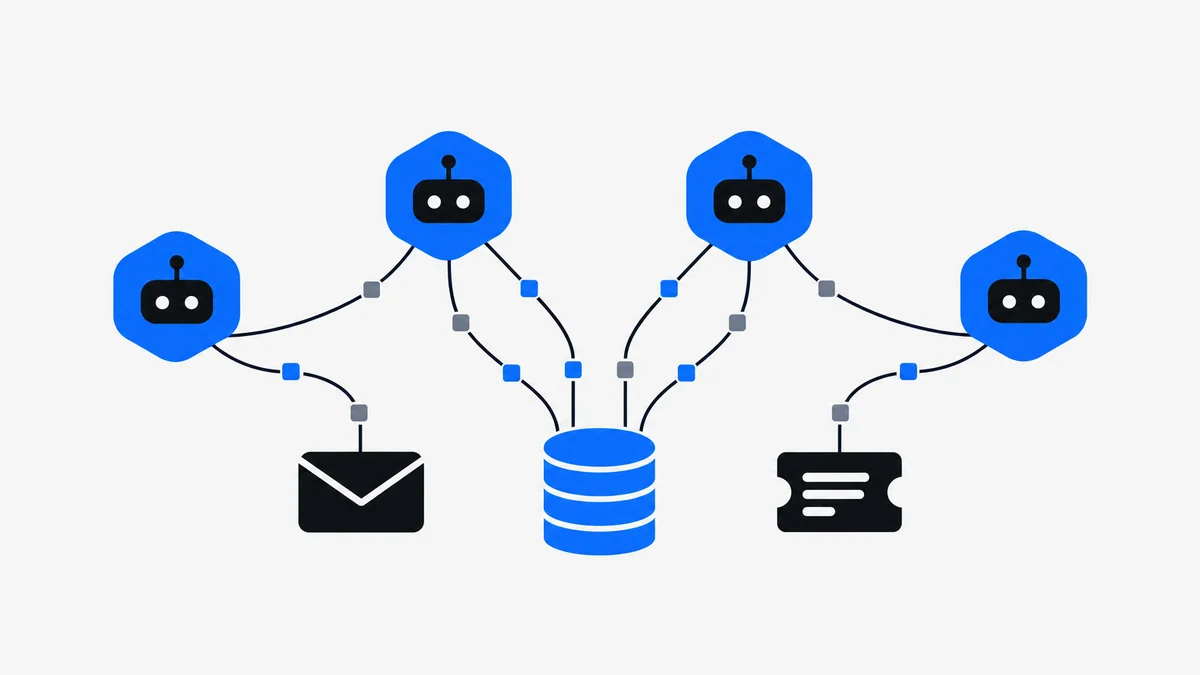
The common thread is a workflow that used to need a person for each step. In Grail Computer Labs' own client work (anonymised), the pattern looks like this:
Each of these touches customer or transaction data. Each therefore needs a record of what the agent did.
Agentic AI is an approach where a model plans and executes multi-step work on its own. A conventional program runs the same code path every time, so a log of events is enough. An agent picks its tools at runtime. Two runs of the same request can take different routes. The record has to capture the decisions, not only the events.
An AI agent audit trail is a time-ordered, tamper-resistant record that links each agent action to the prompt that triggered it, the agent's identity, the data it touched and the human who approved it. Deloitte describes mature governance as "audit trails that capture the full chain of agent actions to help ensure accountability and enable continuous improvement" (Deloitte, 2026).

The record is rarer than it should be. The Cloud Security Alliance's 2026 research note, citing the EY/AIUC-1 Consortium survey, reports that only 38% of organisations monitor AI traffic end-to-end across prompts, tool calls and outputs (CSA, 2026).
We treat seven fields as the minimum for each consequential action. Each field exists because its absence causes a specific failure in review.
| Field | What it records | Failure it prevents |
|---|---|---|
| Prompt | The instruction and context the agent received, including source records | A reviewer cannot tell what the agent knew when it acted |
| Response | The model's output before any tool was called | The reasoning behind a wrong action cannot be reconstructed |
| Agent identity | A unique agent ID, version and the human or system that started the run | Actions are attributed to a shared service account |
| Action taken | The exact tool call and its arguments, plus the result | The record shows intent but not what actually happened |
| Data touched | Records, files or systems read or written, by identifier | Scope of exposure cannot be sized after an incident |
| Timestamp | A trusted, synchronised time for every event | Events across agents cannot be put in order |
| Human approval decision | Who approved, rejected or overrode, when, and on what evidence | Approvals exist only as chat messages nobody can prove |
A trace is the full record of one agent run from trigger to outcome. A span is one timed step inside a trace, such as a single tool call. A correlation ID is a shared identifier stamped on every span so events from parent and child agents can be joined later. Without it, concurrent runs cannot be separated.
No single rule defines an AI agent audit trail yet, so compliance means mapping the seven record fields to each regime that applies. Under the EU AI Act, as reported in 2026, high-risk system logs must be kept at least six months and technical documentation ten years (Praesidia, 2026). Singapore's MAS finalised its AI risk guidelines on 7 October 2026 (LeapRate, 2026).
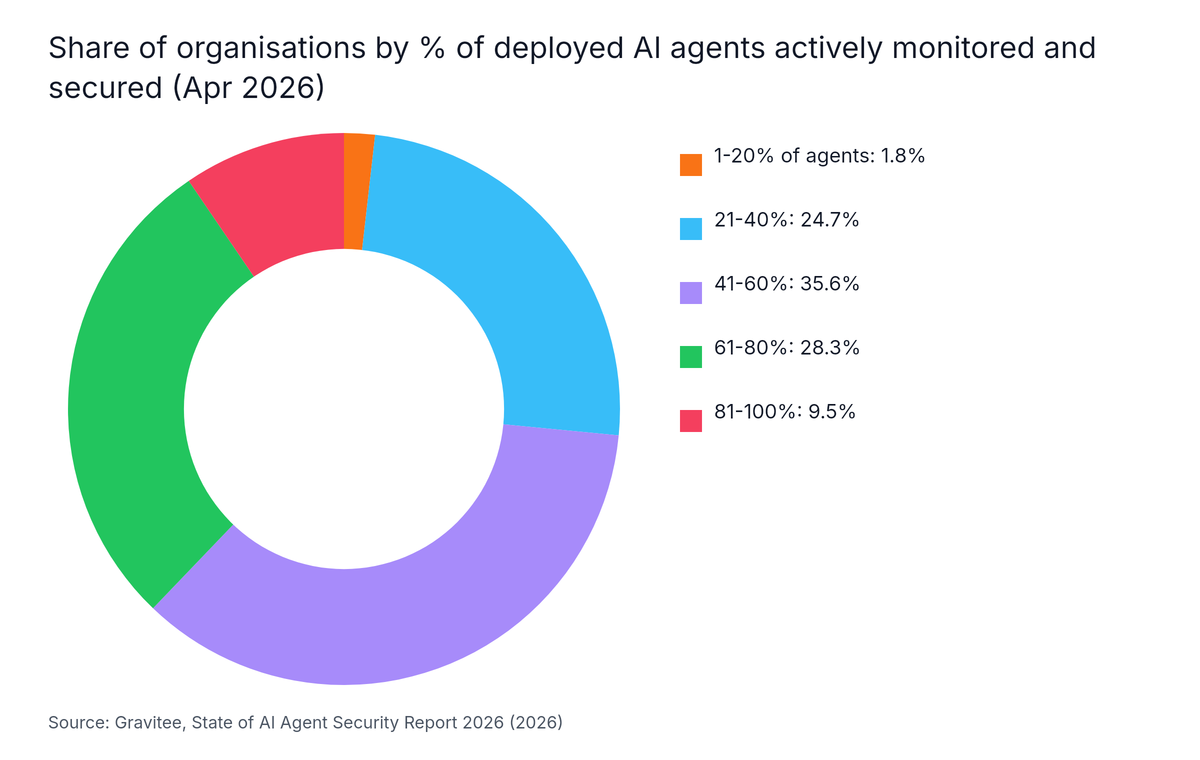
Source: Gravitee, State of AI Agent Security Report 2026, 2026
The gap between policy and practice is wide. Gravitee's State of AI Agent Security Report 2026, a vendor survey, puts mean monitoring and security coverage across deployed agents at 52%, so roughly 48% of production agents run unsecured (Gravitee, 2026). Only 9.5% of organisations monitor and secure 81-100% of their agents, per the same report. The sample size is not visible in the excerpt, so read the figures as indicative.
| Regime | Date | What it says about records | Fields it leans on |
|---|---|---|---|
| EU AI Act, Art. 12, 18, 19, 26(6) | Reported as applying from 2 Aug 2026 | Logging for high-risk systems; logs kept at least six months; technical documentation ten years | Timestamp, action taken, identity |
| MAS Guidelines on AI Risk Management | Final 7 Oct 2026; Sections 3-4 apply from 7 Oct 2027, Sections 5-6 from 7 Oct 2028 | Documenting logs and records, reviewing human oversight decisions, enhanced documentation for AI agents, regularly tested kill-switch protocols | Human approval decision, prompt, response |
| IMDA Model AI Governance Framework for Agentic AI | Original Jan 2026; updated 20 May 2026 | Names logging and monitoring, human approvals and guardrails as core agent components; recommends tracking human override rates and response times | Human approval decision, timestamp |
| NIST AI Agent Standards Initiative | Launched 17 Feb 2026 | Multi-year effort; NCCoE flags non-repudiation and audit-trail integrity as gaps | Tamper resistance, identity |
Two cautions apply. Article 12 of the EU AI Act sets purposes rather than a schema, and many agents are not high-risk, so check the regulation text on EUR-Lex and any change to its application date. The IMDA detail comes from a legal-commentary summary of the 20 May 2026 update (Inside Global Tech, 2026). NIST's tamper point, as summarised by the Cloud Security Alliance, calls for logging that agent systems themselves cannot tamper with (CSA, 2026).
Retention should be planned in three tiers:
Health records, financial records and employment screening often carry their own, longer periods. Confirm those with counsel. We did not research Australian rules such as APRA CPS 230 or Privacy Act automated-decision transparency for this guide, so treat Australia as an open item.
Creating an audit trail for AI decisions takes five steps: give each agent its own identity, emit a structured event for every step, mask secrets before anything is logged, write events to append-only storage, and review them on a schedule. Deloitte counts audit trails of the full chain of agent actions as part of mature governance, which around 80% of surveyed organisations lack (Deloitte, 2026).
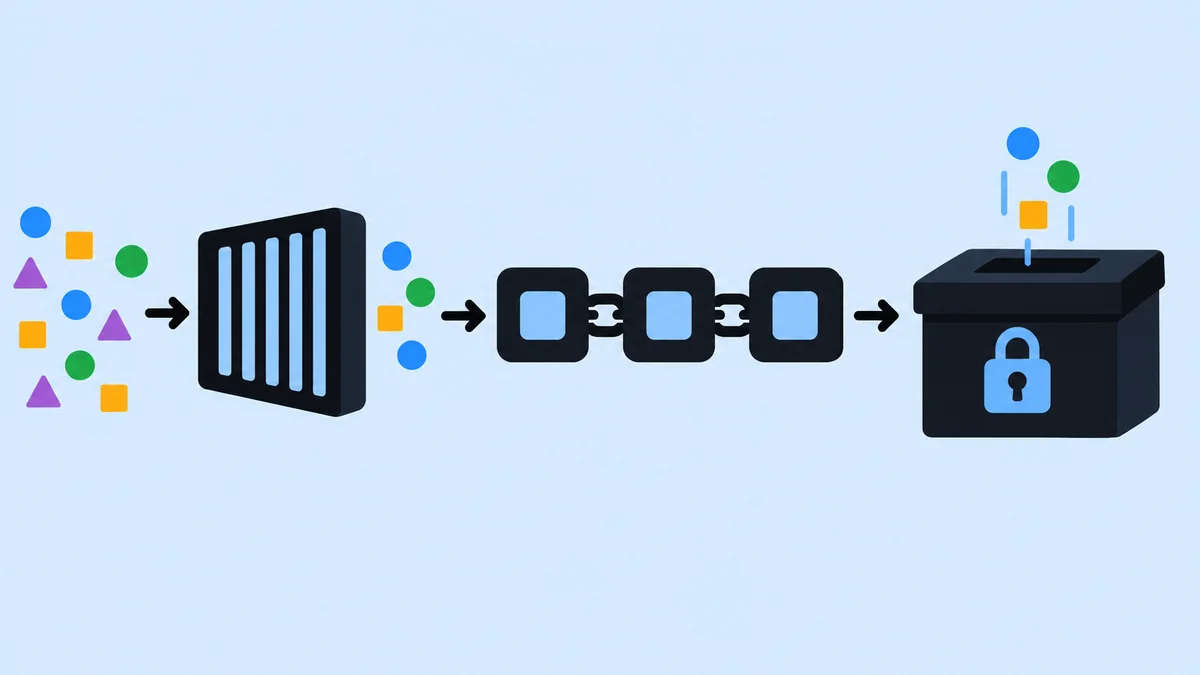
A human approval decision is the logged outcome of a person approving, rejecting or overriding an agent action, with the evidence they saw. Log the approver, the timestamp, the proposed action and the decision. Also log how long the review took. The IMDA update recommends tracking human override rates and response times to counter automation bias, and the same fields serve a compliance reviewer.
Grail Computer Labs (GC Labs) runs agents under the principle that agents execute, humans decide and customers see progress. In that architecture, agent traces are recorded by default, and likely secrets are masked before they reach an agent. A secret the agent never sees cannot appear in its prompt, its response or its trace. Human review stays in the loop where judgement or risk sits.
Our data: GC Labs built a human-reviewed know-your-transaction (KYT) workflow for a Singapore-based neobank in one week. Automated approvals rose from approximately 44% to approximately 90% in testing. Every review that stays with a person is a human approval decision, and each one needs its own record.
This is engineering practice, not an audit-trail product.
AI agent audit trail visualisation shows each agent run as a tree of timed steps, so a reviewer can see which parent agent started which child, what ran in parallel and where a human approval paused the flow. A Cloud Security Alliance research note citing the EY/AIUC-1 Consortium survey reports only 17% of organisations continuously monitor agent-to-agent interactions (CSA, 2026).
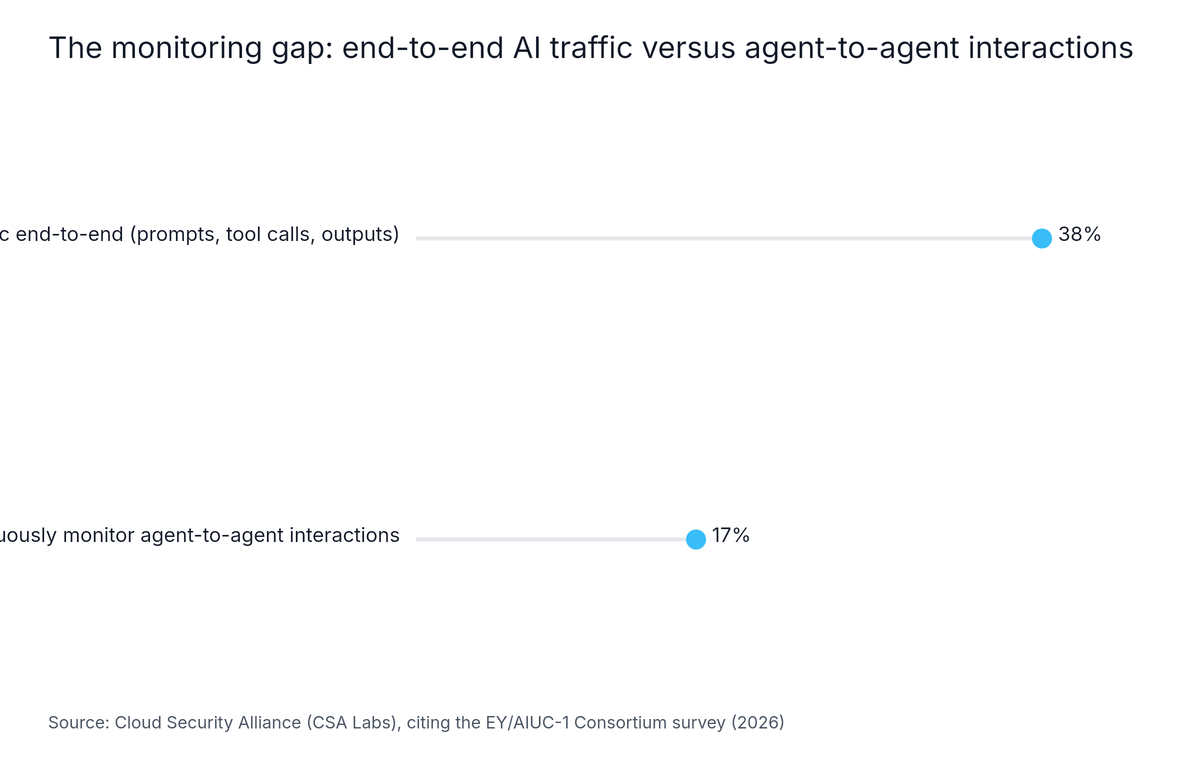
Source: Cloud Security Alliance (CSA Labs), citing the EY/AIUC-1 Consortium survey, 2026
The same note reports that only 38% of organisations monitor AI traffic end-to-end. The 21-point drop from 38% to 17% is the concurrent-agent visibility gap: teams can often see single agents, but not the hand-offs between them. Datadog states the underlying problem plainly: "traditional observability tools often fall short in making that behavior understandable, because many agentic systems are fundamentally nonlinear." (Datadog, 2025)
Fan-out is one agent starting several child agents at once. Fan-in is their results returning to the parent. Both break a flat log, because lines from different agents interleave. Four views cover what a compliance review asks.
| View | What it shows | Best for | What it hides |
|---|---|---|---|
| Timeline | Spans in time order, parallel runs stacked | Reconstructing one incident | Which agent caused which |
| Parent-child tree | Delegation chain from trigger to leaf call | Attributing an action to its origin | Timing overlaps between branches |
| Agent graph | Agents as nodes, calls as edges | Spotting unexpected agent-to-agent paths | Order of events |
| Approval queue | Pending and decided human reviews with evidence | Proving oversight and measuring override rates | Everything the agent did between approvals |
Counts and averages answer how often. A reviewer asks who did what, in what order, with whose approval. Two agents that each stay within their own limits can together move data somewhere neither could alone. Only a trace joined by correlation ID shows that. Visualisation is a compliance need, not only a debugging aid.
No AI platform should be assumed to log everything a compliance review will ask for. Prompt and response bodies, tool-call arguments and some API traffic can be opt-in or excluded, so buyers should test each platform against the seven-field record. AvePoint's 2026 survey of 750 IT leaders found 62.4% plan to increase investment in tools that monitor agents' actions for policy alignment (AvePoint, 2026).
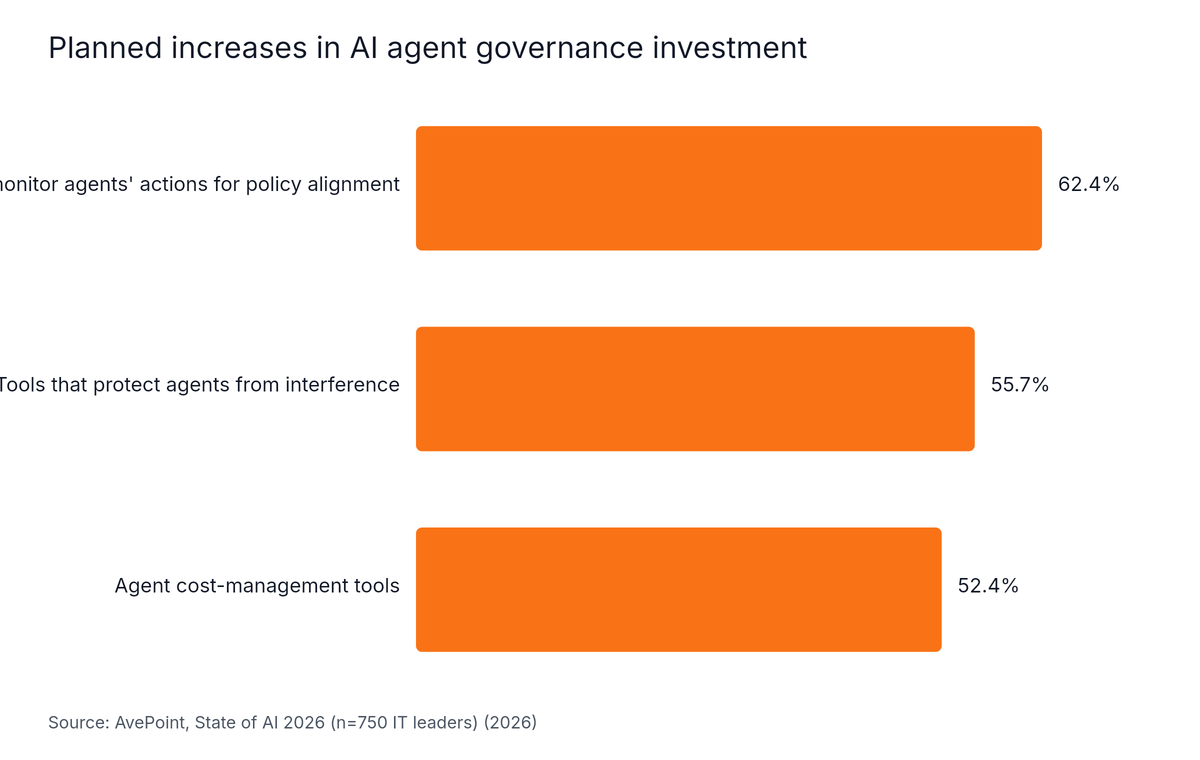
Source: AvePoint, State of AI 2026 (n=750 IT leaders), 2026
We do not rank vendors here. Features change by plan and workload, so the useful move is a test list.
| Question to ask | Why it matters | Evidence to request |
|---|---|---|
| Are prompt and response bodies logged by default, or opt-in? | Metadata alone cannot show what the agent saw | A settings screenshot and a sample record |
| Are tool-call arguments recorded? | Without them the action taken is unprovable | A sample trace with arguments |
| Does the log cover API-key traffic and every workspace? | Some compliance feeds cover only part of the usage | Written scope of coverage |
| Can records be exported and kept beyond the vendor's retention? | The retention rule that applies may be longer | Retention terms and export format |
| Is the log tamper-evident? | NIST's NCCoE flags audit-trail integrity as a gap | Description of write protection |
| Are human approvals recorded in the same trace? | Approvals split across systems cannot be joined | A sample joined record |
Run the checklist against a real agent action, then compare the output to the seven fields. Gaps found in a pilot cost little. Gaps found in a review cost a deployment.
Offboarding an AI agent means revoking every credential, token and delegated permission it holds, archiving its logs separately, and recording proof that nothing remains. The step can be automated as a workflow triggered by a retirement event. The Cloud Security Alliance's 2026 note reports 92% of large-enterprise CISOs and CIOs lack full visibility into their AI agent identities (CSA, 2026).
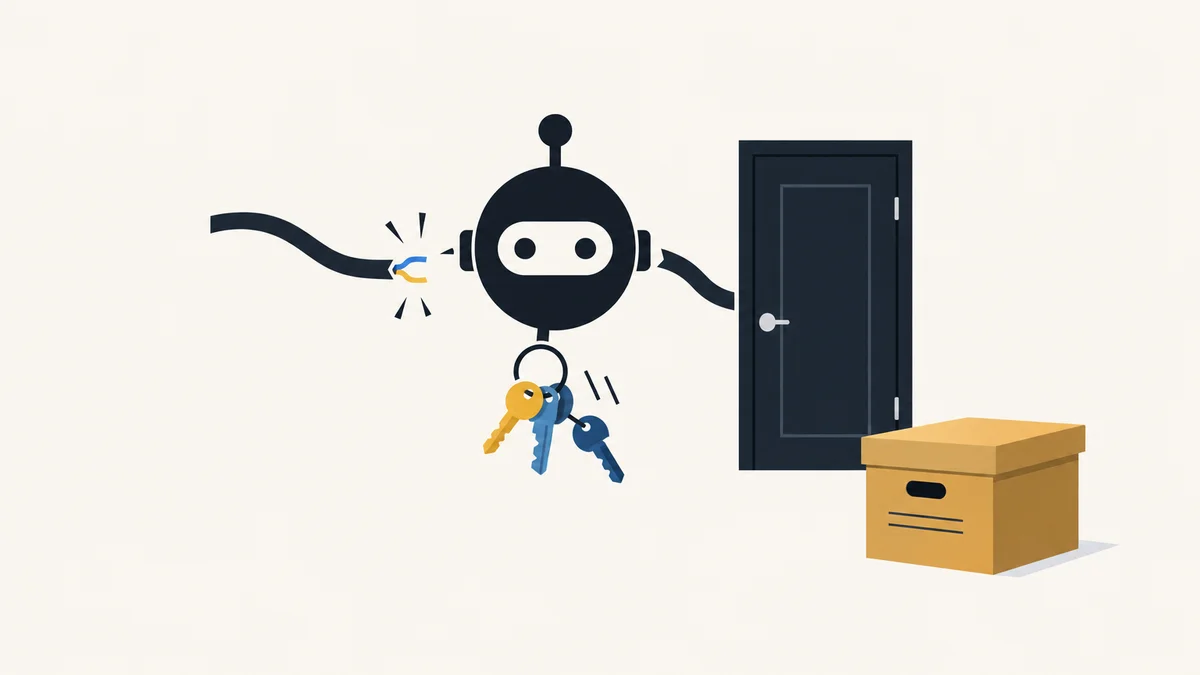
Agent decommissioning is the lifecycle control that retires an agent and removes every route by which it could act again. Revocation cannot cover what the inventory does not list, so the identity inventory behind the audit trail is the starting point. The MAS guidelines also expect kill-switch protocols to be tested regularly, and the same workflow can serve that test.
Step 5 produces the proof. Auditors rarely ask whether access was revoked; they ask for evidence that it was.
An AI agent audit trail does not replace legal advice, a certification or a vendor ranking, and it cannot prove that an action was correct or lawful. It records what an agent did. IBM's 2026 survey of more than 3,200 executives found only 37% say their current governance system is designed to scale with agentic AI (IBM, 2026).
An AI audit trail is a time-ordered record of what an AI system received, decided and did, kept so a reviewer can reconstruct any outcome later. It records inputs, the model or agent version, outputs, the action taken, the data accessed, the timestamp and any human approval. For agents it also records tool calls and the identity that made each one.
Requirements depend on the regime and the system's risk class, and no single rule covers every agent. Under the EU AI Act, as reported in 2026, high-risk systems need logs kept at least six months and technical documentation kept ten years (Praesidia, 2026). Singapore's MAS guidelines, finalised on 7 October 2026, cover documenting logs and records and reviewing human oversight decisions (LeapRate, 2026).
An AI agent audit trail is a tamper-resistant, time-ordered record linking each agent action to its prompt, response, agent identity, data touched, timestamp and human approval decision. It differs from ordinary application logs because the agent chooses its steps at runtime, so the record must capture the decisions as well as the events.
An AI audit trail should document the seven-field record for every action, plus the agent version, policy decisions and denials. Retention is set by the strictest rule that applies: the EU AI Act, as reported in 2026, sets at least six months for high-risk logs and ten years for technical documentation (Praesidia, 2026). Sector rules for health, finance and employment records can run longer, so confirm them.
An AI governance audit trail across a production deployment should capture an inventory of agents, each agent's identity and permissions, every action record, every human approval or override, policy denials and retirement evidence. Deloitte's 2026 survey of 3,235 leaders found only about one in five organisations (21%) has a mature governance model for agentic AI (Deloitte, 2026).
AI agent audit trail visualisation usually combines a timeline of timed steps, a parent-child tree of agent calls, and an approval queue that shows where humans paused the flow. Together they let a reviewer follow concurrent agents without reading raw logs. Only 17% of organisations continuously monitor agent-to-agent interactions, according to a 2026 Cloud Security Alliance note (CSA, 2026).
A reliable AI agent audit trail is hard because agents act across many tools and identities, and most organisations lack the visibility to record all of it. The Cloud Security Alliance's 2026 note reports only 38% monitor AI traffic end-to-end across prompts, tool calls and outputs, and 17% monitor agent-to-agent interactions (CSA, 2026).
Decommissioning an AI agent means revoking its credentials, tokens and delegated permissions, archiving its logs in a separate store, and recording evidence that no access remains. Automate it as a workflow triggered by a retirement event, and keep the agent's identity as a tombstone record so later reviews can still attribute its past actions.
An AI agent audit trail is the evidence that lets security and legal teams sign off. The record is simple to state and hard to deliver across many agents.
Next step: run one real agent action through the seven-field table and note which fields are missing. For a stalled or ungoverned agent project, Book a call ↗.
© 2026 Grail Computer All rights reserved.