Blog
Software Development Project Rescue: What the First 30 Days Involve
How software development project rescue works: triage, codebase inheritance, outcome agreement, stabilisation and release, anchored in a real 30-day case.

How to keep annuity and contract data compliant when AI agents process it: client-side deployment, zero data retention, masking and read-only rollout.

How software development project rescue works: triage, codebase inheritance, outcome agreement, stabilisation and release, anchored in a real 30-day case.
Enterprise AI guardrails explained: instruction-based vs architecture-based controls, plus a go-live checklist for data access, action scope and fallback.
A legacy system is software that is hard to change safely. See the warning signs, the improve-or-rebuild test and a phased migration plan for real platforms.
Request a quote and our experts will contact you within 24 hours with tailored solutions and pricing.
You can also send us a quick email at [email protected].
Grail Computer
Last updated: Nov 15, 2026
By Shiva Mangal | Published 28 October 2026
AI agent data residency is the practice of keeping every data layer an agent touches, including prompts, logs, embeddings and memory, inside the regions and systems that regulators and contracts allow. Annuity and insurance contract data makes that hard. One record can carry policy terms, claims history and beneficiary details, and standard cloud AI endpoints were not built to keep all of it in one place. This guide sets out the controls Grail Computer Labs (grail.computer) uses: deployment on client infrastructure, zero data retention where required, secrets masking and read-only access to start. Our short control page on data residency gives the summary. This post gives the mechanisms.
Key Takeaways
- AI agent data residency covers six layers, not one: source records, prompts, inference, logs and traces, embeddings, and agent memory.
- Zero data retention at a model provider does not remove the records a regulator may require a firm to keep on its own side.
- The Monetary Authority of Singapore set no minimum controls for generative or agentic AI in its final October 2026 guidelines, so firms must define their own controls and evidence.
- Masking secrets and sensitive fields before data reaches an agent turns a policy promise into a technical boundary.
- Read-only access first, with agent traces recorded, treats an AI agent as a restricted non-human identity.
AI agent data residency is the requirement that every layer of data an agent touches stays in an approved location: source records, prompts, model inference, logs, embeddings and memory. Data sovereignty is broader: it asks which country's law governs the data. Gartner predicts region-specific AI platforms will lock in 35% of countries by 2027 (Gartner, 2026), so both questions now reach agent design.

Data sovereignty is the principle that data is subject to the law of the country that governs it, whatever server holds it. Residency is the narrower, physical question: where is the data stored and processed? An agent complicates both. A traditional application reads a record from one database. An agent reads a record, builds a prompt, calls a model, writes a log, stores an embedding and may keep memory between sessions. Each step is a place where data can leave the approved region.
A residency review that checks only the database misses most of the exposure. We map six layers:
An embedding is a list of numbers that represents the meaning of a passage of text, so documents can be searched by meaning. A vector store is a database of embeddings. It can hold enough of a contract's meaning to count as personal data in a review, so treat it as a copy of the contract, not as metadata.
Satisfying data residency and retention rules for annuity contract data takes four controls: run the agent on client infrastructure, apply zero data retention at the model provider where required, mask sensitive fields before the agent sees them, and start with read-only access. The stakes are visible in AM Best's 2026 survey of 152 rated carriers and MGAs, where 43% named security and privacy a barrier to deploying AI (AM Best via Risk & Insurance, 2026).
The table summarises how each control maps to the layers above.
| Control | Layers it protects | Residency effect |
|---|---|---|
| Deployment on client infrastructure | Runtime, logs, traces, embeddings, memory | Processing stays in the client's account and region |
| Zero data retention where required | Model inference | Provider keeps nothing after responding |
| Secrets and field masking | Prompt and context | Sensitive values never reach the model |
| Read-only access to start | Source records | The agent cannot alter contract records |
Three properties of annuity and contract data change the residency design:
A caveat on the evidence: the AM Best percentages below are as reported by Risk & Insurance, a trade publication. We have not checked them against AM Best's own segment report, so read them as indicative. Data readiness ranked first among deployment barriers at 45% (AM Best via Risk & Insurance, 2026). Security and privacy followed at 43%. Residency sits inside that second figure.
The same survey asked about the largest implementation risk. Operational risk led at 41%. Data privacy came second at 22%, and regulatory risk followed at 15% (AM Best via Risk & Insurance, 2026). A separate 2026 survey from the Big 'I' Agents Council for Technology found data privacy or compliance risk was the top AI concern among independent insurance agencies at 24%, ahead of inaccurate outputs at 22% (Big I via IndependentAgent.com, 2026).
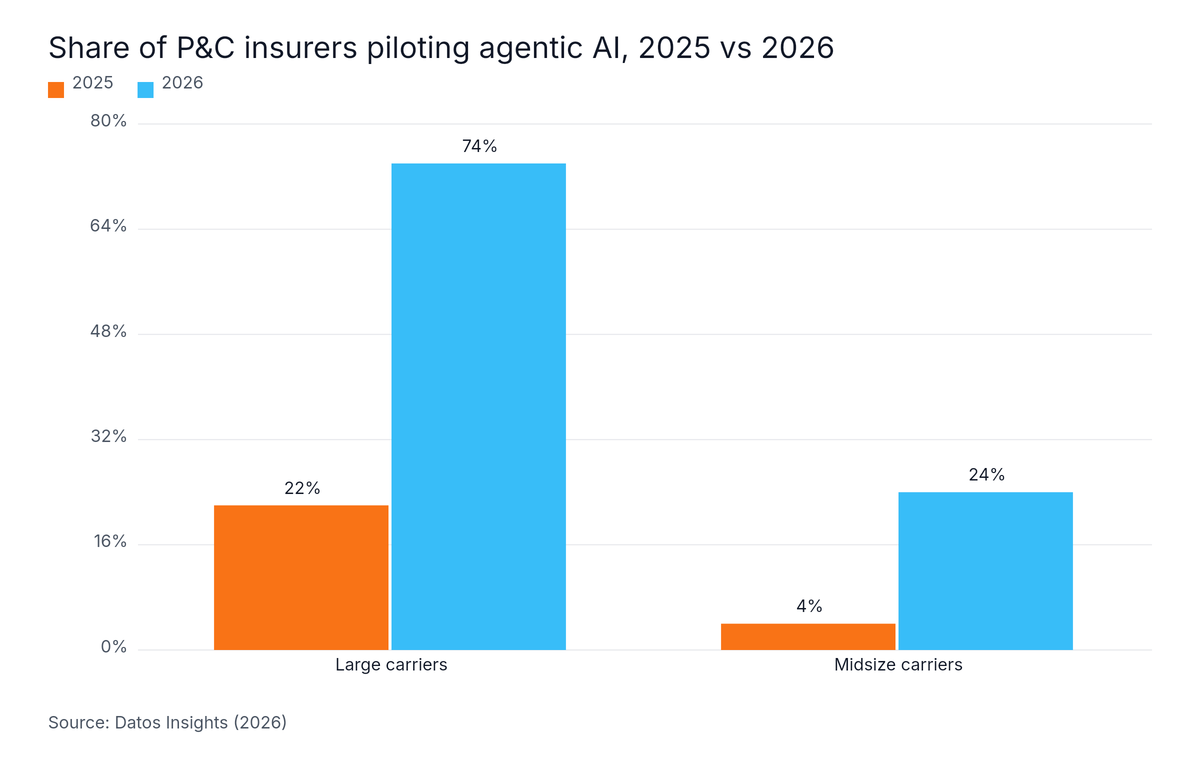
Carriers are moving from talk to pilots. Datos Insights' Q2 2026 survey of 44 P&C insurer CIOs found 74% of large carriers piloting agentic AI in 2026, up from 22% in 2025. Midsize carriers rose to 24% from 4% (Datos Insights, 2026).
Source: Datos Insights, 2026
Chart: share of P&C insurers piloting agentic AI. The chart plots the 2025 values (large carriers 22%, midsize 4%). The 2026 values are 74% and 24% (Datos Insights, 2026).
Most insurers describe their approach as careful. In the AM Best data as reported by Risk & Insurance, 53% say they are cautiously keeping pace with the industry, 27% call themselves successful followers, and 20% say they are first movers or innovators (AM Best via Risk & Insurance, 2026).
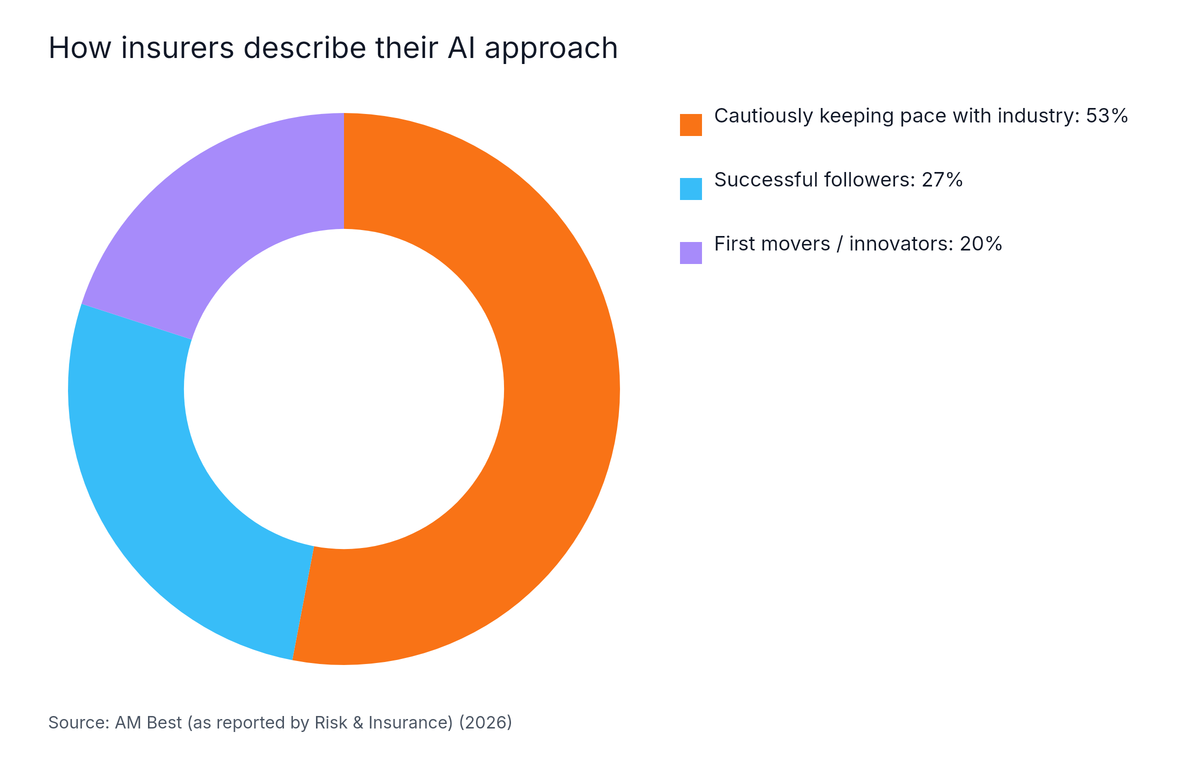
Source: AM Best (as reported by Risk & Insurance), 2026
Chart: how insurers describe their AI approach, as reported by Risk & Insurance (AM Best survey, 2026).
No source we reviewed states a blanket in-country rule for AI agent data in Singapore or Australia. The Monetary Authority of Singapore (MAS) finalised its AI Risk Management Guidelines on 7 October 2026, effective 7 October 2027, and firms stay accountable for third-party AI (LeapRate, 2026). The Australian Prudential Regulation Authority (APRA) flagged data leakage and access gaps in April 2026 (APRA, 2026).

The table sets out what each source says and what it means for an agent design.
| Source | Date | What it says about AI | Design implication |
|---|---|---|---|
| MAS Guidelines on AI Risk Management | Finalised 7 Oct 2026; effective 7 Oct 2027; sections 5 and 6 from 7 Oct 2028 | Firms remain accountable for third-party AI. No minimum controls set for generative or agentic AI. MAS plans to consult on agentic AI in 2027. | Define agent controls now and keep evidence of them. |
| APRA Letter to Industry on AI | 30 Apr 2026 | Flags identity and access management gaps, prompt injection and data leakage. Warns of stronger supervisory action where AI risk is unmanaged. | Treat agents as non-human identities with scoped access. |
| Gartner on region-specific AI platforms | 29 Jan 2026 | Governance and data residency practices must meet country-specific requirements. | Design for per-region deployment from the start. |
Sources: LeapRate (2026), Blockhead (2026), APRA (2026), Gartner (2026).
The sources we reviewed show no Singapore in-country rule for AI processing data. MAS did not set minimum controls or mandated testing for generative or agentic AI in the final text (Blockhead, 2026). Ho Hern Shin, Deputy Managing Director at MAS, said: "With greater regulatory clarity on financial institutions’ AI usage, FIs can innovate with confidence" (LeapRate, 2026). Clarity here means accountability, not a checklist. The firm decides which controls are enough, and it must show why.
No source we reviewed states that the Australian Privacy Act or APRA's CPS 234 information security standard requires AI agent data to stay in Australia. APRA's April 2026 letter does name data leakage and weak access controls as attack pathways, and it warns of stronger supervisory action where AI risk is unmanaged (APRA, 2026). Whether a given workflow must stay in-country depends on the firm's licence, contracts and legal advice.
We are not lawyers. Counsel should confirm what a firm's own licence, contracts and privacy law require.
Deploying AI agents on client infrastructure means the agent runtime, model calls, logs and traces run inside the client's own cloud account or private cloud, under the client's AI and security policies. Grail Computer Labs works this way, so contract data never needs to sit in a vendor-operated environment. The principle is simple: residency should be a physical fact, not a contract clause.

A residency promise in a contract is an instruction. A deployment inside the client's boundary is a physical fact. The only reliable way to prevent an agent from moving data somewhere is to make that path impossible.
| Control | Vendor-hosted agent | Agent on client infrastructure |
|---|---|---|
| Where the runtime executes | Vendor's environment | Client's cloud account or private cloud |
| Who sets security policy | Vendor, with client review | Client's AI and security policies |
| Where logs and traces land | Vendor systems unless exported | Client systems, recorded as agent traces |
| Ownership of code, models and documentation | Often stays with the vendor | Client owns code, cloud, models and documentation |
| Exit path | Depends on contract | Client already holds the assets |
Ownership matters for a second reason. Gartner predicts 70% of enterprises will abandon agentic AI built by vendor forward-deployed engineering by 2028, and points to ownership, governance and transition decisions made before contracting (Gartner, 2026). A client that already owns the code, cloud, models and documentation has a clean exit.
Our results: GC Labs built a human-reviewed KYT (know-your-transaction) workflow for a Singapore-based neobank in a one-week build. Automated approvals rose from approximately 44% to approximately 90% in testing, with human review kept where risk sits. The figure shows that human approvals can stay inside a regulated workflow. It is not a residency measurement.
Client content is never used to train AI models or shown to other clients, under GC Labs' Terms of Service. Deployment on client infrastructure is the technical half of that promise. The contract is the legal half. To test the approach on a pre-defined outcome, Book a call ↗.
Zero data retention (ZDR) covers what a model provider stores about a customer's requests, not what an application or a regulator requires. Reconciling it with records retention means splitting duties: the provider retains nothing, while the client keeps required records in systems it owns. Gartner predicts region-specific AI platforms will lock in 35% of countries by 2027 (Gartner, 2026), so schedules will differ by region.
Zero data retention is an arrangement in which a model provider stores nothing about a customer's requests after it returns a response. It answers one question: what does the provider keep? It does not answer what the application keeps, and it does not say what the firm must keep.
Practitioner commentary from August 2026 warns that a ZDR clause is undermined if an application's own logging, embeddings or vector database still stores prompts in another region. The same commentary notes that ZDR coverage varies by provider and model (Startup Fortune, 2026). Confirm ZDR per model, in writing.
| Layer | What it can hold | Residency control | Who owns retention |
|---|---|---|---|
| Source records | Policies, contracts, claims | Stay in the client's approved region | Client, per statutory schedule |
| Prompt and context | Extracted contract text | Masked before sending; model runs inside the boundary or under ZDR | Not retained by the provider |
| Model inference | Transient request data | ZDR where required | Provider keeps nothing |
| Logs and agent traces | Actions, inputs, outputs | Written to client systems | Client, per audit needs |
| Embeddings and vector stores | Searchable copies of content | Same region and policy as the source records | Client, deleted with the source |
| Agent memory and caches | Carried-over state | Scoped per task; cleared on schedule | Client |
A legal hold freezes deletion. If agent logs, embeddings or memory carry contract content, they fall under the hold too. Decide in advance which layers are records and which are disposable, then write that into the retention schedule. A design that deletes data fast and a regulator that wants records are both reasonable. The map above is how they coexist.
Secrets masking is the removal or replacement of credentials and sensitive values before text reaches an AI agent or model. At Grail Computer Labs, likely secrets are masked before they reach an agent. For annuity data, the same step can tokenise names, policy numbers and beneficiary details, because 24% of independent agents name data privacy or compliance risk as their top AI concern (Big I, 2026).

Most residency guidance covers vaults and credential hygiene. Fewer pages treat masking contract content as a residency control. It is one. If a name never reaches the model, the model's location matters less for that field.
The word "likely" matters. Pattern-based detection finds most secrets, not all of them. That is why masking sits beside deployment on client infrastructure, not in place of it. Masking personal fields is a design choice agreed with the client before build, because it trades some context for lower exposure.
Read-only access lets an AI agent view records but not change them, so a wrong answer cannot become a wrong contract entry. APRA's April 2026 letter says "Identity and access management capabilities have not yet adjusted to nonhuman actors such as AI agents" (APRA, 2026). Starting read-only treats the agent as a restricted non-human identity from day one.

Read-only access is a permission level that lets an agent read data but not create, change or delete it. Pilot volume raises the stakes: 74% of large P&C carriers piloted agentic AI in 2026 (Datos Insights, 2026). Prompt-based restrictions live in the same context as the agent. They are instructions, not boundaries. A permission set at the system level is a boundary.
A non-human identity is an account or credential that represents software rather than a person. An agent that logs in as a shared service account cannot be traced to one task. An agent with its own identity, scoped permissions and a trace of each action can. This is the gap APRA describes, and it applies to firms under CPS 234 or MAS expectations alike.
Regulators and auditors ask the same plain question: show where the data went. APRA warns of stronger supervisory action where AI risk is not managed (APRA, 2026), and MAS leaves the choice of controls to the firm. Prepare these artefacts before the review, not during it.
| Evidence artefact | Question it answers |
|---|---|
| Data-flow map of the six layers | Where was data stored and processed? |
| Deployment record (account, region, network) | Does the agent run inside the approved boundary? |
| ZDR confirmation per model, in writing | What does the model provider retain? |
| Retention schedule with legal-hold rules | Which layers are records, and for how long? |
| Masking rules and sample masked prompts | What reached the model? |
| Access plan and agent trace samples | What could the agent do, and what did it do? |
Grail Computer Labs' deployment on client infrastructure is not for buyers who need a vendor holding SOC 2, ISO 27001 or HIPAA certification, or who want a shared multi-tenant SaaS product. Grail Computer Labs holds none of those certifications. It completes vendor security assessments during onboarding, and its controls reduce residency risk without replacing legal advice.
Four honest limits apply:
Teams that cannot take ownership of code, cloud, models and documentation should settle that before signing.
No in-country rule for AI processing appears in the sources we reviewed. The Monetary Authority of Singapore finalised its AI Risk Management Guidelines on 7 October 2026, effective 7 October 2027, and firms stay accountable for third-party AI. MAS set no minimum controls for generative or agentic AI in the final text. Confirm obligations with counsel.
No source we reviewed states that the Australian Privacy Act or APRA's CPS 234 requires AI agent data to stay in Australia. APRA's 30 April 2026 letter names data leakage and weak access controls as attack pathways and warns of stronger supervisory action. Whether a workflow must stay in-country depends on the licence, contracts and legal advice.
Yes. Grail Computer Labs deploys AI agents on client infrastructure or private cloud, under the client's AI and security policies, with zero data retention where required. The agent processes contract data inside the client's boundary, so source records, logs and traces stay in systems the client controls and can audit.
Zero data retention covers what a model provider stores about a customer's requests, and coverage varies by provider and model. It does not automatically cover an application's own logs, embeddings, vector stores or agent memory. Practitioner commentary from August 2026 warns that these can still hold prompts, sometimes in another region. Each layer needs its own check.
Read-only access limits the damage an agent can do while a team learns how it behaves. An agent that cannot write cannot alter a contract record, so errors stay reviewable. Grail Computer Labs begins access read-only, shares the access plan upfront and records agent traces, so write permissions are added one reviewed step at a time.
No. Grail Computer Labs holds no SOC 2, ISO 27001 or HIPAA certification. It states that it is an OpenAI Select Partner, and it completes vendor security and compliance assessments as part of onboarding. Buyers who need a certified vendor should treat that as a firm requirement and raise it before any engagement starts.
AI agent data residency is a design problem before it is a policy problem. For annuity and contract data, five points carry the most weight:
That is the standard enterprise teams should demand before putting AI agents into real workflows. To test these controls against real systems, Book a call ↗ and bring a data-flow map and the regulator's questions.
© 2026 Grail Computer All rights reserved.