ai agent for month end accrualsmonth-end accruals automationaccruals audit trail
AI Agent for Month-End Accruals: What Stays Human
Which month-end accrual steps an AI agent can own, which need a named approver, and the audit trail fields a controller or external auditor will expect.
An AI agent for month-end accruals can own data gathering, classification and rule-based drafting of entries, but a named human should still approve judgmental estimates, first-time vendors and amounts above materiality. Half of finance teams still need six or more business days to close the month (Ledge, 2025), and manual accrual work adds to that time. The volume spike is predictable and the cost of an error is high. This article maps each accrual step to an autonomy level, lists the decision rules that keep a person in charge, and sets out the audit trail fields a controller or external auditor will ask for.
Key Takeaways
An AI agent for month-end accruals can gather data, classify candidates and draft rule-based entries; a named approver should own estimates, new vendors and amounts above materiality.
Half of finance teams take six or more business days to close, and most automate less than 40% of the close (Ledge, 2025).
An accrual audit trail must record inputs, policy and model version, calculation, exception flags, reviewer decision, timestamp, posting reference and reversal link.
A month-end accruals pilot should start with one entity or account category, and track override rate and accrued-versus-actual variance before widening scope.
How much of the month-end accruals process can an AI agent handle without a human signing off every line?
An AI agent for month-end accruals can handle gathering source data, classifying candidates and drafting rule-based entries without line-by-line human review, because those steps are repeatable and checkable. Estimates, first-time vendors and amounts above materiality still need a named approver. Only 43% of large North American CFOs feel confident in their AI governance (Deloitte, 2026), so most teams should keep a human on posting.
Ledger pages sorted into three labelled trays on a desk
An accrual is an expense or revenue recorded in the period it was incurred, before the invoice or cash movement arrives. The table below splits the process into six steps and assigns each one an owner.
Step
What the agent does
What the human does
Autonomy level
1. Data gathering
Pulls open purchase orders, goods receipts, contracts and prior-period accruals
Confirms the source systems and cutoff date
Agent owns
2. Classification
Tags each candidate by account, entity, vendor and accrual type
Reviews exceptions the agent flags
Agent owns, human reviews exceptions
3. Rule-based drafting
Prices recurring and received-not-invoiced lines using the written policy
Samples drafts against policy
Agent drafts, human samples
4. Estimation and judgment
Prepares evidence and a suggested range
Decides the amount and the basis
Human owns
5. Approval and posting
Prepares the entry pack with evidence
Accepts, adjusts or rejects, then posts or releases
Human decides
6. Reversal
Creates the linked reversing entry and checks it landed
Reviews missed or late reversals
Agent owns, human reviews exceptions
Three autonomy tiers
Month-end accrual work divides into three autonomy tiers, and the controller sets the boundaries in writing.
Agent owns. Reading systems, matching documents, tagging and building the candidate list. No ledger impact.
Agent proposes, human samples. Recurring, low-value, rule-based entries inside a threshold the controller approves. Reviewers check a sample and every exception.
Human decides. Anything that needs a judgment, a new counterparty or a figure above materiality.
SAP's Accounting Accruals Agent, released on 25 September 2026, follows the same pattern. It applies a company-provided policy handbook, explains the rules it used, checks for duplicates and lets accountants accept, adjust or reject before posting (ERP Today, 2026).
Why do manual month-end accruals bottleneck the close?
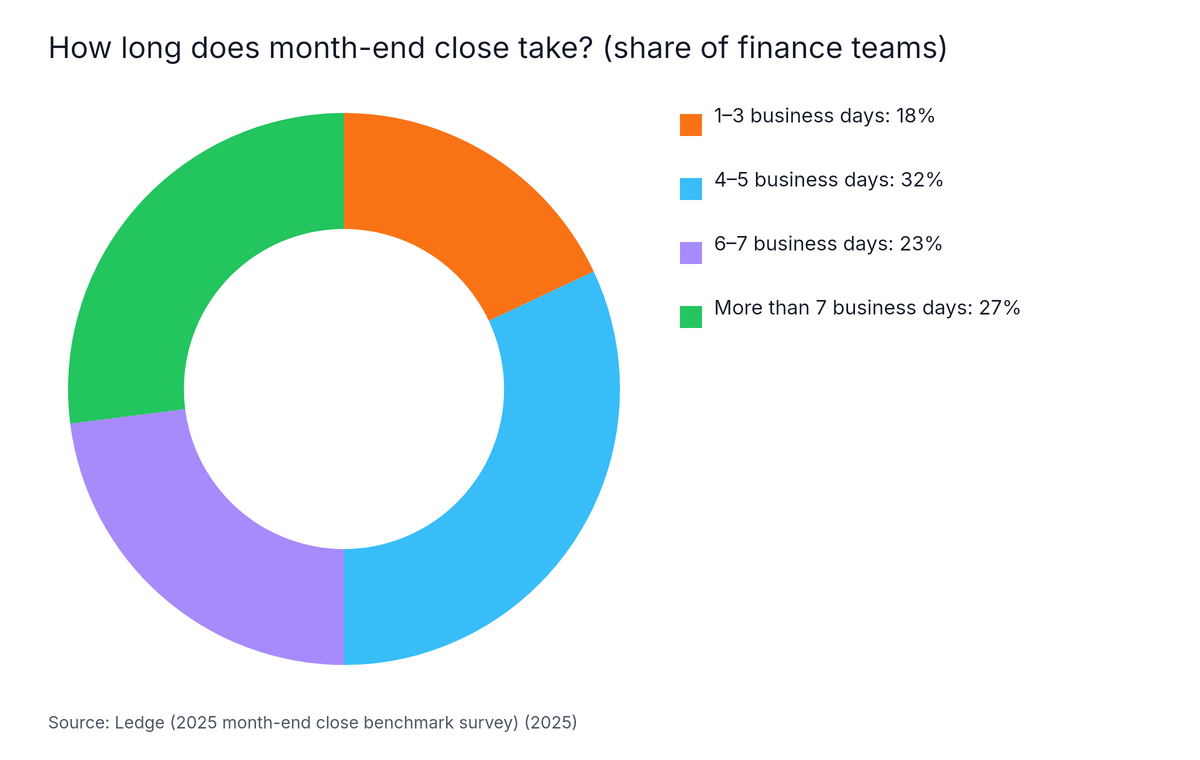
Manual month-end accruals bottleneck the close because every open purchase order, goods receipt and recurring contract must be checked by hand against one deadline. In a 2025 survey by Ledge, an AI-close vendor, 50% of finance teams still take six or more business days to close (Ledge, 2025), and most automate less than 40% of the close.
Wall calendar with the last days of a month circled and a clock beside it
The same survey gives the full spread: 18% of teams close in one to three business days, 32% in four to five, 23% in six to seven, and 27% need more than seven (Ledge, 2025). Ledge is a vendor and the sample size is not shown in the excerpt we retrieved, so treat the split as indicative.
Donut chart: How long does month-end close take? (share of finance teams). Highest: 4–5 business days at 32%.
An error found after posting costs a reversal, a re-review and sometimes a restated report.
Received-not-invoiced (GRNI) is goods or services received by period end for which the vendor invoice has not arrived. It is the classic accrual candidate, and the matching work is mechanical. An agent can compare receipts to invoices across every open line far faster than manual matching, which is where the time saving comes from.
Gartner predicts that finance teams on cloud ERP with embedded AI assistants will see a 30% faster financial close by 2028 (Gartner, 2026). That is a forecast, not a measured result. Vendor speed claims without a stated method deserve the same caution.
What accrual decisions stay with a human?
Human decisions in month-end accruals stay with judgmental estimates, first-time vendors, amounts above materiality and cutoff disputes between periods. A materiality threshold is the amount above which a misstatement could change a reader's decision, and the controller sets it, not the agent. In Deloitte's 2026 survey, 59% of large North American CFOs named balancing deployment speed against risk as their biggest governance challenge (Deloitte, 2026).
Rubber approval stamp resting beside a single document awaiting review
Deloitte's survey commentary puts the principle plainly: "Having effective governance protocols can provide important guardrails for responsible AI use." (Deloitte, 2026). Finance leaders in Australia say the same. In Workday's research, 87% of Australian CFOs insist on a human in the loop so every autonomous action is traceable (Workday, 2026). That is vendor research with no stated sample, so we treat it as a signal, not a benchmark.
Decision rules for what stays human
Accrual type
Why a human decides
Evidence the agent prepares
Provisions under IAS 37 or ASC 450 (litigation, onerous contracts)
Probability and measurement are judgments
Correspondence, counsel letters, prior outcomes
Bonus and commission
Depends on targets and approvals outside the ledger
Plan terms, attainment data, prior true-ups
Payroll and award-rate true-ups (for example healthcare or aged-care staffing)
Rate rules change and interpretation varies
Rosters, rate tables, variance to prior period
First-time or one-off vendors
No history to price against
Contract, quote, who requested the work
Amounts above materiality
An error here moves reported results
Calculation, source documents, comparison to budget
Cross-period or cutoff disputes
Needs a decision on when the service was delivered
Delivery dates, receipts, correspondence
Who sets the materiality threshold?
The controller sets the materiality threshold, and the agent applies it as a routing rule. The research we reviewed gives no universal figure, so the threshold is a policy decision per entity, written down and reviewed each period. Entries above it go to a named approver before posting.
Maker-checker is a control in which one party prepares a transaction and a different party approves it. With an agent as the maker, the checker must be a named person, never the same system. Approval rights stay with people, and the agent's posting rights stay narrow.
Our data: Grail Computer Labs built a human-reviewed transaction-check workflow for a Singapore-based neobank that raised automated approvals from approximately 44% to approximately 90% in testing, in a one-week build. Manual reviews had taken 30+ minutes each. This is a transaction-review workflow, not an accruals one, but it follows the same design: automate the routine, route the exceptions to people.
What must an audit trail record for an AI-proposed accrual?
An audit trail for an AI-proposed accrual must record what the agent saw, which rule or model version produced the entry, and who accepted, adjusted or rejected it. An audit trail is the time-ordered record that lets an external auditor reproduce an entry. COSO's February 2026 guidance maps controls to capabilities including ingestion, transformation, posting and judgment (Journal of Accountancy, 2026).
Row of numbered index cards linked by string forming a trail across a table
The fields below work as a checklist. Each row lets an auditor test a different part of the entry.
Field
What it records
Why the auditor needs it
Inputs and source population
Which POs, receipts and contracts were read, and which were excluded
Shows the population was complete
Policy or prompt version
The written accrual policy or instruction in force
Shows the rule was approved
Model version
The model that produced the draft
Allows the result to be reproduced
Calculation logic
How quantity, price and period were derived
Lets the amount be re-performed
Confidence or exception flags
Duplicates, missing receipts, stale POs, price variance
Shows what the agent could not resolve
Reviewer identity
The named person who reviewed the entry
Evidences segregation of duties
Decision
Accept, adjust or reject, with the reason
Shows the human exercised judgment
Timestamp
When the draft and the decision occurred
Supports cutoff testing
Posting reference
The journal ID in the ledger
Links the record to the books
Reversal link
The reversing entry and its posting date
Regional and framework notes
Most published guidance is US and SOX-centric. Entities reporting under IFRS, SFRS(I) or AASB should ask their external auditor whether and how ISA 315 applies to IT and automated controls in their case. A 2026 APAC survey from Wolters Kluwer, covering 484 senior finance leaders, describes a governance-first approach to AI in the region (Wolters Kluwer, 2026). Requirements differ by jurisdiction and audit firm, so the evidence list should be agreed before go-live.
Policy and model versions should stay locked within a quarter. A prompt change mid-quarter can make last month's entry impossible to reproduce.
How is an accruals agent rolled out without duplicates and missed reversals?
An accruals agent is rolled out on one entity or one account category first, then widened once override and variance figures hold steady. Duplicate accruals and missed reversals are controlled by a duplicate check before drafting and a linked reversal on every entry. Gartner reported in September 2026 that data extraction, AP/AR automation and report creation return value in about nine to 10 months (Gartner, 2026).
Small seedling in a pot beside a measuring ruler on a clean desk
A staged rollout
Write the policy. Document accrual types, thresholds and who approves each tier.
Run in shadow. The agent drafts alongside the team for one close. Nothing posts.
Pilot one category. Pick recurring, rule-based accruals in one entity.
Add controls. Duplicate check, linked reversals, exception queue and the audit fields above.
Widen by evidence. Add categories only when the metrics below hold.
Teams planning finance workflows with named approvers can read how GC Labs frames finance workflow controls.
Metrics that show control health
Override rate: the share of agent drafts a reviewer changes or rejects.
Reviewer-change rate: the average size of those changes.
Accrual variance: accrued amount versus the actual invoice, by category.
Late or missed reversals: count per close.
Automation bias is a risk too. Reviewers who approve every draft in seconds are not reviewing. A low override rate is only good news if sampling shows it is earned.
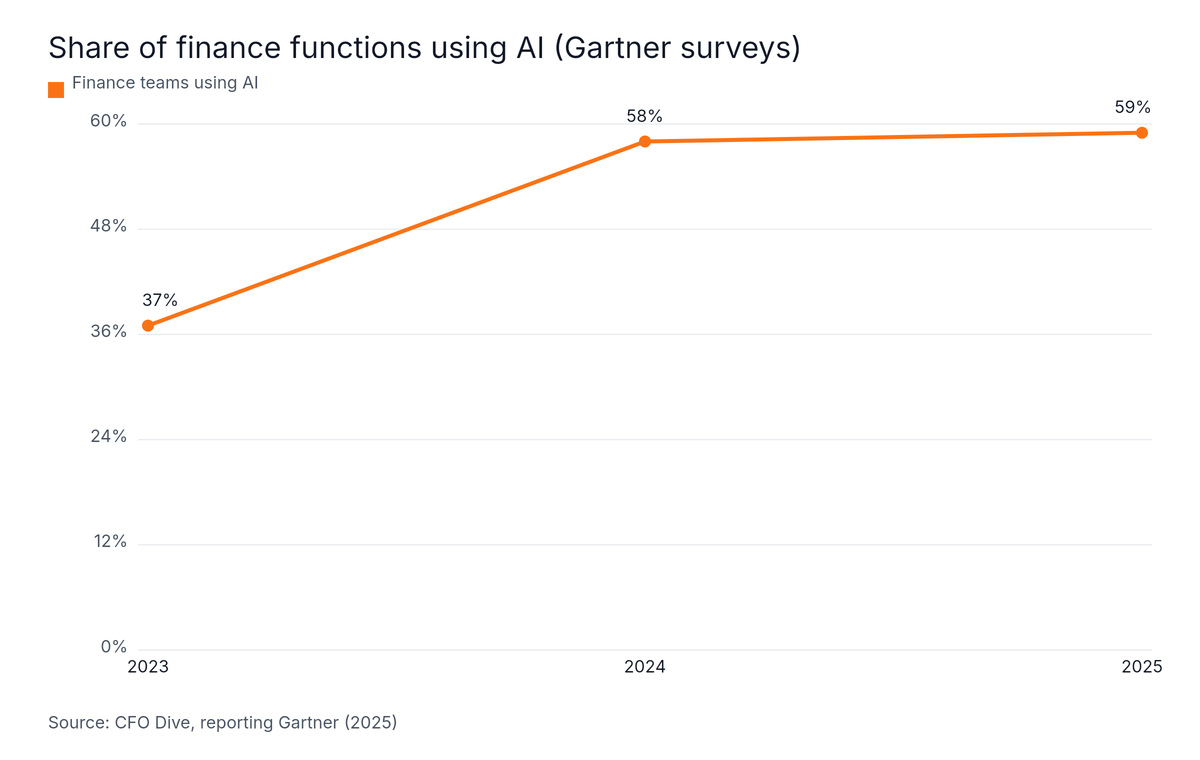
Adoption data shows how early most teams are. In Gartner's 2025 survey of 183 finance leaders, 59% used AI in finance, up from 58% a year earlier and 37% in 2023 (CFO Dive, 2025).
Line chart: Share of finance functions using AI (Gartner surveys). Highest: 2025 at 59%.
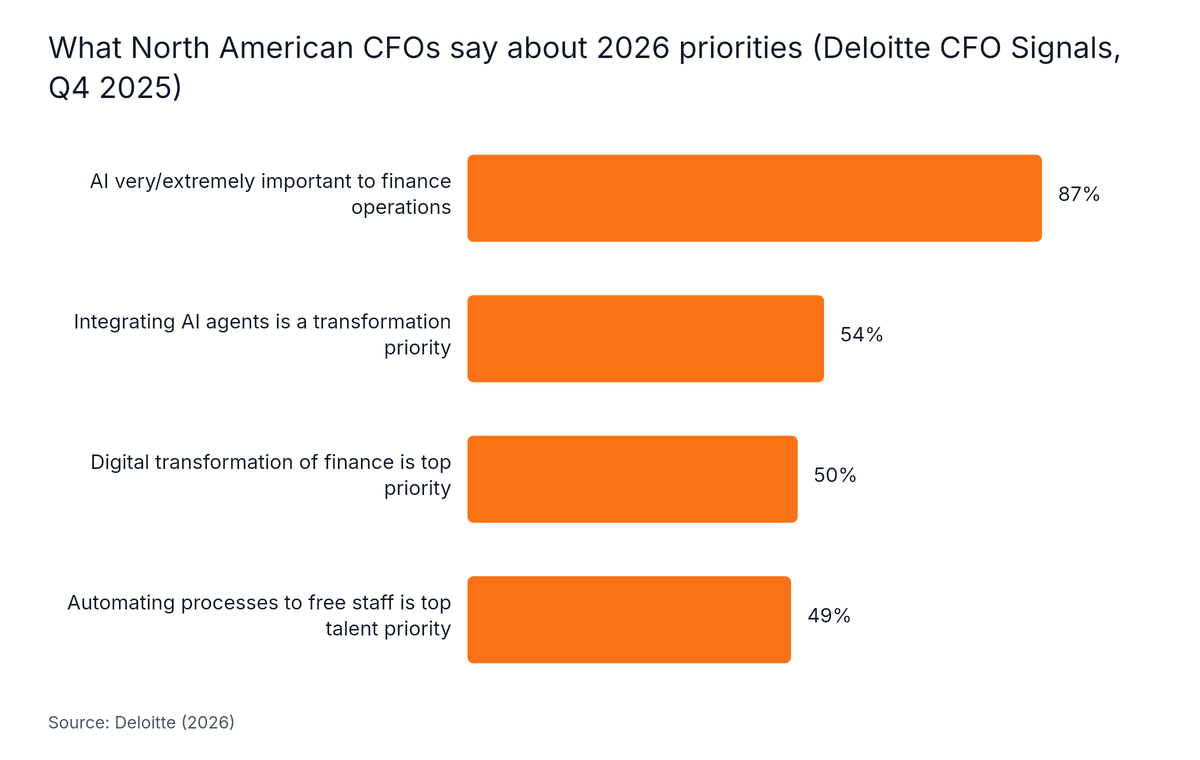
Marco Steecker of Gartner's finance practice described the context: "This growing confidence shows that even though the pace of AI adoption in finance has slowed due to complexity, data, and talent challenges" (CFO Dive, 2025). Intent is still strong. In Deloitte's Q4 2025 survey, 54% of CFOs said integrating AI agents into finance is a transformation priority for 2026 (Deloitte, 2026), and 87% rated AI very or extremely important to finance operations (Deloitte, 2026).
Horizontal Bar chart: What North American CFOs say about 2026 priorities (Deloitte CFO Signals, Q4 2025). Highest: AI very/extremely important to finance operations at 87%.
An accruals agent is not for finance teams with unreliable purchase order data, no written accrual policy or no named approver, because the agent can only apply rules that exist. It also pays off less where most of the balance is judgmental estimates, since a human owns those steps and the drafting saving is small.
Adoption is still early in some regions: 79% of Australian organisations are still in the early stages of exploring agentic AI (Workday, 2026). That supports starting small in a contained workflow.
Fit checks before starting:
No clean source data. If POs are raised after the work is done, the agent drafts from bad inputs.
Mostly judgmental accruals. Provisions and estimates stay with people.
No reviewer capacity. An agent that drafts faster than anyone can review only moves the queue.
This article describes a control design. The agent proposes and people decide. Posting rights, thresholds and sign-off stay with the finance function.
Frequently Asked Questions
Can an AI agent post month-end accrual journal entries without human approval?
An AI agent can technically post accrual entries without approval, but most finance teams should not allow it beyond low-value, rule-based recurring items. The controller sets the policy, and posting rights should be limited, logged and sampled. Judgmental estimates, first-time vendors and amounts above materiality should always route to a named approver before posting.
What is maker-checker control for AI in finance?
Maker-checker control means one party prepares a transaction and a different party approves it before it takes effect. When an AI agent is the maker, a named human is the checker. The agent drafts the accrual with its evidence, and the reviewer accepts, adjusts or rejects it, with that decision recorded.
What does an auditor expect in an AI audit trail for journal entries?
An external auditor expects to reproduce each entry from the record: the source data, the policy or prompt version, the model version, the calculation, any exception flags, the reviewer's identity and decision, a timestamp and the posting reference. Exact requirements vary by jurisdiction and audit firm, so the evidence list should be agreed with the auditor before go-live.
Does SOX or ICFR apply when an AI agent prepares or posts accruals?
If the entity is subject to SOX or an equivalent internal control over financial reporting (ICFR) regime, accruals prepared by an AI agent fall inside that scope and need the same controls as manual entries. COSO's February 2026 guidance on generative AI offers audit-ready control mapping (Journal of Accountancy, 2026). The external auditor confirms how it applies.
What materiality thresholds should trigger human review of an AI-proposed accrual?
No universal figure exists: the controller sets the materiality threshold for each entity, and the agent applies it as a routing rule. Entries above the threshold, first-time vendors and judgmental estimates go to a named approver before posting. The threshold should be written into the accrual policy and reviewed each period.
Conclusion
An AI agent can take the repeatable work out of month-end accruals. People keep the decisions that carry judgment or risk.
The agent owns data gathering, classification and rule-based drafting.
A named approver owns estimates, first-time vendors, amounts above materiality and cutoff disputes.
The audit trail records inputs, policy and model version, calculation, flags, reviewer decision, timestamp, posting reference and reversal link.
A pilot on one category, tracked by override rate, reviewer-change rate and accrual variance, shows when to widen scope.
Agents execute. GC Labs engineers make the decisions. For a manual finance workflow that needs the right approvals built in, Book a call ↗ and we will map the first safe scope together.