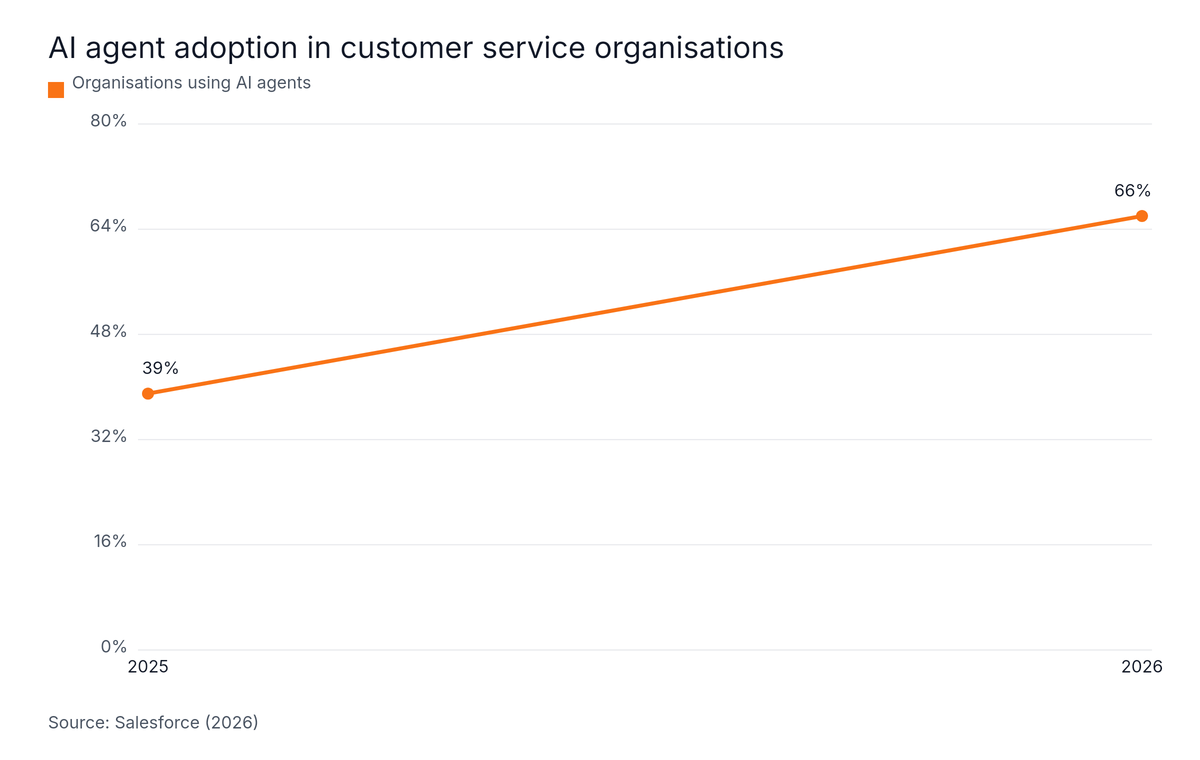
AI agents for customer success teams are software systems that carry out defined follow-up, renewal and routing tasks within limits a named person sets, while people keep account judgement, escalation and negotiation. Manual follow-ups pile up fast, because each reminder or check-in takes minutes and repeats across hundreds of accounts. Adoption is rising: AI agent use in customer service organisations went from 39% in 2025 to 66% in 2026 (Salesforce, 2026). Yet 74% of organisations that deployed customer-communications agents later rolled one back (Sinch, 2026). Grail Computer Labs, an applied-AI and digital product research lab, wrote this post to draw the line, and has published customer success workflow examples for scoping.
Key Takeaways
AI agents for customer success teams reliably own routine, rule-based work: follow-up sequencing, reminders, account summaries and churn-flag routing.
An autonomy ladder with three tiers (agent owns, agent drafts and a person approves, human only) sets where each customer success action sits.
Renewals and churn flags can be prepared and routed by an agent, but negotiation, escalation and pricing stay with a person.
74% of organisations that deployed AI customer-communications agents later rolled one back (Sinch, 2026), so guardrails come before launch.
Override rate, escalation accuracy, repeat-contact rate and renewal save rate show whether the agent-human boundary holds.
What can AI agents for customer success teams reliably handle without human error?
AI agents for customer success teams reliably handle bounded, rule-driven work: sequencing follow-ups, drafting renewal reminders, compiling account summaries and routing churn flags to a named owner. Among adopting service organisations, 70% see measurable value within 60 days (Salesforce, 2026). People keep account judgement, escalation and negotiation.
Renewal follow-up emails queued in sequence on a laptop beside a paper renewal calendar
An AI agent is software that carries out a defined task across systems, within permissions a person sets. "Without human error" is the wrong bar, because agents make errors too. The better bar is a task whose inputs are structured, whose output can be checked, and whose mistakes are easy to reverse.
Four task types meet that bar:
Follow-up sequencing. The agent schedules check-ins and reminders from contract dates and last-contact dates.
Account summaries. The agent pulls usage, open tickets and contract terms into one reviewable page before a call.
Ticket summaries and triage. The agent classifies requests and attaches context for the right team.
Churn-flag routing. The agent raises a flag and sends it to a named owner with evidence.
Adoption explains why teams are asking now. The share of customer service organisations using AI agents grew from 39% in 2025 to 66% in 2026, in a Salesforce survey of 3,075 customer service professionals (Salesforce, 2026). That is vendor research, so treat it as direction, not a benchmark.
Line chart: AI agent adoption in customer service organisations. Highest: 2026 at 66%.
Which customer success tasks should an agent own, draft or leave to a human?
An autonomy ladder is a three-tier rule set that fixes, per action type and account tier, whether a customer success agent acts alone, drafts for approval, or stays out. Routine reminders sit on tier one, renewal emails on tier two, and pricing, escalation and executive conversations on tier three.
Three-rung ladder diagram in blue tones showing agent-owned, agent-drafted and human-only actions
The human tier is not a stopgap. A Gartner survey found 85% of service and support leaders are expanding human agent responsibilities rather than cutting staff (Gartner, 2026). The ladder works on two axes: the action type and the value of the account. A reminder to a small account can run without review. The same reminder to a strategic account should be drafted and approved.
Account tier then moves each action up or down. For a low-value account, tier 2 work can often drop to tier 1 once the templates are proven. For a high-value account, even reminders can move to tier 2. We do not suggest automating tier 3 decisions.
Our data: In a one-week build of a human-reviewed know-your-transaction workflow for a Singapore-based neobank, GC Labs raised automated approvals from approximately 44% to approximately 90% in testing. It is transaction review, not customer success, but it shows the tier 1 and tier 2 split: the agent clears routine volume and people review the rest.
Can AI agents handle customer success renewals and flag churn risk, or do they still need a human for every account?
AI agents can prepare customer success renewals and flag churn risk, but they do not need to own every account. An agent can compile usage, open issues and contract dates, raise a churn flag and route it to a named owner. A person decides what to say and what to offer, which matters because 54% of customers trust humans more than AI for recommendations (Gartner, 2026).
A highlighted account card travelling along a track toward a named owner's desk
A churn flag is an alert that an account shows signals of leaving, raised for a named owner to review. Detection is the easy part. Routing decides whether the flag changes anything. Each flag should carry five fields:
The account and the signal. Which account, and what changed (for example, falling usage or an unresolved ticket).
The evidence. The data behind the signal, so the owner can check it in minutes.
A named owner. One person, not a shared inbox.
A response window. A time limit the team sets, with an automatic nudge when it passes.
A false-positive path. One action to mark the flag wrong, so the rule can be tuned.
Data quality is the precondition. If a product-usage feed has a gap, the agent never raises the signal, or raises it on the wrong account. The team should check the data behind each signal before trusting its flag.
The renewal itself follows the ladder. The agent assembles the renewal pack and drafts the reminder. The customer success manager reviews the pack, decides the offer and holds any negotiation. Negotiation and pricing stay on tier 3.
How common are AI agent rollbacks, and which limits reduce the risk?
AI agent rollbacks are common: 74% of organisations that deployed AI customer-communications agents later shut one down or rolled it back (Sinch, 2026), in a survey of 2,527 enterprise leaders. The survey reports how often it happens, not why. We recommend fixing limits on data, actions and audit trails before an agent contacts any customer.
A hand holding a large lever pulled back on a control panel in a dim operations room
The Sinch survey covered decision-makers at firms with 1,000 or more employees across 10 countries, fielded in January 2026. It is vendor-commissioned, so it is a signal, not a benchmark. Coverage of the study reports the rollback rate was 81% at firms with mature guardrails (The Register, 2026). Guardrails reduce risk. They do not remove it.
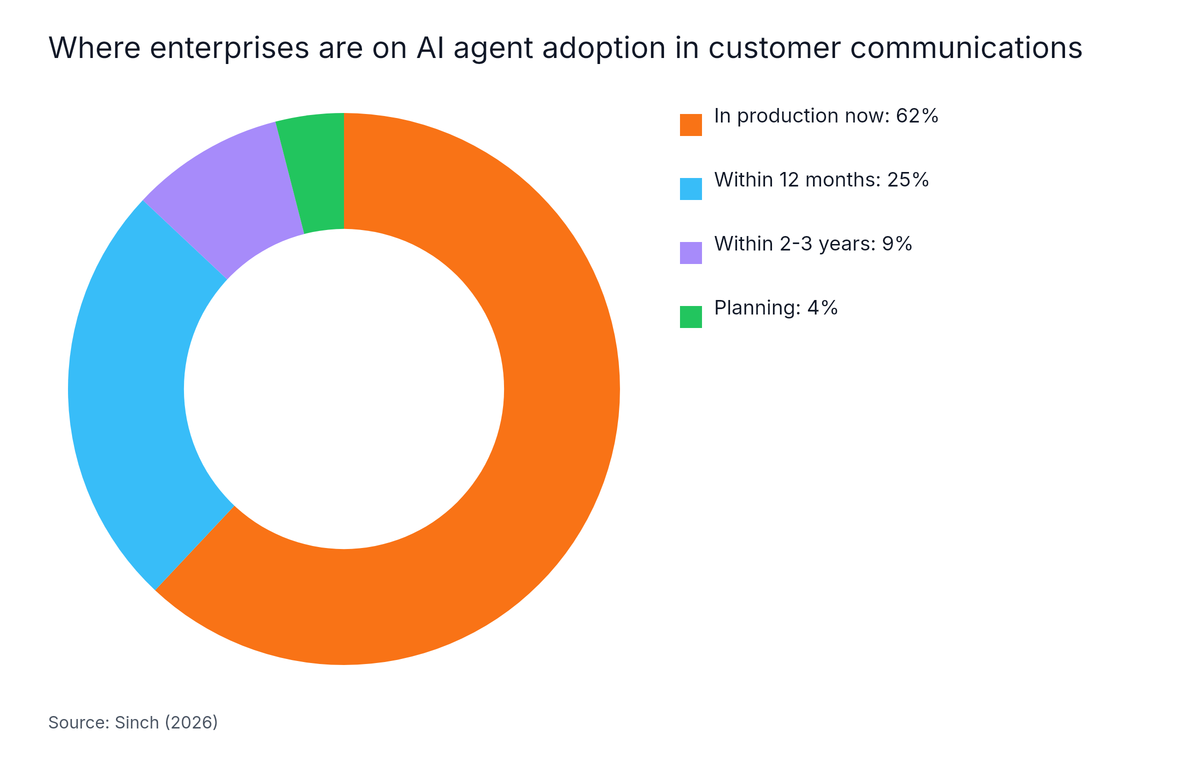
The same survey found 62% of organisations already have AI agents live in production across customer channels, and 88% expect to be there by the end of 2026 (Sinch, 2026). Production is common and rollback is common. Both are true at once.
Donut chart: Where enterprises are on AI agent adoption in customer communications. Highest: In production now at 62%.
These three limits are our recommendation for any customer success agent, not a finding of the survey:
Personal data: limit the fields an agent can read to what the task needs.
Invented answers: restrict customer-facing text to approved templates and checked account facts.
Audit trails: record every action the agent takes, with the data it used.
How are human-in-the-loop checkpoints set for customer success agents?
Human-in-the-loop is a design in which a named person reviews or approves an AI agent's action before it takes effect. In customer success, set checkpoints at customer-facing messages, pricing, escalation and exceptions, then track how often people override the agent. Singapore's IMDA framework for agentic AI, launched in January 2026, names human accountability as a core control (Baker McKenzie, 2026).
A finger tapping the approve button on a tablet showing a draft customer message
The IMDA Model AI Governance Framework for Agentic AI covers risk bounding, meaningful human accountability, technical controls and end-user responsibility. A May 2026 update (v1.5) added methods to reduce automation bias, such as monitoring human override rates. Automation bias is the habit of accepting a machine's output without checking it. Customers push the same way: they expect a route to a human agent when companies use AI (Gartner, 2026).
Put checkpoints in four places:
Before any customer-facing send on tier 2 accounts.
Before any change to price, terms or commitments.
On any exception the agent's rules do not cover.
On any escalation signal, such as a complaint or an executive contact.
Then measure the boundary. Override rate is the share of agent actions a person changes or reverses.
Metric
What it shows
What to do when it moves
Override rate
How often people correct the agent
A rising rate means retune the rules or pull the action back to tier 2
Escalation accuracy
Whether escalated accounts truly needed a person
Low accuracy means tighten escalation triggers
Repeat-contact rate
Whether customers return with the same issue
A rising rate means the agent's follow-ups are not resolving anything
Renewal save rate
Whether flagged accounts are retained
A flat rate means flags arrive too late or reach the wrong owner
Who should not use AI agents for customer success yet?
AI agents for customer success teams are a poor fit where account data is unreliable, where one person already knows every customer, or where renewals turn on negotiation. In those cases an agent adds review work without removing follow-ups. Also, 54% of customers trust humans more than AI for recommendations (Gartner, 2026).
Four limits are worth stating plainly:
Thin or inconsistent data. An agent cannot flag a signal it never receives.
Small, relationship-led portfolios. A manager with a short account list gains little from automation.
Regulated communications. Fee, renewal, health and financial messages carry compliance risk and need approval and audit evidence on every send.
Multi-party platforms. Where one customer success owner serves workers, employers and clients at once, a single flag may need three different owners.
One limit applies to this article. The adoption and rollback figures come from vendor-commissioned surveys. They describe what organisations report, not what any single agent achieves in a given stack.
Frequently Asked Questions
Can AI agents handle customer success renewals and flag churn risk, or do they still need a human for every account?
AI agents can prepare routine renewals and flag churn risk, but they do not need to own every account. An agent can compile usage, open issues and contract dates, then route a flag to a named owner. A person should still handle negotiation, escalation and any high-value or sensitive account.
Which customer success tasks can AI agents fully own today?
AI agents can fully own low-risk, rule-based customer success tasks: scheduling follow-up sequences, sending approved reminder templates, summarising tickets, preparing account summaries and routing churn flags. Anything that changes price, commits the company or reaches an executive contact should be drafted by the agent and approved by a person.
Can AI agents negotiate renewals or pricing?
AI agents should not negotiate renewals or pricing without a person in control. Negotiation depends on account judgement, relationship history and commercial authority that an agent does not hold. An agent can prepare the brief, usage evidence and options, while a customer success manager makes and delivers the offer.
Will AI agents replace customer success managers?
AI agents are more likely to change customer success work than remove it. A Gartner survey published in April 2026 found 85% of service and support leaders are expanding human agent responsibilities rather than cutting staff (Gartner, 2026). Agents take repeatable follow-ups, and managers spend the freed time on judgement, escalations and relationships.
Conclusion
Agents execute. Humans decide. That split lets customer success teams clear their follow-ups without handing over the accounts that need a person.
Five takeaways:
Give agents routine work: sequencing, reminders, summaries and flag routing.
Use an autonomy ladder tied to action type and account tier.
Route every churn flag to one named owner with evidence and a response window.
Set limits on data, actions and audit trails before launch, since 74% of organisations that deployed customer-communications agents later rolled one back (Sinch, 2026).
Track override rate, escalation accuracy, repeat-contact rate and renewal save rate.
The next step is small. List the ten most frequent follow-up tasks and place each on the ladder before building anything. To talk through that first scope, Book a call ↗.