Last updated: Nov 25, 2026
What Are AI Agents Actually Doing Inside Fintech Operations Today?
By Shiva Mangal, Founder, Grail Computer Labs · 28 October 2026

What AI agents do in fintech operations today: adoption data from the Bank of England and Cambridge, invoice-matching steps, and where humans stay in control.
Last updated: Nov 25, 2026
By Shiva Mangal, Founder, Grail Computer Labs · 28 October 2026
How software development project rescue works: triage, codebase inheritance, outcome agreement, stabilisation and release, anchored in a real 30-day case.

Enterprise AI guardrails explained: instruction-based vs architecture-based controls, plus a go-live checklist for data access, action scope and fallback.

A legacy system is software that is hard to change safely. See the warning signs, the improve-or-rebuild test and a phased migration plan for real platforms.
Request a quote and our experts will contact you within 24 hours with tailored solutions and pricing.
You can also send us a quick email at [email protected].
AI agents in fintech operations are software systems that read records, match them across systems, flag exceptions and prepare actions, mostly as decision support while humans approve anything that moves money. The picture is less dramatic than the headlines. On 26 October 2026 the Bank of England and the FCA reported that most deployments are narrow and supervised (Bank of England and FCA, 2026). This article covers what agents do today, how much autonomy firms allow, how invoice and payment matching works step by step, and what regulators in Singapore and Australia expect.
Key Takeaways
- AI agents in fintech operations are mainly back-office tools: 79% of surveyed financial-services organisations report process automation at pilot stage or beyond (Cambridge CCAF, 2026).
- Autonomy is limited: only 2% of UK firms report AI agents with broad autonomy (Bank of England and FCA, 2026).
- Invoice matching by an AI agent follows eight steps, and humans keep control of exceptions and payment release.
- Regulators such as MAS and APRA expect firms to stay accountable for AI agent actions, so audit logs and agent access controls are operating requirements.
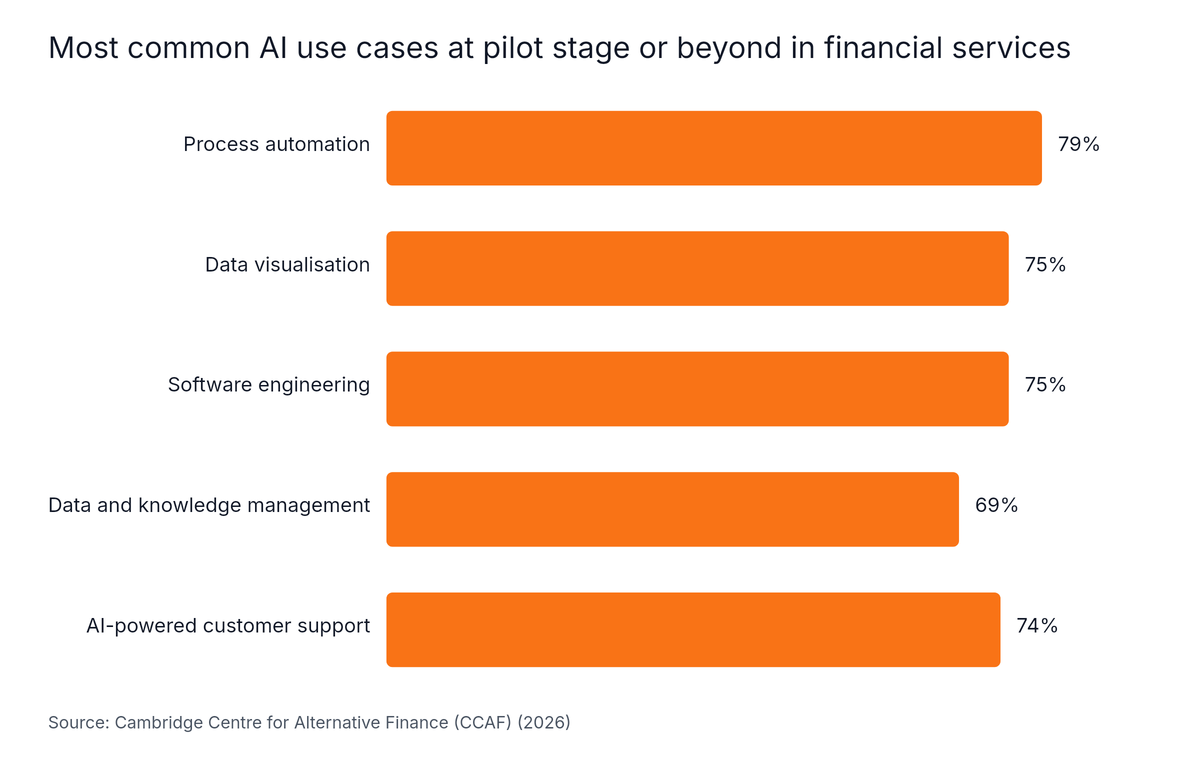
AI agents in fintech operations mostly handle back-office work today: process automation, reconciliation, onboarding checks and fraud triage. In the 2026 Cambridge Centre for Alternative Finance survey of 628 organisations, process automation led at 79% of firms at pilot stage or beyond, ahead of AI-powered customer support at 74% (CCAF, 2026).
Source: Cambridge Centre for Alternative Finance (CCAF), 2026
An AI agent is a software system that reads records, decides on a next step and prepares or takes an action inside a defined permission boundary. Adoption is broad. The Bank of England and FCA found that 80% of surveyed UK financial firms have agents deployed, and a further 14% plan to deploy within 12 months (Bank of England and FCA, 2026). The survey is self-reported and most findings come from 105 firms, so it describes participating firms, not the whole market.
The regulators summarise it in one line: "AI agent deployment is widespread, but autonomy is limited." (Bank of England and FCA, 2026). Accenture's Andrew Young describes the working pattern: "Leading banks are deploying AI agents across operations, where they work alongside employees and independently handle defined tasks" (CIO Dive, 2026).
Regulated financial firms give AI agents limited autonomy. In the Bank of England and FCA survey published on 26 October 2026, 80% of UK firms report agents in production for decision support, where the agent recommends and a human decides, while only 2% report broad autonomy (Bank of England and FCA, 2026).

Decision support is a deployment pattern in which the agent recommends and a human decides and executes. The table summarises where UK firms sit.
| Autonomy pattern | What the agent does | UK survey evidence (2026) |
|---|---|---|
| Decision support | Recommends; a human decides and executes | 80% have agents in production |
| Broad autonomy | A survey category; the survey's own definition applies | 2% report it |
| High-consequence actions | Approves or declines customer outcomes, executes trades, moves payments, changes limits | No more than 9%, including planned deployments |
| Customer communications | Automated messages to customers | 16% now; 34% including planned |
The 9% ceiling is the most useful number for an operations leader. Even counting deployments planned over the next 12 months, no more than 9% of firms expect agents to do any of the following (Bank of England and FCA, 2026):
The autonomy categories can overlap, so treat the table rows as indicative, not additive.
AI agents follow eight steps to match invoices automatically: ingest, extract, look up the vendor and purchase order, match within a tolerance, classify exceptions, route them to a person, post approved items and log everything. This is how AI agents automate invoice reconciliation, and humans keep every exception and any payment release.

An exception rate is the share of invoices that fail automatic matching and need a person. Exceptions are where the effort and cost sit.
Benchmark context: Ardent Partners' 2026 analyst survey found Best-in-Class accounts payable teams (the top 20% of enterprises on cost and cycle time) have per-invoice costs 79% lower and exception rates 47% lower than peers (Ardent Partners, 2026). The survey covers AP teams in general, not AI agents. It shows why exception handling is the step to design first.
Straight-through processing (STP) is the share of items that complete without a human touching them. We found no primary-source benchmark for invoice-matching STP, and vendor-quoted figures are not independent. Teams should measure STP on their own invoices before setting a target. The Grail Computer Labs invoice reconciliation workflow page shows one staged-queue design.
| Exception | What the agent does | Who decides |
|---|---|---|
| Price or quantity mismatch outside tolerance | Shows PO, invoice and receipt lines side by side; proposes a resolution | Buyer or AP analyst |
| Missing PO number | Searches by vendor, amount and date; suggests candidates | Budget owner |
| Changed vendor bank details | Holds the item and flags the change | Finance controller |
| Tax edge case | Attaches the invoice and tax fields | Tax or finance lead |
| Any payment release | Stages the approval pack | Named approver |
AI agents reconcile payments and ledger entries by pulling records from two systems, such as a wallet ledger and a bank statement, matching them on amount, date window and reference, grouping breaks by cause and passing unclear ones to an analyst. The packet of survey data does not size this use case, so this section describes the mechanism, not adoption.
The flow mirrors invoice matching, with a ledger and a bank feed in place of an invoice and a PO:
Our data: Grail Computer Labs built and deployed eight transaction checks for a Singapore-based neobank, live in under 30 days. In a separate human-reviewed know-your-transaction (KYT) workflow, a one-week build raised automated approvals from approximately 44% to approximately 90% in testing. Before that build, a transaction review took 30+ minutes.
Those results come from testing in one client's environment. They show the pattern, not a market average.
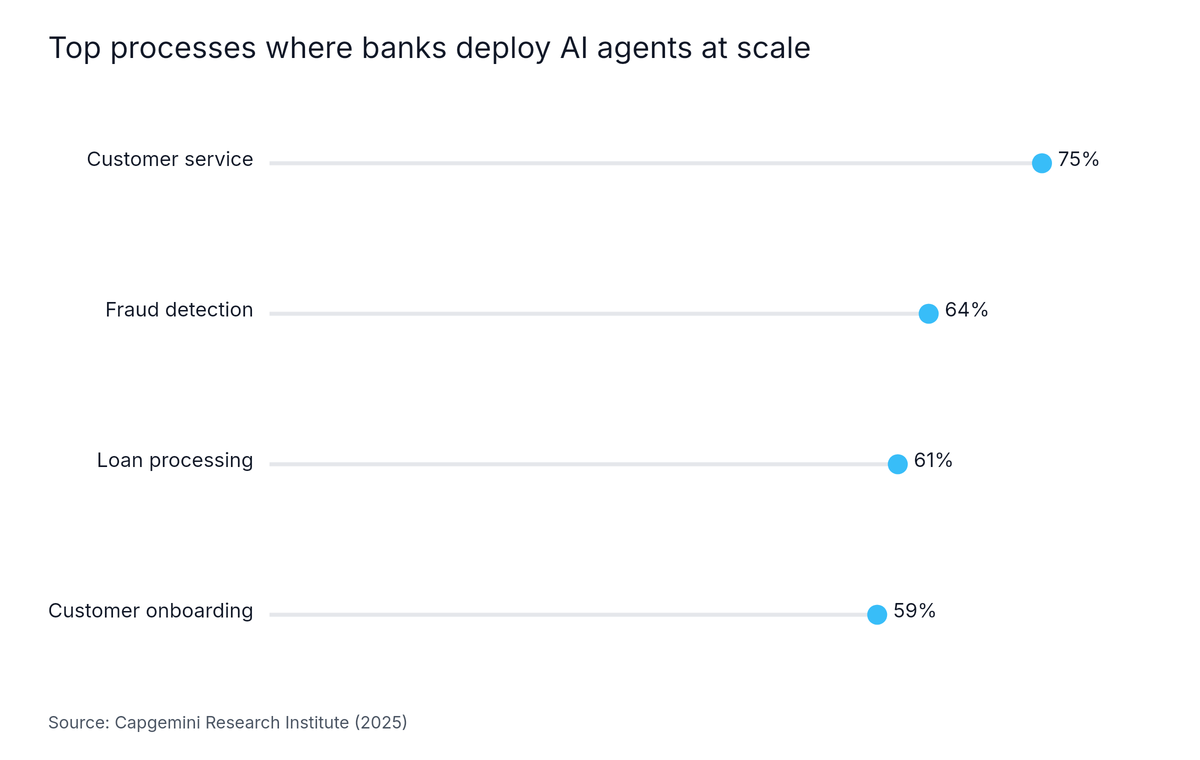
Beyond reconciliation, agents work on fraud detection, loan processing, customer onboarding and customer service. Capgemini's 2025 survey of 1,100 financial institution leaders found banks deploying agents at scale in customer service (75%), fraud detection (64%), loan processing (61%) and customer onboarding (59%) (Capgemini Research Institute, 2025).
Source: Capgemini Research Institute, 2025
Customer messaging is growing but is still a minority use. The Bank of England and FCA found that 16% of UK firms use agents for automated customer communications today, rising to 34% when planned deployment is included (Bank of England and FCA, 2026).
Regulators in Singapore and Australia expect firms to stay accountable for AI agent actions under existing and new rules. The Monetary Authority of Singapore (MAS) issued final AI risk management guidelines on 7 October 2026, effective 7 October 2027 (MAS, 2026). APRA's April 2026 letter said CPS 230 and CPS 234 already apply.

| Regulator | Date | What it says |
|---|---|---|
| MAS | 7 Oct 2026 | Final AI risk management guidelines cover agentic AI; effective 7 Oct 2027, phased to 7 Oct 2028. Boards oversee AI risk and firms keep an AI inventory (MAS, 2026) |
| MAS (SAFR) | Jul 2026 | White paper on how agent actions are authorised, when human oversight triggers and what is recorded; MAS did not commit to making it mandatory (MAS, 2026) |
| APRA | 30 Apr 2026 | As reported by Corrs: governance and assurance are not keeping pace; CPS 230 and CPS 234 already apply (Corrs, 2026) |
| FCA | 20 Oct 2026 | As reported by Trade2Spike: applies existing rules such as Consumer Duty and the Senior Managers regime to AI use (Trade2Spike, 2026) |
Agent identity is a control that operations teams often miss. A non-human identity is a credential and permission set issued to software, such as an AI agent, rather than to a person. APRA's letter said: "Identity and access management capabilities have not adapted to nonhuman actors like AI agents." (AegisIQ, 2026).
We recommend giving each agent a named identity with least-privilege access. In Grail Computer Labs' own engagements, access can begin read-only, an access plan is shared upfront, and agent traces are recorded.
AI agents in fintech operations are a poor fit where records are unreliable, owners are unnamed, or the action moves money without a human check. Even counting planned deployments, no more than 9% of UK firms expect agents to initiate, execute or block payments (Bank of England and FCA, 2026).

Governance often trails deployment. A Cloud Security Alliance report found 62% of financial institutions already deploy AI agents, with governance maturity lagging (Cloud Security Alliance, 2026). A vendor commissioned it and the page shows no sample size, so treat it as directional.
Teams should wait before deploying an agent if:
We build with humans in the loop: agents execute, engineers and finance owners decide. That is a design choice, and it costs some speed.
AI agents match invoices in eight steps: ingest the invoice, extract its fields, look up the vendor and purchase order, compare amounts within a set tolerance, classify any exception, route it to a person, post only approved items, and write an audit log. Humans decide the exceptions and any payment release.
Invoice exceptions that involve a missing purchase order, a changed vendor bank detail, a tax treatment question or a payment release should always go to a human. Each can move money or create legal exposure, so the AI agent should stage the evidence and a recommendation while a named person decides.
Regulated financial firms give AI agents limited autonomy. The Bank of England and FCA's 2026 survey found 80% of UK firms have agents in production for decision support, where a human decides and executes, while only 2% report broad autonomy (Bank of England and FCA, 2026). No more than 9% expect agents to initiate or block payments.
Teams should record each input, the source record used, the action proposed or taken, the rule that triggered human review, and the approval decision. This is recommended practice, not a regulatory list. MAS's July 2026 SAFR white paper covers how agent actions are authorised, when human oversight triggers, and what is recorded.
AI agents in fintech operations are useful, narrow and supervised today. The Bank of England and FCA found that only 2% of UK firms report broad autonomy, while 80% run agents in production for decision support (Bank of England and FCA, 2026). Let the agent match and stage, and keep a named person on every payment, limit and customer outcome.
If a manual finance workflow is your bottleneck, Grail Computer Labs can map it and automate it with human approvals where judgement sits. Book a call ↗
© 2026 Grail Computer All rights reserved.