Best AI Integration Service for Deal Teams: What to Test Before You Commit
By Shiva Mangal, Grail Computer Labs. Updated 28 October 2026.
The best AI integration service for deal teams is a partner that proves how it handles confidential data, restricts access per deal, logs every output, and agrees a measurable outcome before work starts, not just a vendor with a strong demo. Most teams skip that test. In Deloitte's 24th Fair Valuation Pricing Survey (October 2026), only 10% of fund groups using AI in valuation had established vendor due diligence processes, and 39% had no formal AI governance (InvestmentNews, reporting Deloitte, 2026). Deal data is confidential, the stakes are high, and most integrations are built for generic enterprise workflows. This guide sets out seven tests to run before signing, a jurisdiction check, and a template for defining the outcome first.
Key Takeaways
A PE deal team should test an AI integration partner on seven things: data flow, residency, access control, audit logging, accuracy, outcome definition and exit terms.
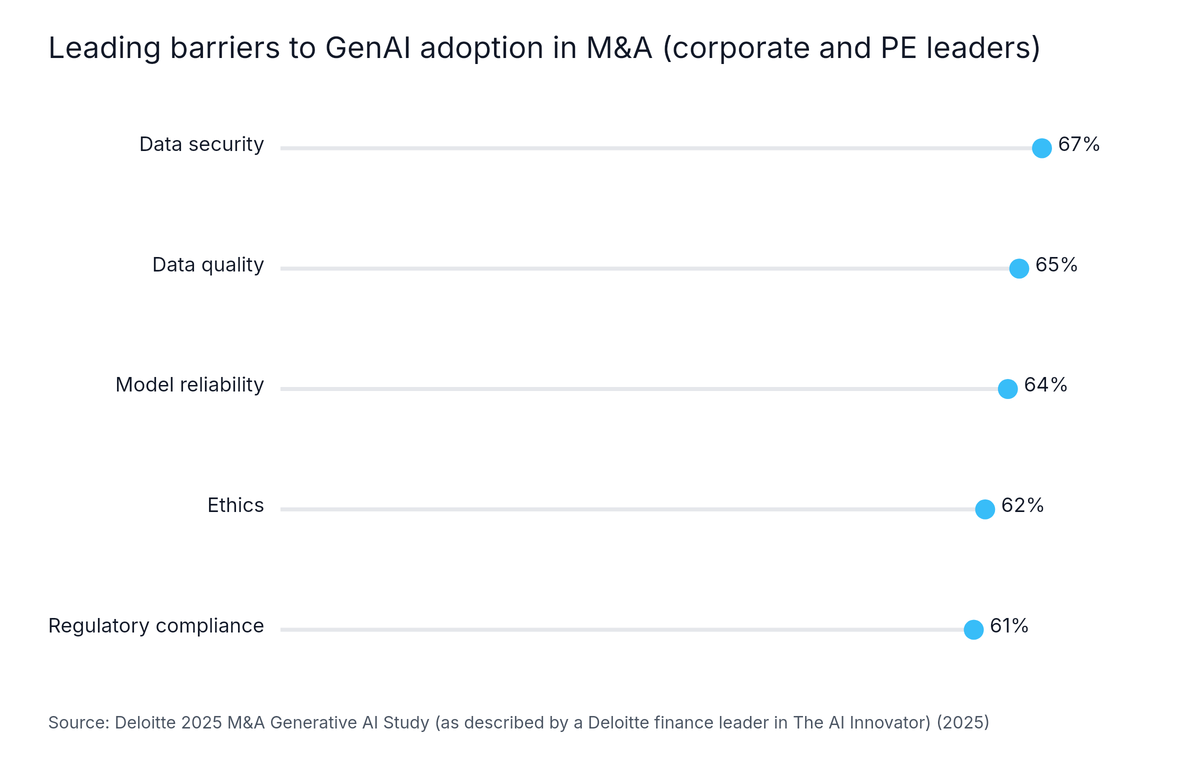
Data security is the most-cited barrier to GenAI in M&A, at 67% of corporate and PE leaders (The AI Innovator, reporting Deloitte, 2026), so a data flow diagram naming every model host is the first document to request.
An AI engagement needs a baseline, one metric, a named owner, an evidence standard, a stop or go gate and exit terms agreed before work starts.
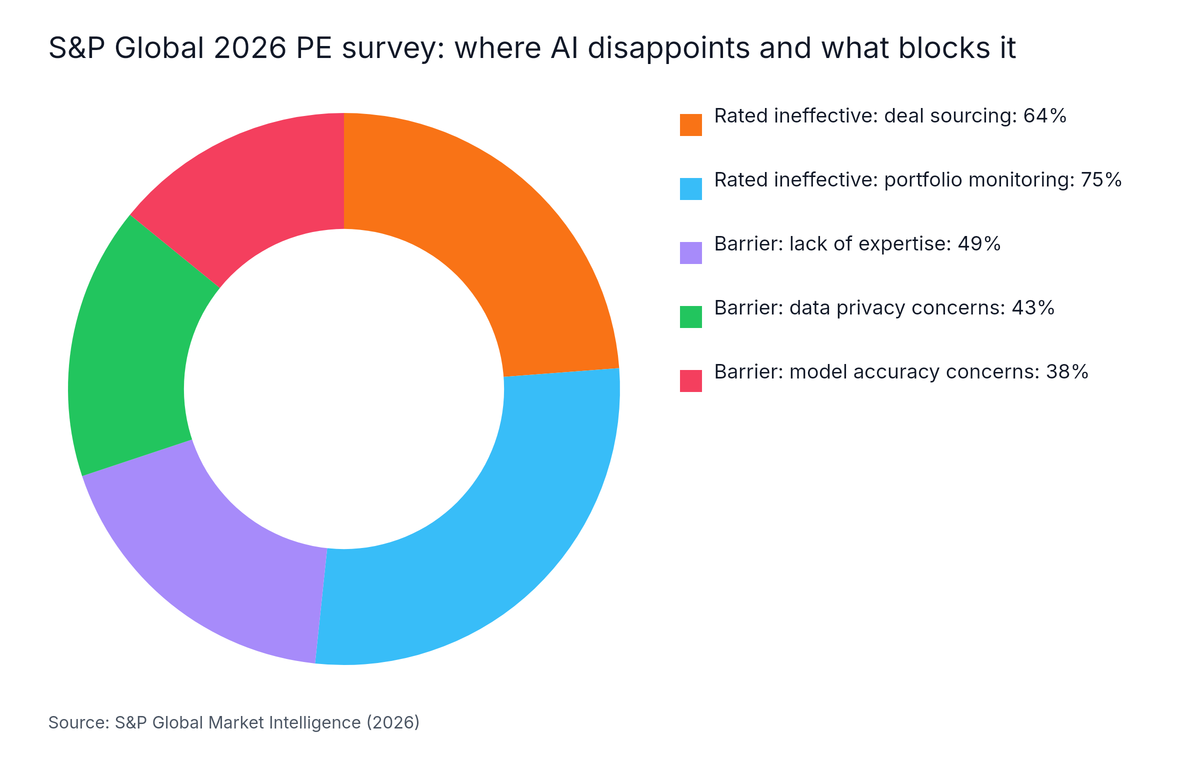
AI in private equity is most integrated in due diligence (31% of GPs) and least trusted for portfolio monitoring (75% rate it ineffective), per S&P Global Market Intelligence (2026).
What should a PE deal team test an AI integration partner on?
A PE deal team should test an AI integration partner on seven things: data flow, residency, access control, audit logging, accuracy, outcome definition and exit terms. Each test should produce a document the team can file, not a verbal assurance. In Deloitte's October 2026 survey, only 10% of fund groups using AI in valuation had established vendor due diligence processes (InvestmentNews, 2026).
Two deal team members reviewing a printed data flow diagram with sticky notes in a meeting room
An AI integration partner is a firm that connects AI to a team's documents, systems and approvals and runs it in production. An AI tool is a licensed product. A tool vendor answers for its software. A partner also answers for how confidential data moves through that software, so the partner needs its own test.
The seven tests, in the order to run them:
Data flow
Residency
Access control
Audit logging
Accuracy
Outcome definition
Exit terms
#
Test
Ask the partner for
Passing evidence
1
Data flow
A diagram of every hop a document takes
Every model host and sub-processor named
2
Residency
Storage, processing and retention locations
Regions written into the contract
3
Access control
Per-deal ring-fencing and role-based access
A seeded cross-deal query returns nothing
4
Audit logging
An export of the log for one query
Prompt, source, model version, user and deal ID present
5
Accuracy
A seeded-error test on a historical data room
A pass threshold agreed before the test
6
Outcome definition
Written acceptance criteria
Baseline, metric, owner and stop or go gate
7
Exit
A kill switch and data destruction procedure
Written destruction proof, plus code and models handed over
The first three tests decide whether the partner can touch the data at all. The last four decide whether the work is worth the risk.
How do you test data residency and confidentiality?
Data residency is the location where data is stored, processed and accessed, including by sub-processors and model hosts. To test it, ask the partner for a data flow diagram that names every hop a document takes and every party that touches it. Data security is the most-cited barrier to GenAI in M&A, at 67% (The AI Innovator, reporting Deloitte, 2026).
A lawyer and an operating partner reading a confidentiality agreement together at a table
The same Deloitte survey of 1,000 senior corporate and PE leaders put data quality at 65%, model reliability at 64%, ethics at 62% and regulatory compliance at 61% (The AI Innovator, reporting Deloitte, 2026). Confidentiality sits at the top of the list, ahead of accuracy.
Lollipop chart: Leading barriers to GenAI adoption in M&A (corporate and PE leaders). Highest: Data security at 67%.
Which sub-processors and model providers touch the data, by name?
What does each party retain, and for how long?
Is any client content used to train a model?
Vague answers fail. A reasonable answer is deployment in the client's own cloud or a private cloud, under the client's security policies, with zero data retention where required and secrets masked before they reach an agent.
Check the NDA and MNPI exposure
MNPI is material non-public information, which is information about a company that is not public and could move its share price. A deal NDA may not permit sending target documents to a model provider. Ask counsel to review the partner's model host list against the NDA before any document is uploaded.
Privacy worries are common. In S&P Global Market Intelligence's April 2026 survey, 43% of GPs cited data privacy concerns as a barrier to AI, behind lack of expertise (49%) and ahead of model accuracy (38%) (S&P Global Market Intelligence, 2026).
Map the jurisdiction rules
Residency rules differ by market. This table summarises what the sources below report, as of October 2026. It is not legal advice.
Jurisdiction
What applies
What to ask the partner
Singapore
The PDPA imposes no explicit data localisation requirement and there is no AI-specific legislation (Chambers, 2026). MAS issued final AI Risk Management Guidelines on 7 October 2026, effective 7 October 2027, and financial institutions remain accountable for third-party AI (LeapRate, 2026).
Which contractual transfer safeguards and sub-processor disclosures the firm receives, and what assurance it can show a regulator.
Australia
APP 8 keeps the discloser accountable for overseas recipients, and APRA CPS 230 extends obligations to material service providers including AI vendors, per a secondary source (Neomeric, 2026). Verify against APRA and the OAIC.
Whether any model host is overseas, and how supplier obligations flow into the contract.
EU
The EU Digital Omnibus on AI moved Annex III high-risk obligations to 2 December 2027, while Article 50 transparency obligations were not delayed (Legal 500, 2026).
Which use cases a regulator could treat as high-risk, and how the partner supports the logging that follows.
What access controls and audit trails should a partner prove?
An audit trail is a tamper-evident record of each AI query: the prompt, the sources retrieved, the model version, the user and the deal ID. A partner should prove it by exporting the log for one seeded query, and prove access controls by showing that one deal's team cannot retrieve another deal's documents. Among fund groups, 39% report no formal AI governance (InvestmentNews, 2026).
A security engineer pointing to a printed audit log on a desk while a deal lead takes notes
Test the access controls
Run these four checks in a live environment, not a slide deck:
Ring-fencing: upload a marker document to Deal A, then query from a Deal B account. The answer must show nothing from Deal A.
Role-based access: confirm an associate cannot see what a partner can see, and that a leaver's access ends the same day.
Read-only first: the partner's agent should start with read-only access, with the access plan shared upfront.
Approval gates: high-risk actions, such as sending a document outside the deal team, should wait for a named human approval.
Rules written into an agent's instructions are not controls. They are instructions, not boundaries. Ask what makes the forbidden action physically impossible.
Check what the log holds
The log should record the prompt, the retrieved source, the model version, the user and the deal ID. Ask four more questions: how long logs are retained, whether they can be altered, whether they export in a readable format, and whether agent traces are recorded. LPs, regulators and sellers may each ask for them. The EU AI Act high-risk date of 2 December 2027 and MAS lifecycle controls both make logging easier to defend when it exists from day one.
How should you define the outcome before the engagement starts?
An outcome definition for an AI engagement should state six things in writing before any work begins: a baseline, one metric, a named owner, an evidence standard, a stop or go gate and exit terms. Because 81% of PE firms expect measurable GenAI returns within one to three years (Deloitte, PR Newswire, 2025), an open-ended pilot cannot meet that clock.
Three colleagues around a whiteboard filling in a table of baseline, metric, owner and gate
Acceptance criteria are the written conditions a deliverable must meet before the client pays for it or moves to the next phase. Use this template.
Element
What to write
Example
Baseline
The current measured state
Manual review takes 30+ minutes per item
Metric
One number that defines success
Share of items approved automatically
Owner
A named person on the client side
The operating partner's delegate
Evidence standard
How the number is measured
A held-out sample, checked by a human reviewer
Stop or go gate
The date and threshold for a decision
Stop at day 15 if the metric is below target
Exit terms
What the client keeps and what is destroyed
Code, models and documentation handed over, data destroyed with written proof
The need is real. FTI Consulting's 2026 Private Equity AI Radar found that 95% of funds report meeting or exceeding the business case, yet only 17% say AI initiatives significantly exceed it (FTI Consulting, 2026). A business case that is never quantified up front cannot be tested.
Our data: Grail Computer Labs reports that a one-week build of a human-reviewed know-your-transaction (KYT) workflow raised automated approvals from approximately 44% to approximately 90% in testing for a Singapore-based neobank. The baseline was a manual review process taking 30+ minutes per review.
To test a partner against this template on a live workflow, Book a call ↗ with Grail Computer Labs. The team agrees one pre-defined outcome first, delivers it in 4 to 8 weeks, and starts with a 15-day trial with no payment commitment.
Where does AI work in diligence, and where does it fall short?
Due diligence is the PE function with the most AI integration, yet only 31% of GPs report it as somewhat or fully integrated, while 75% rate AI ineffective for portfolio monitoring and 64% for deal sourcing (S&P Global Market Intelligence, April 2026). A partner's first pilot should therefore target document-heavy diligence tasks and treat portfolio monitoring claims sceptically.
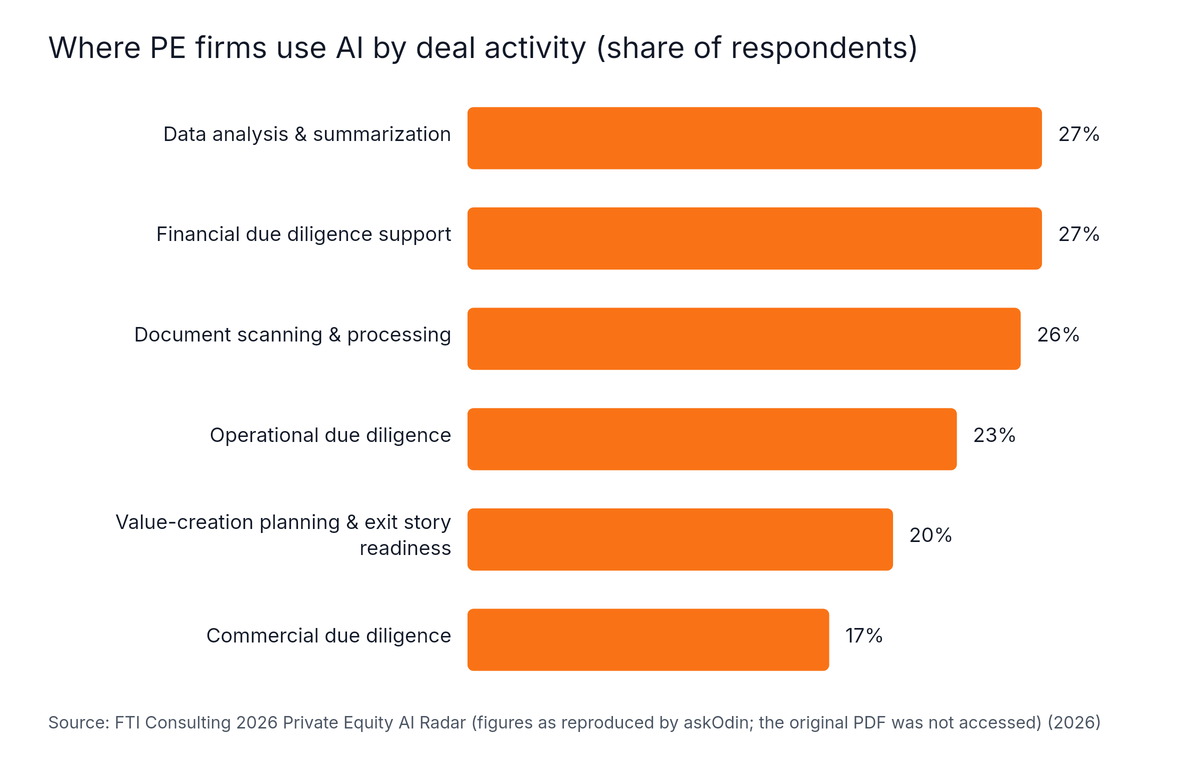
Horizontal Bar chart: Where PE firms use AI by deal activity (share of respondents). Highest: Data analysis & summarization at 27%.
FTI Consulting's 2026 Private Equity AI Radar reports where firms use AI by deal activity: data analysis and summarisation and financial due diligence support at 27% each, document scanning and processing at 26%, operational due diligence at 23%, value-creation planning and exit story readiness at 20%, and commercial due diligence at 17% (FTI Consulting, 2026). Each figure is a share of respondents, so no single activity dominates.
Treat portfolio operations as a separate test
Portfolio operations are harder. The same FTI research (May 2026) found only 36% of portfolio companies use AI day to day and 7% are at enterprise scale (FTI Consulting, 2026). Ask the partner for a portfolio-operations result with a baseline and a metric, not a diligence demo.
Weigh the barriers that apply to partner choice
In the S&P Global Market Intelligence survey, lack of expertise (49%), data privacy concerns (43%) and model accuracy (38%) were the top barriers (S&P Global Market Intelligence, 2026). FTI's separate survey of 200 PE decision-makers found a shortage of AI and IT specialists at 35%, data quality and availability at 33% and integration into existing IT systems at 28% (FTI-Andersch, 2026). Deloitte's Erik Dilger called generative AI in dealmaking "still early innings for the technology" (Deloitte, PR Newswire, 2025).
Donut chart: S&P Global 2026 PE survey: where AI disappoints and what blocks it. Highest: Rated ineffective: portfolio monitoring at 75%.
Some of the work is diligence of the target, not diligence with AI. PE leaders now weigh a target's AI maturity: 67% say AI talent and technical teams are important or critical, and 57% say the same of data assets and AI infrastructure (FTI Consulting, 2026).
Limitations: who this scorecard is not for
The scorecard in this guide suits PE deal teams and operating partners who can set confidentiality and acceptance standards before a pilot starts. It does not suit teams that need a certified partner on day one: Grail Computer Labs (GC Labs) holds no SOC 2, ISO 27001 or HIPAA certification, and teams that require one should rule GC Labs out early.
A PE operating partner reading a printed risk checklist alone at a cafe table
Four more limits apply:
Survey figures are directional. The S&P Global and Deloitte valuation figures come from surveys whose sample sizes were not shown in the sources reviewed. The FTI percentages for deal activities were reproduced by a third party, and the original report was not reviewed.
The numbers are not like-for-like. FTI's 95% and 17% describe funds. The 36% and 7% describe portfolio companies. Do not combine them.
Jurisdiction notes are a starting point. The Australian points come from a secondary source. UAE, UK, Canada, German and Swiss residency rules were not reviewed. Take legal advice.
A test shows evidence, not safety. Passing all seven tests lowers risk. It does not remove it.
Frequently Asked Questions
Is it safe to upload confidential deal documents to an AI tool?
Uploading confidential deal documents to an AI tool is safe only when the deployment keeps documents in an environment the firm controls, the partner names every model host and sub-processor, and the firm's NDA permits disclosure to them. Data privacy concerns are a barrier to AI for 43% of GPs (S&P Global Market Intelligence, 2026). Get the data flow diagram and counsel's NDA review in writing first.
Does Singapore require AI data to stay in Singapore?
Singapore does not require AI data to stay in Singapore. The PDPA imposes no explicit data localisation or residency requirement, and there is no AI-specific legislation (Chambers, 2026). The PDPA still applies across the AI lifecycle, so contractual transfer safeguards and sub-processor transparency matter. Financial institutions also face MAS's AI Risk Management Guidelines, which take effect on 7 October 2027.
What is the difference between an AI tool and an AI integration partner?
An AI tool is a licensed product, while an AI integration partner connects AI to a team's documents, systems and approvals and runs it in production. A tool vendor answers for its software. A partner also answers for how confidential data moves through that software, so it should be tested on data flow, access, logging and outcomes.
What audit trail should an AI diligence system keep?
An AI diligence system should log the prompt, the retrieved sources, the model version, the user and the deal ID for every query. Logs should be tamper-evident, kept for an agreed retention period and exportable for LPs and regulators. Test this by requesting the export for one seeded query before signing.
Conclusion
Choosing an AI integration partner for a deal team comes down to evidence, not demos. Most fund groups still have no vendor due diligence process, so a written scorecard is already an advantage. Carry these five points into the next partner call:
Ask for a data flow diagram that names every model host and sub-processor.
Prove deal-level ring-fencing with a seeded cross-deal query.
Export the log for one query and check it holds prompt, source, model version, user and deal ID.
Write the baseline, metric, owner, gate and exit terms before work starts.
Start with diligence tasks, not portfolio monitoring claims.
Next step: pick one live workflow, fill in the six-element outcome table, and send the seven tests to the shortlist this week. Any partner that cannot answer them in writing has answered the question.