From AI Pilot to Production: Timeline, Steps and What Actually Blocks It
ai pilot to productionai pilot to production timelinepilot to production
From AI Pilot to Production: Timeline, Steps and What Actually Blocks It
A week-by-week plan for moving an AI pilot to production in 4 to 8 weeks, plus the three failure modes (owner, scope, exit criterion) that stall projects.
Nov 11, 2026
Last updated: Nov 11, 2026
From AI Pilot to Production: Timeline, Steps and What Actually Blocks It
By Shiva Mangal, Grail Computer Labs. Updated 28 October 2026. Shiva's prior venture, Nurture Labs, had one product pass $2M in lifetime revenue.
AI pilot to production is the work of turning a working experiment into a live system that has a named owner, a bounded scope, a written exit criterion and controls a team can run every week. Deloitte's 2026 survey found only 25% of respondents had moved 40% or more of their pilots into production (Deloitte, 2026). A pilot that works in a demo but has no launch date rarely has a model problem. It has an ownership problem. This guide gives a week-by-week plan, names three failure modes that keep pilots stuck, and lists the controls an AI agent needs before go-live.
Key Takeaways
An AI pilot moves into production fastest when it has a named production owner, one bounded workflow and a written exit criterion before engineering starts.
A single-workflow AI pilot can move into production in 4 to 8 weeks through gated stages. That is Grail Computer Labs' delivery practice, not an industry benchmark.
Published pilot-to-production statistics measure different things (deployment, cancellation, P&L impact) and should not be compared directly.
An AI agent should reach production through shadow mode, limited release and full rollout, with read-only access first and every action logged.
What does it take to get an AI project into production?
Getting an AI project into production takes three things settled before more engineering: one named production owner, one bounded workflow to release first, and a written exit criterion that says when to ship, extend or stop. Deloitte's survey of 3,235 leaders, fielded in August and September 2025, found only 25% had moved 40% or more of their pilots into production (Deloitte, 2026).
Operations lead and engineer reviewing a printed release checklist on a glass office wall
A pilot proves a demo can work. Production asks whether a team can run the workflow every week, handle its exceptions and stay accountable for it. That is an operating change more than a model upgrade. The Deloitte AI Institute describes the direction of travel: "Organisations are starting to pivot from experimentation to integrating AI into the core of the business." (Deloitte AI Institute, 2026). Ownership is moving with it. "We’re seeing a clear shift from pilots to scaled execution, with CIOs increasingly leading the charge" (Steve Chase, KPMG, 2025).
How to move from AI pilots to production?
To move from AI pilots to production, pick the one workflow that matters most, name who will own it after launch, write down the result that counts as success, then harden, release in stages and hand over. Stop widening scope until that first workflow runs reliably. Three conditions come first.
Production owner is the one person accountable for an AI workflow after launch: exceptions, drift review, on-call and the cost ceiling.
Bounded scope is a single workflow, system and approval path that can be released in one step, with everything else held for later.
Exit criterion is a written, measurable condition that says whether the pilot ships, extends or stops.
How long does it realistically take to move an AI pilot into production?
An AI pilot realistically moves into production in 4 to 8 weeks when the scope is one workflow and the owner is named. That is the window of our outcome engagement, not an industry benchmark. Market-wide, IDC research for Lenovo found 46% of the AI pilots surveyed had progressed into production (Lenovo, 2026).
Wall planner with eight weekly columns marked by blue sticky notes
The outcome engagement is one pre-defined, measurable outcome agreed before work starts and delivered in 4 to 8 weeks. The Lenovo figure comes from 3,120 IT and business decision makers surveyed between 16 September and 17 October 2025, and the research was vendor-commissioned. Timelines stretch beyond 8 weeks when scope grows mid-flight, when the sponsor changes, or when security and governance reviews begin only after the build.
Which number measures what
Published figures answer different questions. Mixing them makes a pilot look better or worse than it is. As of October 2026, these four are the ones most often confused.
Agentic AI projects forecast to be cancelled by end of 2027
Pilots that were never started
The Gartner figure is a June 2025 forecast. Later coverage often presents it as new 2026 research, which it is not.
What separates a pilot that stays a pilot from one that reaches production?
A pilot that reaches production has a named production owner, a scope small enough to release in one step and an exit criterion agreed before work starts. A pilot that stays a pilot is missing at least one. These three failure modes are our reading of the evidence, not Gartner's wording. Gartner forecast in June 2025 that over 40% of agentic AI projects will be cancelled by end of 2027 (Gartner, 2025).
Team sorting index cards into a small first release pile and a larger later pile
Each failure mode is a different way a team loses control of an AI pilot. Each one can be closed in a specific week.
No production owner
No production owner means nobody is accountable for integration, evaluation and release once an AI pilot's demo ends. The sponsor moves on and the workflow becomes everyone's side task. MIT NANDA's 2025 analysis, reported by The National CIO Review, found external specialist AI tools reached deployment about twice as often as internal builds (67% vs roughly a third) (National CIO Review, 2025). The finding is self-reported. It still points one way: delivery needs a team that owns the result.
Big-bang scope
Big-bang scope is releasing many workflows, teams or systems in one step, so an AI pilot cannot be verified piece by piece. Operations leaders rightly call a big-bang migration risky. Wide scope also widens what governance must cover, and only 21% of companies have a mature governance model for autonomous agents (Deloitte, via Solved Magazine, 2026).
The remedy is the improve-or-rebuild decision: keep what can support reliable releases and migrate in phases. In our Australian healthcare platform engagement, we inherited 1.5 million lines of code and used a phased approach. The platform was live in production within 30 days. Expand only into adjacent workflows that reuse the same systems and approval logic. Our earlier guide to taking AI agents from pilot to production covers that expansion rule in more detail.
No exit criterion
No exit criterion means an AI pilot has no agreed point at which it ships, extends or stops. Without one, a pilot runs on goodwill until budget or patience ends. The criterion should be measurable: a target override rate, a cost ceiling per run and a date for the go or no-go decision.
What separates a production-grade AI pilot from one that never leaves testing?
A production-grade AI pilot is one that meets all three conditions and also has logging, tests, a cost ceiling and a tested rollback. A pilot that never leaves testing usually lacks at least one of these, so nobody can say when it is finished or who runs it afterwards.
How do I move AI agents from pilot to production safely?
Moving an AI agent from pilot to production safely means releasing it in three stages (shadow mode, limited release, full rollout), granting only the access the workflow needs and recording every action. Singapore's Model AI Governance Framework for Agentic AI, launched on 22 January 2026, rests on four dimensions, including technical controls across the agent lifecycle (MDDI, 2026).
Engineer moving a magnet across a three-lane release board
The framework's other dimensions are bounding risks upfront, human accountability and end-user responsibility. Treat them as go-live gates, not reading material. IMDA updated the framework on 20 May 2026 with guidance on automation bias, such as monitoring human override rates (Baker McKenzie, 2026).
Release in three stages
Stage
What runs
Gate to advance
Shadow mode
The agent processes live inputs, but its outputs are not acted on
Agent decisions compared with human decisions; override rate within the target set in advance
Limited release
A small slice of real volume, with a person approving each action
Exceptions categorised and small enough to review; cost per run under the ceiling
Shadow mode is a release stage where an AI agent runs on live inputs but its outputs are not acted on. Limited release (often called a canary release) exposes the agent to a small share of real traffic. Human override rate is the share of agent outputs that a person changes or rejects.
Controls that apply from day one
Start with read-only access and share the access plan upfront.
Mask likely secrets before they reach an agent.
Record agent traces so every action can be audited.
Keep a human approval wherever judgement or risk sits.
Deploy on the client's own infrastructure or private cloud, with zero data retention where required.
The principle behind all five is simple: agents execute, humans decide, customers see progress.
How do I move AI agents from pilot to production reliably?
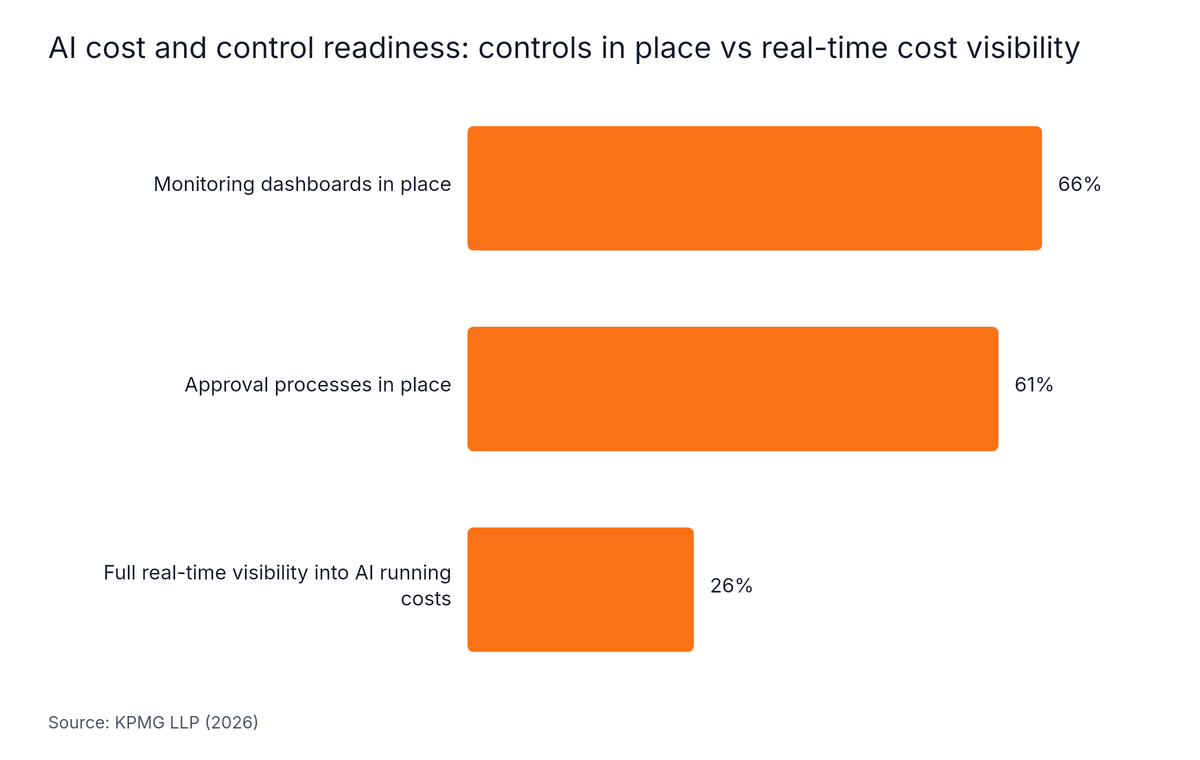
Moving an AI agent from pilot to production reliably depends on run-state controls, not a better model: tested inputs, a measured human override rate, a cost ceiling and one owner for exceptions. KPMG's Q2 2026 pulse found two-thirds of organisations have AI monitoring dashboards and 61% have approval processes, but only 26% have full real-time visibility into what their AI systems cost to run (KPMG, 2026).
Horizontal Bar chart: AI cost and control readiness: controls in place vs real-time cost visibility. Highest: Monitoring dashboards in place at 66%.
The chart compares monitoring dashboards (two-thirds of organisations), approval processes (61%) and full real-time cost visibility (26%). Controls exist on paper far more often than cost visibility does. Reliability depends on the unglamorous parts: a cost ceiling, tests against real inputs and a tested rollback.
How do companies move AI workflows from pilot to production?
Grail Computer Labs (GC Labs) moves AI workflows from pilot to production by running one pre-defined outcome through fixed gates: owner and scope in week 1, hardening in weeks 2 to 3, staged release in weeks 4 to 5, and handover in weeks 6 to 8. The outcome engagement compresses this into 4 to 8 weeks depending on how much the workflow touches.
Two colleagues passing a printed runbook across a table after release
The schedule below is our delivery practice. A four-week version merges the middle gates. It suits a narrow workflow with clean inputs.
Weeks
Gate
What gets done
Failure mode closed
1
Agree the outcome
Name the production owner, pick one workflow, write the exit criterion, map systems and access
No production owner, no exit criterion
2 to 3
Harden
Fix input quality, add tests and evaluations, turn on logging, set the cost ceiling, restrict access to read-only
Big-bang scope
4 to 5
Shadow and limited release
Run in shadow mode, review overrides and exceptions, release to a small slice with approvals
No exit criterion
6 to 8
Full rollout and handover
Widen volume, test rollback, hand over the runbook, documentation, code and cloud
No production owner
The loop for each change is Triage → Specify → Implement → Review → Verify → Release, run through GC Labs' Software Factory. Engineers review every change, and tests reject incomplete work. After the outcome is live, continuous delivery keeps the same team shipping.
A worked example from two engagements
We have not published a weekly log for any client. The rows below place the milestones we have published against the gates above, as an interpretation.
Engagement
Published milestone
Nearest gate
Australian healthcare platform, stalled 8 months
Live in production within 30 days (about week 5)
Shadow and limited release, weeks 4 to 5
Australian healthcare platform
100 business customers had been onboarded by day 40 (about week 6)
Full rollout, weeks 6 to 8
Australian healthcare platform
500 bug and feature tickets handled across a 10-day period
Harden and verify, run through the Software Factory
Singapore-based neobank, KYT workflow
One-week build raised automated approvals from approximately 44% to approximately 90% in testing
Harden, weeks 2 to 3 (testing, not live)
Singapore-based neobank, reconciliation
Eight transaction checks live in under 30 days
Full rollout, within the 4 to 8 week window
Our data: An Australian healthcare platform stuck in development for 8 months was live in production within 30 days; by day 40, 100 business customers had been onboarded.
A small financial-services operator shows the same shape on a narrower scope: one live sales queue in 11 days, with 360 submissions processed in the first 10 days. The first engagement begins with a 15-day trial with no payment commitment, so a team can judge on results. For a stalled pilot that needs a week-by-week plan for its own workflow, Book a call ↗.
Who is this pilot-to-production plan not for?
The 4 to 8 week plan in this guide does not suit teams whose pilot has no real users, whose owner cannot be named, or whose platform needs a multi-quarter rebuild first. Readiness is also uneven: in Asia Pacific, only 10% of organisations consider themselves ready for scaled agentic AI, and 41% need more than 12 months (Lenovo CIO Playbook, press release reproduced by Techbroll, January 2026).
The weeks in this guide are delivery practice, not a published industry benchmark. Three further limits apply:
Wider scope takes longer. Several workflows, several departments or a legacy platform that blocks integration push timelines past eight weeks. The improve-or-rebuild decision comes first in those cases.
Evidence is partial. Surveys use different samples and definitions, and several are vendor-commissioned or self-reported. Treat each figure as a direction, not a forecast.
Regulated work needs extra checks. Healthcare and finance workflows add consent, audit and approval requirements. GC Labs holds no SOC 2, ISO 27001 or HIPAA certification, and completes vendor security assessments as part of onboarding.
Frequently Asked Questions
How long does it realistically take to move an AI pilot into production?
An AI pilot realistically takes 4 to 8 weeks to move into production when the scope is one workflow and a production owner is named. Wider scopes take longer. IDC research for Lenovo found 46% of the AI pilots surveyed had progressed into production (Lenovo, 2026), so timelines depend on scope, owner and controls.
What separates a production-grade AI pilot from one that never leaves testing?
A production-grade AI pilot has a named production owner, one bounded workflow, a written exit criterion, logging, a cost ceiling and a tested rollback. A pilot that never leaves testing usually lacks at least one of these, so nobody can say when it is finished or who runs it afterwards.
How do I move AI agents from pilot to production safely?
Move an AI agent to production safely by releasing it in stages: shadow mode, limited release, then full rollout. Start with read-only access, mask secrets before they reach the agent, record every action in traces, and keep a human approval wherever judgement or risk sits. Advance each stage only when its gate is met.
How do I move AI agents from pilot to production reliably?
Move an AI agent to production reliably by testing it against real inputs before release, measuring the human override rate, setting a cost ceiling and giving one owner responsibility for exceptions. Reliability comes from run-state controls and a tested rollback, not from a better model alone.
How do companies move AI workflows from pilot to production?
Companies move AI workflows from pilot to production by naming a production owner, limiting scope to one workflow, writing an exit criterion, hardening inputs and tests, releasing in stages and handing over a runbook. Teams that follow fixed gates can complete this in 4 to 8 weeks for a single workflow.
How to move from AI pilots to production?
To move from an AI pilot to production, pick the one workflow that matters most, name who will own it after launch, write down the result that counts as success, then harden, release in stages and hand over. Stop widening scope until that first workflow runs reliably.
Conclusion
Moving an AI pilot into production is a delivery problem with a short list of causes. Hold to these points:
Name one production owner in week 1, before any more building.
Release one bounded workflow first, then widen by adjacency.
Write the exit criterion down and set a date for the go or no-go decision.
Release agents through shadow mode and limited release, with read-only access and logged actions.
Compare production statistics only when they measure the same thing.
The next step is a short audit of the stalled pilot: who owns it, what the first workflow is, and what would make the team stop. If you want a second pair of eyes on that audit, the same Book a call link above is the place to start.