ai software factoryai factory software platformfactory ai software development platform
How an AI Software Factory Accelerates Production Delivery
An AI software factory runs every change through a fixed loop where agents execute and engineers review. See the mechanism, the evidence and the limits.
Oct 30, 2026
Last updated: Oct 30, 2026
How an AI Software Factory Accelerates Production Delivery
By Shiva Mangal, Grail Computer Labs. Published 28 October 2026.
An AI software factory is a delivery model in which software agents execute every change in a fixed loop while engineers review every decision, so small fixes stop waiting on whoever remembers how the system works. One client told Grail Computer Labs: "Even a small bug fix could take days or a week, and fixing one problem often broke something else." This post explains the mechanism behind the fix. Grail Computer Labs runs it as GC Labs' Software Factory, and we cover the loop, where context lives, how incomplete work is rejected, and what the evidence says about throughput.
Key Takeaways
The factory model speeds delivery by removing waits between steps (context, specification, verification), not by typing code faster.
GC Labs' Software Factory runs Triage → Specify → Implement → Review → Verify → Release, with agents executing and engineers reviewing every change.
Agent-driven gains shrink between commit and release, so delivery speed should be measured at release.
A platform should be judged on ownership and exit, evidence per change, isolation, review gating and cost per merged change.
Would an AI software factory change weeks-long fixes into days?
GC Labs' Software Factory targets changes that wait on lost context and slow verification, not typing speed. Grail Computer Labs reports that an Australian healthcare platform stuck in development for 8 months went live in production within 30 days, and that 100 business customers had been onboarded by day 40.
Top-down view of a paper ticket card beside a half-finished tile and a finished blue tile on a pale strip
Our data: An Australian healthcare platform was stuck in development for 8 months and went live in production within 30 days. By day 40, 100 business customers had been onboarded, and 500 bug and feature tickets were handled across a 10-day period, on a codebase of 1.5 million lines of code that GC Labs inherited and rebuilt.
That is one engagement, and we treat it as one. The wider picture is mixed. Google's DORA 2025 survey of nearly 5,000 technology professionals found 90% use AI at work and more than 80% believe it has raised their productivity (Google Cloud, DORA, 2025). The same report found AI adoption still correlates negatively with delivery stability unless control systems are in place.
Capability has moved too. SWE-bench Verified is a benchmark that scores how many real software issues an agent resolves. Agent scores on it rose from 1.96% to 78.4% between October 2023 and April 2026, and controlled studies in the same review show time savings of 13.6% to 55.8% on narrow tasks (Bhati, arXiv, 2026). So the answer is conditional: a factory helps when the delay is process, and it fails when the controls are missing.
How does the Software Factory loop work, stage by stage?
GC Labs' Software Factory runs every request through six stages: Triage, Specify, Implement, Review, Verify and Release. Agents execute each change, GC Labs engineers make the decisions, and customers see progress on a dashboard that shows requests, status, communication and release history. The principle is short: agents execute, humans decide, customers see progress.
Six unlettered wooden blocks in a row, each in a different stage of finish, on a light linen surface
The software development life cycle (SDLC) is the full sequence of planning, building, testing and releasing software. The Software Factory speeds up the whole sequence, not only the coding step. The table shows what each stage does and what it stops.
Stage
What happens
What gets stopped
Triage
A request enters the system and is read against the client's codebase context
Duplicate or unclear requests
Specify
The change is written as acceptance criteria
Work with no definition of done
Implement
An agent writes the change
Nothing yet; the output is a draft
Review
An engineer reviews every change
Changes that do not fit the codebase or intent
Verify
Tests run against the acceptance criteria
Incomplete work
Release
The change ships and is logged in release history
Unverified changes
Acceptance criteria are the written conditions a change must meet before it counts as done. They make the later gates mechanical rather than a matter of opinion.
Others have published the same shape. Stripe describes its in-house agents this way: "A typical minion run starts in a Slack message and ends in a pull request which passes CI and is ready for human review" (Alistair Gray, Stripe, 2026). Stripe reports over 1,300 weekly merged pull requests that are fully agent-produced and human-reviewed (Stripe, 2026). That is a company self-report with no denominator, so it shows the model works, not how much faster it is.
How does the Software Factory keep context and reject incomplete work?
GC Labs' Software Factory is configured around each client's codebase, release process and operating model, so context sits in the system instead of in one person's memory. Tests reject incomplete work before it reaches a reviewer, and GC Labs engineers review every change. Agent traces are recorded, and likely secrets are masked before they reach an agent.
Stacked blank binders with tabbed index card dividers on a light desk, representing context stored in a system
Context lives in the system
Key-person risk is the risk that work stalls because one person holds knowledge nobody else has. It is the usual reason a small fix takes a week: someone has to find the person who remembers why the code works that way. In GC Labs' Software Factory, the codebase, release process and business rules are set up once, so the client never explains the product twice. The next change starts with that context already in place.
Tests reject incomplete work before review
Review is where volume becomes a problem. Faros AI's 2026 report on 22,000 developers found median time in review up 441.5%, bugs per developer up 54% and pull requests merged without any review up 31.3% (Faros AI, 2026). More code arrived than humans could check.
Sonar's 2026 survey of more than 1,100 developers points at the cause. 96% do not fully trust AI-generated code, yet only 48% always verify it before committing (Sonar, 2026). Sonar sells verification software, so the survey should be read with that in mind.
The Verify stage answers this. A change that fails its acceptance tests goes back to the agent, and a reviewer sees only work that already meets the written criteria. Research names the shift: "the central object of inquiry has shifted from code generation to delegated execution under human supervision" (Bhati, arXiv, 2026).
To see the loop run on a stalled codebase, Book a call ↗
How do AI software factories accelerate a development team's output?
AI software factories accelerate output by removing waits between steps, but the gain shrinks toward release. A 2026 study of more than 100,000 GitHub developers, reported by Happy Bhati of Northeastern University, found agent-driven gains of 180% at commit level, 50% at project level and 30% at actual releases (Bhati, arXiv, 2026).
The authors call this a weak-link production structure: a pipeline whose output is capped by its slowest stage. Human and organisational stages set the limit. This is why we design the Review and Verify stages first and the Implement stage last.
Against a conventional delivery team
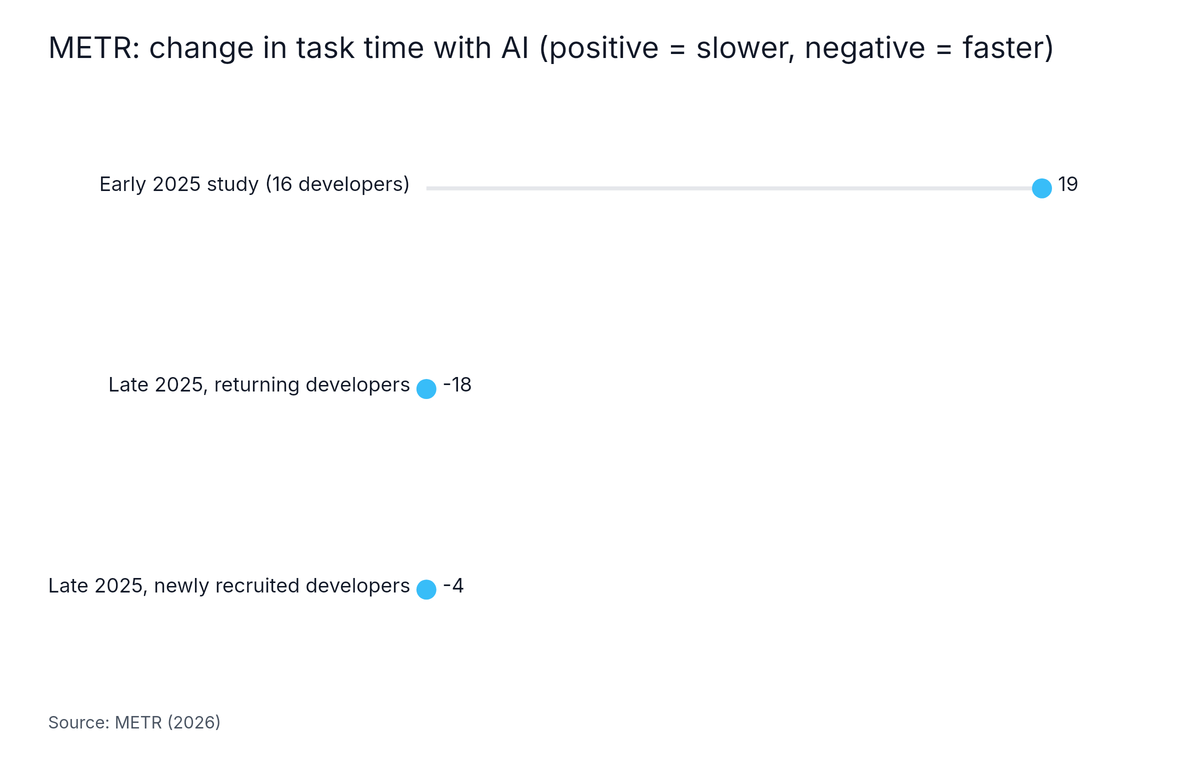
Individual speedups are hard to measure. METR's randomised trial found experienced open-source developers took 19% longer with AI tools in early 2025. Its late-2025 follow-up estimated 18% less task time for returning developers and 4% less for new ones, but the confidence intervals cross zero (METR, 2026).
Lollipop chart: METR: change in task time with AI (positive = slower, negative = faster). Highest: Early 2025 study (16 developers) at 19.
METR says selection effects make the estimate unreliable. The honest reading is that speedups now look likely and their size is unknown.
We have not published a controlled comparison of GC Labs' Software Factory against a conventional team. What we can state is volume under real conditions: 500 bug and feature tickets handled across a 10-day period on the Australian healthcare platform. That is a count, not a ratio.
What are the best AI software factory platforms for teams that need to ship production code continuously?
The best AI software factory platform is the one that passes five checks: ownership and exit, evidence per change, isolation from production, human review gating and cost per merged change. Gartner predicts 70% of enterprises will abandon agentic AI built by vendor forward-deployed engineering by 2028 (Gartner, 2026).
A brass caliper resting across the tallest of three blue tiles of descending height beside a steel ruler
Gartner cites soaring costs and an inability to evolve the systems in-house, and recommends clear IP ownership, knowledge transfer and an exit strategy. We do not rank products here. The criteria below let a team test any candidate, including ours.
Criterion
What to ask
Why it matters
Ownership and exit
Does the client keep the code, cloud, models and documentation?
Avoids lock-in if the vendor fails
Evidence per change
Do requirements and test results travel with each diff?
Reviewers can verify quickly
Isolation
Can agents reach production or secrets?
Limits damage from a bad run
Review gating
Does a human approve every merge?
Controls instability from added volume
Cost per merged change
What does a change that ships cost, not a change drafted?
Compares delivery, not activity
At GC Labs, the client owns the code, cloud, models and documentation, and access can begin read-only. A pre-defined outcome comes first, delivered in 4 to 8 weeks, with a 15-day trial and no payment commitment. Continuous delivery follows with the same team.
Who is an AI software factory not for?
GC Labs' Software Factory is not for teams that want engineers removed, measure output in pull requests, or need a certified vendor today. Sonar's 2026 survey found 38% of developers say reviewing AI code takes more effort than reviewing a colleague's (Sonar, 2026), so review capacity matters. GC Labs holds no SOC 2, ISO 27001 or HIPAA certification.
A clipboard with blank tick boxes beside a magnifying loupe and a blue pencil on a pale wooden table
Four limits are worth stating plainly:
This is not AI replacing engineers. Agents execute, but engineers make every decision. If the goal is headcount removal, the model fits badly.
The evidence is uneven. Our healthcare platform result is one engagement, and several public figures (Stripe, Sonar) are self-reported by the publisher.
Review capacity caps the gain. If reviewers cannot keep up, extra agent output turns into the instability DORA describes.
Regulated work needs extra checks. Healthcare and finance work carries privacy and audit duties that a loop alone does not satisfy. GC Labs completes vendor security and compliance assessments as part of onboarding.
Frequently Asked Questions
What are the best AI software factory platforms for teams that need to ship production code continuously?
The best platform is the one that passes five checks: the client owns the code and can exit, evidence travels with each change, agents are isolated from production, humans gate every merge, and cost per merged change is visible. Teams should rank candidates against those criteria rather than a vendor list, then test one on a real outcome.
How do AI software factories accelerate a development team's output?
AI software factories accelerate output by removing the waiting between steps, not by typing faster. Agents execute each change, automated tests reject incomplete work before review, and engineers spend their time on decisions. Gains depend on review capacity: a 2026 study of 100,000+ GitHub developers reported 180% gains at commit level but 30% at actual releases (Bhati, arXiv, 2026).
Do humans still review code in an AI software factory?
In GC Labs' Software Factory, humans review every change. Agents execute the work and GC Labs engineers make the decisions before release. Stripe describes the same pattern: "A typical minion run starts in a Slack message and ends in a pull request which passes CI and is ready for human review" (Alistair Gray, Stripe, 2026).
How do teams stop AI agents from shipping incomplete or low-quality code?
Teams stop AI agents shipping incomplete code by making verification a gate, not a suggestion. Tests reject unfinished work before a reviewer sees it, engineers review every change, and agent traces are recorded. Without those controls, Sonar's 2026 survey found only 48% of developers always verify AI code before committing (Sonar, 2026).
Conclusion
The factory model changes delivery speed only where the delay is process: lost context, vague specifications and slow verification. The takeaways:
Agents execute and engineers decide, so accountability stays with people.
Context belongs in the system, which removes key-person risk from small fixes.
Tests should reject incomplete work before review, because review is the bottleneck.
Gains shrink downstream, so measure releases, not commits.
Judge any platform on ownership, evidence per change, isolation, review gating and cost per merged change.
The next step is small. Pick one change that has waited too long, and ask for one pre-defined outcome in 4 to 8 weeks before any longer commitment. We agree the outcome first, deliver it, then keep shipping.