Blog
Software Development Project Rescue: What the First 30 Days Involve
How software development project rescue works: triage, codebase inheritance, outcome agreement, stabilisation and release, anchored in a real 30-day case.

What audit trails and monitoring an enterprise should require from an AI vendor: trace contents, zero data retention, storage, access and drills to run before approval.
How software development project rescue works: triage, codebase inheritance, outcome agreement, stabilisation and release, anchored in a real 30-day case.

How credit worklist prioritization software auto-clears low-risk files: rules, a risk score and a human gate, with build time and approval-rate data.
Enterprise AI guardrails explained: instruction-based vs architecture-based controls, plus a go-live checklist for data access, action scope and fallback.
Request a quote and our experts will contact you within 24 hours with tailored solutions and pricing.
You can also send us a quick email at [email protected].
Last updated: Nov 27, 2026
By Shiva Mangal, Grail Computer Labs. Updated 28 October 2026.
An enterprise AI vendor audit trail is a structured, tamper-evident record of every action an AI agent takes, kept where the buyer controls access, and paired with live monitoring. Policy is rarely the gap: 98% of large-enterprise AI executives report formal AI governance policies, yet 69% worry about the expertise to evolve those controls (EY US, 2026). Security and compliance teams approve what they can inspect. This guide gives a pass/fail checklist, a test that separates an audit trail from an ordinary log, and the drills that expose gaps. The audit trails for AI agents control page from Grail Computer Labs gives a shorter summary.
Key Takeaways
- An enterprise AI audit trail must be structured, complete, tamper-evident and reconstructible. An ordinary application log usually fails at least two of those tests.
- Zero data retention covers the model provider's copy of prompts and outputs. It does not cover the audit record the customer keeps, and the two should not be confused.
- Traces belong on infrastructure the enterprise controls, with the people who run agents separated from the people who administer the audit store.
- Mean monitoring coverage of deployed AI agents is 52% in one 2026 survey (Gravitee, 2026), so vendors should show evidence of coverage, not a policy statement.
- Before approval, run three drills: a sample trace export, a six-month-old decision reconstruction, and an attempted edit of a record.
An enterprise should require five things from an AI vendor: a structured agent trace of every action, tamper-evident storage, access controls that separate operators from audit administrators, live monitoring with alerting, and a retention setting the customer controls. Mean monitoring coverage of deployed agents is only 52% (Gravitee, 2026), so ask for proof, not policy.

The table turns those five requirements into evidence that can be requested during an evaluation.
| Capability | What to require | Evidence to request |
|---|---|---|
| Agent trace | Every prompt, tool call, result, approval and state change recorded | A sample export from a real run |
| Tamper evidence | Records cannot be edited or deleted without detection | A demonstration of an administrator attempting an edit |
| Storage location | Traces held in infrastructure the customer controls | Deployment diagram and data-flow description |
| Access control | Operators and audit administrators are different roles | Role list and a log of who read what |
| Monitoring | Live coverage of every deployed agent, with alerts | Coverage report and an alert example |
| Retention | Period set by regime and data class | Contract clause and a configuration screenshot |
The Gravitee survey covered 750 senior technology leaders in the UK and USA. It is vendor research, so treat the direction as useful and the exact percentages as indicative. Across the 2026 surveys cited here, the pattern is the same: deployment is moving faster than oversight.
An audit trail is a structured, complete, tamper-evident record that lets a reviewer reconstruct who or what acted, on which inputs, and why. An application log is a diagnostic record of system events, usually written for developers and often editable. The gap is easy to miss: 17.6% of IT leaders don't know whether staff use unsanctioned GenAI tools, up from 6.3% in 2025 (AvePoint, 2026).

Apply these four tests to any record a vendor calls an audit trail. A record that fails one is a log.
| Test | Application log | Audit trail |
|---|---|---|
| Structured | Free text, varies by developer | Fixed fields: actor, action, inputs, outputs, time |
| Complete by construction | Records what developers chose to log | Records every action automatically, with no opt-in |
| Tamper-evident | Editable by anyone with file access | Edits and deletions are detectable and attributed |
| Reconstructible | Explains that something happened | Explains what happened, with which data, and why |
The AvePoint figures come from a survey of 750 global IT leaders in financial services, healthcare and government. A second finding is related: 21.1% of organisations do not know whether unsanctioned tools are being used to build agents for work processes (AvePoint, 2026). An agent nobody knows about cannot be audited, so the trail must start at registration of the agent itself.
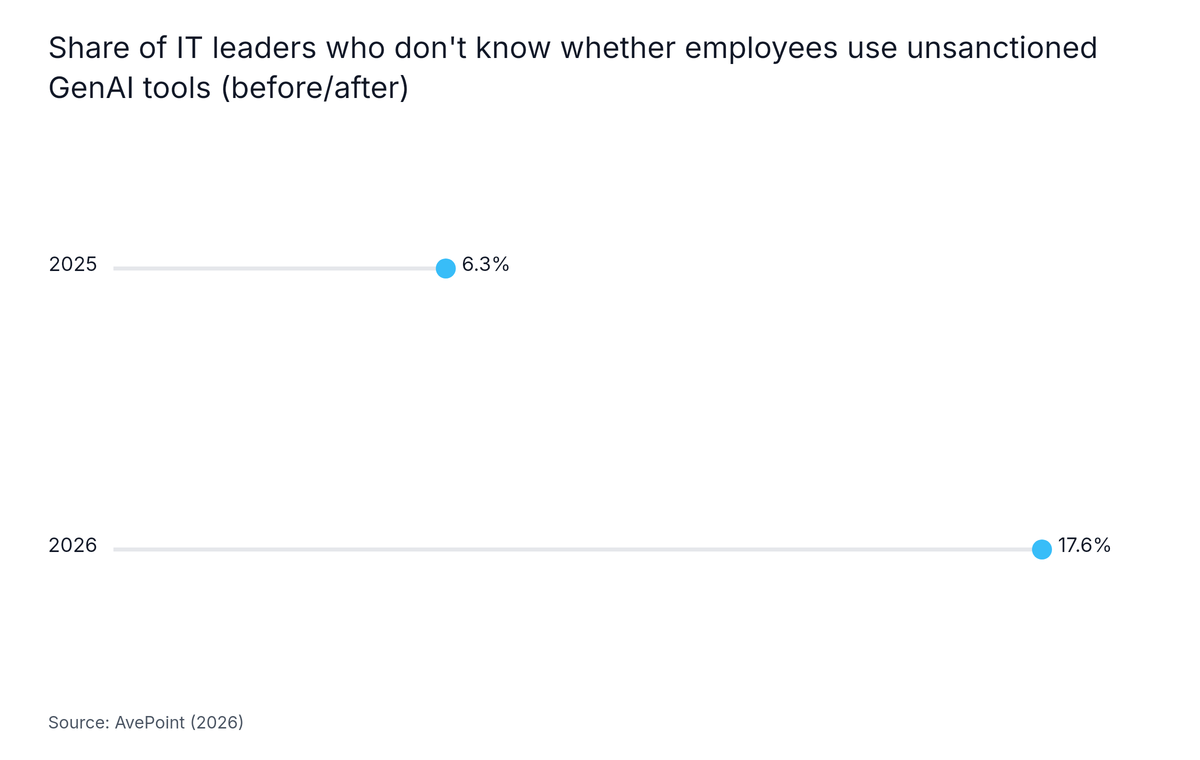
Source: AvePoint, 2026
The chart shows the share of IT leaders unaware of unsanctioned GenAI use rising from 6.3% in 2025 to 17.6% in 2026 (AvePoint, 2026).
An agent trace is the ordered record of everything one agent run did, from the triggering request to the final state change. A chat transcript is not enough. Require these elements:
Missing context is a control gap, not a harmless omission.
Zero data retention is a vendor commitment that the model provider does not keep a customer's prompts and outputs after processing. It does not delete the audit record the customer keeps. Three questions stay separate: whether the vendor retains data, whether it trains on data, and who holds the audit store. Deploying on client infrastructure puts the third answer in the customer's hands.
Buyers often hear a contradiction: the vendor keeps nothing, yet a full record is required. The two statements describe different copies of the data.
| Question | Whose copy | What to ask |
|---|---|---|
| Does the model provider keep prompts and outputs? | Provider | Is zero data retention in force, in writing, for this account? |
| Is customer content used to train models? | Provider | Does the contract prohibit training on customer content? |
| Is there a full record of agent activity? | Customer | Where is it stored, and who can read it? |
"No training on my data" does not mean "no storage". A vendor can promise one and not the other, so each row needs its own answer. The cleanest design has the provider keep nothing while the audit store sits in the customer's own cloud, with secrets and personal data masked before they enter it.
Traces can contain personal data and business reasoning, so the audit store is itself a target. Among organisations reporting AI-related breaches, 97% lacked proper AI access controls, and customer PII was compromised in 65% of shadow AI breaches against 53% of breaches overall (IBM, 2025). Those figures come from IBM's 2025 Cost of a Data Breach research. Apply four rules:
For multi-party platforms, such as healthcare or workforce services, add per-tenant export so each client sees only its own records.
Retention advice conflicts. Some checklists cite six months, others warn against anything under 90 days, and data-minimisation duties push the other way. Do not adopt a single number. Set a period per regime and per data class, then check it against the primary text.
| Regime | Relevant point | Verify against |
|---|---|---|
| Singapore IMDA agentic AI framework | Version 1.5, updated 20 May 2026, adds logging and monitoring, access controls and human approvals as core agent components (Baker McKenzie, 2026) | IMDA publication |
| MAS AI Risk Management Guidelines | Issued 7 October 2026, with third-party AI vendor governance and auditability expectations; phase-in dates are from secondary summaries (RegReportingDesk, 2026) | MAS media release |
| Australian ADM transparency obligation | Starts 10 December 2026, with no grace period reported (Responsible AI Australia, 2026) | OAIC guidance |
| EU AI Act Article 12 | Event logging for high-risk systems; sources disagree on application dates | EUR-Lex |
Monitoring is the live measurement of what deployed AI agents do, so failures and policy breaches trigger action before a quarterly review. In the 2026 Splunk State of Observability survey of 2,050 respondents, nearly 9 in 10 called monitoring AI a priority, but over half still can't effectively measure agent quality (Cisco / Splunk, 2026).

The publisher's own summary is blunt: "the urgency to deploy AI agents is rapidly outpacing the ability to monitor them." (Cisco, 2026). A trail that nobody watches protects the enterprise only after the incident.
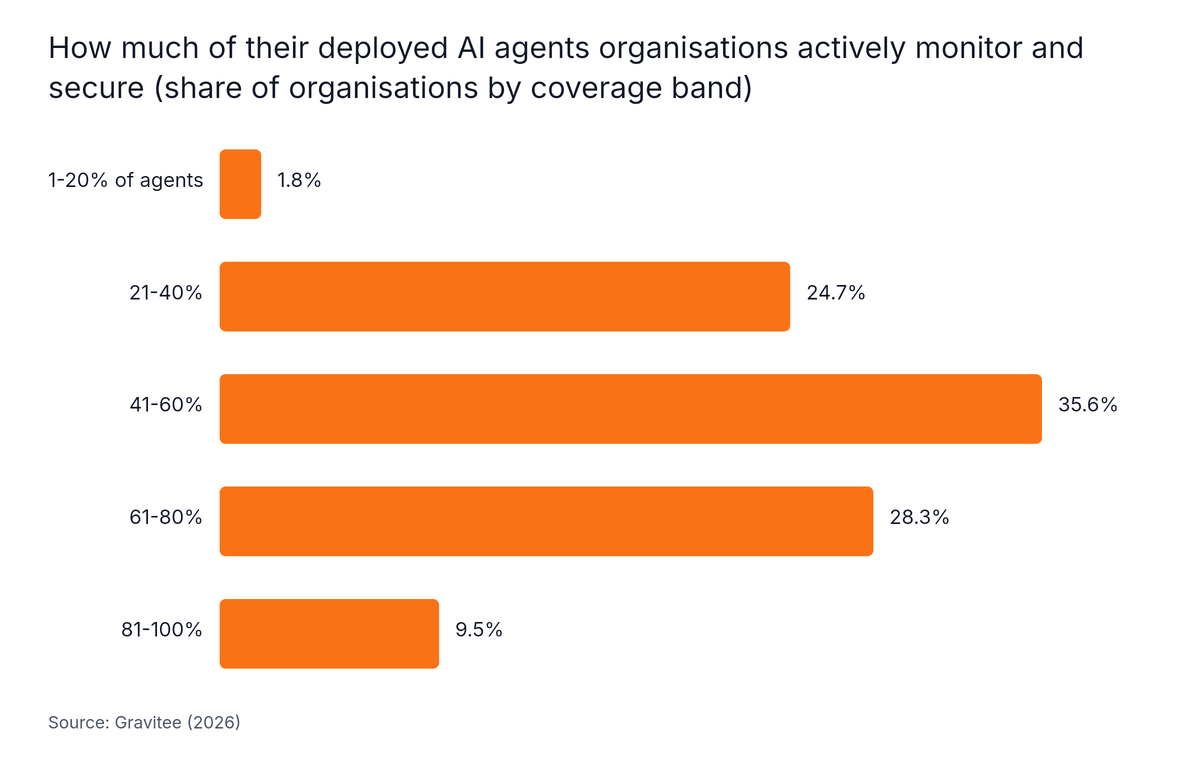
In the Gravitee survey, only 9.5% of organisations secure more than 81% of their deployed agents (Gravitee, 2026). Mean coverage is 52%, which leaves roughly 48% of production agents unmonitored (Gravitee, 2026). The largest single band, 35.6% of organisations, covers 41-60% of agents (Gravitee, 2026).
Source: Gravitee, 2026
Buyers are reacting: 62.4% of respondents plan to increase investment in tools that monitor agents' actions for policy alignment (AvePoint, 2026).
An enterprise can verify an AI vendor's audit trail with three tests before approval: request a sample trace export, ask the vendor to reconstruct a decision from six months ago, and try to edit or delete a record as an administrator. The stakes are real, since over half of 2,050 surveyed respondents cannot effectively measure agent quality (Cisco / Splunk, 2026). A vendor that fails any test has a log, not an audit trail.

Grail Computer Labs (grail.computer), or GC Labs, records agent traces, shares an access plan upfront and masks likely secrets before they reach an agent. It deploys on client infrastructure or private cloud under the client's AI and security policies, with zero data retention where required. Its Terms of Service state that client content is never used to train AI models or shown to other clients.
| Control | What GC Labs states | What to ask for |
|---|---|---|
| Agent activity | Agent traces recorded | A sample trace export |
| Agent access | Access can begin read-only; access plan shared upfront | The written access plan |
| Secrets | Likely secrets masked before reaching an agent | The masking rules and test results |
| Location | Client infrastructure or private cloud | Deployment diagram |
| Retention | Zero data retention where required | Contract clause per data class |
Our data: GC Labs handled 500 bug and feature tickets across a 10-day period on an Australian healthcare platform engagement. This is volume context only. It does not measure audit-trail quality, so the drills above still apply.
The same drills apply to GC Labs as to any other vendor. Ask for the sample export.
The enterprise AI vendor audit trail checklist is not for buyers who need a vendor holding SOC 2, ISO 27001 or HIPAA certification today: Grail Computer Labs holds none of the three. The checklist also cannot replace legal advice, because the MAS guidelines issued on 7 October 2026 and their phase-in dates are known here only from secondary summaries (RegReportingDesk, 2026).
Three further limits apply:
An AI audit trail is a structured, complete, tamper-evident record that lets a reviewer reconstruct what an agent did and why, while an application log is a diagnostic record of system events written for developers. A log can be free text and editable. An audit trail must survive an administrator trying to change it.
Zero data retention does not conflict with an AI audit trail, because it covers the model provider's copy of prompts and outputs, not the record the customer holds. The cleanest design keeps the audit store on infrastructure the customer controls, with secrets and personal data masked, so the provider keeps nothing and the customer keeps the evidence.
AI agent logs should be retained for the period the applicable regulatory regime and data class require, not for a single universal number. Retention guidance conflicts across sources, and data-minimisation duties push the other way. Set a retention period per regime and per data class, write it into the contract, and confirm it against the primary legal text.
Access to AI agent audit logs should be limited to named audit and security roles, separate from the operators who run the agents. Vendor staff should not read traces by default. Require role-based access, a record of every read, and the ability to export logs into the enterprise's own tools.
An enterprise AI vendor earns approval when it can show what its agents did, where the record lives and who can read it. Carry these points into the evaluation:
The next step is to take the capability table from the first section to the next vendor call and ask for a sample trace export. To see how GC Labs answers it, Book a call ↗.