An approval gate in an AI agent workflow is a checkpoint that pauses the agent before a defined high-risk action and releases it only after a named human, or a policy acting for one, approves the exact action. Most teams have moved past asking whether to run agents. The harder question is which tools support approval gates in AI agent workflows, and where each gate belongs. On average, only 47.1% of an organisation's AI agents are actively monitored or secured (Gravitee, 2026). This guide defines the gate, maps four action types to gate tiers, compares the tooling options, and lists what an approval decision record needs for a compliance audit. The aim is to put human judgement where risk sits and let low-risk work keep moving.
Key Takeaways
An approval gate pauses an AI agent before a payment, vendor change, production deployment or data deletion, and runs the action only after an approved decision.
Agent frameworks provide approval primitives, but a primitive alone does not notify reviewers, time out, escalate, check approver roles or write an audit record.
Enforcement has to live in code and infrastructure, because a prompt rule is an instruction, not a boundary.
An approval decision record needs the action, arguments, risk tier, approver identity and role, decision, timestamps and outcome.
What is an approval gate in an AI agent workflow?
An approval gate is a control point that stops an AI agent before it commits a consequential action, such as a payment, a vendor record change, a production deployment or a data deletion. The agent proposes the action, a human reviews it, and only an approved action runs. Only 14.4% of organisations send every AI agent live with full security and IT approval (Gravitee, 2026).
Top-down view of a small wooden barrier gate model beside a blank approval card on a pale grey desk
A gate is not a general review step. It sits at one defined point: after the agent has decided what to do and before the system of record changes. Everything before that point is easy to redo. Everything after it may not be.
Which AI agent actions should always require human approval?
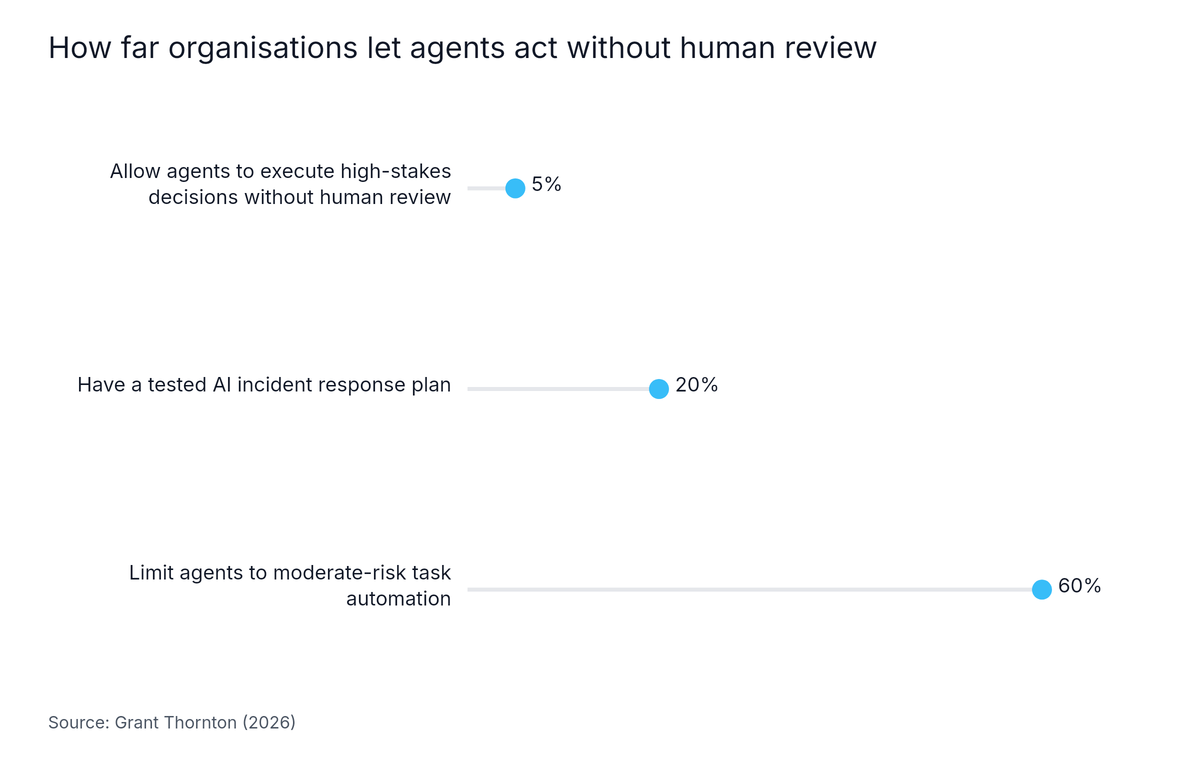
Four action types should always pass an approval gate: financial transactions, vendor record changes, production deployments and data deletions. Each is hard to reverse or touches money, counterparties or live systems. Only 5% of organisations let agents execute high-stakes decisions without human review, and 60% limit agents to moderate-risk task automation (Grant Thornton, 2026).
Flat-lay of four physical objects representing money, a vendor folder, a server key and a shredder bin
The test is reversibility and blast radius. Blast radius is the amount of money, data or live service an action can damage if it is wrong. AWS Well-Architected guidance (2026) sets a similar baseline: read-only work runs autonomously, low-risk writes get a single reviewer, and financial or deletion actions get stricter review. The table below is our suggested mapping of that idea to business actions.
Action type
Reversible?
Blast radius
Suggested gate
Read-only queries
Yes
Low
No gate; log the call
Low-risk writes (internal ticket update)
Mostly
Low
Policy rule or single reviewer
Financial transactions
Rarely
Money leaves the account
Gate on defined transaction types; stricter review above set limits
Vendor record changes
Partly
Payment routing, counterparties
Named approver with a finance role
Production deployments
Partly
Live users and services
Release-owner approval
Data deletions
No
Permanent loss
Two-person or stricter review
AWS puts the principle plainly: "Human review depth scales with the consequence of the action, by design rather than by reaction." (AWS Documentation, 2026)
Lollipop chart: How far organisations let agents act without human review. Highest: Limit agents to moderate-risk task automation at 60%.
Grant Thornton's 2026 figures show where organisations draw the line: 5% allow unreviewed high-stakes execution, 20% have a tested AI incident response plan, and 60% cap agents at moderate-risk automation.
Worked example: human approval before a payment
Grail Computer Labs (grail.computer) built a human-reviewed know-your-transaction (KYT) workflow for a Singapore-based neobank. Before the build, a manual transaction review took 30+ minutes and automated approvals sat at approximately 44%. The lever was definition. The team stated which transaction types needed a human and which did not, then routed the rest through automated checks.
Our data: A one-week build raised automated approvals from approximately 44% to approximately 90% in testing for a Singapore-based neobank's human-reviewed KYT workflow.
That is a testing result, not a production figure, and no outside source covers it. The point is not fewer humans. Transactions that carry risk still reach a person, and reviewers stop spending time on those that do not.
Which tools let you insert a human approval gate, and which include RBAC and audit logs?
Agent frameworks such as LangChain's HumanInTheLoopMiddleware, the OpenAI Agents SDK (needsApproval) and Microsoft Agent Framework supply the approval pause, while durable engines such as Temporal and AWS Step Functions can hold the paused run. A pause alone is not a control: 97% of per-command permission requests were approved in Anthropic usage data reported by heise (heise online, 2026).
Overhead shot of five blank checklist cards fanned out beside a padlock and a rubber stamp
Since July 2026, LangChain's middleware supports conditional interrupts, so safe reads run and risky calls halt for review (LangChain, 2026). The matrix below separates what each option provides for approvals from what we could not verify for RBAC and audit logs.
Option
Approval mechanism
RBAC for approvers
Audit log of decisions
LangChain HumanInTheLoopMiddleware
Conditional interrupts with a per-call policy
Check documentation
Check documentation
OpenAI Agents SDK
needsApproval flag on a tool
Check documentation
Check documentation
Microsoft Agent Framework
Comparable tool-approval pattern
Check documentation
Check documentation
Temporal or AWS Step Functions
Durable workflow that waits for an external decision
Check documentation
Check documentation
A flag such as needsApproval pauses a call. It does not notify a reviewer, time out, escalate or write an audit record. Those behaviours turn a primitive into a gate.
RBAC for approvers
Role-based access control (RBAC) is a way of granting permissions by role, so only people with the right role can approve a given action. For gates, it answers two questions. Who may approve a vendor change or a deployment? And can the requester ever approve their own request? Teams should map each risk tier to a role and block self-approval.
Five questions to ask any tool
Can it pause and resume a run without losing state?
Can a policy decide per call which actions halt?
Does it check the approver's role before accepting a decision?
Does it handle timeout and escalation?
Does it write the decision to a record an auditor can read?
Teams that want a workflow mapped end to end, with approvals where judgement or risk sits, can Book a call ↗.
How do you enforce an approval gate beyond the prompt?
An approval gate holds only when code enforces it, not the prompt. A prompt rule is an instruction the agent can reason around. Keep credentials away from the agent, put a deterministic policy engine outside the model, and bind each approval to the exact arguments. In Kiteworks' 2026 survey, purpose binding sat at 37% and kill-switch capability at 40% (Kiteworks, 2026).
Still life of a brass key, a padlock and a blank card on a pale surface, representing enforcement outside the prompt
Prompt rules live in the same context as the agent. They are instructions, not boundaries. The only reliable way to prevent an AI agent from doing something is to make it physically impossible.
Hold credentials outside the agent. A separate runner holds the keys and executes only approved actions.
Decide with a policy engine. Deterministic rules outside the model assign each call a risk tier.
Bind approval to arguments. Approve the exact action and parameters, not "a payment".
Consume approval once. An idempotency key is a unique token that stops the same approved action from running twice.
Verify the reviewer. Check identity and role before accepting the decision.
Containment lags deployment. Fewer than half of organisations report either purpose binding or a kill switch.
How do you choose between synchronous and asynchronous approval?
Choose synchronous approval when a reviewer is in the session and the decision takes seconds; choose asynchronous approval when the reviewer may take hours or days. Synchronous approval holds the agent open until someone answers. Asynchronous approval saves the paused state, notifies the reviewer and resumes on their decision. Both need a timeout and a default-deny rule.
Still life of an hourglass and a small desk bell on a pale surface, representing waiting and escalation
Factor
Synchronous
Asynchronous
Reviewer availability
In the session now
Anywhere, any time
Typical wait
Seconds
Minutes to days
Paused state
Held in the live run
Stored durably and resumed
Best for
Interactive assistants, quick confirmations
Payments, vendor changes, deployments
Failure risk
Blocked sessions
Lost or stale requests
Set timeouts, escalation and default-deny
Default-deny is a rule that treats silence as a refusal: if no approver answers before the timeout, the action does not run. AWS guidance (2026) lists a missing timeout and escalation path as anti-patterns. Set a deadline per tier, escalate to a named backup, then deny and log.
Plan for the failure case too. Only 20% of organisations have a tested AI incident response plan (Grant Thornton, 2026).
What must an approval decision record contain for a compliance audit?
An approval decision record is the audit evidence of one human decision about one agent action. It must capture the proposed action and arguments, risk tier, approver identity and role, decision, timestamps and outcome. Organisations without evidence-quality audit trails sit 20 to 32 points behind on every AI maturity metric (Kiteworks, 2026).
AWS gives the minimum: "You log human approval decisions with timestamps and reviewer identities, creating an auditable record of human oversight for compliance purposes." (AWS Documentation, 2026) For financial services in Singapore, the Monetary Authority of Singapore describes its SAFR framework as covering "how agent actions are authorised, how human oversight is activated, and what is recorded at the point of every consequential decision" (MAS, 2026).
Field
What it records
Why an auditor asks
Action and arguments hash
Exactly what the agent proposed
Proves the approval matched the execution
Policy version
The rules in force at the time
Explains why a gate fired
Risk tier
The tier assigned
Shows review depth fit the risk
Approver identity and role
Who decided and with what authority
Proves authorised oversight
Context shown
What the reviewer saw
Shows the decision was informed
Decision
Approve, reject or edit
The core evidence
Timestamps
Requested, decided, executed
Reconstructs the sequence
Outcome
What the action did
Closes the loop
Idempotency key
Token for one-time use
Shows no replay
Store the request, approval and writeback together. Our existing page on audit trails for AI agents covers the wider logging basics.
When do approval gates stop helping?
Approval gates stop helping when reviewers approve nearly everything without reading it. Approval fatigue is that habit of approving requests without reading them. Anthropic usage data reported by heise online shows 97% of per-command permission requests approved, against 39% of suggestions rejected in higher-level planning dialogues (heise online, 2026). That favours gates at plan or intent level.
Reducing approvals is not the goal. Putting judgement where it belongs is. These limits apply:
A gate does not fix a weak agent. It catches bad actions at one point, not bad reasoning.
Too many gates train rubber-stamping. Watch approval rate and time-to-decision for drift.
Low-risk, high-volume actions suit a policy or classifier. Keep humans on the tiers that carry real consequence.
Read-only agents rarely need a gate. Log them and move on.
Frequently Asked Questions
What agent platforms include RBAC, audit logs, and approvals?
Agent platforms fall into three groups. Agent frameworks (LangChain, the OpenAI Agents SDK, Microsoft Agent Framework) supply the approval pause. Durable workflow engines (Temporal, AWS Step Functions) hold paused runs. Role-based access control (RBAC), which limits who may approve, and a decision-grade audit record usually need adding or confirming in each product's documentation.
What is an approval gate in an AI agent workflow?
An approval gate is a checkpoint that pauses an AI agent before a defined high-risk action, such as a payment or a production deployment, and releases it only when a named human or a policy acting for one approves the exact action. Low-risk actions pass through without review, so human judgement is spent where the risk sits.
Should every AI agent action require human approval?
No. Routing every action through review produces rubber-stamp approvals, which AWS Well-Architected guidance warns against. Gate actions by consequence: let read-only work run, give low-risk writes a policy rule or single reviewer, and reserve strict human review for financial transactions, vendor changes, production deployments and data deletions.
What should happen if an approver does not respond?
The action should not run. Apply a default-deny rule: when the timeout expires, escalate to a named backup approver, and if nobody answers, refuse the action and log the outcome. Never let a pending approval convert into an approval by silence, and record the timeout in the decision record.
Conclusion
Approval gates work when they are specific, enforced in code and recorded. Four points carry the argument:
Gate financial transactions, vendor changes, production deployments and data deletions by reversibility and blast radius.
Treat framework approval primitives as a starting point, then add notification, timeout, escalation, approver roles and audit writes.
Enforce gates with separate credentials and a policy engine, not prompt rules.
Record the action, approver, decision, timestamps and outcome for every approval.
Measure approval rates over time so reviews stay real. The next step is a short inventory: list every action the agents can take, assign each a tier, and mark which ones lack a gate today. Teams that want help mapping that workflow can Book a call ↗.