How to Automate Evidence Collection Using AI Agents
By Shiva Mangal, Grail Computer Labs. Updated 28 October 2026.
Automating evidence collection with AI agents means giving software agents scoped, read-only access to systems of record so they gather timestamped raw records for each control, while humans review the results and sign the conclusions. The pressure to do this is rising. In OneTrust's 2026 survey, 86% of organisations reported an AI-related incident in the past year, yet only 27% slowed or paused deployment (OneTrust, 2026). Evidence work grows while the agents keep shipping. This guide shows how to automate evidence collection using AI agents, from control map to tamper-evident record, and how a software factory turns that evidence into a byproduct of the build.
Key Takeaways
Automating evidence collection with AI agents works when each agent has its own read-only identity and captures raw records with a timestamp and hash.
A language model should summarise evidence, never replace it: the raw system result is the evidence.
A software factory built on AI agents emits a record at every stage (Triage, Specify, Implement, Review, Verify, Release), so audit evidence arrives with the build.
Automated evidence collection gathers and organises records. People interpret controls, accept exceptions and sign conclusions.
Why does evidence collection for AI agents need automating now?
Evidence collection for AI agents needs automating because agent adoption is outrunning proof of control. In OneTrust's 2026 survey of 1,200 senior decision-makers, 87% encourage AI agent use but only 47% have clear governance, oversight and controls (OneTrust, 2026). Manual evidence gathering cannot keep pace with agents that act continuously.
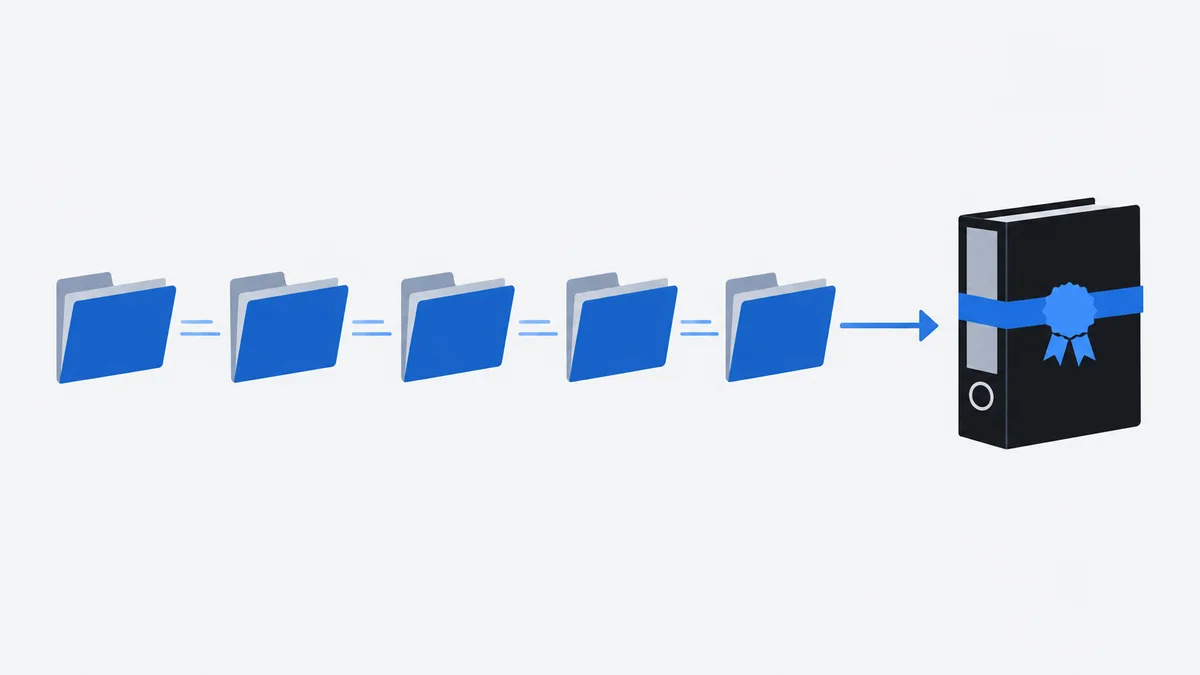
Flat illustration of scattered document folders flowing toward one sealed evidence binder
Evidence collection is the recurring work of gathering, mapping and packaging records that prove each control operated during an audit period. Audit evidence is a record, such as a log, ticket or configuration export, that shows a control operated as described. The records usually exist already. The hard part is proving they are complete and current.
The workload is growing. In the same OneTrust survey, 80% said their function spends more time managing AI risk than 12 months ago, and 98% plan to raise AI governance technology budgets (OneTrust, 2026).
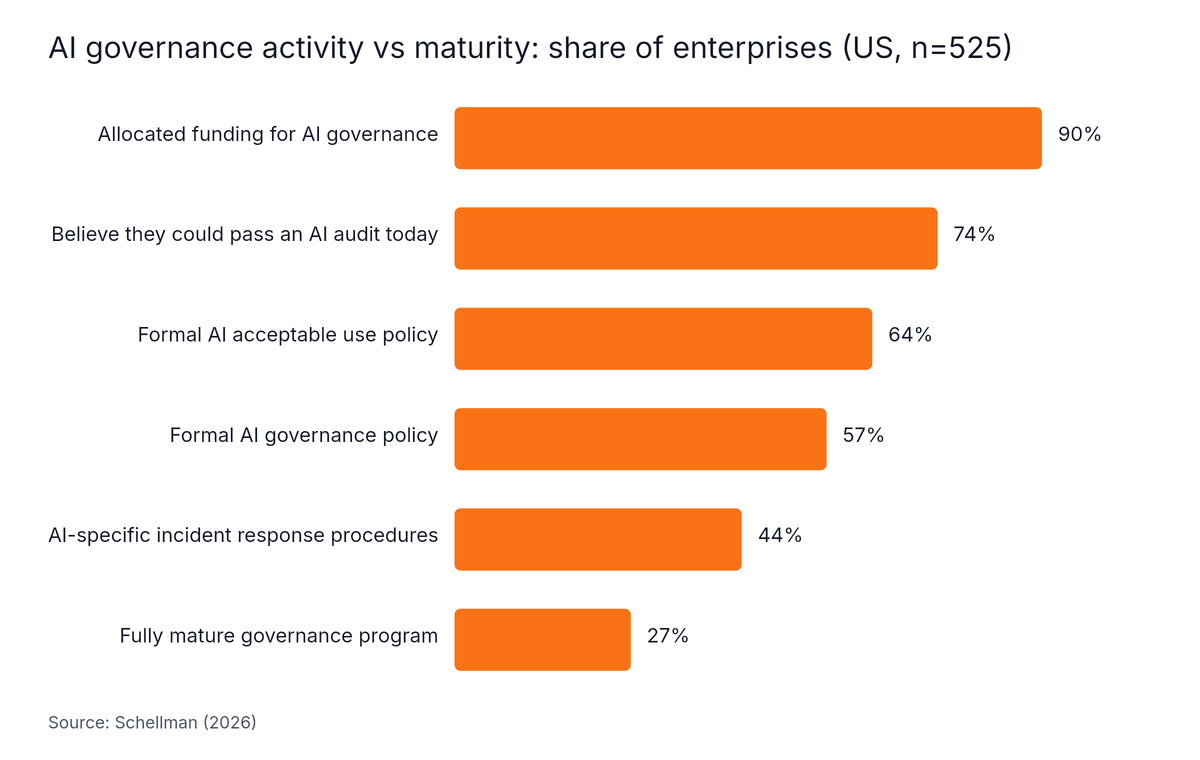
Confidence also runs ahead of readiness. Schellman's 2026 survey of 525 US professionals found 74% believe they could pass an AI compliance audit today, but only 27% describe their governance programmes as fully mature (Schellman, 2026). Funding is not the gap: 90% allocated funding. Policy coverage lags, with 64% holding a formal AI acceptable use policy, 57% a formal AI governance policy and 44% AI-specific incident response procedures (Schellman, 2026). Danny Manimbo of Schellman put the standard plainly: "It has to become a continuous process of oversight, accountability, and validation." (Schellman, 2026)
Horizontal Bar chart: AI governance activity vs maturity: share of enterprises (US, n=525). Highest: Allocated funding for AI governance at 90%.
How to automate evidence collection using AI agents?
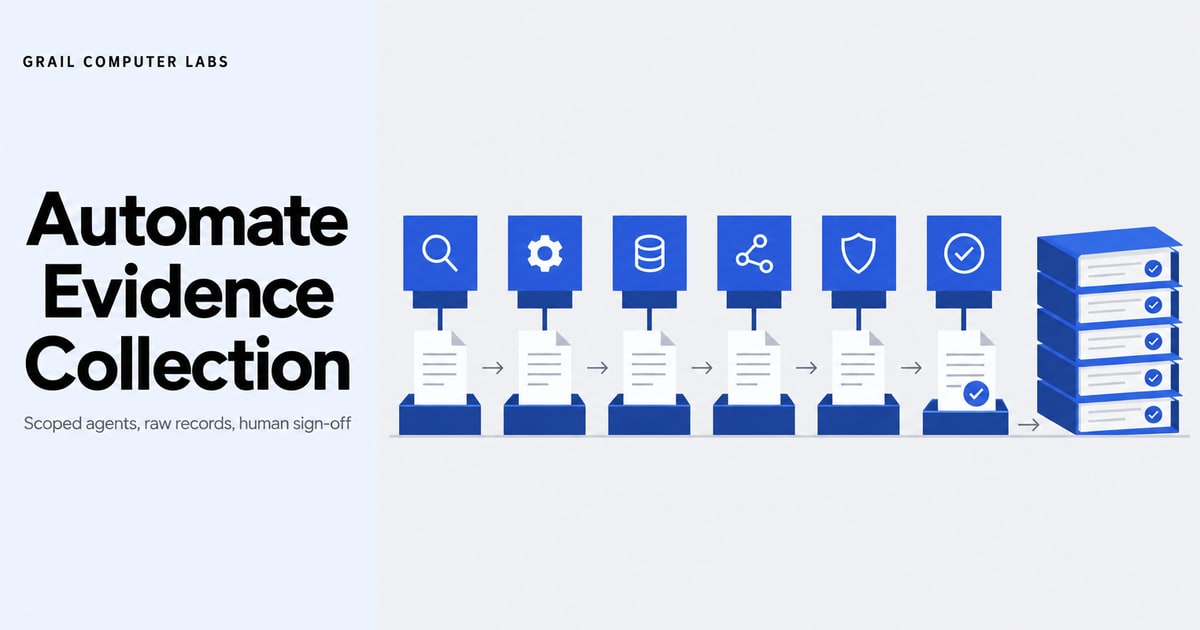
Automating evidence collection using AI agents is a six-step process: map each control to a system of record, issue each agent a read-only identity, capture raw records with a timestamp and hash, let a model summarise them, route exceptions to a named human, and log every tool call. The method is defined by what the agent may touch and what it must leave behind.
Flat illustration of six numbered stepping stones leading to a locked evidence vault
The six steps
Map each control to one system of record. List the control, the system that proves it (ticketing, source control, identity provider, cloud logs) and the query that returns the proof. Verify the map by running each query by hand once.
Issue each agent its own identity with least privilege. An agent identity is a distinct credential issued to one AI agent so that every action traces back to it. Least privilege is the practice of giving an agent only the access its current task needs, for only as long as it needs it. Start read-only.
Capture the raw result, not a description of it. Store the query, the returned rows or log lines, the time, and a hash. A hash is a fixed-length fingerprint of a record that changes if even one character changes.
Let the model summarise and map. The model drafts the control narrative and flags gaps such as a missing approver or a stale version. The summary links back to the raw record.
Route exceptions to a named human. Missing approvals, policy exceptions and risk acceptance go to an owner. The agent does not decide them.
Log every tool call and test the stop. Keep a central log of what each agent called and returned. Then confirm that revoking an agent's access works before the first audit period starts. Kiteworks' 2026 vendor survey of 459 organisations found 79% have no automated mechanism to terminate a misbehaving agent (Kiteworks, 2026). Treat that as a signal, not a benchmark, and test your own stop control.
Who does what at each step
Step
What the agent does
What a human does
Evidence produced
1. Map controls
Drafts a control-to-source list
Approves the map
Versioned control map
2. Issue identities
Nothing (set up by engineers)
Grants read-only, task-scoped access
Access grant record
3. Capture raw records
Runs queries, stores results with hash
Spot-checks a sample
Timestamped, hashed artefacts
4. Summarise
Drafts narrative, flags gaps
Reviews wording
Summary linked to raw record
5. Route exceptions
Opens a remediation item
Decides and signs
Approval and reviewer notes
6. Log and stop
Writes tool-call log
Tests revocation
Central agent log
Grail Computer Labs keeps a shorter policy evidence collection workflow page for teams that want the summary version. The steps above add what that page leaves out: agent identity, record integrity and the build pipeline behind the evidence.
How to build a software factory using AI agents?
A software factory is a pipeline in which AI agents execute defined stages of the software development life cycle (SDLC) while humans approve each gate, so every stage leaves a record. Grail Computer Labs (GC Labs) runs its Software Factory as Triage → Specify → Implement → Review → Verify → Release, and the same loop yields audit evidence by design.
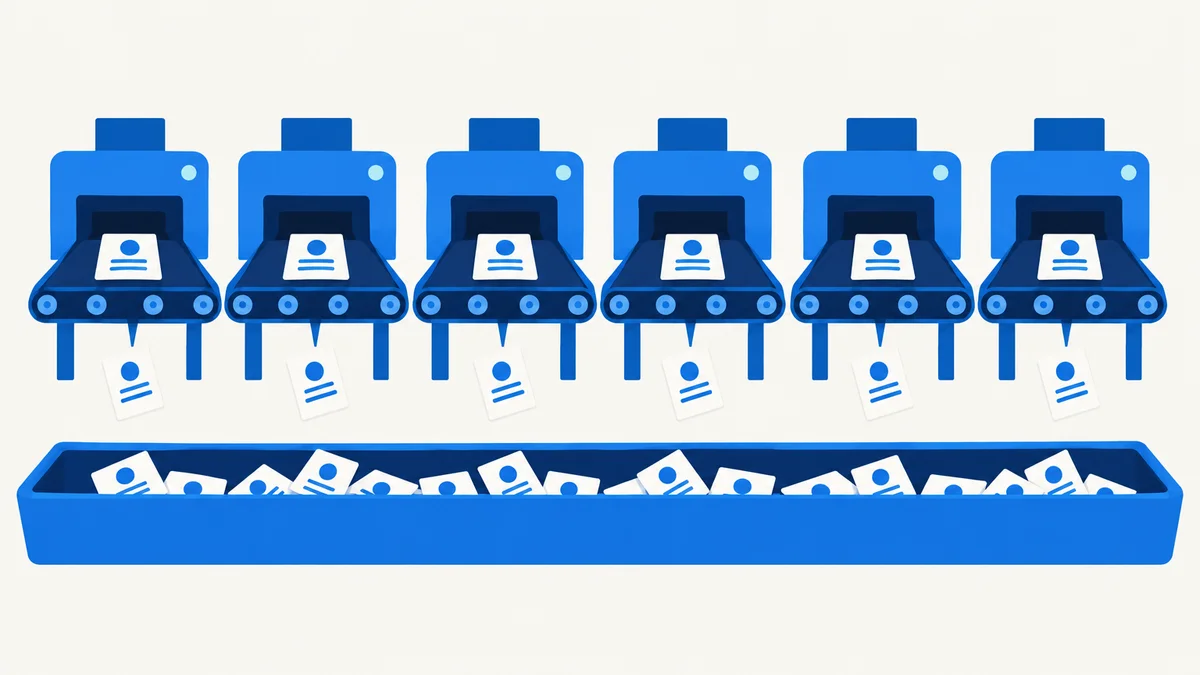
Flat illustration of a six-stage conveyor with a stamped record leaving each stage
Why the pipeline needs evidence stages
Trust is the reason to build it this way. In the 2025 DORA survey of nearly 5,000 technology professionals, 90% use AI at work and 30% report little or no trust in AI-generated code (Google Cloud, 2025). The DORA authors add that "AI adoption does continue to have a negative relationship with software delivery stability." (Google Cloud, 2025) Verification and evidence stages answer that gap directly.
Build the factory in five steps
Define the stages and the record each one emits. Write down what enters and leaves each stage before any agent runs.
Separate the agent from its actions. GC Labs uses a sandboxed agent, a permissioned runner that executes approved actions, and a permission ledger that records every grant. Rules written into an agent's prompt are instructions, not boundaries. The only reliable way to prevent an AI agent from doing something is to make it physically impossible.
Make tests reject incomplete work. A change that fails verification does not reach Release.
Put a named human at each decision gate. Agents execute, humans decide, customers see progress. This is not AI replacing engineers.
Store every output with its hash. Specs, diffs, review comments, test runs and release notes become the evidence set.
What each stage emits
Stage
Agent executes
Human decides
Evidence emitted
Triage
Classifies the request
Accepts or rejects scope
Ticket with owner and priority
Specify
Drafts the specification
Approves the spec
Versioned spec and approver
Implement
Writes the change in a sandbox
Nothing yet
Diff and agent trace
Review
Prepares the review summary
Engineer reviews every change
Pull request approval log
Verify
Runs tests
Reviews failures
Test run record
Release
Prepares the release
Approves deployment
Release history
Pull request approvals and policy-as-code checks can serve as change-management records, with no separate audit-prep project. An auditor decides which criteria these records support, so ask the auditor before mapping them.
Our data: Grail Computer Labs' own case-study data: in a one-week build for a Singapore-based neobank, a human-reviewed know-your-transaction (KYT) workflow raised automated approvals from approximately 44% to approximately 90% in testing.
How do you keep agent-collected evidence trustworthy?
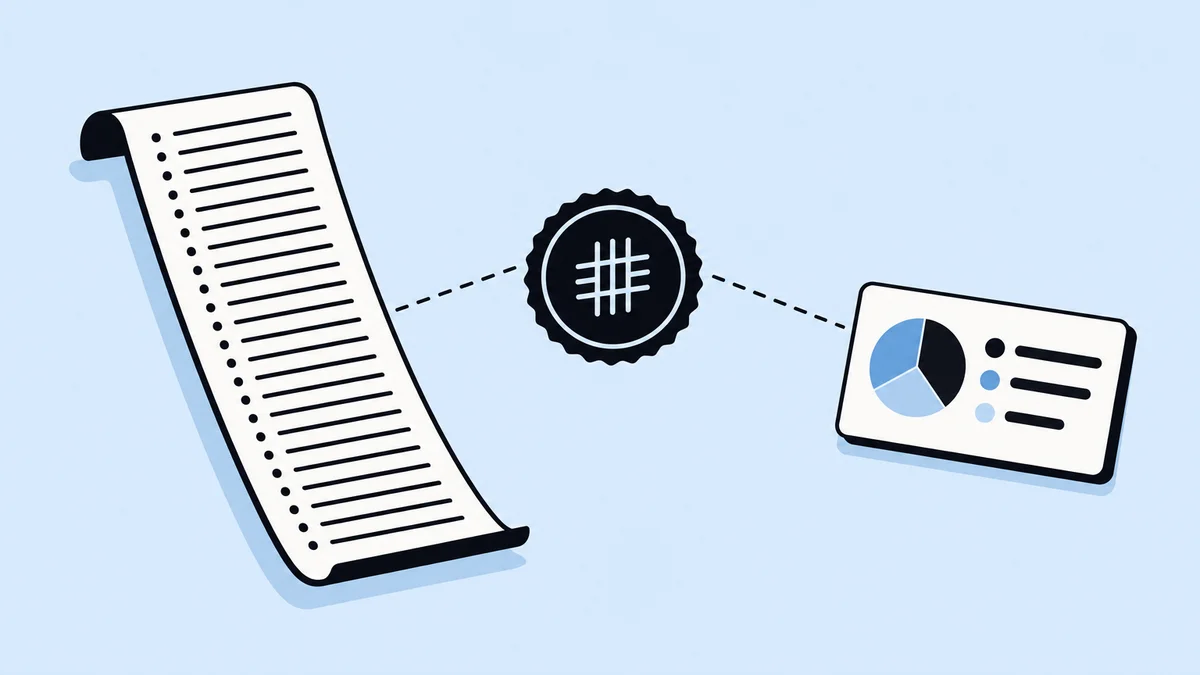
Agent-collected evidence stays trustworthy when the evidence is the raw system result, stored with a timestamp and a hash, and the language model only summarises it. Agents cannot sign opinions, accept risk or vouch for controls they cannot observe. This matters because 86% of surveyed US organisations are testing AI agents and nearly half already run them in production (ESG Dive, 2026).
Flat illustration of a raw log page beside a hash seal and a short summary card
Live agents mean live actions, so the evidence set must cover what agents did, not only what policies say.
What the agent may and may not do
Task
Agent may
Agent may not
Gather records
Query systems it is scoped to
Widen its own access
Store evidence
Save raw results with a hash
Edit or replace stored records
Write narrative
Summarise and link to raw records
Present a summary as the evidence
Judge controls
Flag gaps and stale versions
Sign opinions or accept risk
Unobservable controls
Ask a human for an attestation
Vouch for what it cannot see
Three controls that make it real
Forrester's 2026 analysis of agentic software development carries a section titled "Testing And Governance Will Become More Critical, Not Less" (Forrester, 2026). Three controls put that into practice:
Per-agent identity. Every action traces to one agent, so the log answers who did what.
Task-scoped authorisation. Access ends when the task ends.
A tested kill switch. Revoke access, then confirm the agent can no longer reach the system.
GC Labs' Software Factory masks likely secrets before they reach an agent and records agent traces. Both are design choices, not policy text.
Which regulations and frameworks shape AI agent evidence in Asia-Pacific?
Several 2026 instruments in Singapore and Australia affect AI agent evidence, but the details below come from secondary reports, not primary texts. The Monetary Authority of Singapore (MAS) finalised AI risk management guidelines on 7 October 2026, covering AI agents (LeapRate, 2026). Australia's September 2026 ISM release added central logging of tool calls for agents (Solcis, 2026).
Flat illustration of a map outline with timeline markers and document stacks
Instrument
Date
What it means for evidence
Source (secondary)
MAS Guidelines on AI Risk Management
Final 7 Oct 2026; Sections 3-4 from 7 Oct 2027; Sections 5-6 from 7 Oct 2028
Keep AI inventories and show monitoring, human oversight and change management; financial institutions remain accountable for third-party AI
Human approval before sensitive actions (ISM-2113); agent identity and registers, least privilege, task-scoped authorisation, central logging of tool calls
Financial-services and healthcare platforms are likely to be asked about these rules first. Every row comes from a secondary report. A compliance lead should confirm each date and requirement against the primary regulator text before relying on it.
Who is this approach not for, and what can agents not do?
Automated evidence collection with AI agents is not for teams that want an agent to make compliance judgements, and it does not replace an auditor. Agents gather, organise and summarise records, while people interpret controls and sign conclusions. Schellman's 2026 survey found only 27% of US enterprises describe their governance programmes as fully mature (Schellman, 2026), so human sign-off still carries the weight.
Controls without a system of record. Automated evidence collection has nothing to gather if proof lives only in someone's head. Write the control down first.
Unproven hour savings. We have no independent before-and-after benchmark for hours saved by automated evidence collection, so we give none. Teams should measure their own baseline before starting.
No certification by association. Grail Computer Labs holds no SOC 2 or ISO 27001 certification. Automating evidence collection does not certify anyone.
Sample bias in the sources. The survey evidence behind automated evidence collection is limited. The OneTrust survey is vendor-sponsored and Schellman's sample is US-only.
Frequently Asked Questions
How do AI agents automate evidence collection for SOC 2 or ISO 27001?
AI agents automate evidence collection for SOC 2 or ISO 27001 by querying each system of record on a schedule with read-only, task-scoped credentials, saving the raw result with a timestamp and hash, and mapping it to the relevant control. A language model drafts the summary. A named human reviews exceptions and signs off the final packet.
Can an AI agent pass a SOC 2 audit?
No. An AI agent can gather and organise evidence, but it cannot sign an opinion, accept risk or vouch for a control it cannot observe. An independent auditor performs a SOC 2 audit. What an agent can do is shorten preparation by keeping a complete, current, traceable evidence packet ready for that auditor.
Is LLM-generated output acceptable as audit evidence?
A summary written by a large language model (LLM) should not be the evidence itself. The evidence should be the raw system query or log result with a timestamp and hash, and the LLM should only summarise it. Whether an auditor accepts a given artefact is the auditor's decision, so keep the raw record linked to every summary.
What should an AI agent audit trail capture?
An AI agent audit trail should capture which agent identity acted, the task it was authorised for, each tool call with its inputs and outputs, the time, the human who approved any gated action, and the hash of every stored artefact. Australia's September 2026 ISM release adds central logging of tool calls to its agentic AI controls, as reported by Solcis in 2026.
How long should AI agent audit logs be retained?
The retention period for AI agent audit logs depends on the framework you are assessed against, your regulator and your auditor, so confirm it before setting a policy. Keep the raw record, its hash and the tool-call log together for at least the full audit period, and agree archive tiers with the auditor.
What is an AI software factory?
An AI software factory is a pipeline in which AI agents carry out defined stages of the software development life cycle and humans approve each gate. Because every stage runs inside the pipeline, every stage can write a record of what was specified, changed, tested and released, which makes audit evidence a byproduct of the build.
Conclusion
Automating evidence collection with AI agents is an architecture decision before it is a tooling decision. Five points carry the argument:
Map every control to a system of record before any agent runs.
Issue each agent its own read-only, task-scoped identity.
Store raw results with a timestamp and hash, and let the model only summarise.
Build the pipeline as a software factory so each stage emits its own record.
Keep people in charge of interpretation, exceptions and sign-off.
The next step is small. Pick one control set, run the six steps for one audit period, and compare the effort with the last manual cycle. Teams that want help scoping one pre-defined outcome can talk to us. We agree the outcome first, deliver it in 4 to 8 weeks, then keep shipping. Book a call ↗