Blog
Software Development Project Rescue: What the First 30 Days Involve
How software development project rescue works: triage, codebase inheritance, outcome agreement, stabilisation and release, anchored in a real 30-day case.

Autonomous AI agents execute; human-in-the-loop assistants suggest. Compare quality, audit trails and accountability for enterprise engineering teams.
How software development project rescue works: triage, codebase inheritance, outcome agreement, stabilisation and release, anchored in a real 30-day case.
Enterprise AI guardrails explained: instruction-based vs architecture-based controls, plus a go-live checklist for data access, action scope and fallback.
A legacy system is software that is hard to change safely. See the warning signs, the improve-or-rebuild test and a phased migration plan for real platforms.
Request a quote and our experts will contact you within 24 hours with tailored solutions and pricing.
You can also send us a quick email at [email protected].
Last updated: Nov 12, 2026
By Shiva Mangal, Grail Computer Labs. Updated 28 October 2026.
Autonomous AI agents plan and carry out multistep coding work and return a finished change, while human-in-the-loop coding assistants propose each step and wait for a developer to accept, edit or reject it. For autonomous AI agents vs human-in-the-loop coding assistants for enterprise teams, the real choice is who holds decision authority and what the record shows afterwards. Most vendor comparisons rank tools by autonomy level and skip that question. This article defines both models, reviews the evidence on quality and security, and maps which decisions belong to an agent and which to an engineer.
Key Takeaways
- Human-in-the-loop coding assistants keep a developer deciding at every step; autonomous coding agents decide within the permissions they are given.
- Autonomous coding agents are spreading quickly: agent use among developers rose from 31% in Stack Overflow's 2025 survey to 59% in an April 2026 pulse, though the two samples differ, so the jump is directional.
- Unreviewed AI-generated code carries measurable security and review costs in published vendor studies, including a 56% average security pass rate across 100+ models.
- An enterprise audit trail for AI coding agents must name the approving engineer and record the agent version, policy version, commit and tests.
- Singapore's IMDA agentic AI framework says humans must be meaningfully accountable, so agents execute, engineers decide, and every approval is recorded.
Autonomous AI coding agents plan and carry out multistep work across a repository, then hand back a finished change. Human-in-the-loop coding assistants suggest code and wait for a developer to accept each step. The gap is decision authority, not capability. In Stack Overflow's 2026 survey, 65.9% of developers used coding assistants or agents, but only 26.2% used AI agents or automated workflows (Stack Overflow, 2026).

A human-in-the-loop coding assistant is an AI tool that proposes code or actions and waits for a developer to accept, edit or reject each step. An autonomous AI coding agent is an AI system that plans and executes multistep coding work with limited step-by-step supervision and returns a finished change. Real products sit on a spectrum between the two. The useful question is where a named human decides.
| Dimension | Human-in-the-loop assistant | Autonomous agent |
|---|---|---|
| Who decides each step | The developer | The agent, within set permissions |
| Unit of work | A line, function or file | A ticket, branch or pull request |
| Review point | Every suggestion | End of the task, if configured |
| Main risk | Slow throughput, rubber-stamped accepts | Unreviewed changes at volume |
| Audit question | Which suggestions were accepted | What the agent did and who approved it |
| Best fit | Security-sensitive or unfamiliar code | Well-specified, reversible tasks |
The survey had 17,464 respondents and allowed multiple answers. The data is self-reported, so read it as direction.
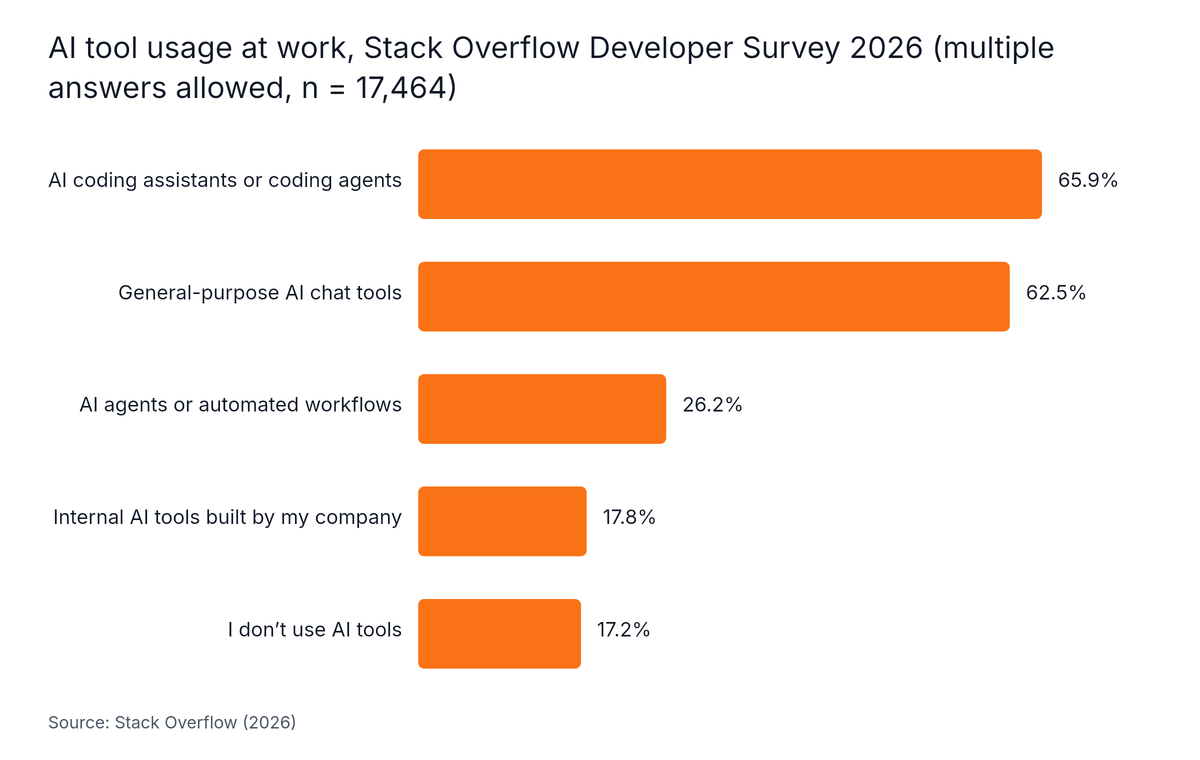
Source: Stack Overflow, 2026
Assistants win on control. Agents win on throughput. Neither wins on accountability by default, because that depends on what the team records. Our page on human-in-the-loop versus autonomous agents applies the same trade-off to business workflows.
AI-generated code passes security tests only about 56% of the time across 100+ models (Veracode, 2026). In CodeRabbit's study of 470 pull requests, AI co-authored pull requests averaged 10.83 issues, against 6.45 for human-only ones (CodeRabbit, 2025). Adoption is wide, but measured quality lags it, so unreviewed agent output carries real security and review costs.
Stack Overflow reported that agent use roughly doubled, from 31% in its 2025 survey to 59% in an April 2026 pulse (Stack Overflow, 2026). The two samples differ, so treat the jump as directional.
Veracode tracked 100+ models with no security prompting. Syntax was nearly always correct. Even so, roughly 44% of tasks introduced a risky vulnerability. The average pass rate of 56% has barely moved from 55% in the first report (Veracode, 2026). This is vendor research, so read it as direction, not a universal rate.
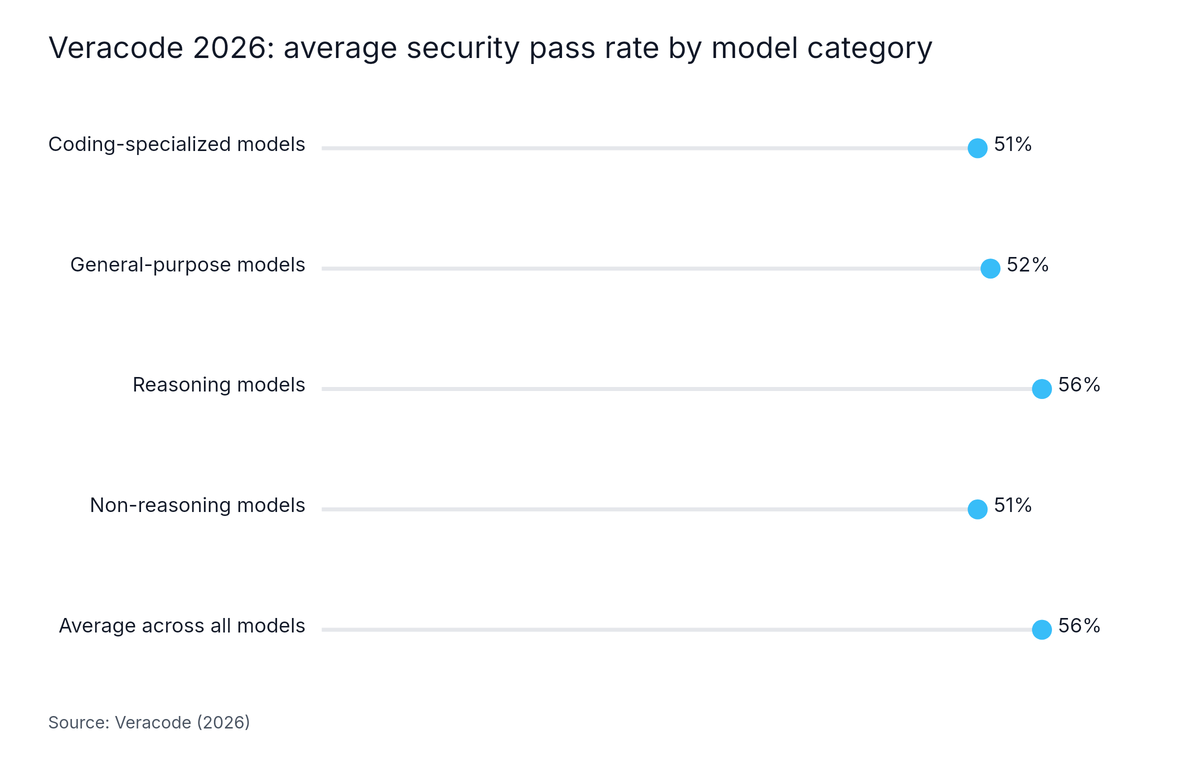
Source: Veracode, 2026
CodeRabbit found security issues up to 2.74× higher in AI-authored pull requests. That peak was in one category, cross-site scripting (CodeRabbit, 2025). Across all categories, AI co-authored pull requests averaged 10.83 issues and human-only ones 6.45.
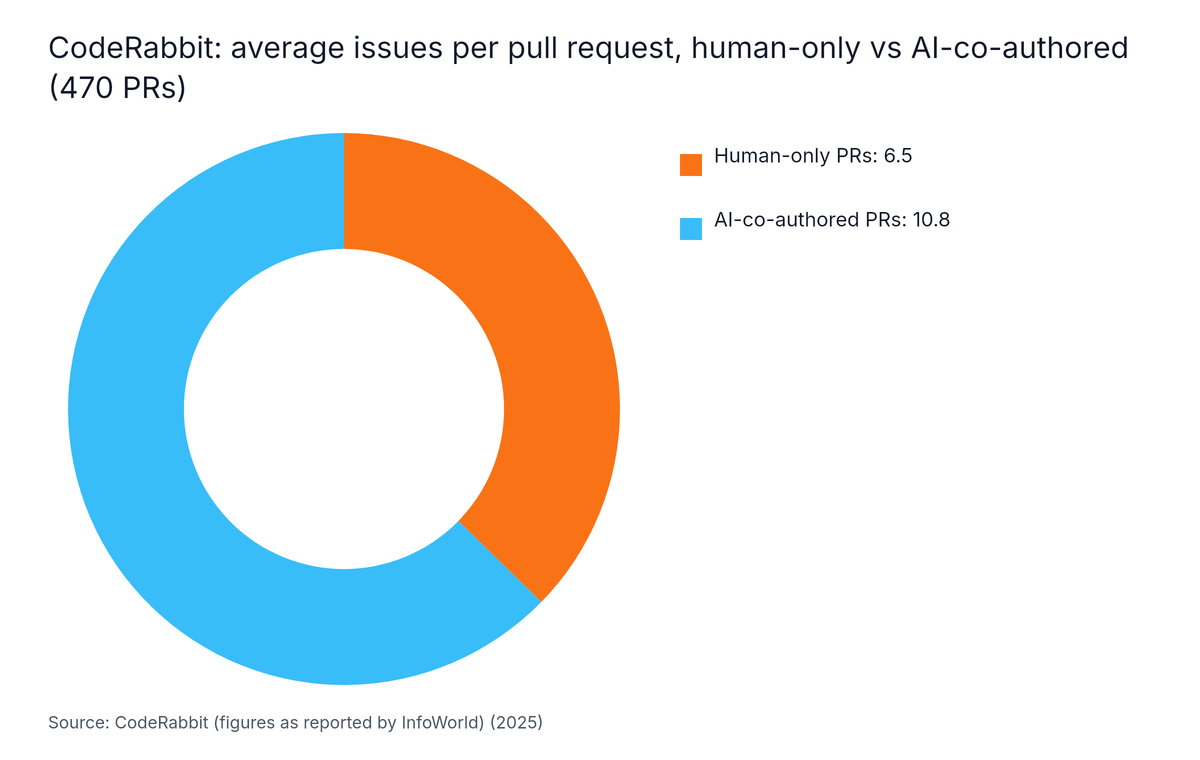
Source: CodeRabbit (figures as reported by InfoWorld), 2025
The Google Cloud DORA team found 90% of respondents use AI at work and more than 80% believe it raised their productivity. Even so, AI adoption still related negatively to delivery stability (Google Cloud, 2025). The team's summary: "AI accelerates software development, but that acceleration can expose weaknesses downstream." (Google Cloud DORA team, 2025)
Perception can also mislead. A 2025 randomised trial by METR found experienced developers took 19% longer with AI tools while believing they were about 20% faster (METR, 2025). METR has since called that result outdated. We use it only to show that felt speed and measured outcomes can differ.
An agent trace is the recorded sequence of what an AI agent did, under whose delegation, and with what result. A usable trace separates "agent did it" from "engineer approved it". It records the agent and version, the delegating human, the policy version, the commit, the tests run and the named approver. Only 6.6% of developers trust AI for important decisions (Stack Overflow, 2026).

| Trace field | What it records | Why an auditor needs it |
|---|---|---|
| Agent identity and version | Which agent and model produced the change | Reproduce or roll back a behaviour |
| Delegating human | Who assigned the task | Establish who set the scope |
| Policy version | Permissions and rules in force | Show the agent stayed inside bounds |
| Commit and diff | Exactly what changed | Link the record to the code |
| Tests and results | What ran and what passed | Prove the change was verified |
| Human approval | Named engineer, time, decision | Prove a person accepted it |
Trust depends on verification. In 2025, 46% of developers distrusted the accuracy of AI tools and 33% trusted them. Only 2.6% of experienced developers "highly trusted" them (Stack Overflow, 2025). The same analysis points to "a widespread need for human verification for those in roles with accountability" (Stack Overflow, 2025).
Automation bias is the tendency of a reviewer to approve a machine's output without genuinely checking it. A rubber stamp is not accountability. Singapore's IMDA recommends monitoring human override rates and response times (Baker McKenzie, 2026). If an engineer never rejects anything, or approves in seconds, the trace shows a gate that does not work.
Agents suit well-specified execution inside reversible boundaries, such as implementing a scoped ticket or writing tests. Engineers should own decisions that are hard to undo: architecture, data models, security-sensitive changes and production actions. Only 6.6% of developers say they would trust AI for important decisions (Stack Overflow, 2026).
The mapping below is our working rule, not a regulatory list.
| Decision type | Who decides | Agent's role |
|---|---|---|
| System architecture and service boundaries | Engineer | Draft options, never choose |
| Data model and schema changes | Engineer | Propose migrations for review |
| Security-sensitive changes (auth, secrets, permissions) | Engineer | Implement only against an approved spec |
| Production deploys and irreversible actions | Engineer | None without explicit approval |
| Scoped feature or bug ticket | Engineer approves the result | Implement and test |
| Test writing, refactors, documentation | Engineer approves the result | Implement within set limits |
Assign each decision type an owner before rollout. Start agents with read-only access. Widen permissions only as the trace shows the gates working.
Singapore's IMDA Model AI Governance Framework for Agentic AI, launched on 22 January 2026, says humans must be meaningfully accountable and that significant checkpoints should trigger human approvals (Stephenson Harwood, 2026). Its mid-2026 update adds logging, monitoring and human approvals as core agent components (Baker McKenzie, 2026). It is a framework, not a certification.
The IMDA Model AI Governance Framework for Agentic AI is Singapore's guidance on governing AI agents. It has four dimensions:
The 2026 update also separates platform providers from the system providers or app developers who build on them. That split matters for enterprise teams. Buying an agent platform does not move accountability away from the team that deploys it.
Safety depends on the controls around the agent, not on the agent alone. The sources reviewed for this article include no banking or healthcare rules written for coding agents, so we make no sector claim. Two facts are relevant. AI-generated code passed security tests about 56% of the time in Veracode's 2026 data. DORA found AI adoption still related negatively to delivery stability. Regulated teams should require named approvals, passing tests and a full trace. Then they should confirm sector rules with their regulator.
Agents can execute while engineers decide when the workflow separates the two roles: agents implement changes, a named engineer reviews every change, tests reject incomplete work, and the trace records the approval. Grail Computer Labs builds this into GC Labs' Software Factory. Forbes revisited Gartner's forecast that over 40% of agentic AI projects may be cancelled by 2027, citing weak governance and rollback controls (Forbes, 2026).

GC Labs' Software Factory is a proprietary AI software factory customised around each client's codebase. It moves work through six stages:
The principle is: agents execute, humans decide, customers see progress. This is not AI replacing engineers. Access can begin read-only. Likely secrets are masked before they reach an agent. Deployment can sit on client infrastructure, with zero data retention where required.
Our data: On an Australian healthcare platform, GC Labs handled 500 bug and feature tickets across a 10-day period. In a human-reviewed know-your-transaction (KYT) workflow for a Singapore-based neobank, a one-week build raised automated approvals from approximately 44% to approximately 90% in testing.
These are GC Labs' own customer results, not independent research. They show that human review and high throughput can coexist. They do not show that every team will see the same numbers.
GC Labs' agents-execute, engineers-decide model is not for teams that want fully unattended code changes or maximum throughput with no review cost. Review adds time by design. Developers share the caution: 87% of respondents were concerned about the accuracy of AI agents in Stack Overflow's 2025 survey (Stack Overflow, 2025). The model also does not replace certification: GC Labs holds no SOC 2, ISO 27001 or HIPAA certification.
The limits run in both directions:
As Stack Overflow's CEO put it, "AI is a powerful tool, but it has significant risks of misinformation or can lack complexity or relevance" (Prashanth Chandrasekar, Stack Overflow, 2025). The answer is verification, not avoidance.
An autonomous AI coding agent plans and executes multistep work across a repository and returns a finished change, while an AI coding assistant suggests code that a developer accepts, edits or rejects step by step. The practical difference is decision authority: the assistant keeps the developer deciding at every step, and the agent decides within the permissions it was given.
Human-in-the-loop means a named person must review or approve an AI agent's work at defined points before it takes effect. For coding agents, that usually means an engineer reviews the pull request, tests must pass, and the approval is recorded. It only counts as accountability if the reviewer can reject the work and the record shows who did.
Autonomous coding agents can be used in regulated industries only with controls that keep named engineers accountable. The sources reviewed here include no banking or healthcare rules written for coding agents. Singapore's IMDA framework, launched in January 2026, says humans must be meaningfully accountable (Stephenson Harwood, 2026). Teams should require approvals, tests and a trace, then confirm sector rules with their regulator.
In published studies, yes. Veracode's 2026 report found AI-generated code passes security tests about 56% of the time across 100+ models (Veracode, 2026). CodeRabbit's 2025 study of 470 pull requests found AI co-authored pull requests averaged 10.83 issues against 6.45 for human-only ones (CodeRabbit, 2025). Both are vendor studies, so treat them as direction.
Humans stay accountable: Singapore's IMDA Model AI Governance Framework for Agentic AI, launched in January 2026, says humans must be meaningfully accountable (Stephenson Harwood, 2026). In practice, that points to the organisation that deployed the agent and the engineer who approved the change. A trace naming the approving engineer makes that accountability provable.
Assistants win on line-by-line control. Agents win on throughput for well-specified work. Neither wins on auditability unless the trace records the approver. Enterprise teams should carry these points into the decision:
To see how GC Labs' Software Factory applies this to a stalled or high-risk project, Book a call ↗.
© 2026 Grail Computer All rights reserved.