Best Finance Operations Automation Software: Controls to Require Before an AI Agent Approves Payments
best finance operations automation softwareai agent for financeapproval thresholds for AI agents
Best Finance Operations Automation Software: Controls to Require Before an AI Agent Approves Payments
Choosing finance automation software? Check the approval thresholds, exception routing and audit logging an AI agent needs before it touches a payment.
Nov 27, 2026
Last updated: Nov 27, 2026
Best Finance Operations Automation Software: Controls to Require Before an AI Agent Approves Payments
By Shiva Mangal, Grail Computer Labs. Published 28 October 2026.
The best finance operations automation software is software that lets an AI agent act only inside the approval limits, exception routes and audit logs a finance team has set, because controls matter more than speed once an agent can touch a payment. A Singapore-based neobank raised automated approvals from approximately 44% to approximately 90% in testing after a one-week build. Speed was not the hard part. Before an AI agent touches a payment or a close step, approval thresholds, exception routing and audit logging have to exist. This guide shows where automation removes the most manual work in a finance close, which controls to demand from any tool, and where full automation backfires. It is written for CFOs and heads of finance operations.
Key Takeaways
AI automation in a finance close removes the most manual work at evidence gathering, matching, exception sorting and approval staging, not at the final release of money.
Five controls come first for any finance AI agent: role-based limits, agent identity, approval thresholds, exception routing and an audit log with a kill switch.
Only 9% of surveyed finance leaders would let an AI agent approve or release a third-party payment automatically (OvationCXM, 2026).
Month-end journals, reconciliations and accruals need maker-checker rules for AI agents as much as payments do.
The Monetary Authority of Singapore holds financial institutions accountable for the AI they use, including AI supplied by vendors.
Where does AI automation make the biggest dent in a slow finance close?
AI automation makes the biggest dent in a finance close where work is repetitive, evidence-based and reviewable: gathering invoice and beneficiary context, matching transactions, sorting clean items from exceptions, and staging approvals. Gartner lists accounts payable and receivable automation among finance AI use cases that pay back in about nine to 10 months (Gartner, 2026). Judgement steps stay with people.
A finance operations desk with invoices sorted into two neat trays, one clean and one flagged
Four tasks absorb most of the manual effort in a close and approval cycle:
Evidence gathering. Pulling the invoice, beneficiary record, policy limit and reconciliation context for each item.
Matching. Comparing transactions against ledgers and purchase records.
Sorting. Splitting clean items from those that need judgement.
Staging. Preparing the approval packet in the tool the approver already uses.
An agent can do all four without releasing a single payment. That is where the hours sit.
Our data: Grail Computer Labs' own project data: a Singapore-based neobank's manual transaction review took 30+ minutes, and a one-week build raised automated approvals from approximately 44% to approximately 90% in testing. A small financial-services operator had approximately 2 hours per day of admin removed and processed 360 submissions in its first 10 days.
The neobank figure is a testing result, not a production outcome. It also exposes the real question. Moving auto-approval from 44% to 90% means an agent now decides far more items alone. Each of those decisions needs a limit, a route for doubt and a record.
What controls does a finance team need before an AI agent can approve or initiate a payment?
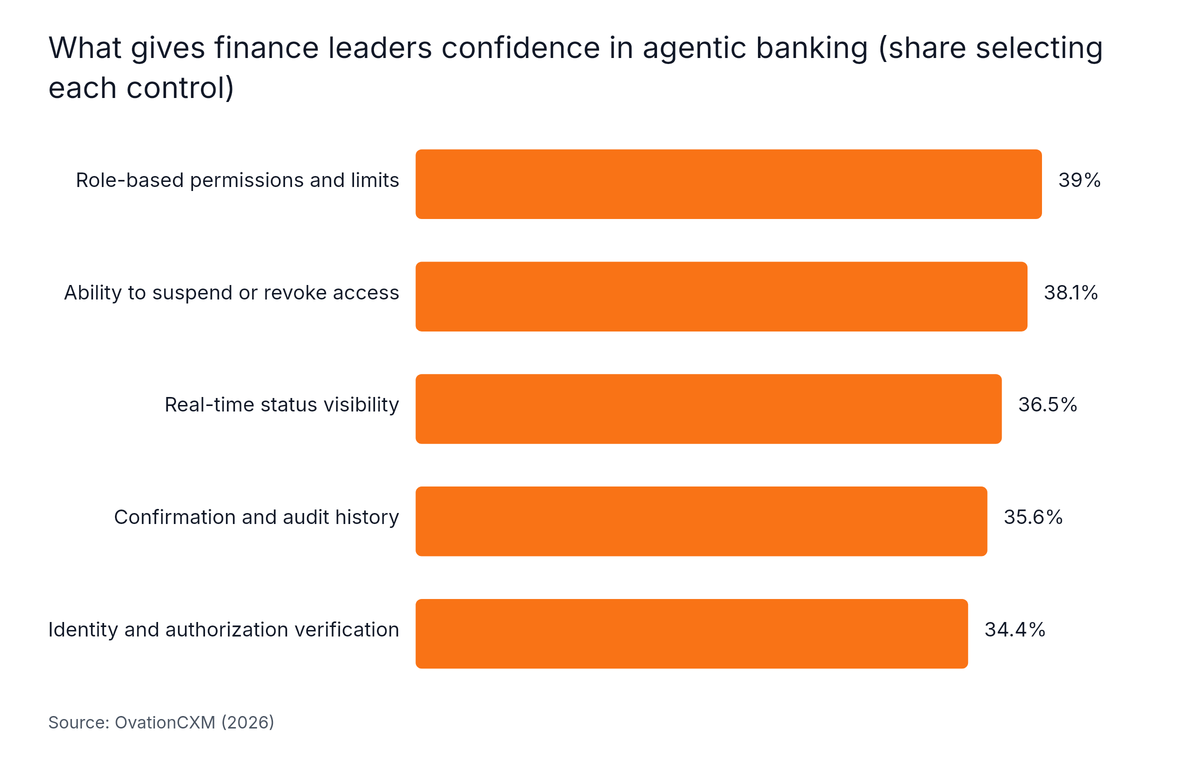
Before an AI agent can approve or initiate a payment, a finance team needs five controls: role-based permissions and limits, a verified agent identity, approval thresholds with human escalation, exception routing for unusual payees, and an audit log with a kill switch. In an OvationCXM survey of 520 US finance leaders, role-based permissions and limits ranked first at 39% (OvationCXM, 2026).
Five brass padlocks of different sizes lined up along a steel rail, representing layered payment controls
The table maps each control to what it does and to the survey result. The percentages are the share of finance leaders who said each control would give them confidence in agentic banking. OvationCXM sells banking-connectivity software, so the findings are vendor research.
Proves which agent acted and under whose authority
34.4%
Horizontal Bar chart: What gives finance leaders confidence in agentic banking (share selecting each control). Highest: Role-based permissions and limits at 39%.
The spread in the OvationCXM survey is narrow, from 39% at the top to 34.4% at the bottom (OvationCXM, 2026). Finance leaders want all five, not one. A rule written into an agent's prompt is an instruction, not a boundary. The only reliable way to prevent an AI agent from doing something is to make it physically impossible, for example by granting read-only access until a human grants more.
How should approval thresholds work for an AI agent in accounts payable?
An approval threshold is a value or risk limit above which an AI agent may prepare a payment but a human must release it. Finance leaders set these limits cautiously: only 9% would let an agent approve or release a third-party payment automatically, while about 49% would let it at least initiate one (OvationCXM, 2026).
Four wooden steps of increasing height, the top step closed off by a rope barrier
A workable design is an autonomy ladder, a set of outcomes that scale an agent's freedom to the risk of each action. The Monetary Authority of Singapore's SAFR white paper describes four outcomes for a proposed agent action: it executes, is flagged, pauses for human approval, or is denied. The table turns that into an accounts payable policy. The example triggers are suggested starting points, not regulatory values.
Outcome
What the agent does
Example trigger
Execute
Acts and logs
Low-value payment to a long-standing payee with a matched invoice
Execute and flag
Acts, then queues the item for sampled review
Mid-value payment with a minor mismatch inside tolerance
Pause for human
Prepares the packet and waits
New beneficiary, changed bank details or a limit breach
Deny
Refuses and alerts the owner
Payee on a block list or a request outside the agent's permissions
Limits should vary by payee type as well as amount. A small payment to a new beneficiary carries more risk than a large one to a payee paid monthly for years.
Segregation of duties is the principle that no single actor can both create and approve the same transaction. It applies to agents. An agent that drafts a payment batch must not also hold the authority to release it. The preparing agent and the releasing step need different identities, and a human owns release above the threshold.
How should exception routing and audit logs work for an AI finance agent?
Exception routing is the rule that sends any payment an AI agent cannot clear with confidence to a named human queue instead of letting it proceed. Triggers should include changed vendor bank details, new beneficiaries and threshold breaches. Business email compromise affected 74% of organisations in 2025 (AFP, 2026), and vendor impersonation is the case routing must catch.
A ledger book open beside a magnifying glass and a stack of folders with red flag tabs
Design the exception queue
A good exception queue has four features:
a named owner for each exception type, not a shared inbox;
a time limit, so a paused payment does not sit unseen;
the full evidence packet attached, so the reviewer does not rebuild the case;
a rule that the agent cannot reopen or clear its own exception.
Our payment approval workflow page describes the approval packet idea in shorter form.
Specify what the audit log captures
An audit log is a time-ordered, tamper-evident record of every action an agent proposed, took or was refused. For each payment or close action, it should capture:
the agent's identity and the permissions it held;
the evidence and inputs it used;
the rule or threshold it applied;
the outcome: executed, flagged, paused or denied;
the human approver, if any, and the decision;
the timestamp.
The log must also be exportable. A log that cannot be handed to an auditor is a feature, not a control.
Which month-end close steps need AI agent controls too?
Month-end close steps such as journals, reconciliations and accruals need the same agent controls as payments, built on maker-checker: one party prepares an entry, a different party approves it, and an agent never approves its own work. COSO's February 2026 guidance extends the 2013 Internal Control Framework to generative AI, including automated transaction processing and autonomous task execution (Deloitte DART, 2026).
A month-end calendar page with a row of checklist cards, some ticked and some waiting for review
The risk is real. In the AFP's 2026 survey, 76% of US organisations experienced attempted or actual payments fraud in 2025 (AFP, 2026). COSO's chair, Lucia Wind, named the wider risk: "GenAI can be confidently wrong, easily manipulated, or deployed outside formal oversight channels" (Lucia Wind, COSO, 2026).
The COSO roadmap has six steps: govern, inventory, assess, design, implement and monitor. For a close, "inventory" means listing every close step an agent touches before anything is switched on.
Close step
What the agent may do
Control to require
Transaction matching
Propose matches and flag breaks
Evidence kept for each match; unmatched items routed to a named owner
Journal entries
Draft entries
A different person approves; no self-approval
Accruals
Calculate and propose
Reviewer signs off; source data retained
Payment release
Stage the batch
Human release above the threshold; log of the decision
Teams should start with steps where a wrong answer is visible and reversible, such as matching and evidence gathering. In Grail Computer Labs' own project data, one Singapore-based neobank had eight transaction checks live in under 30 days.
What do MAS expectations mean when choosing finance operations automation software?
Singapore financial institutions remain accountable for AI agents they deploy, including agents supplied by vendors. The Monetary Authority of Singapore (MAS) issued final Guidelines on AI Risk Management on 7 October 2026, with governance expectations from 7 October 2027 and lifecycle controls by 7 October 2028. MAS states "FIs remain accountable for AI used in the services they deliver" (MAS, 2026).
That accountability line shapes software selection. If a vendor's agent approves a bad payment, the financial institution (FI) still answers for it. The table lists questions to put to any vendor, as a suggested checklist rather than a regulatory text.
Control
Question for the vendor
Evidence to request
Action-level audit trail
Can every agent action be exported with inputs, rule applied and outcome?
A sample log export
Kill switch
Can access be revoked at once, and are queued actions held?
A live demonstration of revocation
Permissions
Can limits be set by role, payee type and amount?
The permission configuration screen or document
Agent identity
Does the preparing agent differ from the releasing step?
An identity and role diagram
SAFR (Safeguards for Agentic Finance at Runtime) is a voluntary framework published by MAS and industry on 3 July 2026. It describes "governance checkpoints that verifies and records an AI agent’s proposed actions before the execution of its tasks" (MAS, 2026). Its four components are agent identity, a controls repository, a disposition engine and an audit log. They line up with the controls above.
Two limits apply. SAFR is voluntary, and MAS plans to consult on additional agentic AI guidance in 2027, so detail may change. Australian expectations from APRA and ASIC were not part of the research behind this guide.
Limitations: who this controls-first approach is not for
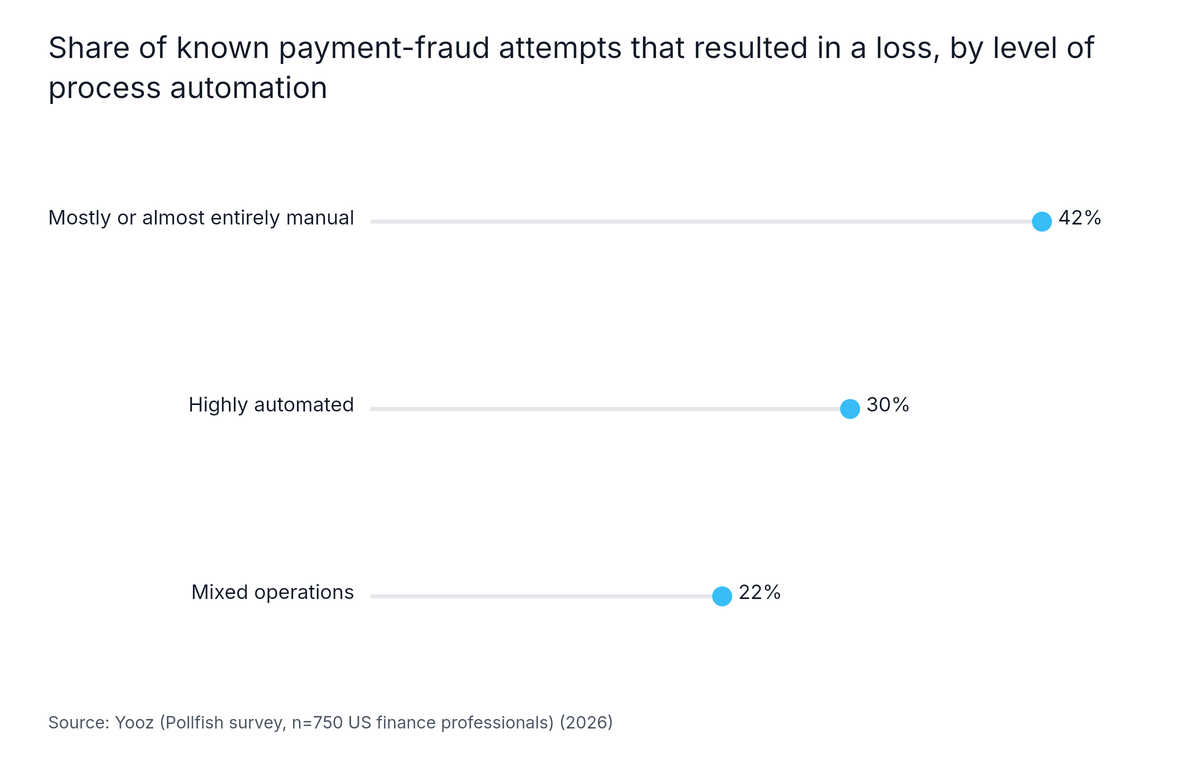
Full automation is not automatically safer. In a July 2026 Yooz survey of 750 US finance professionals, mostly manual teams lost money in 42% of known fraud attempts, against 30% for highly automated teams and 22% for mixed operations (Yooz, 2026). Yooz sells AP automation, so treat the figures as vendor research.
Lollipop chart: Share of known payment-fraud attempts that resulted in a loss, by level of process automation. Highest: Mostly or almost entirely manual at 42%.
Mixed operations lost least, at 22%, while highly automated teams lost 30% (Yooz, 2026). The data does not show that more automation is worse. It shows that automation without matching controls does not remove risk. This approach has limits:
It is not for teams that want agents to release payments with no human step. Only 9% of surveyed finance leaders would allow that (OvationCXM, 2026).
It is not a fit where approval policies are undocumented. An agent cannot apply limits nobody has written down.
The neobank result was a testing result from a one-week build. Production results depend on data quality and exception volume.
Frequently Asked Questions
What controls does a finance team need in place before an AI agent can approve or initiate a payment?
A finance team needs role-based permissions and spending limits, a verified agent identity, approval thresholds that escalate to a human, exception routing for new or changed payees, and an audit log of every action. It also needs a way to suspend or revoke the agent's access immediately if the agent behaves unexpectedly.
What approval thresholds should apply to an AI agent in accounts payable?
Approval thresholds should limit an AI agent to preparing payments above a value and risk ceiling that the finance policy sets. New beneficiaries, changed bank details and policy overrides should always pause for a human. Thresholds should be set by payee type as well as amount, and reviewed regularly against actual exceptions.
What should an audit log capture for an AI agent's payment or close action?
An audit log should record the agent's identity, the evidence it used, the rule or threshold it applied, the outcome (executed, flagged, paused or denied), the human approver if one was involved, and a timestamp. Entries should be tamper-evident and exportable so auditors can reconstruct each decision later.
How do finance teams stop an AI agent that has gone wrong?
A finance team stops a misbehaving AI agent by revoking its credentials and permissions, ideally from a single control that works at once, and by holding any queued actions for human review. The agent should act through a permissioned runner, so removing access makes further action physically impossible rather than just discouraged.
Conclusion
The best finance operations automation software proves its controls before it shows its speed. Five points carry the argument:
Automate evidence gathering, matching, sorting and staging first, where manual hours concentrate.
Require role-based limits, agent identity, approval thresholds, exception routing and an audit log with a kill switch.
Use an autonomy ladder: execute, execute and flag, pause for human, deny.
Apply maker-checker and no self-approval to journals, reconciliations and accruals.
Treat vendor accountability as the buyer's own: MAS holds institutions accountable for the AI they deploy.
Next step: list every step in the close and payment cycle, then mark each one execute, flag, pause or deny. The steps marked "pause" are where controls must exist before an agent goes live. To map these controls onto a specific approval flow, Book a call ↗.