business application modernizationlegacy platform blocks AIimprove-or-rebuild decision
Business Application Modernization: Where to Start When Your Legacy Platform Blocks AI and Integrations
Legacy platform blocking AI or integrations? Decide what to keep, wrap, migrate or retire, then move in phases without stopping the business. Worked example.
Nov 1, 2026
Last updated: Nov 1, 2026
Business Application Modernization: Where to Start When Your Legacy Platform Blocks AI and Integrations
Business application modernization is the work of moving an ageing platform onto a stack that can support new AI features and integrations, in controlled stages, without stopping the systems customers and staff rely on. The pressure is concrete. In a 2026 survey, 84% of CIOs and CTOs at companies with $500M+ revenue said legacy-system limits made their organisation cancel an AI pilot or project (GFT Technologies, 2026). When a platform blocks every AI feature or integration, the team needs a starting point that does not freeze the business. This guide gives a keep, wrap, migrate or retire rule for each component, a phased path, and a worked 1.5-million-line rebuild.
Key Takeaways
A legacy platform blocks AI when each new feature or integration needs changes to the core code, and 95% of 945 surveyed CIOs and CTOs say legacy systems slow AI deployment and scaling (Unite.AI reporting GFT Technologies, 2026).
Business application modernization is usually triggered by a dated event such as an audit finding or an inherited codebase, and 48% of 250 UK IT and risk leaders had already faced compliance challenges in audits because of outdated IT (Cloudhouse, 2025).
The improve-or-rebuild decision is made per component, and 52% of organisations already modernise applications in place rather than replace them outright (Ensono, 2026).
Phased migration, with old and new systems in parallel, avoids the big-bang rewrite, and 61% of organisations paused, scaled back or abandoned modernisation work in 24 months (Ensono, 2026).
In Grail Computer Labs' reference case, an Australian healthcare platform went from 8 months stuck to live in production within 30 days after 1.5 million lines of code were inherited and rebuilt.
How can a team tell its legacy platform is blocking AI?
A legacy platform is blocking AI when every new feature or integration needs changes to the core code instead of a connector. The pattern is common: 95% of 945 CIOs and CTOs surveyed said legacy systems slow their ability to deploy and scale AI (Unite.AI reporting GFT Technologies and Wakefield Research, 2026).
Server racks with tangled cables and one dark, unlit connector port
A legacy platform is any production system whose design limits how fast it can be changed, regardless of its age. Four signs show up in delivery before they show up in a report:
Each integration needs custom changes in the core code, not configuration.
Fixing one defect breaks something else. One Grail Computer Labs client described it this way: "Even a small bug fix could take days or a week, and fixing one problem often broke something else."
No documented APIs exist, so data is reachable only through the database.
Releases are rare and manual, and nobody can say what a change will affect.
The scale is wide. In the same GFT and Wakefield Research survey, 99% said AI runs on or connects to legacy systems (Unite.AI, 2026). Separately, 68% of respondents to a Savanta survey said legacy systems and applications stop their organisation fully adopting modern technologies such as AI (Pegasystems, 2025). Both surveys are vendor-sponsored. The 84% GFT figure (GFT Technologies, 2026) counts respondents who cancelled at least one project. It is not a project failure rate.
Which trigger events force business application modernization?
Business application modernization is usually forced by a dated event, not a planning cycle. Two recur: a security or compliance audit that flags the platform, and an acquisition that inherits a codebase nobody on the team wrote. In a 2025 survey of 250 UK IT and risk leaders, 48% had already faced compliance challenges in audits because of outdated IT (Cloudhouse, 2025).
A printed audit report with highlighted lines on a desk beside a laptop
Each trigger exposes something different, so the first move differs too:
Scope the finding to named components and fix those first
Acquisition inherits a codebase
Code nobody on the team wrote, unknown business rules
Run a read-only review, then rank components by business value and fragility
AI or integration plan is blocked
No API or event surface to attach to
Put an API in front of the data and workflows the feature needs
Fear of the outcome is widespread. 93% of tech leaders believe running AI on unmodernised legacy infrastructure will eventually trigger an enterprise-wide security crisis (GFT Technologies, 2026). That is a belief, not an incident count.
Regulation adds dates. APRA's CPS 230 operational risk standard took effect on 1 July 2025 for APRA-regulated banks, insurers and super funds, with some requirements for smaller entities applying from 1 July 2026 (Cybernion, 2026). Australian law firm MinterEllison argues that "legacy systems don't have to be a liability" (MinterEllison, 2026), and recommends gradual transitions with strong fallback plans.
Where do we start modernising our legacy platform: improve or rebuild?
The improve-or-rebuild decision starts with an inventory, not a verdict: list each component, then decide to keep, wrap, migrate or retire it. Most organisations already lean towards keeping: 52% modernise applications in place rather than replace them outright (Ensono, 2026).
Wooden building blocks sorted into four colour groups on a table
The improve-or-rebuild decision is the call, made per component, on whether to keep and extend existing code or replace it. The rule set has four outcomes:
Decision
Rule
Signal
Action
Keep
Stable business logic and data model that support reliable releases
Tests pass, defects are rare, rules are understood
Leave in place and add tests
Wrap
Brittle integration surfaces whose logic still works
Every integration is custom
Put an API in front
Migrate
The worst-coupled modules that block change
Fixing one thing breaks another
Replace in phases
Retire
Features with no real use
No traffic, no owner
Remove
Keep-first has support in the data. 78% of IT decision-makers say legacy systems matter more to their organisation today than two years ago, because of the data, business logic and stability AI depends on (Ensono, 2026). Ensono's advice is to "Evaluate where legacy systems provide the data, business logic, and operational stability AI depends on" (Channel Insider, 2026).
Layering AI over workflows nobody has examined is a mistake. Deloitte's CTO, Bill Briggs, warned that organisations doing so risk that "they're going to weaponize inefficiency against themselves" (Digital CxO, 2026). Fix the data and integration surface first, then refactor the core.
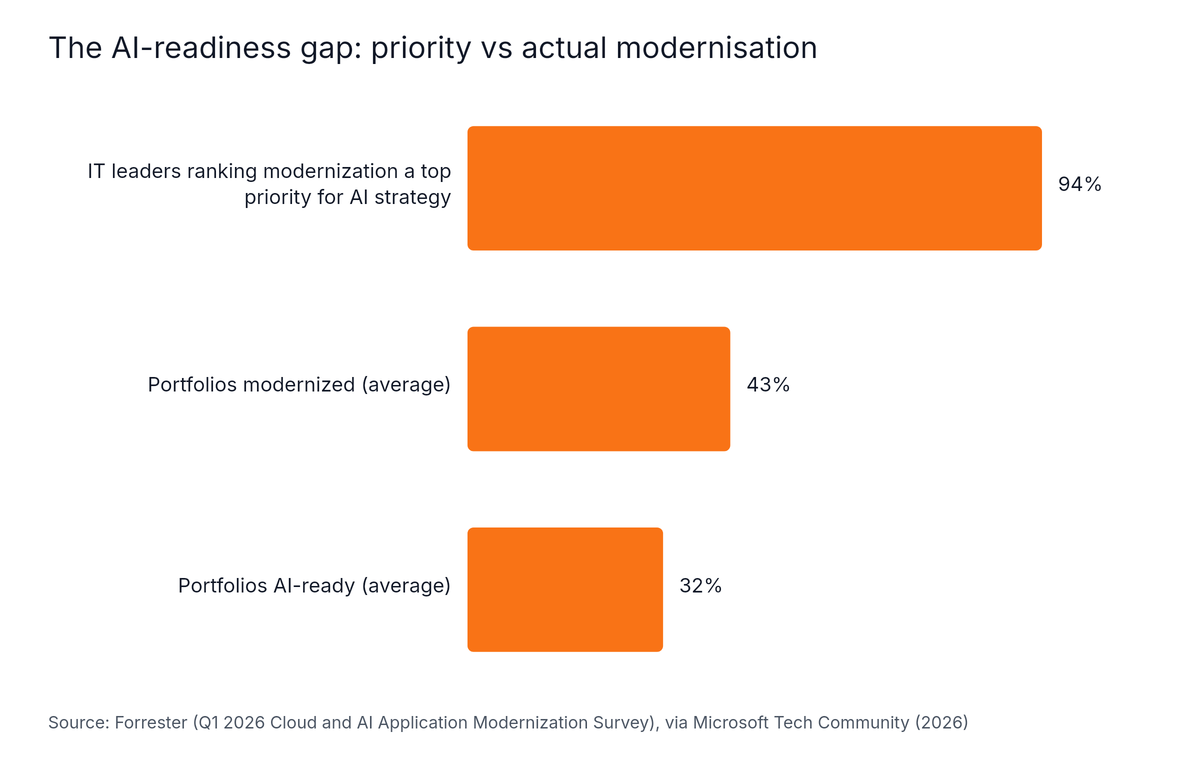
The gap between intent and progress is large. In Forrester's Q1 2026 survey, as published by Microsoft, 94% of IT leaders called modernization a top priority for their AI strategy. On average only 43% of portfolios were modernised and 32% were AI-ready (Forrester, via Microsoft Tech Community, 2026). Microsoft sells modernisation tooling, and the page does not give a sample size.
Horizontal Bar chart: The AI-readiness gap: priority vs actual modernisation. Highest: IT leaders ranking modernization a top priority for AI strategy at 94%.
How do we assess an inherited codebase and recover undocumented business rules?
Assessing an inherited codebase starts with a read-only review that ranks components by business value and fragility, then recovers undocumented business rules by writing tests against current behaviour. The work is hard because monoliths hide their logic: 58% of IT leaders named monolith complexity as a modernisation obstacle (Forrester, via Microsoft Tech Community, 2026).
A hand-drawn notebook page of rules and test cases beside a printed code listing
A business rule is a decision the software makes on the organisation's behalf, such as who is eligible, what a fee is, or when a record is locked. In an old platform, many rules exist only in code. Four steps recover them before anything is replaced:
Review the code and data read-only, so nothing changes while the team learns the system.
List the components and rank each by business value and fragility.
Write tests that record what the platform does today for real inputs, including odd ones.
Ask the people who use the platform which behaviours they depend on, and add a test for each.
A rule that has a test cannot be lost quietly. The replacement module must pass the same tests as the old one. Rules that fail this check get a decision from the business: keep, change or drop.
How do we migrate in phases without stopping the business?
Phased migration moves one slice of a platform at a time while the old and new systems run side by side. Gartner's 2H26 CIO Report recommends this approach (ProgramBusiness reporting Gartner, 2026). The risk to avoid is a big-bang rewrite: 61% of organisations paused, scaled back or abandoned modernisation work in the past 24 months (Ensono, 2026).
A new bridge section being built beside an older bridge still carrying traffic
A big-bang rewrite is a rewrite that replaces an entire platform in a single cutover. A phased path replaces that single bet with a series of small, reversible ones:
Baseline the current behaviour with tests, so every later change has something to be checked against.
Expose data and workflows through APIs or a read-only layer, so AI features have a surface to attach to.
Pick the worst-coupled module and build its replacement beside it.
Run old and new in parallel, and route traffic to the new slice only after it is verified.
Retire the old code once nothing depends on it, then repeat with the next module.
This is the strangler fig pattern: new components grow around the old system and take over its functions one slice at a time.
What stalls phased work
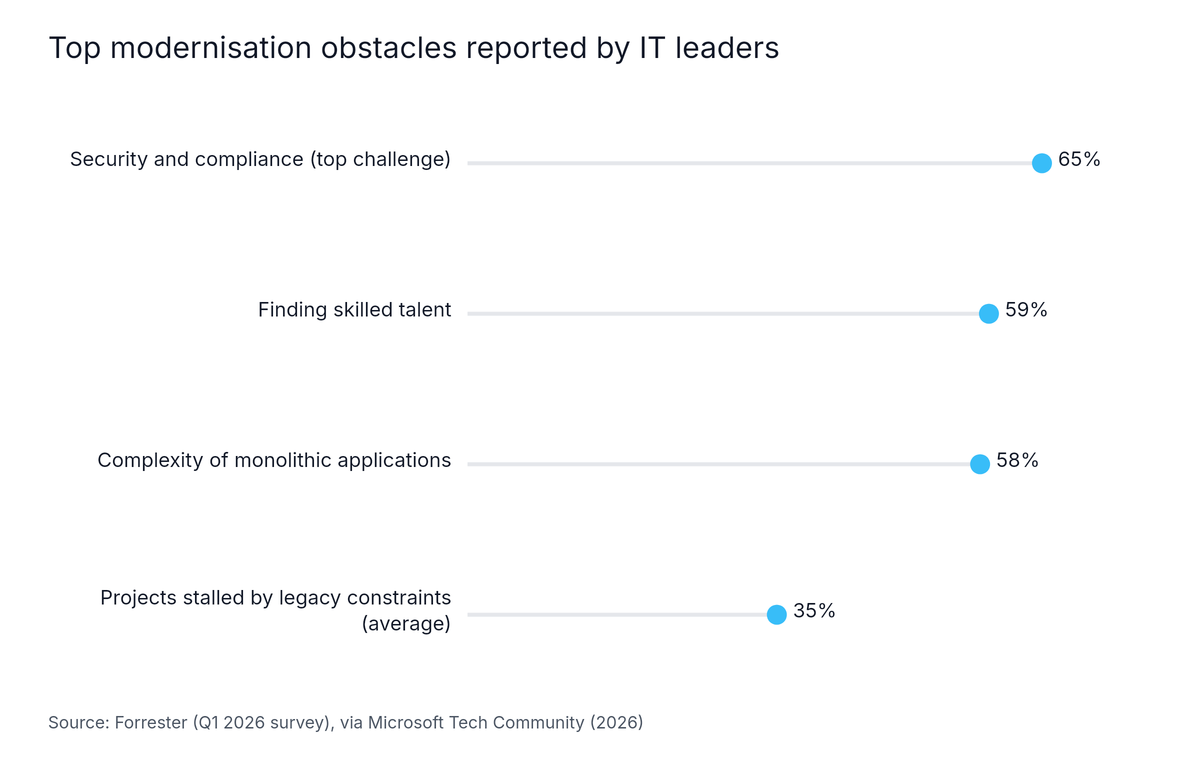
Forrester's Q1 2026 survey, as published by Microsoft, lists the main obstacles. Security and compliance came first at 65%, followed by finding skilled talent at 59% and monolith complexity at 58%. On average, 35% of projects stalled because of legacy constraints (Forrester, via Microsoft Tech Community, 2026).
Lollipop chart: Top modernisation obstacles reported by IT leaders. Highest: Security and compliance (top challenge) at 65%.
The evidence is mixed. Gartner expects GenAI to cut application modernisation costs by 30% by 2028 (ProgramBusiness reporting Gartner, 2026). Gartner also predicts that more than 70% of mainframe exit projects started in 2026 will fail to deliver intended benefits because GenAI migration capability is overestimated (Gartner, 2026). Treat AI tooling as speed for engineers who review every change, not as a substitute for them.
One more caution. Figures such as "most rewrites fail" circulate without a primary source, so this post does not use them. The measured signals above are less tidy than a single statistic, but they are real.
What did a 1.5-million-line rebuild look like in practice?
Grail Computer Labs inherited 1.5 million lines of code from the previous vendor of an Australian healthcare platform and rebuilt it (Grail Computer Labs case study, as of October 2026). The platform had been stuck in development for 8 months and went live in production within 30 days. Forrester reports that on average 35% of projects stall on legacy constraints (Forrester, via Microsoft Tech Community, 2026).
Our data: The Australian healthcare platform, a managed-service business running a multi-party platform, was stuck in development for 8 months with no clear deadline. It went live in production within 30 days. By day 40, 100 business customers had been onboarded, and 500 bug and feature tickets were handled across a 10-day period.
Three lessons follow from those figures:
A live platform is the real test. By day 40, 100 business customers had been onboarded, so the rebuilt platform carried real users, not a demo.
Throughput matters more than line count. Handling 500 bug and feature tickets in a 10-day period shows the inherited code could be changed and released again.
Risk worries are fair. Clients raise the concern that a big-bang migration feels very risky. The answer is the keep-first logic in this guide: keep what supports reliable releases, and migrate the rest in phases.
Grail Computer Labs has not published the phase breakdown or cutover order for this engagement, so this post does not describe one. The phased steps above are a general method, not a record of that project. It is one anonymised case, and every client stays unnamed by choice. It shows that a large inherited codebase can reach production without an indefinite feature freeze. It does not prove that every platform behaves the same way.
Grail Computer Labs agrees the outcome first, delivers it in 4 to 8 weeks, then keeps shipping.
Who is this approach not for?
A phased, keep-first approach to business application modernization is not for every platform. It fits a live system with paying users and rules worth preserving. It fits poorly for mainframe exits, where Gartner predicts more than 70% of projects started in 2026 will fail to deliver intended benefits (Gartner, 2026), or when no one can test the platform.
The limits, stated plainly:
No tests and no owner of the rules. Phasing needs a baseline. If business rules are undocumented, the first phase is recovering and testing them, which takes time before any feature ships.
Certification requirements. Grail Computer Labs holds no SOC 2, ISO 27001 or HIPAA certification. It completes vendor security and compliance assessments as part of onboarding.
Security-led obstacles. Security and compliance was the top obstacle at 65% in Forrester's Q1 2026 survey (Forrester, via Microsoft Tech Community, 2026), and phasing does not remove it. Controls still have to be met component by component.
Thin evidence. Most survey data here comes from vendors, and the reference case is a single anonymised engagement.
Frequently Asked Questions
When should we rebuild a legacy platform instead of modernising it incrementally?
Rebuild a legacy platform component when it cannot support reliable releases, when fixing one defect keeps breaking something else, and when its business rules can be recovered and tested. Keep components that are stable and understood. The improve-or-rebuild decision is made per component, not for the whole platform at once.
What is the strangler fig pattern?
The strangler fig pattern is a migration method in which new components are built around an old system and take over its functions one slice at a time. Traffic is routed to the new slice once it is verified. The old code is retired only when nothing depends on it.
How do we add AI features when our legacy platform has no APIs?
Add a read-only access layer or API wrapper in front of the legacy platform's data and workflows, and attach AI features to that layer instead of the core code. This gives the AI feature a stable surface to call and leaves the legacy system untouched while deeper changes are planned.
How do we avoid losing undocumented business rules during a rewrite?
Avoid losing undocumented business rules by writing tests against the legacy platform's current behaviour before replacing any module. Each test records what the old system does with a given input. The new module must pass the same tests, so a rule nobody remembered is caught before cutover.
What do we do when an audit flags our legacy system?
When an audit flags a legacy system, scope the finding to the named components, fix those first, and keep the rest running under a phased plan with a fallback for each step. The first deliverable is a short list of affected components, owners and fixes, not a full rewrite.
Conclusion
Legacy platforms rarely fail on one day, but they get exposed on one: an audit finding, an acquisition, or an AI plan that cannot ship. Start with what the evidence supports.
Inventory components and decide keep, wrap, migrate or retire for each.
Recover business rules as tests before replacing any module.
Fix the integration surface before refactoring the core.
Migrate in phases with old and new running in parallel, and treat a big-bang rewrite as the risk.
Use the 1.5-million-line case as a reference for what a live, onboarded platform looks like after a stall.
The next step is to scope one pre-defined outcome that can be delivered in 4 to 8 weeks: Book a call ↗