Blog
Software Development Project Rescue: What the First 30 Days Involve
How software development project rescue works: triage, codebase inheritance, outcome agreement, stabilisation and release, anchored in a real 30-day case.

How businesses reduce manual work with workflow automation: set a baseline, separate time saved from work removed, and report metrics a CFO accepts.
How software development project rescue works: triage, codebase inheritance, outcome agreement, stabilisation and release, anchored in a real 30-day case.

Enterprise AI guardrails explained: instruction-based vs architecture-based controls, plus a go-live checklist for data access, action scope and fallback.
A legacy system is software that is hard to change safely. See the warning signs, the improve-or-rebuild test and a phased migration plan for real platforms.
Request a quote and our experts will contact you within 24 hours with tailored solutions and pricing.
You can also send us a quick email at [email protected].
Last updated: Nov 24, 2026
By Shiva Mangal. Shiva writes for Grail Computer Labs, an applied-AI and digital product research lab. His prior venture, Nurture Labs, had one product pass $2M in lifetime revenue.
Measuring the manual work eliminated by workflow automation means comparing a baseline taken before the build with the same measures after launch, for one defined unit of work. When businesses reduce manual work with workflow automation, the saving only counts if someone defined it in numbers first. MIT Project NANDA's 2025 report found that 95% of generative-AI pilots delivered no measurable P&L impact (legal.io, 2025). Teams rarely fail to build. They fail to say what "less manual work" means before they build. This guide sets out the measurement framework we recommend: how to baseline a process, how to separate time saved from work removed, which metrics to report, and where human oversight belongs.
Key Takeaways
- A baseline taken before the build, from logs or a timed sample, is what turns "less manual work" into a number.
- Hours saved alone is a weak metric: it counts freed time, not work removed or cash released.
- Operations teams should report cycle time, quality, financial value and oversight together, not one figure.
- Governing an intelligent workflow means setting approval, sampling and kill rules before launch, then measuring the human-override rate.
- The baseline-first framework needs enough case volume and system logs to work.
Businesses measure eliminated manual work by fixing a baseline before the build, choosing one countable unit of work, and comparing the same measures after launch. The core measures are touch time, elapsed time, touches per case, rework rate and touchless rate. Without that definition, 95% of generative-AI pilots show no measurable P&L impact (MIT Project NANDA, via legal.io, 2025).

Five measures cover most workflows:
| Measure | What it counts | Where the data comes from |
|---|---|---|
| Touch time | Minutes a person actively works on one case | Timed sample or task logs |
| Elapsed time | Calendar time from request to close, including waiting | Timestamps in the case system |
| Touches per case | Number of times a person handles one case | Audit trail or handoff log |
| Rework rate | Share of cases sent back or corrected | Status changes in the system |
| Touchless rate | Share of cases finished with no human action | Workflow logs |
Touch time is the minutes a person actively works on a case. Elapsed time is the calendar time from a request arriving to the case closing, including all waiting. The two diverge sharply in multi-party platforms, where handoffs between clients, workers and providers, plus exception handling, dominate the clock. Automation often cuts elapsed time more than touch time, so both need a number.
MIT Project NANDA's 95% figure needs care. The report is preliminary, self-reported and not peer-reviewed, and "no impact" was judged over roughly six months (legal.io, 2025). It says no profit-and-loss effect was visible. It does not say 95% of pilots crashed.
That is a measurement problem. If nobody wrote down the baseline, nobody can show an effect. Gartner expects over 40% of agentic AI projects to be cancelled by the end of 2027 (Gartner, 2025). Gartner also cites unclear business value as a cause, which is why the metric definition comes first.
A baseline is a measured record of how a process runs today, taken before any automation is built. Teams take it from system logs or a timed sample, not from memory. They choose one unit of work, record touch time, elapsed time, touches per case and rework rate, and write the target down before the build starts.

The touchless rate is the share of cases that complete with no human action. It is the cleanest single number for manual work removed, but only if step 2 is done.
Case volume sets the review window. A process with thousands of cases a month gives a stable before and after within weeks. A slow process needs longer. One option is MIT's roughly six-month horizon, the period over which "no impact" was judged. It is a reference point, not a rule. Pick the date before the build and keep it.
A UK Government Digital Service trial of Microsoft 365 Copilot across 20,000 government employees reported an average saving of 26 minutes a day, but the figure was self-reported (The Register, 2025). Self-reports are a useful signal. They are not a baseline. Ongoing run costs belong in the maths too: model tokens, human review time and maintenance all subtract from the saving.
Hours saved is a common but unreliable automation metric, because it counts time freed rather than work removed or money released. In the 2026 Wharton and GBK Collective survey, hours saved was the most common AI metric at 40% (BERI, 2026). A UK government trial's average of 26 minutes a day was self-reported (The Register, 2025).

Split "hours saved" into three figures:
Capacity redeployed is freed time that a team has put to a defined use. Without it, saved time is absorbed by more work. The UK trial reported: "Trial participants saved an average of 26 minutes a day when using M365 Copilot" (UK GDS, quoted by IDM, 2025). That is gross time saved. It says nothing yet about process change.
A Gartner survey published on 19 May 2026 found AI saves sellers 4.8 hours per week, yet 72% of sales organisations report low reinvestment of that time (Gartner, via Business Wire, 2026). The sample is sales teams, but the pattern applies to operations. Name the destination for freed hours before launch.
SolarWinds reports that among organisations using GenAI-enabled IT service management features, average incident resolution time fell from 27.42 hours to 22.55 hours, a saving of 4.87 hours per incident (SolarWinds, 2026). The report is vendor-run and specific to IT service desks, but the shape is right: one unit of work, one before value, one after value.
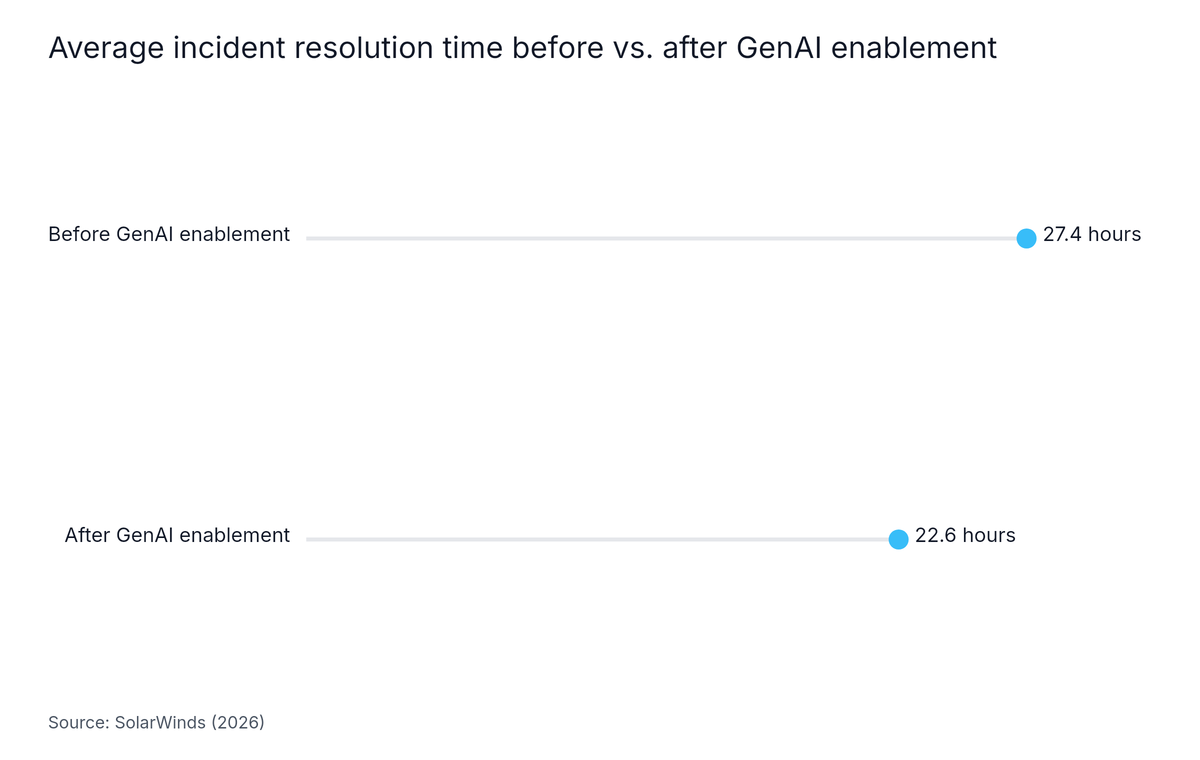
Source: SolarWinds, 2026
Our data: Grail Computer Labs' anonymised case studies report approximately 2 hours per day of admin removed for a small financial-services operator, with 360 submissions processed in the first 10 days. For a Singapore-based neobank, a manual transaction review took 30+ minutes, and a one-week build raised automated approvals from approximately 44% to approximately 90% in testing.
An operations manager should report four groups of numbers to the CFO: change in volume and cycle time, quality, financial value, and oversight. Financial value needs its own line, because 40% of surveyed organisations report AI reducing costs while only 20% report increasing revenue (Deloitte AI Institute, 2026).

| Metric | How to calculate it | What it tells the CFO |
|---|---|---|
| Touch time per case | Total active minutes divided by cases | Labour effort per unit of work |
| Rework rate | Cases sent back divided by cases handled | Quality and hidden cost |
| Touchless rate | Cases with no human action divided by cases | Share of manual work removed |
| Human-override rate | Agent outputs changed by a person divided by outputs | Whether the automation can be trusted |
| Run cost per case | Model, review and maintenance cost divided by cases | Net saving after running costs |
| Capacity redeployed | Hours moved to named work or cost released | Whether savings reached the P&L |
The same Wharton and GBK Collective survey found that 35% of departments tracking a growth metric reported strong AI ROI, against 13% of those tracking efficiency alone, and that net-new revenue was the least used metric at 27% (BERI, 2026). The authors flag this as a correlation, and BERI is a secondary write-up. We read it as a prompt to pair every efficiency number with an outcome the business already tracks, such as backlog, service-level breaches or revenue per case.
Governing an intelligent workflow means deciding in advance which steps an AI agent may complete alone, which need human approval and which are sampled afterwards, then tracking the human-override rate. In the 2026 Wharton and GBK Collective data, departments approving every action reached transformational success at 16%, against 31% for those using agents to the fullest extent (BERI, 2026).
An intelligent workflow is a business process in which an AI agent completes or prepares steps that a person used to do. Governance here is a measurement checkpoint, not a separate tool. Each oversight choice changes the numbers on the scorecard.
| Oversight model | Departments reaching transformational success (Wharton/GBK, 2026) |
|---|---|
| Agents used to the fullest extent | 31% |
| Advise-only | 25% |
| Sampling afterwards | 18% |
| Approving every action | 16% |
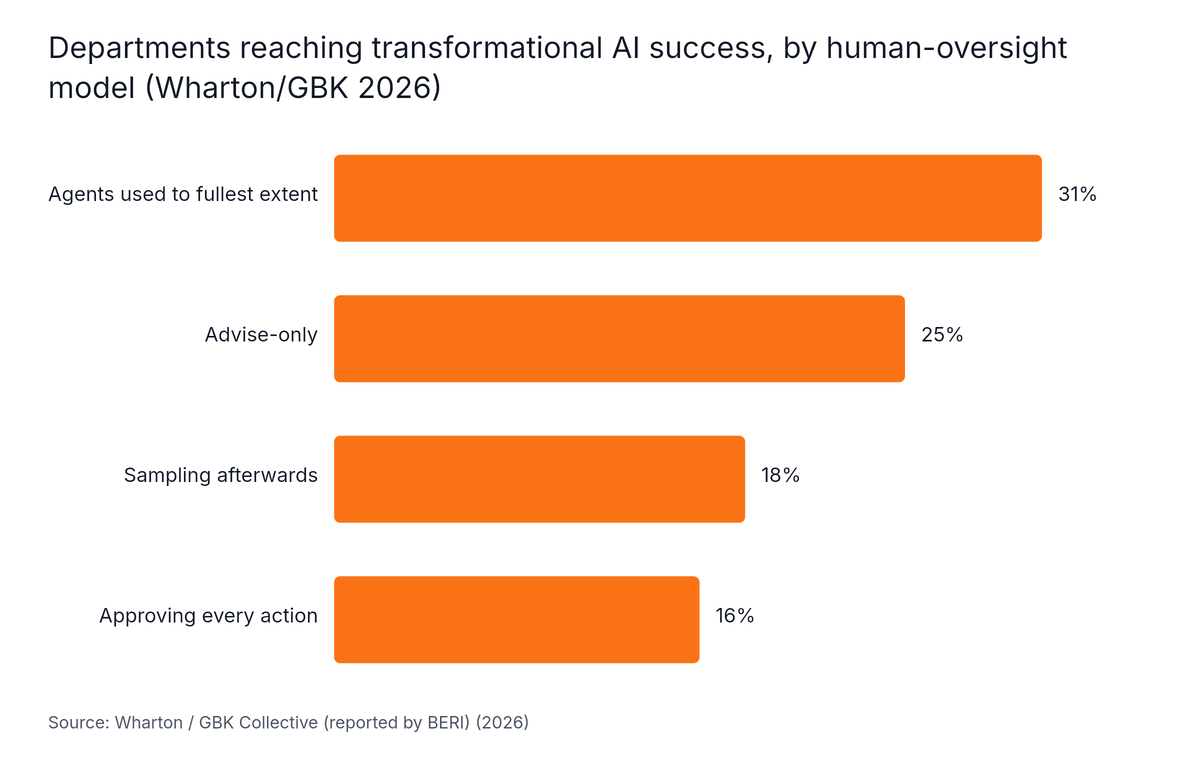
Source: Wharton / GBK Collective (reported by BERI), 2026
The same survey found that only 7% of organisations succeeded on all three of the study's markers (BERI, 2026). The results are correlational. They do not prove that removing approvals causes success. They do suggest that approving every action is associated with weaker outcomes.
Human approval belongs where judgement, regulatory risk or money movement sits, such as a transaction review. Sampling afterwards suits low-risk, high-volume steps. Advise-only fits steps where the agent drafts and a person decides. The override rate then shows whether the split is right: a rising rate means a step needs tighter review.
Singapore's IMDA launched its Model AI Governance Framework for Agentic AI on 22 January 2026, with four dimensions: bound risks upfront, make humans meaningfully accountable, implement technical controls, and enable end-user responsibility (Baker McKenzie, 2026). The pairing below is our own interpretation, not part of the framework:
| IMDA dimension | Metric we would pair with it |
|---|---|
| Bound risks upfront | Kill criteria written before launch |
| Make humans meaningfully accountable | Human-override rate, with a named owner |
| Implement technical controls | Audit-trail coverage |
| Enable end-user responsibility | Share of cases escalated to a person, with a recorded reason |
The baseline-first measurement framework for workflow automation is not for every team. It fails where a process runs too rarely to give a usable sample, where no system logs exist, or where the only evidence is self-reported time, as in the 26-minute UK trial (The Register, 2025). It also does not remove the need for human judgement on high-risk steps.
Four limits to keep in mind:
Intelligent workflows should be governed by deciding in advance which steps an AI agent completes alone, which need human approval and which are sampled afterwards, then measuring the human-override rate and audit-trail coverage. In 2026 Wharton and GBK Collective data, departments approving every action reached transformational success at 16%, against 31% for those using agents to the fullest extent (BERI, 2026).
Eliminated manual work is measured by comparing a pre-build baseline with post-launch logs for the same unit of work. Teams track touch time, elapsed time, touches per case, rework rate and touchless rate, then convert the change into capacity redeployed or cost released, so the result appears in a finance report rather than only in an hours-saved estimate.
Saved time is kept from being absorbed by more work by naming, before launch, where the freed hours will go and then measuring that redeployment. A Gartner survey published on 19 May 2026 found AI saves sellers 4.8 hours per week, yet 72% of sales organisations report low reinvestment of that time (Gartner, 2026). Track capacity redeployed next to time saved.
The wait before judging an automation pilot should be set by case volume, not by a fixed date. A process with thousands of cases a month can show a stable before and after within weeks. MIT Project NANDA judged P&L impact over roughly six months in 2025 (legal.io), which is one option for slower processes. Fix the review date before the build.
A human should approve an AI workflow step where judgement, regulatory risk or money movement sits, and sampling afterwards is enough for low-risk, high-volume steps. In 2026 Wharton and GBK Collective data, departments approving every action reached transformational success at 16%, against 18% for sampling afterwards (BERI, 2026). The data is correlational.
Measuring the manual work that workflow automation removes comes down to one discipline: define the unit of work, the baseline and the target before the build, then report cycle time, quality, financial value and oversight after launch. That is the gap between a pilot and a production win. Five points to carry forward:
A practical first step is a one-week baseline on a single queue: count its cases, pull timestamps from the system, time a small sample for touch time, and write down the touchless definition. We agree the outcome first, deliver it in 4 to 8 weeks, then keep shipping. For a manual workflow that needs a number attached, Book a call ↗ and bring the process to be measured.
© 2026 Grail Computer All rights reserved.