changing a software development partnerqualities of a top software development partnerai in software development ai development partner
What Does Changing a Software Development Partner Actually Involve?
Changing a software development partner takes five steps. See what to secure, how to vet AI-enabled teams, and what regulated buyers must keep running.
What Does Changing a Software Development Partner Actually Involve?
By Shiva Mangal, Grail Computer Labs. Shiva writes for Grail Computer Labs, an applied-AI and digital product research lab that specialises in software rescue, and previously built Nurture Labs, where one product passed $2M in lifetime revenue.
Changing a software development partner means moving a live or half-built product, its code, its accounts and the knowledge of how it works from one team to another, without losing release momentum. In practice it runs in five steps: secure, audit, decide, overlap and prove.
Most buyers start looking when a launch date has slipped for months, or when a small bug fix takes a week and breaks something else. Staying costs more months. Leaving feels like it could break production. This guide sets out what a changeover involves, what separates a strong partner from one that stalls, how to vet a partner that uses AI coding tools, and what regulated buyers must keep running during the handover. It also covers the cases where changing partners is the wrong call.
Key Takeaways
Changing a software development partner is a five-step process: secure code and accounts, audit the codebase, make the improve-or-rebuild decision, run a short overlap, and prove the new team on one agreed outcome.
A strong software development partner gives the buyer ownership of code, cloud and documentation, and is paid for a defined outcome rather than hours.
An AI-enabled partner should show human review gates, security scanning and test gates, because 45% of AI-generated code samples failed security tests in Veracode's 2025 study (Veracode, 2025).
In regulated sectors, a vendor change must preserve continuity: Australia's APRA CPS 230 standard commenced on 1 July 2025 (APRA, 2026).
What does changing a software development partner involve?
Changing a software development partner involves five steps: securing code and accounts, auditing the codebase, making the improve-or-rebuild decision, overlapping outgoing and incoming teams, and proving the new team on one agreed outcome. Deloitte reports that 70% of organisations brought previously outsourced work in-house during the last five years (Deloitte, 2025).
Two engineers reviewing a printed handover plan on a shared meeting table
Unhappy buyers are therefore not unusual, and a switch is a normal management decision. Improve-or-rebuild decision is the judgement on which parts of a codebase can support reliable releases and which must be replaced. It sits at the centre of the process, because it sets the scope, the timeline and the risk.
Secure. Confirm the buyer controls the repositories, cloud accounts, domains and keys.
Audit. Have someone independent of the outgoing vendor review the code, tests, environments and open tickets.
Decide. Apply the improve-or-rebuild decision: keep what supports reliable releases, migrate the rest in phases.
Overlap. Run the outgoing and incoming teams side by side for a short, defined period.
Prove. Agree one measurable outcome and judge the new partner on that result.
Phase
What happens
How to verify it worked
Secure
Access to code, cloud, domains and keys moves to the buyer
The buyer can log in to each asset without the vendor
Audit
Independent review of code, tests and environments
A written list of defects, risks and unknowns
Decide
Improve-or-rebuild decision made per component
A phased plan with an owner for each phase
Overlap
Old and new teams work together on live issues
The new team ships a change with no help
Prove
One pre-defined outcome is delivered
The outcome is live and measurable
The order is a design choice. Confirming access before giving notice means the exit does not depend on the outgoing vendor's goodwill.
Our data: Grail Computer Labs' case study of an Australian healthcare platform shows a platform that had been stuck in development for 8 months live in production within 30 days. By day 40, 100 business customers had been onboarded. The new team inherited 1.5 million lines of code and handled 500 bug and feature tickets across a 10-day period.
A phased migration also answers the common objection that a big-bang migration feels very risky. Each phase ships on its own, so the business keeps running.
What separates a top software development partner from one that will stall a project?
A top software development partner ships small changes without breaking other code, gives the buyer ownership of code, cloud and documentation, is paid for an agreed outcome rather than hours, and shows progress without being asked. A stalling partner shows the opposite. Gartner expects over 40% of agentic AI projects to be cancelled by end of 2027 (Forbes, 2026).
Engineering lead reading a release checklist beside a whiteboard of sprint tasks
Forbes attributes that cancellation risk to governance, data access, ownership and ROI, not to model capability. The same pattern shows up in ordinary software projects. A software development partner is an external team that takes responsibility for designing, building and releasing software, not just supplying people. Responsibility is the test.
Five signals that separate the two
Quality
Top partner
Partner that stalls
Incentive
Paid for an agreed outcome
Paid for effort, so speed earns nothing
Ownership
Buyer owns code, cloud, models and documentation
Code, accounts or knowledge stay with the vendor
Context
Product knowledge lives in the delivery system
Product knowledge lives in two or three people
Visibility
Status, requests and release history visible to the buyer
Status arrives in meetings
Change speed
Small changes ship without side effects
Each fix risks breaking something else
Warning signs of a stalling project
No launch date after months of work.
Status reports describe activity, not shipped features.
One developer holds knowledge nobody else has.
Fixes cause new defects. One GC Labs client described it this way: "Even a small bug fix could take days or a week, and fixing one problem often broke something else."
Access to repositories or cloud accounts is routed through the vendor.
Several causes also sit on the buyer's side: unclear requirements, slow decisions, no single owner. A good partner names those risks early. GC Labs' approach is an outcome engagement: one pre-defined outcome, agreed before work starts and delivered in 4 to 8 weeks.
What should I look for in an AI-enabled software development partner for a production build?
An AI-enabled software development partner for a production build should prove how AI-written code is reviewed, scanned and tested before release. Veracode's 2025 study found 45% of code samples from 100+ language models failed security tests and introduced OWASP Top 10 vulnerabilities (Veracode, 2025). Ask for the review gates, the scanning tools and the named person accountable for every merged change.
Senior developer reviewing a code change on a laptop with a notebook of review notes
Using AI is no longer a differentiator. In the 2025 DORA research, 90% of survey respondents reported using AI at work, and more than 80% believed it had increased their productivity (Google Cloud, 2025). The question is how a partner governs it.
Ask how AI-written code is checked
The OWASP Top 10 is a ranked list of the most common web application security risks. Veracode tested 80 coding tasks across 100+ models. Cross-site scripting was the most frequent failure: AI tools failed to defend against it in 86% of relevant samples. Security performance "remained flat" regardless of model size (Veracode, 2025). The authors put it plainly: "While the models got better at writing functional or syntactically correct code, they were no better at writing secure code." (Veracode, 2025)
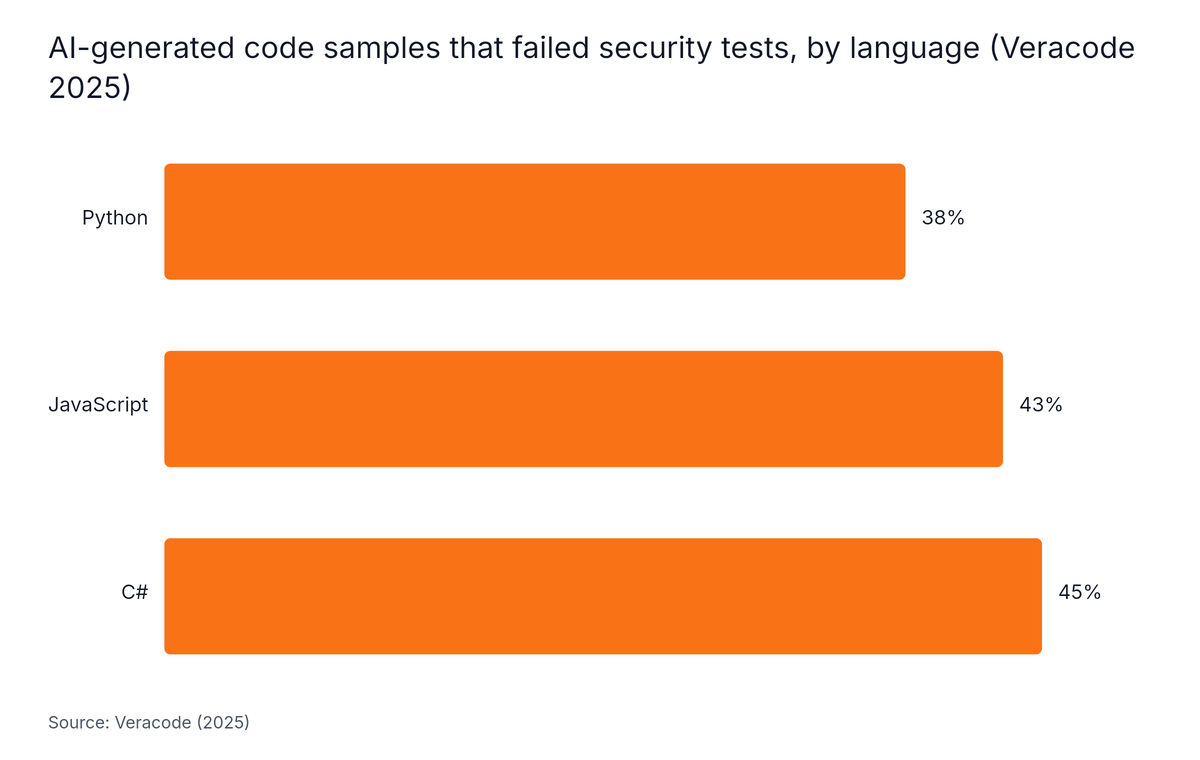
By language, 38% of Python samples, 43% of JavaScript samples and 45% of C# samples failed the security tests (Veracode, 2025).
Horizontal Bar chart: AI-generated code samples that failed security tests, by language (Veracode 2025). Highest: C# at 45%.
Static analysis is automated scanning of source code for known weakness patterns without running it. A partner should run it on every change, and should treat a failed scan as a release blocker.
Ask how pull requests are reviewed
A December 2025 CodeRabbit comparison of 320 AI co-authored pull requests and 150 human-only pull requests found the AI co-authored ones generated 1.7 times more issues overall and 2.74 times more security issues (Cloud Security Alliance, 2026). The Cloud Security Alliance page is a secondary report of the CodeRabbit study, so treat the multipliers as indicative. They still support one requirement: independent code review and security scanning on every AI-assisted change.
Ask how the team handles distrust of AI output
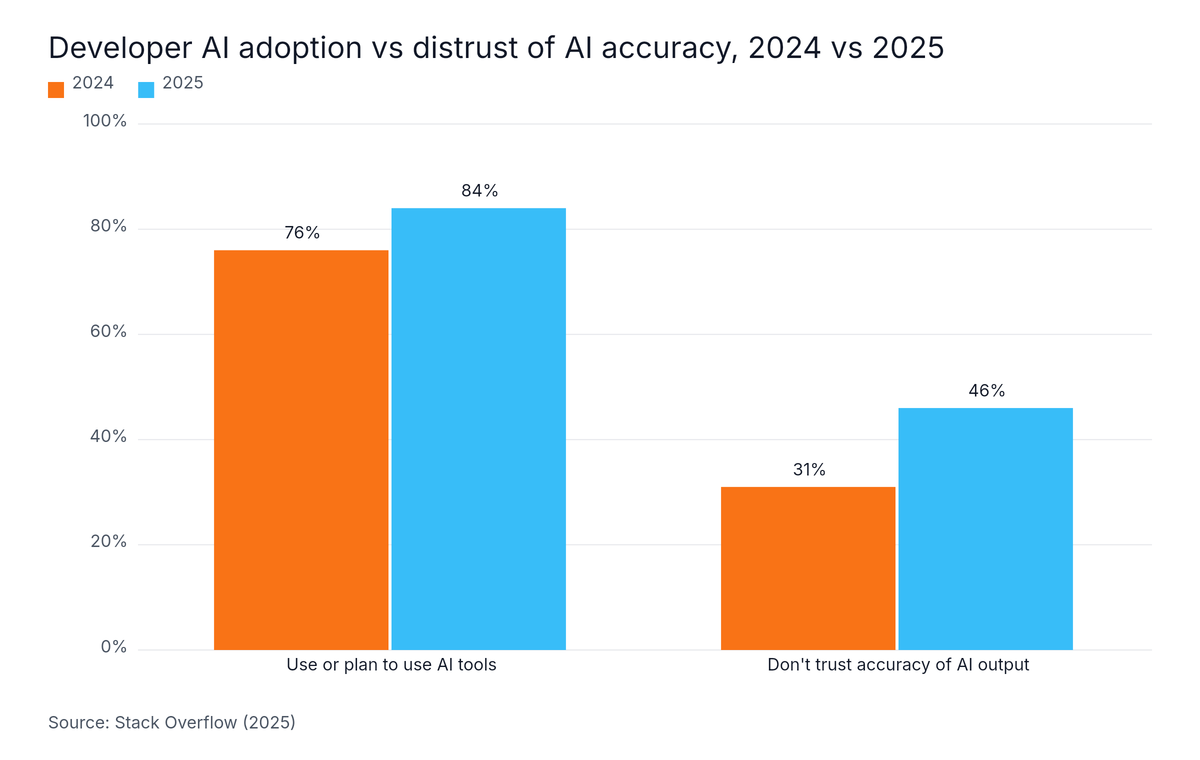
Developers themselves are cautious. Stack Overflow's 2025 survey of over 49,000 developers found 84% use or plan to use AI tools, up from 76% in 2024. In the same survey, 46% said they don't trust the accuracy of AI output, up from 31% a year earlier (Stack Overflow, 2025). Stack Overflow said "The growing lack of trust in AI tools stood out to us as the key data point in this year's survey" (Stack Overflow, 2025).
Grouped Bar chart: Developer AI adoption vs distrust of AI accuracy, 2024 vs 2025. Highest: Use or plan to use AI tools at 76%.
Only 3% of developers "highly trust" AI output, and experienced developers are the most cautious (Stack Overflow, 2025). That supports a simple rule: senior engineers review AI-written changes before they merge.
Ask who is accountable
The DORA team warns that "AI accelerates software development, but that acceleration can expose weaknesses downstream." (Google Cloud, 2025) A human review gate is a required sign-off by a named engineer before AI-written code reaches production. Buyers can use these questions in vendor selection:
Question to ask
A good answer
A red flag
Who reviews AI-written code?
A named senior engineer signs off every change
"The AI checks itself"
What scans run before release?
Static analysis and dependency checks block failing builds
Scans are optional or run monthly
What do tests do to incomplete work?
Tests reject it automatically
Tests are written after release
Can the buyer see what the agents did?
Agent traces are recorded and shared
No audit trail
Where does the buyer's data go?
Buyer infrastructure, zero data retention where required, no training on buyer content
Unclear data handling
The pattern is simple to state: agents execute, humans decide, customers see progress.
What should a buyer secure before telling the current vendor they are leaving?
A day-zero checklist for changing a software development partner secures every asset the outgoing vendor controls before notice is given: repositories, cloud root accounts, domains, app-store accounts, API keys and signed IP assignment. Confirm access first, then give notice under the contract's exit terms. Deloitte reports 70% of organisations brought previously outsourced work in-house in the last five years (Deloitte, 2025), so exits are common enough to plan for.
Hands placing a set of labelled keys and access cards into a folder on a desk
Source code escrow is an arrangement where a neutral third party holds the code as a fallback. It is a backstop, not a substitute for owning the repositories outright. Rotate every shared secret at handover, so no credential outlives the contract.
Asset
What to confirm
Why it matters
Source repositories
The buyer's organisation owns them, with admin rights
The new team needs full history, not a zip file
Cloud accounts
The buyer holds the root account; vendor users are named and removable
Billing, data and deployments sit here
Domains and DNS
Registered in the buyer's name
Losing a domain stops the product
App-store and API accounts
Developer accounts and keys belong to the buyer
Releases cannot ship without them
Secrets and credentials
Rotated after handover
Shared keys stay valid until someone changes them
IP assignment
Signed clause transferring code, models and documentation
The contract decides ownership, not authorship
Documentation and tickets
Exported, with environment diagrams
Context is the first thing lost
Read the contract's exit and termination-assistance clauses before calling anyone. If the vendor owns the cloud account, move it first. Keep the old team productive during a short overlap, and ask them to document what only they know.
How does a vendor change work in regulated industries like banking and healthcare?
In regulated sectors, a vendor change must keep critical operations running. In Australia, APRA's CPS 230 operational risk standard commenced on 1 July 2025 (APRA, 2026), with targeted amendments taking effect on 1 July 2026 (APRA, 2026). It requires regulated entities to manage service-provider risk, so a bank, insurer or super fund must show continuity during any handover.
Compliance officer and engineer discussing a continuity plan in a meeting room
CPS 230 is APRA's operational risk management standard for regulated financial entities. APRA states the duty directly: "Entities must be able to maintain critical operations through disruptions and manage the risks arising from service providers." (APRA, 2026)
In Singapore, the Monetary Authority of Singapore (MAS) consulted from 6 March to 20 April 2026 on third-party risk guidelines. The proposal widens the scope from a narrow set of arrangements to all third-party arrangements, with a register submitted semi-annually and a proposed six-month transition (HSF Kramer, 2026). The source says final guidelines were still pending, so check MAS directly.
For a regulated vendor change, plan for:
A continuity plan that shows which services keep running at each phase.
A phased migration, not a cut-over weekend.
Records of who had access, when, and to what.
Data residency decisions made before the new team starts.
Certifications checked against the buyer's procurement policy.
Multi-party platforms need extra care. A change touches several user groups, integrations and payment flows, so phase by user group.
Who should not change their software development partner?
A buyer should not change a software development partner when the delay comes from unclear requirements, missing decisions or weak internal governance, because a new team inherits the same problems. The Whitelane 2025/2026 study, reported secondhand, put average provider satisfaction at 76% across around 7,000 sourcing relationships (Whitelane, via Milo Software, 2026), so evidence should drive any switch.
The DORA research makes the wider point: "AI's primary role is that of an amplifier, magnifying the strengths of high-performing organizations and the dysfunctions of struggling ones." (DORA, 2025) A new partner, AI-enabled or not, amplifies what the buyer brings.
Stay with the current vendor, or fix the process first, if:
The vendor is delivering and the real gap is a missing product owner.
Requirements change weekly and nobody signs off scope.
The contract holds code or accounts hostage and legal advice has not yet been taken.
Company policy requires a certified partner and the candidates do not hold the certification. Check this before the process starts, not after.
An outcome-based first engagement limits the downside of a wrong decision. One pre-defined result, judged on delivery, tells a buyer more than any proposal.
Frequently Asked Questions
How long does it take to switch software development vendors mid-project?
Switching software development vendors takes as long as the codebase, documentation and access allow, so there is no fixed figure. A replacement partner can agree one pre-defined outcome and deliver it in 4 to 8 weeks. One Australian healthcare platform stuck for 8 months went live in production within 30 days after a vendor change.
What should I do before I tell my current software vendor I'm leaving?
A buyer leaving a software vendor should first secure everything the vendor controls: repository ownership, cloud root accounts, domains, app-store accounts, API keys and signed IP assignment. Confirm the buyer can log in to each one without the vendor's help, rotate shared secrets, and only then give notice under the contract's exit terms.
Who owns the source code if I change software development companies?
Ownership of source code after a buyer changes software development company depends on the contract's IP assignment clause, not on who wrote the code. Check that the clause transfers code, documentation and models to the buyer, and that payment terms do not hold it back. Get this confirmed in writing before giving notice.
How do I vet a software development partner that uses AI coding tools?
A buyer vetting a software development partner that uses AI coding tools should ask how AI-written code is reviewed, scanned and tested before release. Look for a named human accountable for each merged change, automated security scanning, test gates that reject incomplete work, and recorded traces of what the AI agents did.
Conclusion
Changing a software development partner is a controlled sequence, not a leap. The points to carry forward:
Secure code, cloud accounts, domains and keys before anyone is told.
Audit independently, then make the improve-or-rebuild decision component by component.
Choose a partner paid for an outcome, who hands over ownership of code, cloud, models and documentation.
For AI-enabled teams, require human review, security scanning and test gates.
In regulated sectors, show continuity at every phase.
The next step is small: list the assets the current vendor controls and mark which ones the company can reach without them. For a stalled project where a second opinion on the options would help, Book a call ↗ with Grail Computer Labs to talk through what is stuck.