Credit Worklist Prioritization Software: How Automated Triage Cuts Analyst Queue Time
By Shiva Mangal, Grail Computer Labs. Published 28 October 2026.
Credit worklist prioritization software ranks an analyst's queue by risk, auto-clears routine low-risk files under defined rules, and sends the rest to a person.
Many credit teams still open every file in arrival order. A reviewer spends 30+ minutes on a file that a rule could have cleared. We saw that pattern in a Singapore-based neobank's transaction reviews, and the fix was an architecture, not a bigger team. This article explains the three layers behind it: a rules engine, a risk-scoring model and a human-approval gate. It also gives a four-point test, so a Head of Operations can judge whether their own worklist has the same shape.
Key Takeaways
Credit worklist prioritization software works as three layers: rules for policy hard stops, a risk score for ranking and confidence, and a human-approval gate for exceptions.
In one Singapore-based neobank build, automated transaction-review approvals rose from approximately 44% to approximately 90% in testing, in one week.
The human-approval gate stays in place: the Bank of England reported in 2025 that only 2% of UK financial-services AI use cases were fully autonomous.
A credit queue fits automated triage only if most files are low-risk, policy is expressible as rules, decision history is labelled and a wrong approval has a bounded cost.
What is credit worklist prioritization software?
Credit worklist prioritization software is a system that ranks the files in a credit analyst's queue by risk and urgency, clears routine low-risk files under defined rules, and routes the rest to a person. The term covers two queue types: accounts-receivable credit-limit worklists and lending or transaction-review queues. This article addresses the second type, though the ranking logic carries over.
A stack of paper credit files being sorted into two trays on a clean desk
Worklist prioritization is the ordering of open files so the riskiest and most urgent reach an analyst first. It differs from collections prioritization, which ranks overdue receivables by how likely they are to be paid. A credit worklist ranks files that are waiting for a decision.
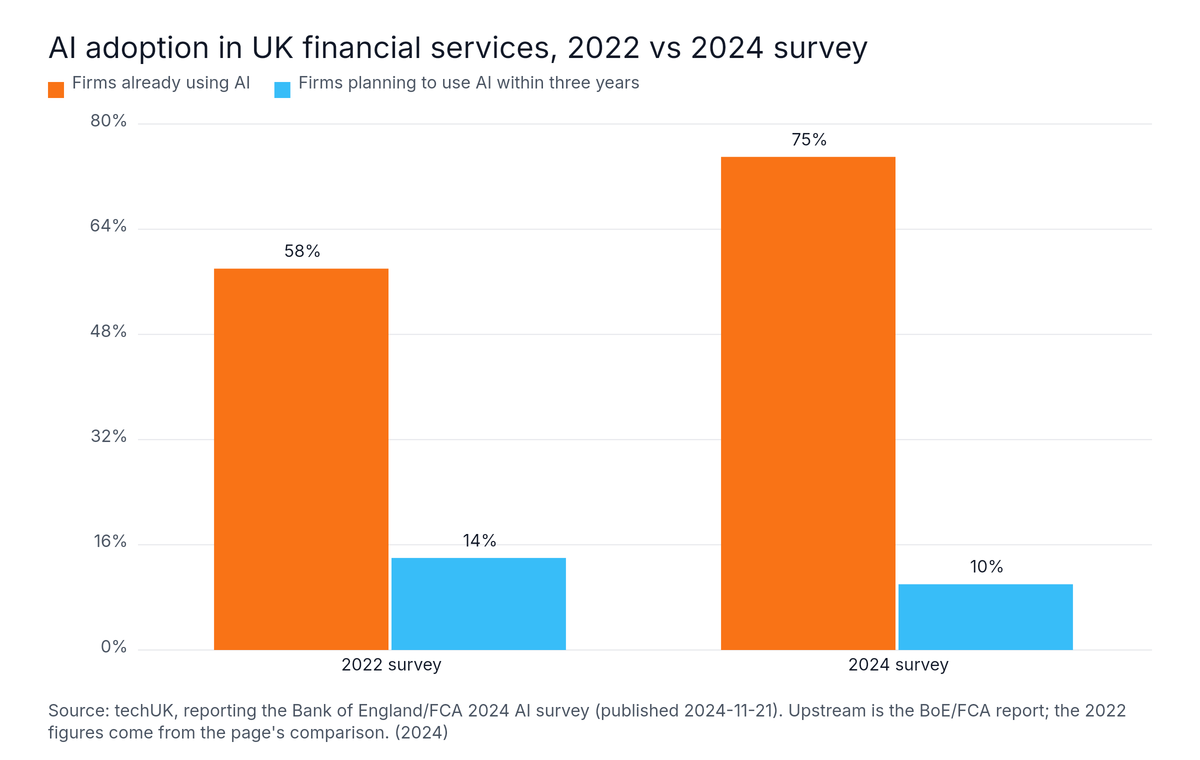
The pressure to build one is rising with adoption. AI use among UK financial firms rose from 58% in 2022 to 75% in 2024, with a further 10% planning adoption within three years (techUK, 2024).
Grouped Bar chart: AI adoption in UK financial services, 2022 vs 2024 survey. Highest: 2024 survey at 75%.
Those figures show where the market is. They do not show whether a given queue is ready for triage, which the later sections address.
How does automated triage work, and are rules enough?
Automated credit triage combines three layers: a rules engine for policy hard stops, a risk-scoring model that ranks files and attaches a confidence value, and a human-approval gate for exceptions. Rules alone plateau because policy cannot list every pattern, and 55% of UK financial-services AI use cases already involve some automated decision-making (Bank of England, 2025).
Three stacked translucent layers representing rules, scoring and human review
Layer
Job
Typical input
Output
Rules engine
Enforce policy hard stops
Missing documents, limit breaches, screening hits
Pass, block or escalate
Risk-scoring model
Rank files and score confidence
File attributes and past analyst decisions
Risk score and confidence band
Human-approval gate
Decide exceptions and audit samples
Escalated, low-confidence and sampled files
Approve, reject or override, with a reason
Layer one: the rules engine
A rules engine is a component that applies written policy conditions to each file and returns pass, block or escalate. It handles anything a policy owner could write on a card: a missing document, a breached limit, a screening hit. Rules are deterministic, so every outcome traces to a line of policy. That makes them the right home for hard stops.
Layer two: the risk-scoring model
A risk-scoring model is a statistical model that assigns each file a risk score and a confidence value, learned from historical decisions. The score orders the queue so the riskiest files reach an analyst first. The confidence value matters more for auto-approval. A file with a low score and low confidence goes to a person, not through.
Rules plateau for a reason we have seen in build work. This is our own observation, not an external finding. Policy rarely says what a file with an unusual mix of attributes should score. Rules then either pass it blindly or escalate it. A model fills that gap.
The order matters. Start with rules, then add the model once labelled decision history exists. The model needs examples of what analysts approved, rejected and escalated, and it needs validating against them.
Where does the human-approval gate go?
The human-approval gate sits after the rules and the score. It receives every high-risk, low-confidence or out-of-policy file, plus a random sample of auto-cleared files for quality assurance. Regulators see the same practice: the Bank of England reported in 2025 that only 2% of UK financial-services AI use cases were fully autonomous (Bank of England, 2025).
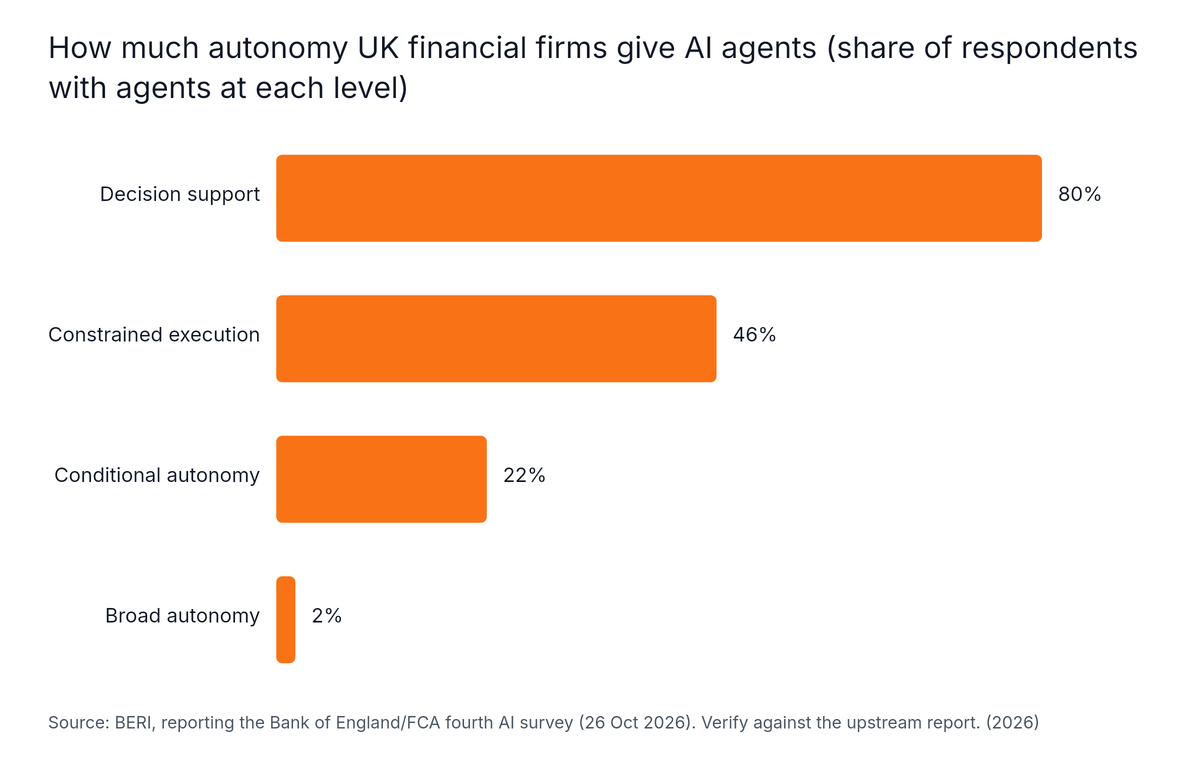
Horizontal Bar chart: How much autonomy UK financial firms give AI agents (share of respondents with agents at each level). Highest: Decision support at 80%.
A human-approval gate is a checkpoint where a named person approves, rejects or overrides files the rules and model cannot clear.
A 2026 survey shows a similar spread. In the fourth Bank of England/FCA AI survey, as reported by BERI on 26 October 2026, 80% of respondents with deployed agents use them for decision support, 46% for constrained execution, 22% for conditional autonomy and 2% for broad autonomy (BERI, 2026). That is a secondary report, and the 2026 and 2024 samples differ, so we do not read it as a trend.
Singapore banks use the same shape. DBS rolled out agentic credit-assessment tools to about 1,500 relationship managers and credit risk managers after a 150-user pilot. The agents handle over 70 tasks to produce a review-ready first draft, and bankers keep the judgement (DBS, 2026). DBS's Han Kwee Juan said, "We believe that agentic AI can help to reimagine corporate banking." (DBS, 2026). That deployment prepares credit memos rather than triaging a queue. The principle is the same: the machine prepares, a person decides.
What do MAS and other regulators expect?
The Monetary Authority of Singapore (MAS) issued its final AI Risk Management Guidelines on 7 October 2026. They cover generative AI and AI agents. Sections 3 and 4 apply from 7 October 2027. MAS says deployment with human-in-the-loop oversight can lower an AI use case's risk materiality (MAS, 2026). MAS's Ho Hern Shin said, "FIs can innovate with confidence, while maintaining the trust of customers and the resilience of Singapore’s financial system." (LeapRate, 2026). A well-designed gate is therefore also a regulatory design choice.
The table summarises what the sources support in each jurisdiction.
Jurisdiction
What the source says
Effect on gate design
Singapore (MAS)
Guidelines finalised 7 October 2026 cover generative AI and AI agents; human-in-the-loop oversight can lower risk materiality
Document the gate as a risk control
United Kingdom (Bank of England/FCA)
Fully autonomous AI use cases are rare, per the 2025 Bank of England account
A human gate matches current practice
United States
Banking regulators rewrote model-risk guidance in April 2026 and left generative AI and AI agents out of scope (Entrepreneur APAC, 2026)
Narrower written scope than MAS; confirm with counsel
European Union
Credit scoring is classed as high-risk under Annex III of the EU AI Act, per a secondary vendor blog (Sigma360, 2026)
Treat any credit-scoring step as high-risk; verify timing against the official text
Australia and UAE
No verified source in our research
Not mapped here; confirm with local counsel
A Singapore firm faces broader written expectations than a US peer, because MAS brings both generative AI and AI agents into scope. We do not map Australia or the UAE, because we found no verified source for either. A compliance team should confirm each jurisdiction before launch. It should also check whether a transaction-review step counts as credit scoring under the EU rule.
How can a team stop analysts rubber-stamping?
Automation bias is the tendency of reviewers to accept a system's recommendation without checking it. It is the main failure mode of a human gate. Four controls help:
Show the evidence behind each recommendation, not only the recommendation.
Require a written reason on approvals and overrides.
Audit a random sample of auto-cleared files in a QA lane.
Track override rate and decision time per file. Near-zero overrides with very short decision times is a warning.
Two further failure modes need owners. Model drift means scores degrade as the file mix changes. A missing feedback loop means analyst decisions never reach the model.
What share of files can be auto-approved, and how is it measured?
No fixed share of credit files is safe to auto-approve; the figure depends on how much policy fits rules and what a wrong approval costs. Most firms keep a person in the loop: 80% of respondents with deployed agents use them for decision support (BERI, 2026). Measure the share alongside error rates, never alone.
A magnifying glass resting on a printed table of numbers beside a pen
Our data: Grail Computer Labs built a human-reviewed know-your-transaction (KYT) workflow for a Singapore-based neobank. Manual reviews took 30+ minutes each and automated approvals sat at approximately 44%. A one-week build raised automated approvals to approximately 90% in testing.
Those are testing figures from one engagement, not a promise for another queue. A second case shows the same shape in a different domain. For a small financial-services operator, GC Labs built one live sales queue in 11 days that merged three scattered lead sources. It processed 360 submissions in its first 10 days and removed approximately 2 hours per day of admin. That queue handled leads, not credit files, so it is evidence of the triage pattern, not of credit outcomes.
Which metrics show queue time honestly?
A single metric never tells the whole story. A high auto-approval rate means little without the error rate on the files that were auto-cleared. Teams should measure five things:
Metric
What it counts
Why it matters
Analyst touch minutes
Minutes of analyst time per file
Turnaround includes waiting time that triage does not change
Auto-approval rate
Share of files cleared without a person
The headline gain, but incomplete alone
Override rate
Analyst changes to the recommendation
Flags poor scoring or rubber-stamping
QA-lane error rate
Errors found in sampled auto-cleared files
Estimates false negatives
Rework rate
Files reopened after a decision
Can rise first while thresholds settle
What are the risks of raising auto-approval rates?
A false negative is a risky file wrongly cleared as routine. Each rise in auto-approval rate widens the exposure, so thresholds should move in small steps, each checked against the QA lane. Expect rework to climb before it falls. We can review whether a specific queue has this shape: Book a call ↗
How long does it take to build an automated triage workflow?
Building an automated triage workflow for one queue takes days to weeks, not a platform programme. Grail Computer Labs built one neobank workflow in one week and a financial-services operator's live queue in 11 days. DBS ran a 150-user pilot before rolling agentic credit tools out to about 1,500 bankers (DBS, 2026), so shadow-mode testing and threshold tuning set the real timeline.
A wall calendar with a single week outlined next to a short checklist
Shadow mode is a test phase where the workflow scores live files and records its decision while analysts still decide every file. The rollout steps are:
Scope one queue. Pick a single queue with a clear owner and a measurable queue-time problem.
Write policy as rules. Convert hard stops into rules and agree each with the policy owner.
Fit the risk score. Train and validate the model on labelled analyst decisions.
Run shadow mode. Compare the workflow's decisions with analysts' decisions on live files.
Set thresholds and the QA lane. Choose the score and confidence cut-offs, and the sampling rate for auto-cleared files.
Go live with a feedback loop. Feed analyst overrides back to the model and review drift on a schedule.
The pattern repeats across checks. Eight transaction checks went live in under 30 days for the neobank's transaction reconciliation. For how GC Labs maps a current process and scopes a first safe workflow, see the finance workflows page.
Does a credit queue have the right shape, and who should not build this?
A credit queue suits automated triage when most files are low-risk, policy can be written as rules, labelled decision history exists, and a wrong approval has a bounded cost. Scale is no guide to readiness: DBS reports more than 430 AI use cases (Fintech News Singapore, 2026), yet each queue still needs its own test. A queue that fails the four tests needs process work or data first.
A four-row checklist card held beside an empty approval stamp
Test
How to check
Good sign
Warning sign
Share of low-risk files
Sample recent files and count routine approvals
Most files are routine
Nearly every file needs judgement
Policy expressible as rules
Ask the policy owner to write the hard stops down
Stops fit on a page
Policy lives in analysts' heads
Labelled decision history
Check for recorded approve, reject and escalate outcomes with reasons
Consistent records
No history, or history without reasons
Error cost per file
Estimate the cost of one wrongly approved file
Bounded and recoverable
Severe or irreversible
Who this is not for
Grail Computer Labs would not recommend this pattern in four cases:
Queues where regulation or policy requires a human decision on every file. The gate stays on every file, and the gain is ranking only.
Teams with no written policy and no decision history. Those come first.
Buyers who want a single accuracy number to sign off. The approval figures here come from testing in one engagement.
Buyers who need a certified vendor today. Grail Computer Labs holds no SOC 2, ISO 27001 or HIPAA certification, though it completes vendor security and compliance assessments during onboarding.
Frequently Asked Questions
What share of credit files can safely be auto-approved?
No universal share is safe; the figure depends on how much of a team's policy fits rules and what a wrong approval costs. In one Singapore-based neobank build, approvals reached approximately 90% in testing, but that is one queue. Set the threshold in shadow mode against past decisions, and keep a sampled QA lane on everything auto-cleared.
Do I need a machine-learning model, or are rules enough?
Rules are enough for hard policy stops, but they plateau on everything policy does not spell out. A risk-scoring model adds ranking and a confidence value, so low-confidence files go to analysts instead of auto-clearing. Start with rules to capture the obvious clears, then add a model once labelled decision history exists to train and validate it against.
How can a team stop analysts rubber-stamping AI recommendations?
Automation bias is countered by design, not reminders. Show the evidence behind each recommendation, require a written reason on approvals and overrides, and audit a random sample of decisions in a QA lane. Track override rate and decision time per file: an override rate near zero with very short decision times suggests analysts are no longer reviewing.
What does MAS expect when AI is used in credit decisions?
The Monetary Authority of Singapore finalised its AI Risk Management Guidelines on 7 October 2026, covering generative AI and AI agents. Sections 3 and 4, on oversight and risk management systems, apply from 7 October 2027. MAS's response says deployment with human-in-the-loop oversight can lower an AI use case's risk materiality. Confirm specifics with a compliance team.
How is analyst queue time measured?
Analyst queue time is best measured as analyst touch minutes per file, not only turnaround, because turnaround includes waiting time that triage does not change. Pair it with auto-approval rate, override rate, the error rate in sampled auto-cleared files and rework rate. In one Singapore-based neobank, manual reviews took 30+ minutes each before automation.
What should a team do next?
Credit worklist prioritization software works when three layers sit in order: rules, a risk score and a human-approval gate. The rollout order matters as much as the design. DBS ran a 150-user pilot before its wider rollout of agentic credit tools (DBS, 2026). Prove the workflow on one small queue first.
Four points to carry away:
Use three layers: rules for hard stops, a risk score for ranking and confidence, and a gate for exceptions.
Measure analyst touch minutes, override rate and the error rate in sampled auto-cleared files, not only turnaround.
Run shadow mode before any file is auto-approved, and keep a QA lane afterwards.
Check the four fit tests first, and confirm regulator expectations in each jurisdiction.
The next step is to run those four tests on one queue. We will review the result with a team on a call: Book a call ↗