Blog
Software Development Project Rescue: What the First 30 Days Involve
How software development project rescue works: triage, codebase inheritance, outcome agreement, stabilisation and release, anchored in a real 30-day case.
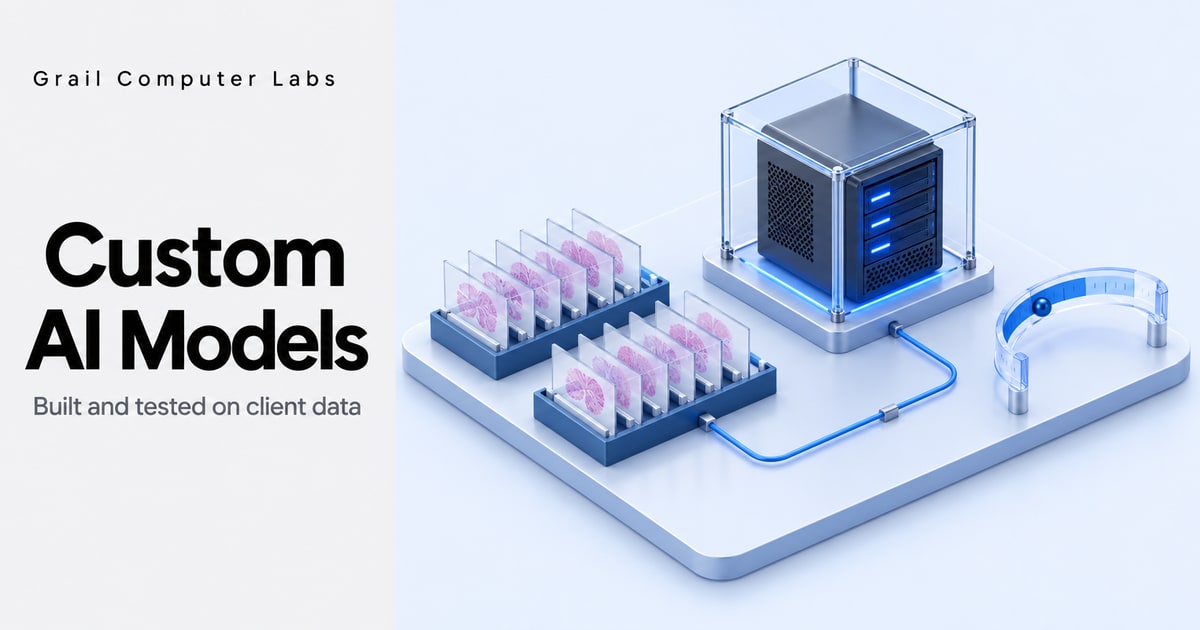
How custom AI model development works when off-the-shelf AI misses on accuracy or privacy: six stages, one measured result, and when not to build.
How software development project rescue works: triage, codebase inheritance, outcome agreement, stabilisation and release, anchored in a real 30-day case.
Enterprise AI guardrails explained: instruction-based vs architecture-based controls, plus a go-live checklist for data access, action scope and fallback.
A legacy system is software that is hard to change safely. See the warning signs, the improve-or-rebuild test and a phased migration plan for real platforms.
Request a quote and our experts will contact you within 24 hours with tailored solutions and pricing.
grail.computer
Last updated: Nov 7, 2026
By Shiva Mangal, Grail Computer Labs
Custom AI model development is the process of designing, training, evaluating and deploying a model on an organisation's own data and infrastructure when off-the-shelf AI cannot meet its accuracy, privacy or cost requirements.
Off-the-shelf AI often stalls at the point that matters: a core use case where the result must hold in production. Grail Computer Labs built a system for the Singapore General Hospital (SGH) synthetic histopathology challenge, and 68 of 72 measured summaries landed within real reference bands, against 50 of 72 for the earlier method. This guide explains how custom AI model development works, stage by stage, and what each stage leaves behind. It also covers privacy, regulation, when not to build, and what a build that ships looks like.
Key Takeaways
- Custom AI model development means designing, training, evaluating and deploying a model on the client's own data and infrastructure, with a measured baseline to beat.
- In the SGH synthetic histopathology work, 68 of 72 category × cut × metric summaries fell within real reference bands, versus 50 of 72 for the earlier construction method.
- Gartner predicts organisations will use small, task-specific models three times more than general-purpose large language models by 2027, driven by accuracy needs and compute cost.
- Custom models are not for every task: low-volume, non-core work is usually better served by an off-the-shelf tool.
- Singapore's final MAS AI Risk Management Guidelines take effect on 7 October 2027, and they keep financial institutions accountable for third-party AI.
Custom AI model development is the work of building a model for one specific job: preparing the organisation's own data, training or fine-tuning a model on it, testing it against a reference, and deploying it where the organisation controls access. It differs from calling a general-purpose API because the data, the success metric and the hosting are chosen for the use case.

Adoption is no longer the question. Organisational AI adoption reached 88% in the Stanford 2026 AI Index (Stanford HAI, 2026). The harder question is fit. Does a model do one specific, valuable job accurately enough, privately enough and cheaply enough to run in production?
A few terms recur throughout this guide.
A custom model is the trained component that produces a prediction, a classification or a generated output. A custom application or agent is the software around it: interfaces, permissions, approvals and integrations. Many failed projects treat the two as one. We scope and evaluate them separately, because a good model inside a poor workflow still fails.
Off-the-shelf AI falls short when a core use case needs domain accuracy, strict data control or a predictable unit cost that a general-purpose model cannot supply. Gartner predicts organisations will use small, task-specific models three times more than general-purpose large language models by 2027 (CIO Dive, 2025), driven by accuracy needs and compute cost.
The three failure modes show up in different places.
| Failure mode | What goes wrong with a general-purpose model | Evidence | What a custom model changes |
|---|---|---|---|
| Accuracy | Generic training data misses the structure of a specialised domain | Gartner links the shift to specialised models to accuracy needs (quoted below) | The model is trained or fine-tuned on client data and scored against a reference |
| Privacy | Sensitive data passes through third-party APIs or unsanctioned tools | One in five organisations studied had breaches linked to shadow AI (IBM Think, 2025) | The model is deployed on the client's infrastructure |
| Cost | A large model is used for a narrow task | The three-times forecast above is a prediction, not a survey result | A smaller model is sized to the job |
Gartner VP Analyst Sumit Agarwal described the drivers this way: "the need for greater accuracy are driving the shift towards specialized models fine-tuned on specific functions or domain data" (CIO Dive, 2025). That is the case for building. The next figure shows why the build needs a defined outcome.
A Gartner survey of infrastructure and operations leaders, run in November and December 2025 and reported by Beri.net (2026), found that 28% of AI projects fully met ROI expectations, 52% delivered partial value and 20% failed outright. Treat this with care. Beri.net re-reports the survey, we did not retrieve the Gartner release, and the survey covers infrastructure and operations projects, not every AI project.
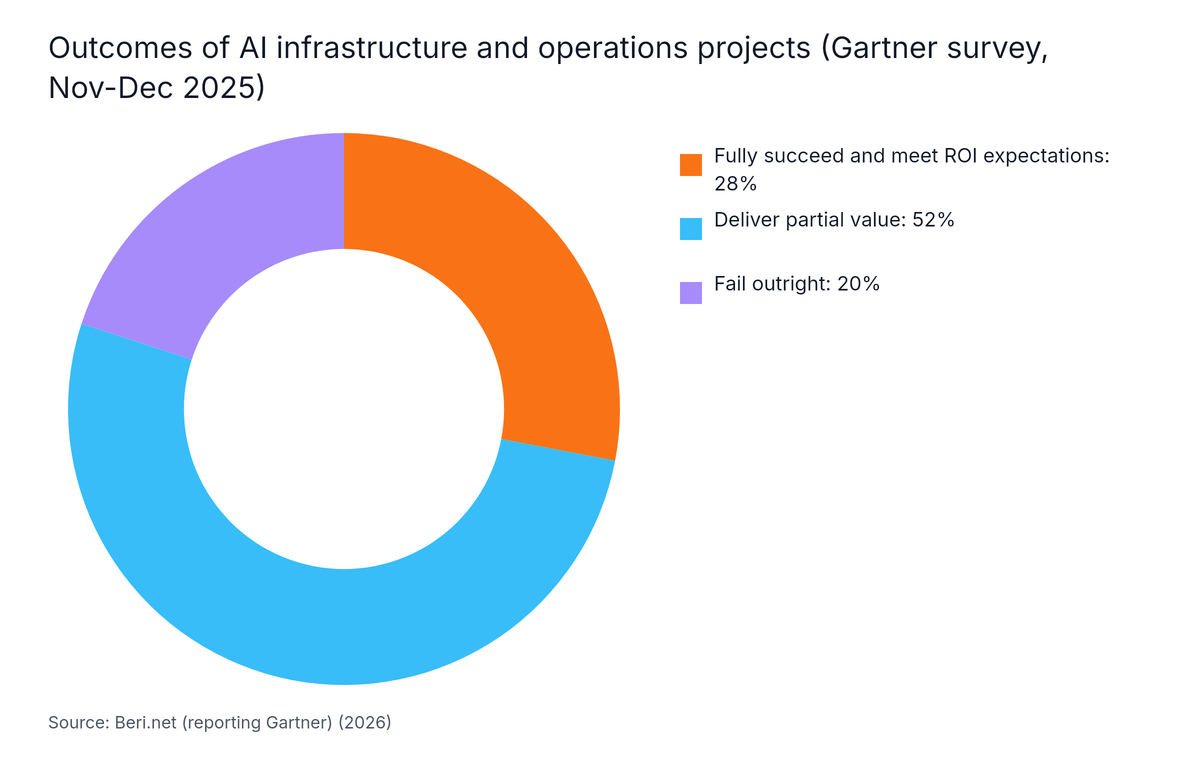
Source: Beri.net (reporting Gartner), 2026
Cost cuts both ways. A custom model can be cheaper to run if a small model replaces a large one on a high-volume task. It can also cost more to build than a subscription. We found no reliable independent source for typical custom-model cost or timeline ranges, so we do not repeat the unsourced ranges that circulate on vendor pages. The honest answer is that it depends on the data, the volume and the outcome.
Demand is high. 81% of US physicians now use AI in a professional capacity, up from 38% when the AMA first polled in 2023 (HIT Consultant, 2026). Deployment lags. Only about 30% of surveyed health systems run generative AI at scale in select areas, and just 2% have deployed it enterprise-wide, per Deloitte's 2026 Global Health Care Outlook as reported by HIT Consultant (2026). Wanting AI and running it reliably on a core workflow are different problems.
Custom AI model development runs in six stages: define the outcome and baseline, prepare the data, train or fine-tune, evaluate against a reference, deploy on the client's infrastructure, and monitor in production. Grail Computer Labs (GC Labs) agrees the outcome first and delivers it in 4 to 8 weeks. Each stage produces an artefact the client can inspect and keep.
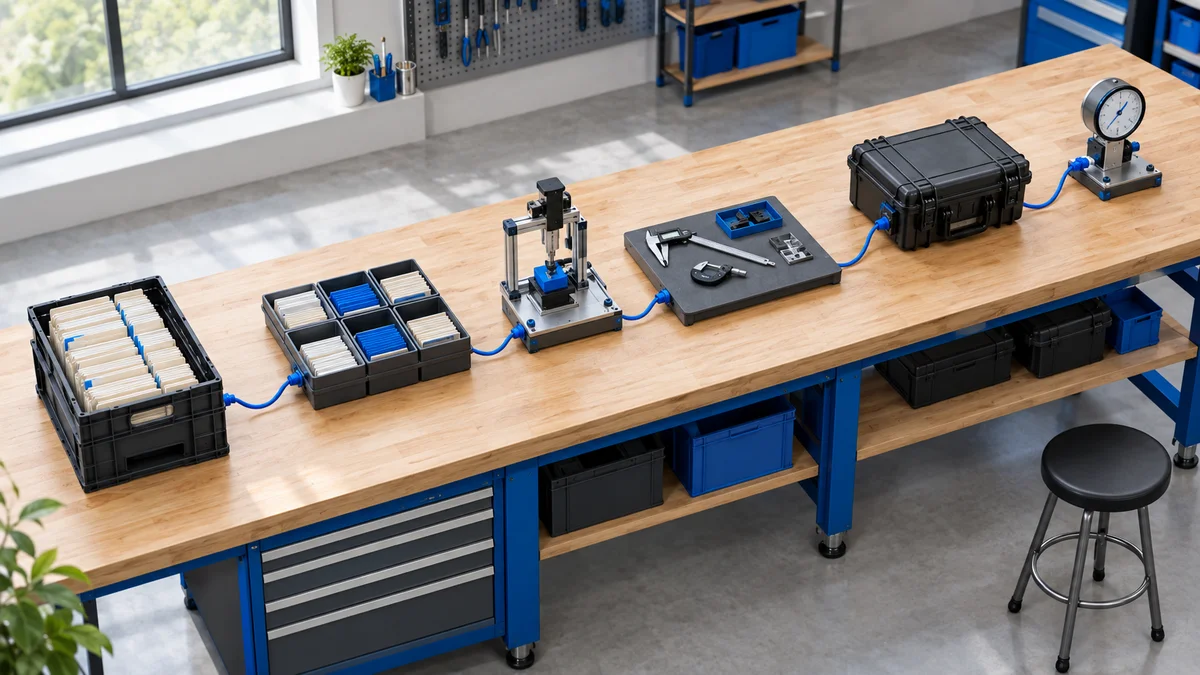
The 4 to 8 weeks is the shape of GC Labs' outcome engagement, not a promise that every model is finished in that window. The agreed scope sets the timeline.
| Stage | What happens | What the client keeps | Check before the next stage |
|---|---|---|---|
| 1. Outcome and baseline | Agree one measurable outcome and measure the current method | Written outcome, baseline measurements | Stakeholders sign off the metric |
| 2. Data preparation | Assess, clean, label and split the data on client infrastructure | Data inventory, record of the train and hold-out split | The data is ready for this use case |
| 3. Training or fine-tuning | Train or fine-tune a model on client data | Training configuration, model files | The training run can be repeated |
| 4. Evaluation | Score the model and the baseline on held-out reference data with an evaluation suite | Evaluation report | The model beats the baseline on the agreed metrics |
| 5. Deployment | Deploy on client infrastructure or private cloud under client policies | Deployed model, documentation | Access controls and retention settings confirmed |
| 6. Monitoring | Track performance in production | Monitoring and release history | Alerts and a review routine are in place |
The first stage fixes what "better" means. We measure the current method before training anything, because a model with no baseline cannot be called an improvement.
Data comes next, and it is where many projects fail early. Gartner predicts that 60% of AI projects lacking AI-ready data will be abandoned through 2026, as reported by Beri.net (2026). So we assess whether the data fits the use case before committing to a model. We also record which records go to training and which stay held out. If the data is not ready, the first deliverable is data preparation, not a model.
The right approach depends on the task and the data, and not every job needs training. We start with the lightest method that meets the agreed metric. Prompting or RAG suits many text tasks, fine-tuning suits consistent domain behaviour, and a purpose-built model suits non-text data such as tissue images.
| Approach | Use it when | Main limit |
|---|---|---|
| Prompting a general-purpose model or API | The task is occasional and tolerant of generic answers | Accuracy and data handling are set by the provider |
| RAG | The model must answer from current or private documents | Retrieval quality caps accuracy, and the model's own behaviour does not change |
| Fine-tuning | A task needs consistent domain behaviour or a smaller, cheaper model | Needs good data and an evaluation suite |
| Purpose-built generator or classifier | The data is not text, such as tissue images | Needs domain-specific measurement to show it works |
In the SGH work, the data was images, so we used a pathology-trained diffusion generator, PixCell-1024, sampled with DPMSolver++, and gave tissue layout its own procedural control. A diffusion model generates an image by removing noise step by step, and DPMSolver++ is the sampler that sets how those steps run.
An evaluation suite is a fixed set of tests and metrics, run against held-out reference data, that scores every model version the same way. Without one, a team cannot tell whether version two improved on version one.
Evaluation, deployment and monitoring each get their own section below, because they decide whether a model is trusted in production.
A team evaluates a custom model by measuring it and the earlier method against the same real reference data, using metrics agreed before training. In the Singapore General Hospital synthetic histopathology work by Grail Computer Labs (GC Labs), 68 of 72 category × cut × metric summaries fell within real reference bands, compared with 50 of 72 for the earlier construction method.
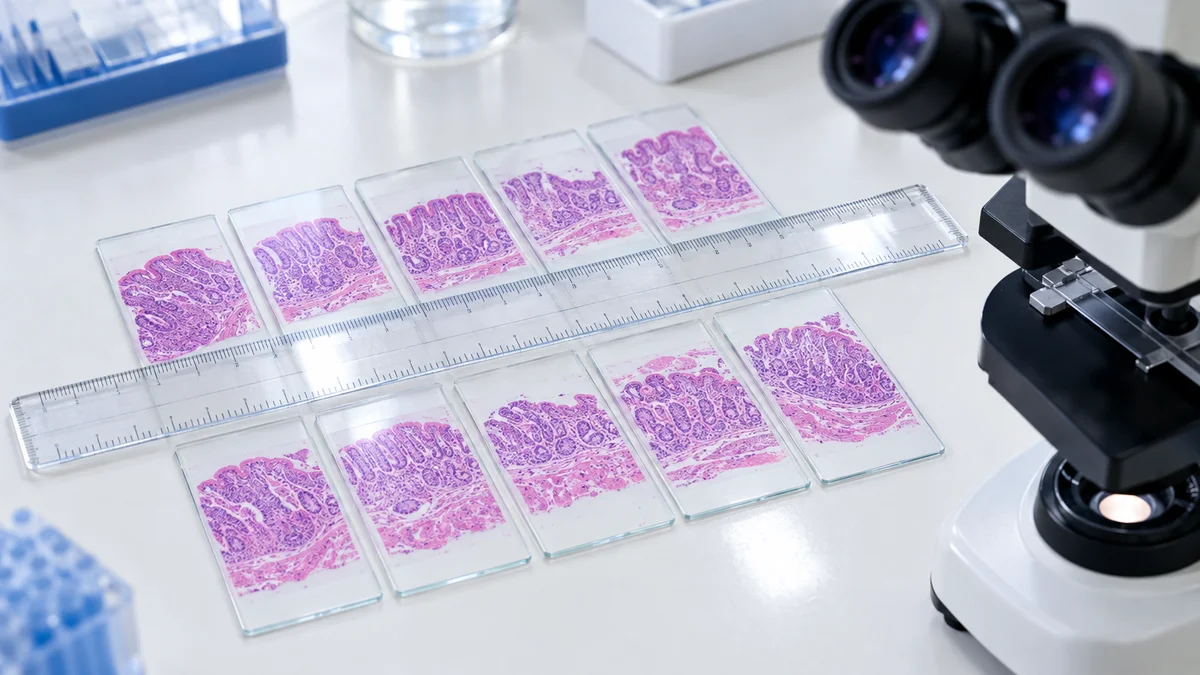
Our data: In the SGH synthetic histopathology challenge, 68 of 72 category × cut × metric summaries fell within the real reference bands, compared with 50 of 72 for the earlier construction method.
A fixed baseline and fixed metrics turn "it feels better" into a number. That is the step most build-or-buy discussions skip.
A histology image holds several kinds of information at once: the arrangement of tissue at a distance, then cells and their nuclei, then small clusters of organisms that can change what the image means. The colours can look convincing before the anatomy does.
We gave tissue arrangement and cellular appearance their own controls. A procedural model described the anatomy, and a pathology-trained generator rendered it. Measurements against real tissue then showed what each part had contributed. We gave up some adherence to the drawing and gained substantially better cellular statistics.
| Item | Count |
|---|---|
| Synthetic fields produced | 70 |
| Public real reference fields | 70 |
| Synthetic images selected from the 70 | 10 |
| Summaries within real reference bands, earlier method | 50 of 72 |
| Summaries within real reference bands, custom pipeline | 68 of 72 |
A reference band is the range of values that one metric takes across the real reference images. A summary counts as inside when the synthetic value falls within that range.
Four rules carry over to any custom model.
One metric is never the whole story. Four summaries still fell outside the bands. Matching reference statistics shows that the images resemble real tissue in measurable ways. It does not show that they are fit for any clinical purpose. Synthetic data for healthcare is also a research-stage area. A 2026 peer-reviewed article in Nature Reviews Cancer finds the potential is real but that standardisation of data selection, evaluation, bias mitigation and privacy is still lacking (Nature Reviews Cancer, 2026). We treat the result as evidence that the method moved the measurement, not as proof of clinical use.
A custom AI model can run on the client's own infrastructure or private cloud. Grail Computer Labs (GC Labs) deploys under the client's AI and security policies, with zero data retention where required. The client keeps the code, cloud, models and documentation, and client content is never used to train AI models or shown to other clients.
Healthcare had the highest average data-breach cost of any sector in IBM's 2025 study, at $7.42 million (HIPAA Journal, 2025). Keeping patient data off third-party AI APIs removes one path for that exposure.
Shadow AI is the use of AI tools by employees without the organisation's approval or oversight. Breaches involving it cost $4.63 million, against a global average of $4.44 million (VentureBeat, 2025). IBM's Suja Viswesan put the pattern plainly: "The data shows that a gap between AI adoption and oversight already exists, and threat actors are starting to exploit it" (VentureBeat, 2025).
Hosting on client infrastructure removes the third-party API as a path for data to leave. It does not remove the need for access controls. So access starts read-only, the access plan is shared upfront, agent traces are recorded and likely secrets are masked before they reach an agent.
The client owns the code, cloud, models and documentation. There is no lock-in, and a 10-point vendor handover checklist covers a clean exit.
Singapore's financial regulator expects institutions to govern AI use case by use case, and it holds them accountable for third-party AI. The Monetary Authority of Singapore (MAS) published final AI Risk Management Guidelines on 7 October 2026, taking effect on 7 October 2027 with phased implementation (LeapRate, 2026).

MAS states: "FIs are expected to manage AI risks at both the enterprise and individual use case levels" (Monetary Authority of Singapore, 2026). Here, FIs are financial institutions. Sections 5 and 6 of the guidelines are due by 7 October 2028, per the same reporting. Because FIs stay accountable when a supplier builds the model, vendors selling AI to Singapore institutions should expect assurance requests.
Singapore's Ministry of Health and the Health Sciences Authority published version 2.0 of the Artificial Intelligence in Healthcare Guidelines (AIHGle 2.0) on 10 March 2026. It covers the AI lifecycle from design to retirement and sets out developer and deployer responsibilities (DataGuidance, 2026).
This is our reading of the lifecycle controls MAS consulted on in November 2025, which covered AI inventories, data management, evaluation and testing, and human oversight. It is not legal advice.
Grail Computer Labs (GC Labs) client work in Australia touches the Australian Privacy Act, health-record privacy and aged-care rules. We did not retrieve primary Australian regulator sources for this guide (the TGA, APRA or the OAIC), so we cite no Australian figures and make no claim about what those bodies require. Teams in Australia should take separate advice before a build.
Custom AI model development is not for low-volume, non-core tasks, or tasks already well served by a general-purpose model or API. Custom work earns its cost only where accuracy, privacy or unit cost on a core use case cannot be met otherwise. For occasional drafting, summarising or search, an off-the-shelf tool usually fits.
Several other limits apply.
A build that ships starts with one pre-defined outcome, agreed before work begins and delivered in 4 to 8 weeks, then continues as continuous delivery. Grail Computer Labs (GC Labs) runs this as an outcome engagement, with a 15-day trial that carries no payment commitment. The client owns the code, cloud, models and documentation.

The gap in healthcare is shipping, not ideas: only 2% of surveyed health systems have deployed generative AI enterprise-wide (HIT Consultant, 2026).
Around the model, GC Labs' Software Factory is GC Labs' AI software factory, customised around each client's codebase, release process and operating model. Its loop is Triage → Specify → Implement → Review → Verify → Release. Agents execute. GC Labs engineers make the decisions. Customers see progress.
Our results: An Australian healthcare platform was stuck in development for 8 months. GC Labs inherited 1.5 million lines of code and rebuilt it. It went live in production within 30 days, and by day 40, 100 business customers had been onboarded.
Other engagements show the same pattern in different settings.
These are software and workflow outcomes, not model benchmarks, and each client is anonymous by choice. They show what "ships, not just plans" means in practice.
Grail Computer Labs (GC Labs) is an applied-AI and digital product research lab that replaces an underperforming vendor and moves stalled software and AI projects to production. GC Labs agrees one measurable outcome, delivers it in 4 to 8 weeks, then keeps shipping. An Australian healthcare platform stuck in development for 8 months went live in production within 30 days.
Custom AI model development is worth it when a core use case fails an off-the-shelf model on accuracy, privacy or cost, and the task runs often enough to justify a build. Gartner predicts organisations will use small, task-specific models three times more than general-purpose large language models by 2027. For occasional, low-volume tasks, an off-the-shelf tool usually fits better.
A team evaluates a custom AI model by scoring it and the earlier method against the same real reference data, using metrics agreed before training. In the Singapore General Hospital synthetic histopathology work, 68 of 72 category × cut × metric summaries fell within real reference bands, versus 50 of 72 for the earlier method.
The client owns a custom AI model built by Grail Computer Labs (GC Labs), along with the code, cloud and documentation. There is no vendor lock-in. GC Labs deploys on the client's infrastructure or private cloud under the client's AI and security policies, and client content is never used to train AI models or shown to other clients.
Custom AI model development timelines and costs depend on the data, the use case and the agreed outcome, and we found no reliable independent source for typical ranges. Grail Computer Labs (GC Labs) delivers one pre-defined outcome in 4 to 8 weeks, scoped and priced after a first call under NDA, starting with a 15-day trial with no payment commitment.
Custom AI model development works when each stage has a measurable check and a deliverable the client keeps. In the Singapore General Hospital work, 68 of 72 summaries fell within real reference bands, against 50 of 72 for the earlier method.
If a core use case has outgrown off-the-shelf AI, or a build has stalled, the next step is a call under NDA to define one outcome. Book a call and bring the use case, the data on hand and the metric that matters.
© 2026 grail.computer All rights reserved.