Data science consulting should deliver a deployed, monitored model with a measurable outcome, not a report: the engagement is finished when a model runs on the client's data, in its infrastructure, and a named team answers for how it performs. Many engagements stop earlier. MIT's GenAI Divide study found that 95% of enterprise generative-AI pilots showed no measurable P&L impact (legal.io, 2025). When analysis work has not reached a live system, the gap usually sits in what was scoped, not in the maths. This guide draws the line between work that stays in a notebook and work that ships. It covers data preparation, training or fine-tuning, evaluation, deployment and monitoring, then lists questions that test a partner.
Key Takeaways
Data science consulting should end with a deployed, monitored model that has a measurable outcome, not with findings or slides.
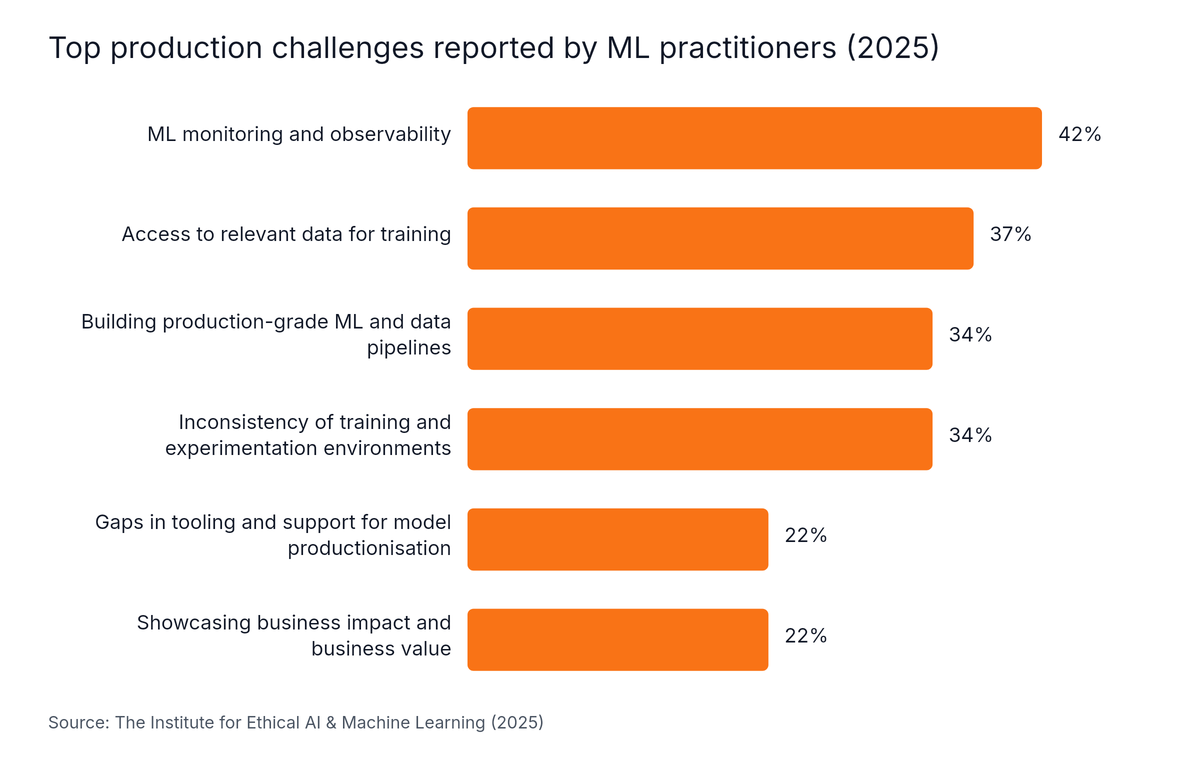
ML practitioners name monitoring (42%), access to training data (37%) and production pipelines (34%) as top production challenges (Ethical Institute, 2025), and all three sit around the model.
Each phase of a data science engagement has a notebook-grade output and a production-grade handoff, and buyers should ask for the second.
A good data science partner can show its evaluation harness, rollback path, retraining triggers and ownership terms in writing.
Why do data science engagements stall at analysis?
Data science engagements stall at analysis because nobody owns the path from notebook to production. MIT Project NANDA's GenAI Divide study found that 95% of enterprise generative-AI pilots produced no measurable P&L impact (MIT Project NANDA, via legal.io, 2025). That figure is self-reported and measures missing business impact, not crashed pilots, but practitioner surveys show similar blockers between analysis and deployment.
A notebook page covered in analysis sitting apart from a locked server rack in a dim office
The Institute for Ethical AI & Machine Learning surveyed 135 practitioners in 2025 (Ethical Institute, 2025). Monitoring model performance was the most common production challenge, at 42%. Access to relevant training data came next at 37%. Building production-grade ML and data pipelines, and inconsistent training environments, each scored 34%. The sample is small and self-selected, so treat it as directional.
These four blockers sit around the model: data, pipelines, environments and monitoring. An analysis-only engagement rarely touches them. A Forbes analysis in July 2026 makes a related argument about agentic AI specifically: cancellations stem from governance, data access, ownership and rollback controls rather than model capability (Forbes, 2026). Both the MIT figure and the survey reach us through secondary reports, so the primary documents deserve a read before anyone quotes them.
Horizontal Bar chart: Top production challenges reported by ML practitioners (2025). Highest: ML monitoring and observability at 42%.
What should a data science engagement deliver beyond notebook work?
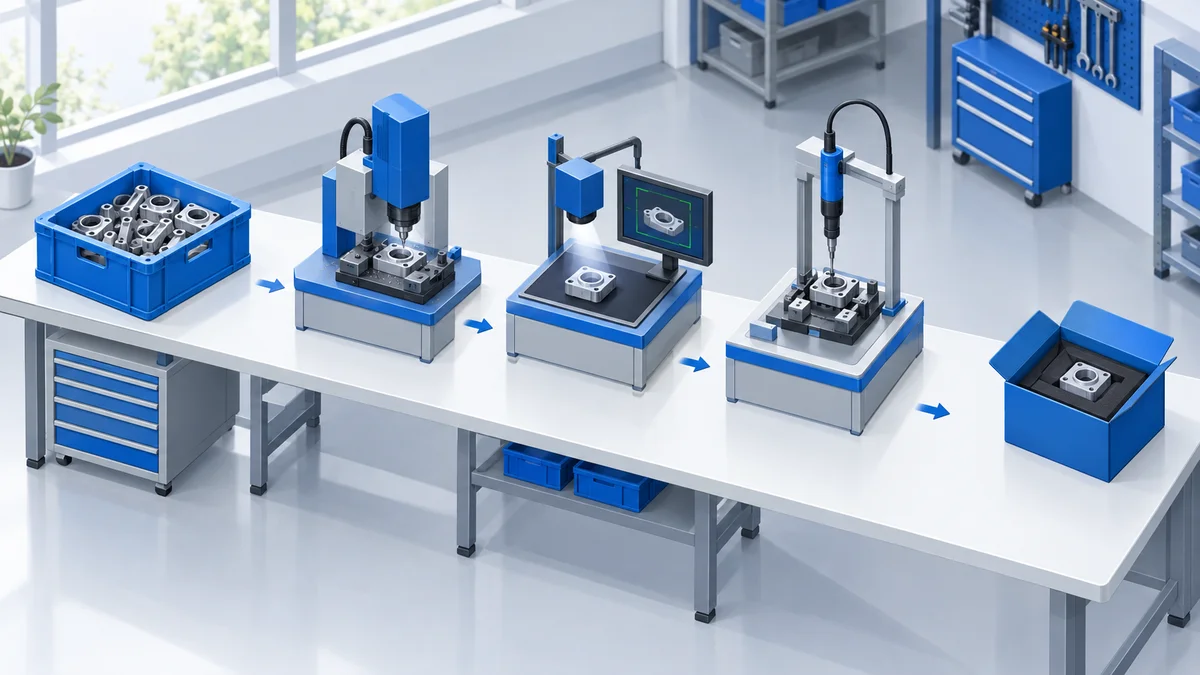
A data science engagement should deliver a model that another team can run, test, roll back and monitor, not findings alone. MLOps is the set of practices that package, deploy and monitor models in production. Five handoff items mark the difference: prepared data pipelines, a trained or fine-tuned model, an evaluation report, a deployed service and a monitoring plan.
Five labelled stages of a data pipeline laid out left to right as physical stations
Pipelines are the item most often missing. Building production-grade ML and data pipelines was a challenge for 34% of practitioners, and inconsistent training environments also scored 34% (Ethical Institute, 2025). The table shows what each phase looks like when it stays in a notebook and what it should look like at handoff.
Phase
Stays in a notebook
Ships to production
Data preparation
One-off cleaned extract, steps undocumented
Versioned, repeatable pipeline with personal data handling documented
Training or fine-tuning
A single run in a shared notebook
Reproducible training job with a fixed environment and tracked parameters
Evaluation
One accuracy number on one split
Report on held-out data with error analysis and agreed acceptance thresholds
Deployment
A slide describing the result
Running service with a release process and a tested rollback
Monitoring
None, or "check back later"
Dashboards, drift alerts and retraining triggers with a named owner
Choosing between classical ML, off-the-shelf models and fine-tuning
Fine-tuning is further training of an existing model on the client's own data so it fits the task. It is one of three build options, and the right one depends on evaluation results, not on preference:
Off-the-shelf model: use it when it passes the evaluation set on accuracy, privacy and cost.
Classical ML: use it for structured data problems where a simpler model meets the target.
Fine-tuned or custom model: use it when off-the-shelf AI cannot meet accuracy, privacy or cost needs.
A partner who picks the option before seeing the evaluation set is selling, not engineering.
How long does it take to get a machine learning model into production?
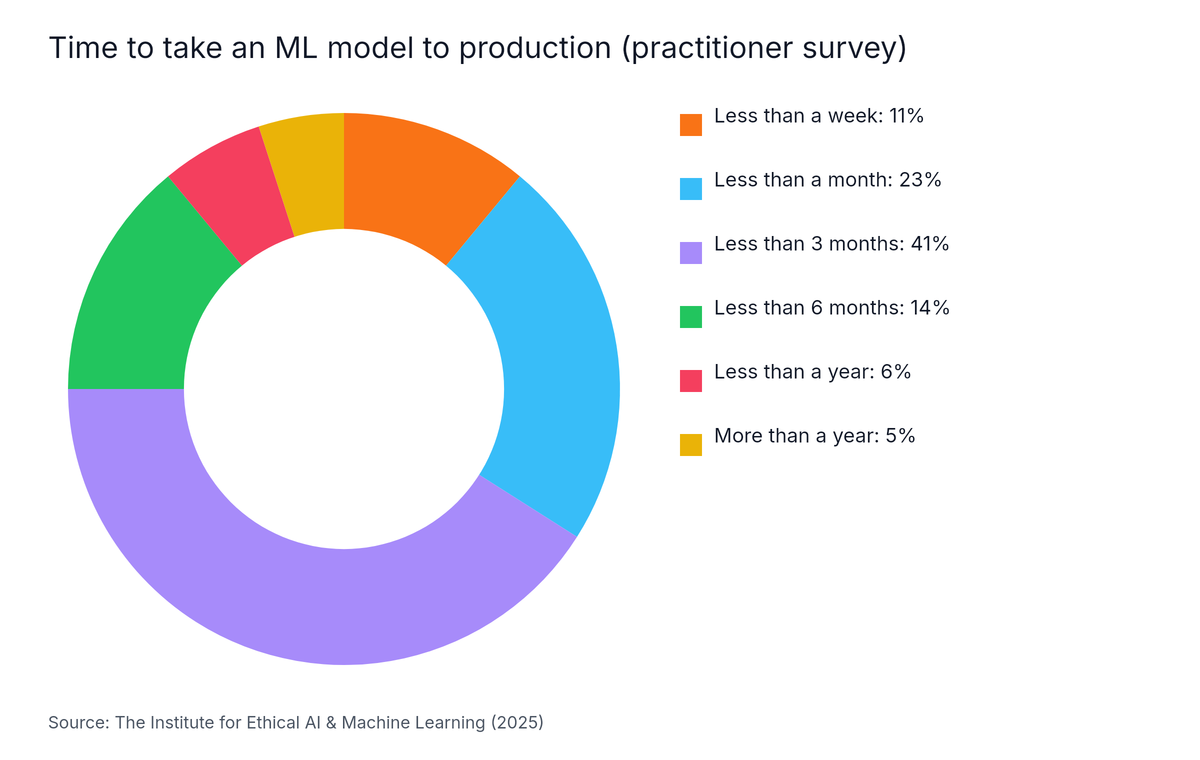
About three-quarters of practitioners (11% + 23% + 41%) reported getting a machine learning model into production in under three months, according to the 2025 survey by The Institute for Ethical AI & Machine Learning (Ethical Institute, 2025). The largest single group, 41%, reported less than three months. A pre-defined outcome keeps timelines near the short end.
A calendar with a short stretch of weeks highlighted next to a finished model package
The tail is longer. In the same survey, 14% reported less than six months, 6% less than a year and 5% more than a year (Ethical Institute, 2025). Engagements that run long usually lack a defined finish line, so scope drifts while the model waits for data, environments or sign-off.
Donut chart: Time to take an ML model to production (practitioner survey). Highest: Less than 3 months at 41%.
Grail Computer Labs, an applied-AI and digital product research lab, scopes its outcome engagement the same way: one pre-defined outcome, delivered in 4-8 weeks, starting with a 15-day trial with no payment commitment. We agree the outcome first, deliver it in 4-8 weeks, then keep shipping. The results below come from our own delivery work and are not independent research.
Our data: For a Singapore-based neobank, we raised automated approvals from approximately 44% to approximately 90% in testing in a one-week build. For the Singapore General Hospital synthetic histopathology challenge, 68 of 72 category × cut × metric summaries fell within the real reference bands, against 50 of 72 for the earlier construction method.
Manual reviews taking 30+ minutes, automated approvals at approximately 44%
Approximately 90% automated approvals in testing, one-week build
Singapore-based neobank, transaction checks
Need to automate transaction checks for internal operations
Eight transaction checks live in under 30 days
Small financial-services operator, lead operations
Three scattered lead sources, approximately 2 hours a day of admin
One live sales queue in 11 days, 360 submissions processed in the first 10 days
Australian healthcare platform (software rescue, not a model build)
Stuck in development for 8 months
Live in production within 30 days, 100 business customers onboarded by day 40
Each row is a different workload, so read them as evidence of shipping speed, not as a benchmark for another team's timeline. A single metric is never the whole story.
What should buyers look for in a data science partner?
Buyers should look for a partner that is accountable for a deployed, monitored model rather than a report. Test five things: the evaluation harness, rollback, drift and retraining triggers, pipeline ownership after handoff, and whether named staff do the work. In Singapore, 86% of surveyed organisations are seeking outside help to speed up AI execution (HCLTech with Omdia, via IT Brief Asia, 2026).
A checklist clipboard with five ticked items beside a printed architecture diagram
Data science consulting is paid analytical and modelling work on a client's data problem, and its scope can stop at analysis or run through deployment. That range is why the questions below matter. Evaluation harness is a repeatable test suite that scores every model version against held-out data. Model drift is the gradual loss of accuracy that happens when live data stops resembling the data a model was trained on.
Ask the partner
A good answer includes
Warning sign
Who owns the pipeline after handoff?
Code, models and documentation owned by the client, in writing
Pipeline lives in the vendor's own tooling
How does rollback work?
A tested path back to the previous model version
"We would retrain"
What is the evaluation harness?
Held-out data, thresholds, error analysis by segment
One headline accuracy number
When does the model retrain?
Named drift metrics and trigger thresholds
Retraining "as needed"
Who does the work?
Named senior staff accountable for delivery
Senior staff pitch, others deliver
Treat the Singapore numbers with care. The 86% comes from 43 respondents at organisations with USD 1 billion or more in revenue, and a services vendor commissioned the research. A ServiceNow survey of 200 Singapore leaders found agentic AI adoption at 51% in 2026, up from 22% a year earlier, yet only 10% had reworked processes so AI completes multi-step tasks end to end (ServiceNow, via IT Brief Asia, 2026). That is also a vendor survey. Both point the same way: adoption is ahead of integration.
Teams with a stalled project can test these questions on a call: Book a call ↗.
Who owns the model, and where does the data stay?
In a sound data science engagement, the client owns the model, code, cloud setup and documentation, and training data stays on the client's infrastructure. Grail Computer Labs deploys on client infrastructure or private cloud under the client's AI and security policies, with zero data retention where required. Its Terms of Service bar using client content to train AI models.
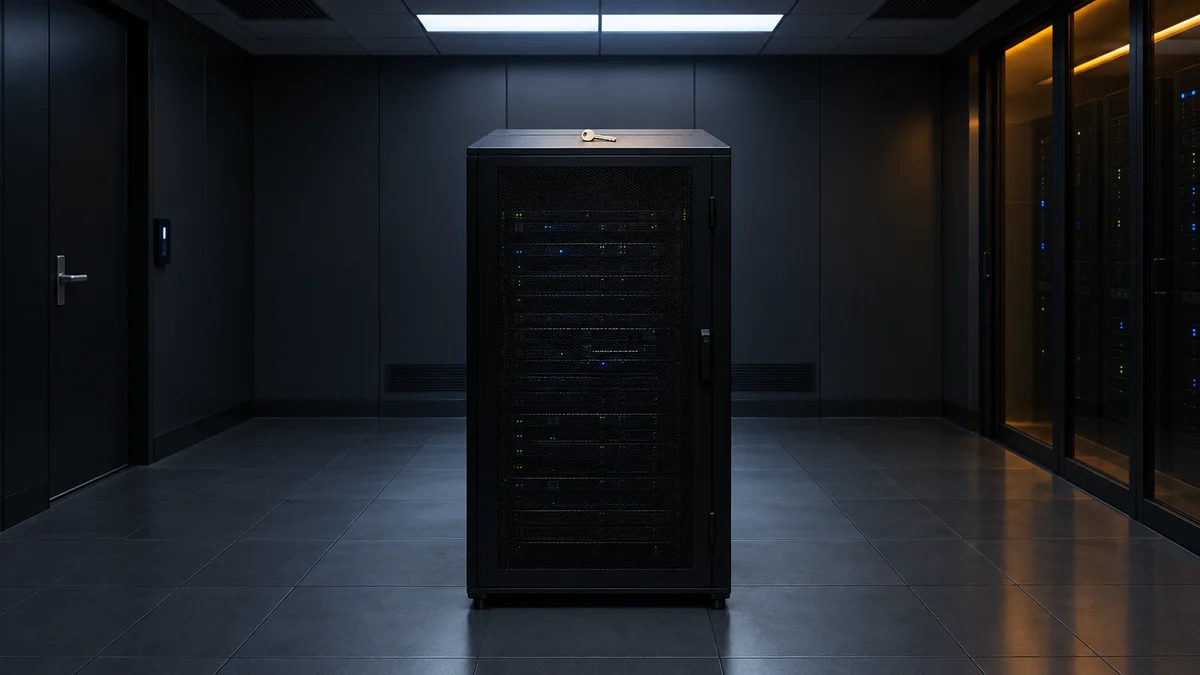
A locked server cabinet inside a private room with a single key resting on top
Ownership and privacy need settling before data preparation starts, because that phase touches the most sensitive data. Access to relevant training data was already a challenge for 37% of practitioners (Ethical Institute, 2025), so these terms also protect the schedule. Confirm these points in writing:
Location: training and inference run on the client's infrastructure or private cloud, not a shared vendor environment.
Retention: AI providers retain no data where the client's policy requires zero retention.
Secrets and traces: likely secrets are masked before they reach an agent, and agent traces are recorded.
Handover: a vendor handover checklist (the one at Grail Computer Labs has 10 points) covers code, models, environments and documentation, so the client can leave cleanly.
Regulation: personal data handling follows the rules that apply, such as Singapore's PDPA, the Australian Privacy Act, or MAS expectations for financial services.
Our results: For an Australian healthcare platform stuck in development for 8 months, Grail Computer Labs inherited 1.5 million lines of code, and the platform went live in production within 30 days. The client owns the code, cloud, models and documentation.
Who is this approach not for?
Grail Computer Labs' outcome engagement is not for teams that want open-ended research, a strategy deck or an hourly team. It suits stalled AI and software projects that matter and need one pre-defined outcome in production. Grail Computer Labs also holds no SOC 2, ISO 27001 or HIPAA certification, which some buyers require.
Other limits to weigh:
Data access sets the pace. A 4-8 week outcome depends on getting usable data early. Slow access moves the date.
Monitoring is ongoing. Monitoring model performance was the top production challenge for 42% of practitioners (Ethical Institute, 2025), so a deployed model needs an owner after launch. That is why continuous delivery follows the first outcome.
Statistics are directional. The practitioner survey has 135 respondents, and the MIT figure is self-reported and not peer-reviewed.
Security reviews still apply. Grail Computer Labs completes vendor security and compliance assessments during onboarding, but that does not replace a buyer's own review.
Frequently Asked Questions
We need data science support that goes beyond analysis and into deployed models. What should I look for in a partner?
Look for a partner that commits to a deployed, monitored model with a measurable outcome. Ask who owns the pipeline after handoff, how rollback works, what the evaluation harness scores, which drift triggers prompt retraining, and whether the named staff do the work. Insist that the client owns the code, models and documentation.
Is the 95% of AI pilots fail statistic accurate?
The MIT Project NANDA figure is real but narrower than the headlines suggest: 95% of enterprise generative-AI pilots showed no measurable P&L impact, as reported in 2025 (legal.io). The research is self-reported and not peer-reviewed, and it does not mean 95% of pilots crashed. Check the primary report before quoting it.
How long does it take to get a machine learning model into production?
About three-quarters of practitioners (11% + 23% + 41%) reported under three months in the 2025 Institute for Ethical AI & Machine Learning survey (Ethical Institute). The largest group, 41%, said less than three months, while 5% needed more than a year. Timelines shorten when the outcome is agreed before work starts.
Should we fine-tune a model, use an off-the-shelf model or build classical ML?
Start with the simplest option that passes the evaluation set. Use an off-the-shelf model if it meets accuracy, privacy and cost needs, classical ML for structured data problems, and fine-tuning when off-the-shelf models fall short. A custom model is justified when off-the-shelf AI cannot meet those requirements.
Conclusion
A data science engagement is worth buying when it ends in production. The practical takeaways:
Define the deliverable as a deployed, monitored model with a measurable outcome before work starts.
Ask for the production-grade handoff in every phase: pipeline, reproducible training, evaluation report, rollback and monitoring.
Expect the blockers around the model (data, pipelines, monitoring) to take as much effort as the model.
Settle ownership and data location in writing, including who keeps the code, models and documentation.
Treat headline failure statistics as directional and read what they measure.
The next step is simple: write down the stalled project's current output for each of the five phases, then compare it with the handoff column in the table above. If the gaps are large, book a call and we will scope one outcome against them.