enterprise ai guardrailsai agent guardrails best practices enterpriseai agent guardrails checklist
Enterprise AI Guardrails: What They Are and How Production Teams Actually Enforce Them
Enterprise AI guardrails explained: instruction-based vs architecture-based controls, plus a go-live checklist for data access, action scope and fallback.
Enterprise AI Guardrails: What They Are and How Production Teams Actually Enforce Them
By Shiva Mangal
Enterprise AI guardrails are the controls that limit what an AI agent can see, say and do in a live workflow, and they only hold when architecture enforces them rather than instructions. The gap between the two is where deployments fail. Gravitee's 2026 survey of 750 technology leaders found that 48% of production AI agents run unsecured (Gravitee, 2026). A written rule that nothing enforces is a wish, not a control. This guide separates instruction-based guardrails from architecture-based ones, shows which risks each can address, and ends with a go-live checklist covering data access, action scope, model fallback and human escalation.
Key Takeaways
Enterprise AI guardrails are controls on what an agent can access, do and say. Controls enforced by infrastructure hold; controls written as prompts do not.
Azure Prompt Shield was bypassed with average attack success rates of 71.98% for prompt injections and 60.15% for jailbreaks in a 2025 arXiv study (arXiv, 2025), so classifiers cannot be the only defence.
A pre-production checklist for AI agents covers four areas: data access, action scope, model fallback and human escalation.
Only 33% of organisations keep tamper-evident audit trails for AI activity (Kiteworks, 2026), so most cannot prove what an agent did.
What are enterprise AI guardrails and how do production teams actually enforce them?
Enterprise AI guardrails are the technical and procedural controls that bound what an AI agent can access, which actions it can take and when a human must step in. Production teams enforce them by building limits into infrastructure, not prompts. Policy alone fails: 87% of 1,200 senior decision-makers encourage AI agent use, but only 47% pair it with clear governance, oversight and controls (OneTrust survey, reported by Kiteworks, 2026).
A paper-thin red tape barrier across an open doorway beside a closed steel vault door
Guardrails fall into two families. An instruction-based guardrail is a rule the model is asked to follow, held in a system prompt, a filter or a classifier. An architecture-based guardrail is a limit built into the environment, so the action cannot happen whatever the model decides.
The two fail in different ways. Instructions live in the same context as the agent. They are instructions, not boundaries. Architecture is a wall. The only reliable way to prevent an AI agent from doing something is to make it physically impossible.
A prompt injection is an attack that hides commands in content an agent reads, such as an email or a web page, so the model treats them as legitimate instructions. Guardrails exist to limit the damage when that happens. They also limit what an agent can do on its own when nobody is attacking it.
Why do instruction-based guardrails fail in production?
Instruction-based guardrails fail in production because they are probabilistic and sit in the same context as the model they constrain. In a 2025 empirical study, character-injection attacks bypassed Azure Prompt Shield with average attack success rates of 71.98% for prompt injections and 60.15% for jailbreaks (arXiv, 2025).
A glowing line of light bending around a flimsy barrier of sticky notes toward a target
The study measured attack success rate (ASR), the share of attack attempts that get through a defence. It tested 2025-era versions of several guardrail systems, so the exact numbers will move. The pattern will not.
Confidence has outrun coverage
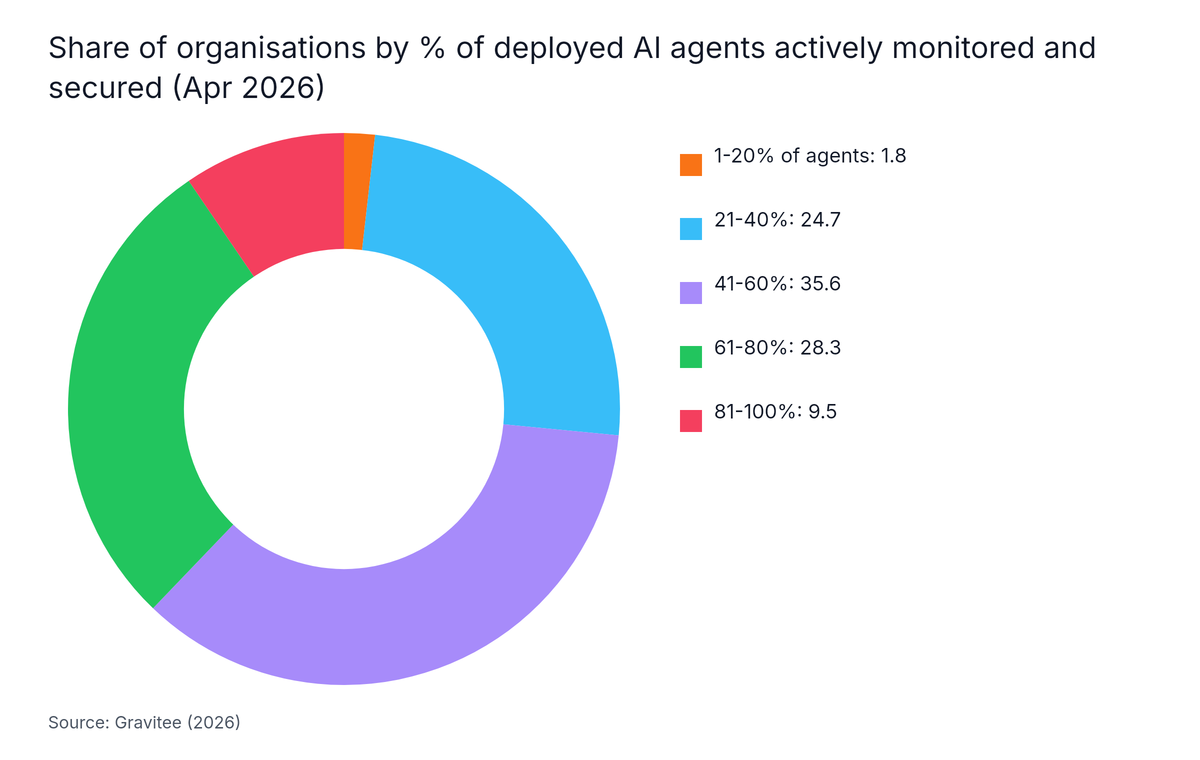
Stated confidence is rising faster than monitoring. In the Gravitee survey, executives' stated confidence in agent visibility rose from 82.6% in December 2025 to 91.8% in April 2026, while monitoring coverage barely moved (Gravitee, 2026). Only 9.5% of organisations monitored and secured 81 to 100% of their deployed agents, and 35.6% covered just 41 to 60% (Gravitee, 2026).
Donut chart: Share of organisations by % of deployed AI agents actively monitored and secured (Apr 2026). Highest: 41-60% at 35.6.
A guardrail that is itself a model inherits model failure modes. The HiddenLayer research team puts it plainly: "If the same type of model used to generate responses is also used to evaluate safety, both can be compromised in the same way." (HiddenLayer, 2025)
Cisco's security team reaches the same conclusion about the whole stack: "Every mitigation we have today, from input filtering to output guardrails to system prompt hardening, is probabilistic." (Cisco Blogs, 2026) Probabilistic controls are useful filters. They are not boundaries.
How do production teams enforce enterprise AI guardrails with architecture?
Production teams enforce enterprise AI guardrails by moving each limit out of the model's context and into infrastructure the model cannot edit: a sandboxed agent, a permissioned runner, a permission ledger, default-deny network egress and short-lived scoped credentials. NVIDIA's AI Red Team describes the goal as "deterministic controls enforced outside the model’s control plane" (NVIDIA, 2026).
Cutaway of nested glass containers with one narrow gated pipe passing through the walls
Five components do most of the work:
Sandboxed agent. A sandboxed agent is an agent that runs in an isolated environment with read access to what it has been given and no direct path to production systems.
Permissioned runner. A locked-down execution environment with its own credential store and audit log. The agent requests an action; the runner performs it.
Permission ledger. A permission ledger is a checkpoint that checks each sensitive request against rules, routes exceptions to the credential owner and logs every decision. Approvals can be one-time, time-limited or standing.
Default-deny egress.Default-deny network egress is a rule that an environment may open no outbound connection unless a destination is explicitly approved.
Scoped credentials. Short-lived credentials limited to one task, issued to the agent's own identity.
Our earlier post on why guardrails are not enough describes the first three in more depth. The table below maps both families to the risks they can and cannot address.
Guardrail
Type
Risk it addresses
What it cannot do
System prompt rules
Instruction
Off-topic output, routine misuse
Stop a manipulated model from acting
Input and output classifiers
Instruction
Known jailbreak and personal-data patterns
Resist evasion by deliberately crafted inputs
LLM judge
Instruction
Policy review of outputs
Stay independent when it shares the generator's weaknesses
Sandboxed execution
Architecture
Unwanted file, process and system access
Judge whether permitted actions are correct
Default-deny egress
Architecture
Data leaving for unapproved destinations
Stop misuse of data inside approved destinations
Scoped, short-lived credentials
Architecture
Over-broad access, stolen tokens
Repair a badly scoped task grant
Permission ledger with approvals
Architecture
Unreviewed high-risk actions
Prevent approval fatigue
Evidence is part of enforcement. Only 33% of organisations keep tamper-evident audit trails for AI activity (Kiteworks, 2026). Without that record, a team cannot show what an agent did or who approved it.
What guardrails should enterprise teams put on AI agents before moving them into live workflows?
Best practice for enterprise AI agent guardrails is to enforce four groups before an agent enters a live workflow: data access, action scope, model fallback and human escalation. Data access covers inventory and identity. Action scope covers allowlisted tools. Fallback defines behaviour on failure. Escalation adds approval gates and a tested kill switch, which 79% of organisations lack (Kiteworks, 2026).
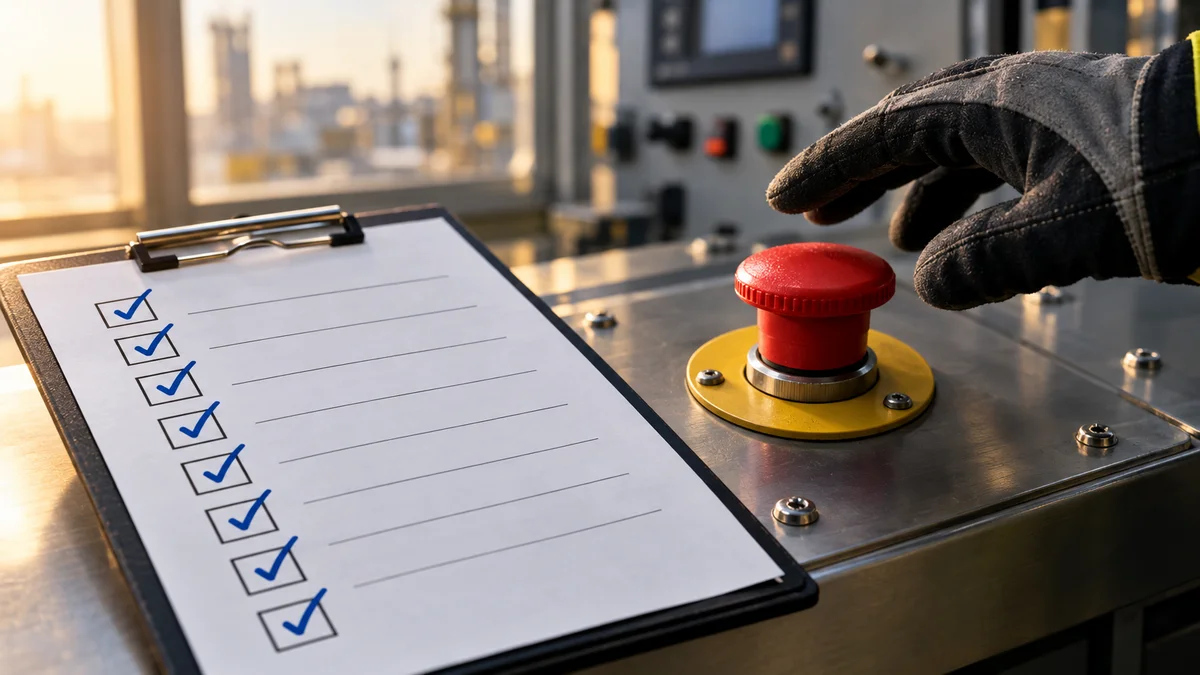
A clipboard with a column of tick marks beside a red emergency stop button
The table works as a go-live gate. A guardrail with no pre-production test is a policy statement.
Area
Guardrail to confirm
Pre-production test
Data access
Inventory lists every agent, its owner and its data sources
Compare the inventory with a discovery scan; no unlisted agents
Data access
Each agent has its own identity and short-lived, task-scoped credentials
Reuse a credential after its task ends; the call must fail
Data access
Access starts read-only; likely secrets are masked before reaching the agent
Plant a dummy secret; confirm the agent never sees it
Action scope
Allowlisted tools; sensitive actions run in a permissioned runner
Request an unlisted action; it must be refused
Action scope
Default-deny egress
Call an unapproved domain from the sandbox; it must be blocked
Model fallback
Defined behaviour on timeout, error or outage; fallback never widens permissions
Force a failure in staging; check the final state and the log
Human escalation
Approval gates for irreversible, regulated or out-of-rule actions
Trigger each gate; confirm it reaches the credential owner
Human escalation
Tested kill switch
Run a drill and time it
Audit
Tamper-evident record of every decision
Alter a log entry; detection must fire
Data access: inventory, identity, read-only starts
Enterprise AI agent data access guardrails begin with an inventory of every agent, its owner and the data it can reach. A Cloud Security Alliance survey, commissioned by Token Security, found that 82% of enterprises discovered previously unknown AI agents in the past year (Cloud Security Alliance, 2026). Yet 68% reported high confidence in their visibility.
An agent nobody listed has no owner, no scoped identity and no log. We start access read-only, share the access plan upfront and mask likely secrets before they reach an agent. Agent traces are recorded.
Action scope: allowlists and default-deny egress
Define the tools an agent may call. Run every sensitive action in a permissioned runner, not in the agent. Block all outbound connections except an allowlist. Every model-level mitigation is probabilistic, so the controls that decide what an agent may do must sit outside the model.
Model fallback: what should happen when the primary LLM fails?
Model fallback is the pre-agreed behaviour of an agent workflow when its primary language model times out, errors or becomes unavailable. Few public sources address it, so teams often skip it. A sound fallback design settles these points before go-live:
Retry within a fixed limit, then stop retrying.
Switch to a secondary model only under the same or narrower permissions, with the same guardrails.
Park unfinished work in a human review queue instead of guessing.
Record which model took each action.
Test every fallback path in staging.
A fallback path with fewer controls is the quickest way to turn an outage into an incident.
Human escalation: approval gates and a kill switch
Escalate to a human when an action is irreversible, touches regulated data, falls outside a standing rule, exceeds a set threshold or repeats after a denial. A kill switch is a single control that ends an agent's access, credentials and running tasks at once.
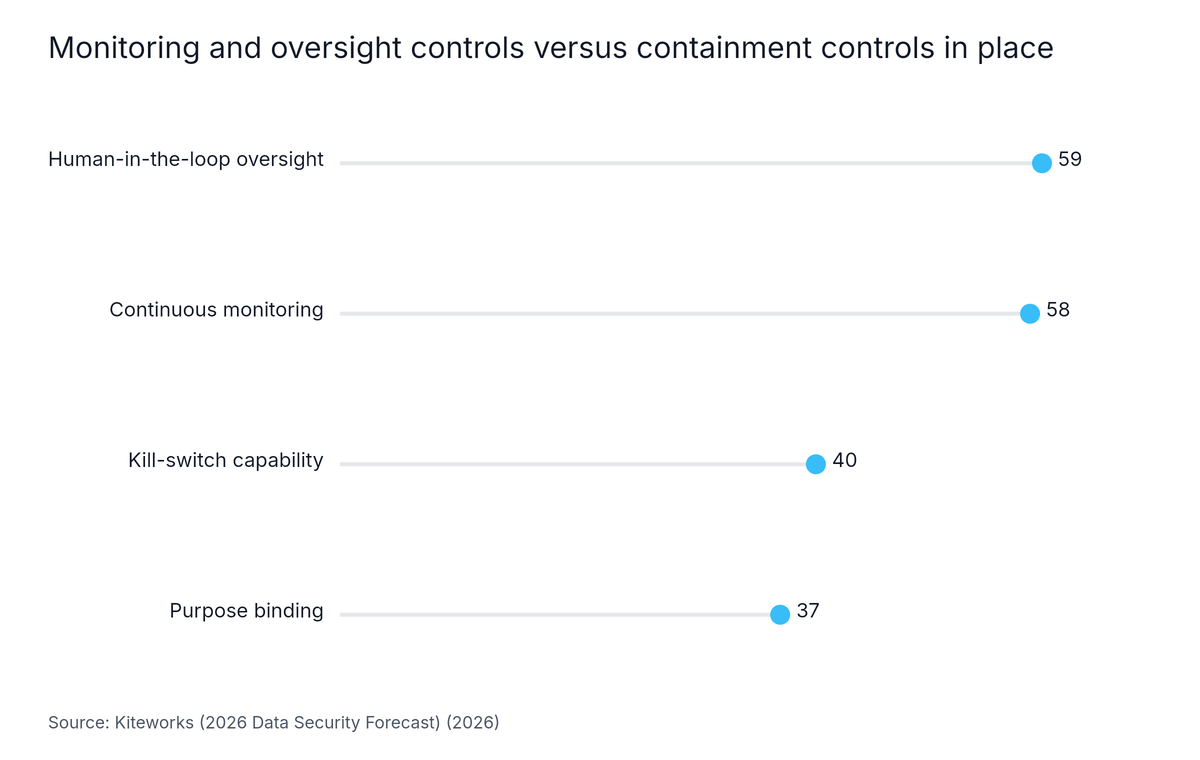
Teams monitor more than they can contain. In the 2026 Kiteworks forecast, 59% had human-in-the-loop oversight and 58% had continuous monitoring, but only 40% had kill-switch capability and 37% had purpose binding, which restricts an agent to its approved task (Kiteworks, 2026). The same research found that 60% could not terminate a misbehaving agent.
Lollipop chart: Monitoring and oversight controls versus containment controls in place. Highest: Human-in-the-loop oversight at 59.
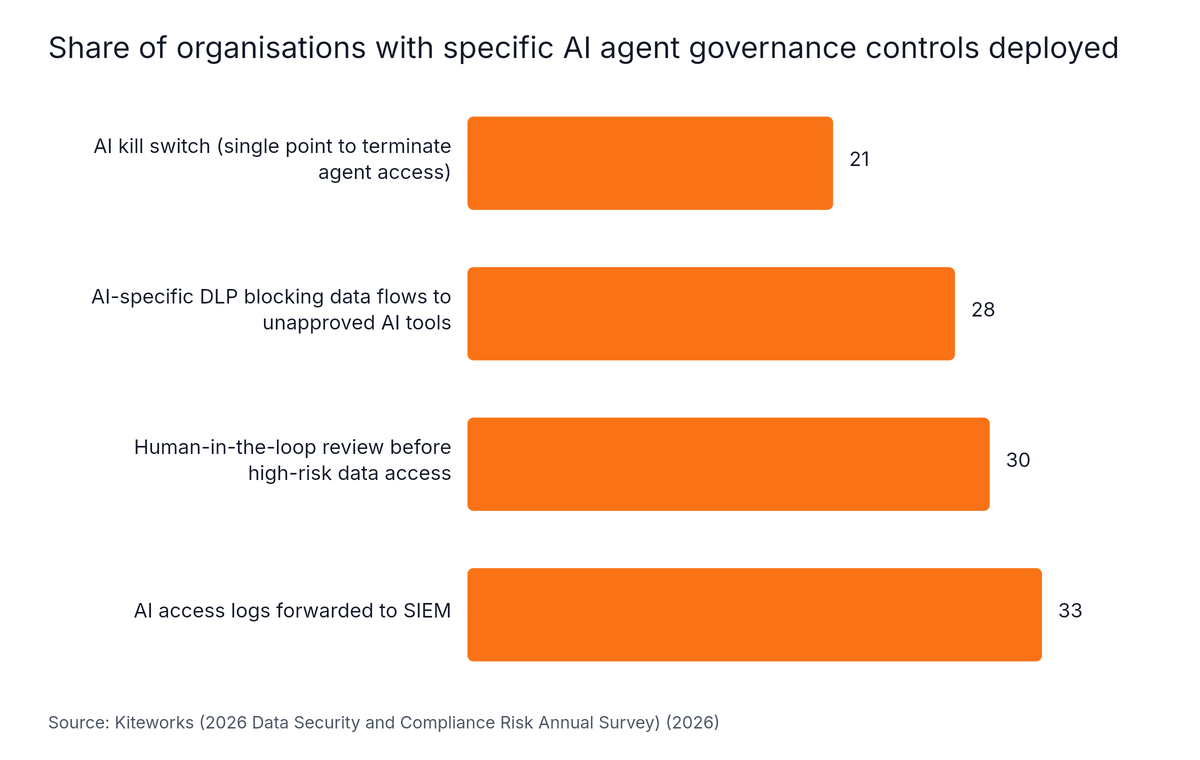
A separate Kiteworks annual survey found lower rates. Only 21% had an AI kill switch, 30% required human review before high-risk data access, 33% forwarded AI access logs to a security information and event management (SIEM) system, and 28% had AI-specific data loss prevention (DLP) blocking flows to unapproved AI tools (Kiteworks, 2026). The two surveys define controls differently, so the pairs are best read as a range, not a single rate.
Horizontal Bar chart: Share of organisations with specific AI agent governance controls deployed. Highest: AI access logs forwarded to SIEM at 33.
Our data: As of 2026, Grail Computer Labs' customer data shows that a human-reviewed know-your-transaction (KYT) workflow built for a Singapore-based neobank raised automated approvals from approximately 44% to approximately 90% in testing, in a one-week build.
Human review and automation are not opposites. Approvals work best when the gate sits where judgement or risk sits, and nowhere else.
How do Singapore and APAC AI governance rules map to AI agent guardrails?
Singapore's Infocomm Media Development Authority (IMDA) launched its Model AI Governance Framework for Agentic AI on 22 January 2026. It asks organisations to bound risk upfront, make humans accountable through approval checkpoints and implement technical controls such as whitelisted services (MDDI, 2026). Financial regulators in Singapore and Australia have since added their own expectations.
Singapore financial district skyline at dusk with glass towers reflecting blue light
Source
Date
What it asks
Guardrail it maps to
IMDA Model AI Governance Framework for Agentic AI
Launched 22 January 2026
Bound risks upfront; approval checkpoints; technical controls such as whitelisted services
Action scope, human escalation, egress allowlist
Australian Prudential Regulation Authority (APRA) letter to industry
30 April 2026
Governance, risk management, assurance and resilience must keep pace with AI adoption; names prompt injection, data leakage and non-human identity
Monetary Authority of Singapore (MAS) supervisory expectations
7 October 2026
Accountability for third-party AI; review controls as agents that access tools become more common
Inventory, vendor controls, permission ledger
MAS Guidelines on AI Risk Management
Issued 7 October 2026; effective 7 October 2027
For agents, the AI inventory may record the tools they can reach and their guardrails
Inventory, tool allowlist
APRA's letter told Australian banks, insurers and super trustees that AI governance is not keeping pace with adoption (APRA, 2026). The MAS guidelines take effect on 7 October 2027, and MAS says separate agentic AI guidance will follow in 2027 (Blockhead, 2026).
The MAS press release says financial institutions remain accountable for third-party AI (MAS, 2026). We describe these sources; we do not interpret them. Legal and compliance teams should confirm the obligations that apply to each organisation.
Where do architecture-based guardrails fall short?
Architecture-based guardrails limit what an AI agent can do, not whether its permitted actions are correct. They add build effort, slow some workflows with approval steps and do not replace evaluation or legal review. Only 5% of organisations say coordination and accountability are clear across the full AI lifecycle (OneTrust survey, reported by Kiteworks, 2026).
The Auth0 blog, summarising OWASP guidance for agentic applications, says "autonomy is a feature that should be earned, not a default setting" (Auth0, 2026). Teams running read-only, low-risk assistants may need only part of the checklist. The limits are worth stating plainly:
Permitted actions can still be wrong. A sandbox does not check a decision made with data the agent is allowed to read.
Approval fatigue is real. Too many gates train reviewers to click through. Reserve gates for irreversible or regulated actions.
Setup costs time. Physical separation is harder to build and slower to ship than a prompt.
The survey figures are directional. Most statistics here come from vendor-run surveys with different definitions. They are indicators, not benchmarks.
Frequently Asked Questions
What guardrails should enterprise teams put on AI agents before moving them into live workflows?
Enterprise teams should put four groups of guardrails on AI agents before go-live: inventory and scoped identity for data access, allowlisted tools and default-deny egress for action scope, a defined and tested model fallback, and approval gates plus a tested kill switch for human escalation. Each guardrail should be enforced by infrastructure and verified in a pre-production test, not only stated in a policy.
What is the difference between prompt-based guardrails and architectural guardrails for AI agents?
Prompt-based guardrails ask a model to behave, while architectural guardrails remove its ability to misbehave. A system prompt can be ignored, bypassed or overridden by injected text because it shares context with the model. A sandbox, egress allowlist or scoped credential applies whatever the model decides, so it holds even when the model is manipulated.
Can prompt injection be fully prevented with system prompts or guardrail classifiers?
No, system prompts and guardrail classifiers cannot fully prevent prompt injection. In a 2025 arXiv study, character-injection attacks bypassed Azure Prompt Shield with average success rates of 71.98% for prompt injections and 60.15% for jailbreaks. Teams should assume some attacks succeed and limit the damage with sandboxing, scoped credentials and human approvals.
What should happen when the primary LLM fails or times out in an agent workflow?
When the primary LLM fails or times out, the agent workflow should move to a defined state with equal or narrower permissions, never wider ones. Retry within a fixed limit, switch to a secondary model under the same permissions, or park the task in a human review queue. Log which model acted, and test every fallback path before go-live.
Conclusion: put the boundary in the architecture
Enterprise AI guardrails work when they are physical limits, not written requests. The evidence in this guide points to five takeaways:
Instruction-based guardrails are probabilistic; treat them as filters, not boundaries.
Architecture-based guardrails (sandboxes, egress allowlists, scoped credentials, a permission ledger) hold whatever the model decides.
Gate go-live on four areas: data access, action scope, model fallback and human escalation.
Test each guardrail, including the kill switch, before any agent touches a live workflow.
State the limits: permitted actions can still be wrong, and approvals can tire reviewers.
The next step is to run the checklist against one agent due to ship. Where a test fails, the guardrail is only a policy. Book a call ↗ to walk through that agent's access plan with GC Labs engineers.