Blog
Software Development Project Rescue: What the First 30 Days Involve
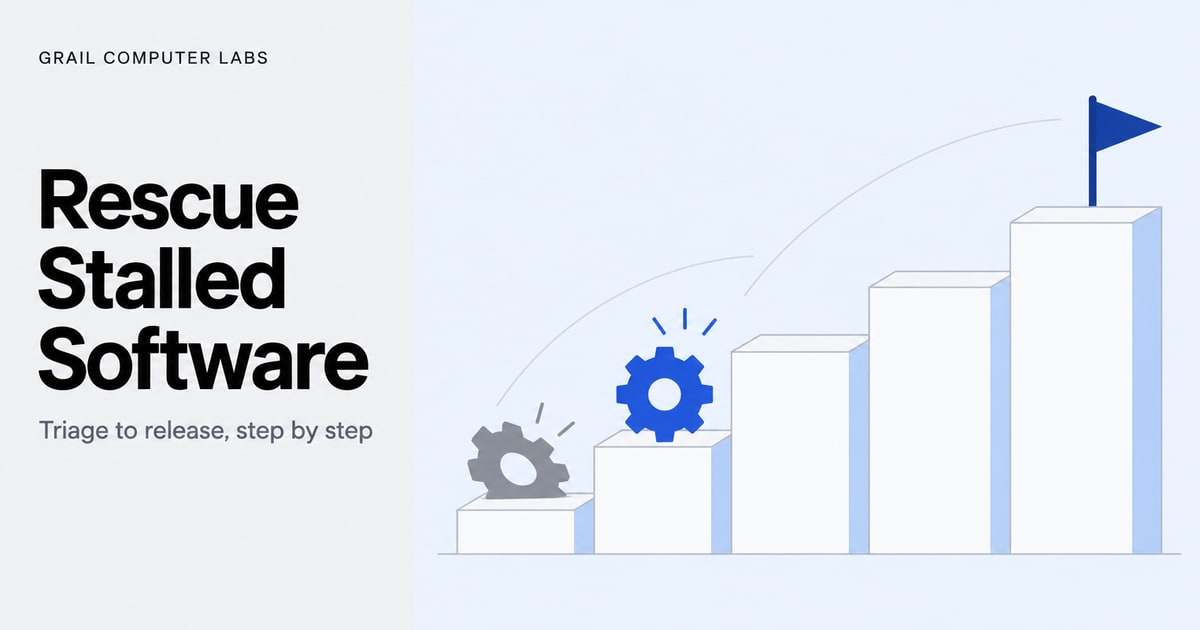
How software development project rescue works: triage, codebase inheritance, outcome agreement, stabilisation and release, anchored in a real 30-day case.

Evaluate a generative AI engineering firm on production proof, not demos. Get a scored rubric, engagement structure and contract checklist for buyers.
How software development project rescue works: triage, codebase inheritance, outcome agreement, stabilisation and release, anchored in a real 30-day case.
Enterprise AI guardrails explained: instruction-based vs architecture-based controls, plus a go-live checklist for data access, action scope and fallback.
A legacy system is software that is hard to change safely. See the warning signs, the improve-or-rebuild test and a phased migration plan for real platforms.
Request a quote and our experts will contact you within 24 hours with tailored solutions and pricing.
You can also send us a quick email at [email protected].
Last updated: Nov 19, 2026
By Shiva Mangal, Grail Computer Labs
A generative AI engineering firm is a team that designs, builds and operates generative AI systems in production, and proves it with live systems, evaluation results on the client's own data and an engagement that pays for shipped outcomes. Most buyers judge on the demo instead.
That is how budgets stall. MIT Project NANDA reported that 95% of generative AI pilots delivered no measurable P&L impact (MIT Project NANDA via legal.io, 2025). The cause is rarely the model. It is a team that optimised for a convincing demo and never owned integration, evaluation or release.
This guide sets out a buyer-side framework for choosing a generative AI engineering firm for your business: the questions to ask, the proof to require, a scored rubric, the engagement structure that limits risk and the contract terms that protect the buyer.
Key Takeaways
- A generative AI engineering firm should prove production delivery with live systems, named operators and a reference call on a system running six months or more.
- Buyers should require an evaluation suite run on their own data, an incident history, a rollback plan and a cost-per-task figure before signing.
- A sound engagement pays against a pre-defined outcome with kill criteria, not against hours.
- The buyer should own the code, models, cloud and documentation, with a written handover plan.
- In Singapore and Australia, third-party risk, data residency and outcome-proof checks belong in the evaluation.
Most generative AI pilots stall because nobody owns the path from demo to production. MIT Project NANDA found that 95% of generative AI pilots delivered no measurable P&L impact, measured roughly six months after deployment (MIT Project NANDA via legal.io, 2025). The study is self-reported and contested, so treat it as a direction, not a precise measurement.

P&L impact is a change in profit and loss that a company can attribute to a deployment. The MIT study used that definition at roughly six months. It drew on 52 executive interviews, surveys of 153 leaders and an analysis of 300 public deployments, and it is not peer-reviewed.
Critics push back hard. Paul Roetzer of the Marketing AI Institute said of the study: "This is not a viable, statistically valid thing." (Marketing AI Institute, 2025). Both views can hold. The exact number is soft, and the pattern is real.
IBM's 2025 survey of 2,000 CEOs found that only 25% of AI initiatives delivered expected ROI and only 16% scaled enterprise-wide (IBM Institute for Business Value, 2025). The same study found that 85% still expect scaled AI efficiency investments to return positive ROI by 2027 (IBM Institute for Business Value, 2025). Ambition is ahead of delivery.
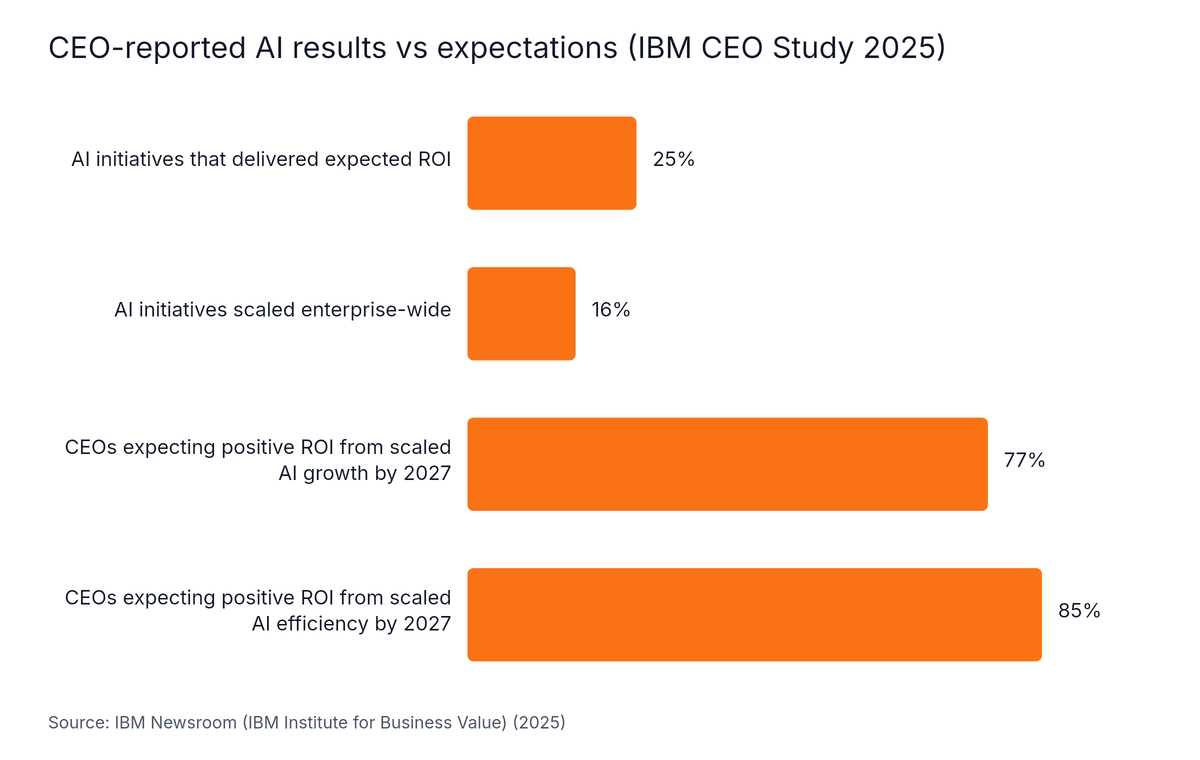
Source: IBM Newsroom (IBM Institute for Business Value), 2025
The gap between a pilot and a production system is not model quality. It is a list of jobs that demos skip:
| Job | In a demo | In production |
|---|---|---|
| Test data | A handful of clean examples | Real, messy data, with a fixed pass mark |
| Failure handling | Not shown | Retries, fallbacks, human review |
| Integration | Mocked | Connected to systems of record |
| Cost | Ignored | Tracked per task |
| Ownership | The vendor's team | A named owner on the buyer's side and the vendor's |
A firm that ships can show live systems, named operators and results measured on a client's own data. A firm that only builds demos shows screens and scripted walkthroughs. Ask for six artefacts: an evaluation suite, an incident history, a rollback plan, observability dashboards, a cost-per-task figure and a reference call with a system live for six months or more.

Score each artefact from 0 to 2, giving a maximum of 12. We treat a total under 8 as a sign that the firm has not yet shown it can run a system in production. That cut-off is our own working heuristic, not a figure from any study.
| Artefact | Strong answer (2) | Weak answer (0) |
|---|---|---|
| Evaluation suite | Test cases and pass marks agreed before the build, run on the buyer's data | "We check outputs by eye" |
| Incident history | A named incident, its cause and the fix | "We have never had a problem" |
| Rollback plan | Written steps to revert a release within a set time | No plan, or "we would patch it" |
| Observability | Traces, error rates and latency visible to the buyer | Logs only the vendor can see |
| Cost per task | A figure from a live system, with a model-cost breakdown | "Costs depend on usage" |
| Reference call | A client running the system for six months or more | Only a case study PDF |
Evaluation suite is a fixed set of test cases, with expected results, that defines what "working" means for an AI system. If a firm cannot write it down before building, it cannot prove the build worked.
Observability is the ability to see what an AI system did and why, through traces, metrics and logs. Gartner's 12 May 2026 forecast expects 40% of organisations deploying AI to use dedicated AI observability tools by 2028 (Gartner, 2026), so buyers should ask for it now.
Agent washing is relabelling ordinary automation or chatbots as agentic AI. A chat window proves little. Ask to see a live system where software decides and acts across several steps, with approval points, recorded traces and a named person who operates it.
The engagement structure that moves a generative AI pilot to production agrees one measurable outcome before work starts, pays against milestones and sets kill criteria for stopping. A pre-defined outcome engagement runs 4 to 8 weeks. Gartner's 19 October 2026 survey found only 13% of CIOs report significant or transformational value from AI (Gartner, 2026).

Kill criteria are conditions, agreed before work starts, under which the project stops. Gartner's same survey found that pilot-stop guidelines correlate with top performance (Gartner, 2026). Without them, a weak pilot keeps its budget by default. Four gates work well:
At each gate, the contract states what score continues the work and what score stops it.
Outcome engagement is a contract for one pre-defined, measurable result, delivered in 4 to 8 weeks, rather than hours. Grail Computer Labs (grail.computer) runs this model. It begins with a 15-day trial with no payment commitment, so a client can stop within the first 15 days without paying. The same team can keep delivering afterwards under continuous delivery, so the buyer does not restart with a new vendor each quarter.
Our data: We took over an Australian healthcare platform that had been stuck in development for 8 months. It went live in production within 30 days, and by day 40, 100 business customers had been onboarded.
Time to production depends on integration, data access and approvals, not on the model. These are our own anonymised client results, so they show what is possible, not a benchmark:
| Client build | What was delivered | Time |
|---|---|---|
| Australian healthcare platform | Platform live in production after 8 months stalled | Within 30 days |
| Small financial-services operator | One live sales queue across three lead sources | 11 days |
| Singapore-based neobank | Eight transaction checks live | Under 30 days |
| Singapore-based neobank | Project-management bot | 3 days |
A Singapore-based neobank's human-reviewed transaction workflow raised automated approvals from approximately 44% to approximately 90% in testing, in a one-week build. That figure is from testing, not production.
A generative AI contract should state, in plain terms, that the buyer owns the code, models, cloud environment and documentation, that the buyer's data is never used to train other models, and how the vendor hands everything over on exit. Terms matter early because only 28% of Australian respondents had moved at least 40% of AI pilots into production (Deloitte Australia, 2026).

Dr Elea Wurth, Deloitte's Trustworthy AI Leader for Asia Pacific and Australia, said agentic workflows need "clear accountability, guardrails, and intervention points" (Deloitte Australia, 2026). In a contract, those map to named owners, approvals with logs, and kill criteria.
A big-bang migration scares operators, and rightly. The improve-or-rebuild decision is a call, made per component, to keep what can support reliable releases and migrate the rest in phases. A buyer should ask any firm how it decides, and ask for a case where it kept existing code.
Singapore and Australian buyers should add regional proof to the evaluation of a generative AI engineering firm: evidence of outcomes, third-party risk controls and data residency. Nearly eight in ten Singapore enterprises will not greenlight new AI projects without proven business outcomes and a clear risk plan (Dell Technologies, 2026), and the Monetary Authority of Singapore (MAS) finalised its AI risk management guidelines on 7 October 2026 (LeapRate, 2026).
Andy Sim of Dell Technologies summed up the mood: "Singapore businesses aren't questioning AI's potential anymore, they're drawing a hard line on ROI and risk" (Dell Technologies, 2026). Dell's Singapore sample is small and the study is vendor-commissioned, so read it as sentiment.
Maturity differs by market. Insight Enterprises found that 21% of Australian organisations were scaling AI across functions and 8% had fully embedded it, against 37% and 14% in Singapore (Insight Enterprises via iDM, 2026). That is vendor research, so it serves as context only.
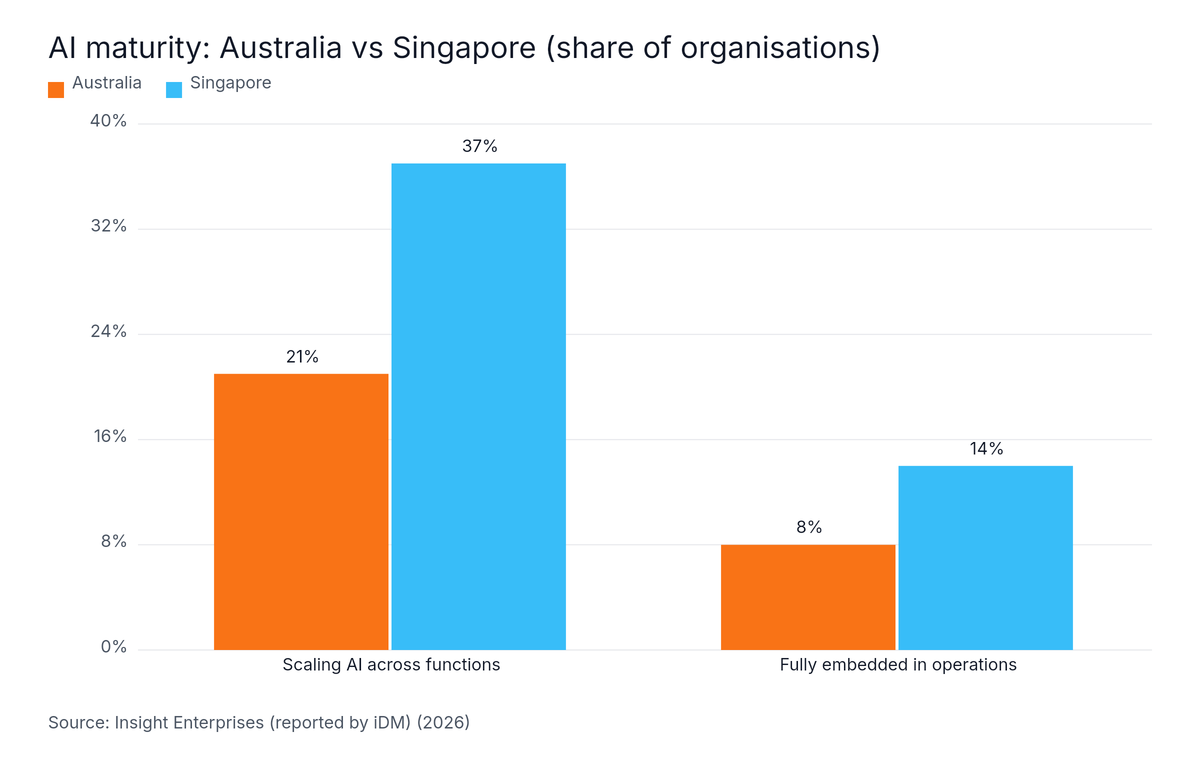
Source: Insight Enterprises (reported by iDM), 2026
For banks, insurers and fintechs, the MAS guidelines cover all forms of AI, including generative AI and agents, and financial institutions stay accountable for third-party AI. Expectations phase in from 7 October 2027 and 7 October 2028. In practice, each vendor should supply an AI inventory, audit trails, human-review points and a lifecycle control description that can be attached to the institution's own risk file.
| Buyer context | Extra proof to request |
|---|---|
| Singapore financial institution | Audit trails, third-party AI inventory, human review on high-risk steps |
| Australian healthcare or aged-care platform | Health-record privacy controls, phased migration plan, data residency |
| Multi-party platform operator | Integration evidence with rostering, payroll or screening systems |
| Mid-market company | One named senior team and an outcome deliverable in weeks |
The buyer-side framework for choosing a generative AI engineering firm is not for teams that want an exploratory pilot or have no owner for the outcome. It suits projects that matter and must reach production, a small group: only 5.2% of Australian and New Zealand organisations qualified as AI Leaders that have scaled AI beyond pilots (Adobe via ecommercenews.com.au, 2026).
The framework also does not replace a buyer's own security review. Four limits apply:
The 95% figure from MIT Project NANDA is a useful signal but not a precise measurement. It rests on 52 executive interviews, surveys of 153 leaders and 300 public deployments, is self-reported, is not peer-reviewed, and defines success as P&L impact about six months after deployment. Use it to frame the risk, then ask vendors for results on your own data.
Moving a generative AI prototype to production took from 3 days to under 30 days across Grail Computer Labs' anonymised client builds, and its pre-defined outcome engagement runs 4 to 8 weeks. Timing depends on integration, data access and approvals. An Australian healthcare platform stalled for 8 months went live in production within 30 days.
Build in-house when you already have engineers who have shipped and operated AI systems. Buy a product when your use case is generic. Hire an engineering partner when the use case is specific to your workflows and you lack the people to ship it. In every case, require an agreed outcome, code ownership and a handover plan.
Agent washing is relabelling ordinary automation or chatbots as agentic AI. To avoid it, ask the vendor to show a live system where software decides and acts across several steps, with approval points, traces and a named operator. If the demo is a chat window with no logs, you are looking at a prototype.
A mid-market company should weigh accountability and speed more heavily than scale. Ask for one named senior team, one pre-defined outcome deliverable in weeks, and full ownership of code and documentation. Enterprises can add formal procurement and panel reviews, but a mid-market buyer usually has no spare capacity to manage a long pilot.
Choosing a generative AI engineering firm comes down to evidence a buyer can check before paying.
If a project matters but could not move, bring it to a call. We agree the outcome first, deliver it in 4 to 8 weeks, then keep shipping. Book a call ↗