Managed Application Services vs. In-House Delivery: What to Expect After Your Vendor Leaves
By Shiva Mangal, Grail Computer Labs. Reviewed 28 October 2026.
Managed application services are contracted support that keeps a production application running, covering monitoring, incident response and patching, but usually not feature delivery, testing or documentation across the whole codebase.
When a vendor or lead developer leaves, the first question is not which service to buy. It is who owns production today. Guessing wrong is costly: 57% of respondents to Uptime Institute's 2025 survey said their most recent major outage cost over $100,000 (Uptime Institute Intelligence, 2026). This guide separates what a conventional managed application service covers from what continuous delivery covers. It ends with a decision matrix, so the CTO or founder can match the model to the gap the business actually has.
Key Takeaways
Production ownership after a vendor exit means named people holding access, on-call duty, deploy rights, secrets, monitoring and the backlog.
A conventional managed application service keeps an application running; continuous delivery also ships features, tests, releases and documentation across the whole codebase.
AI-generated code raises the volume of change, so testing, review and release controls matter more after a handover, not less.
Human-supervised agentic AI workflows need a named approval owner, whether the company uses a managed service or an in-house platform team.
Who owns production right now when a vendor leaves?
When a vendor or lead developer leaves, nobody owns production until a named person takes it on, and the gap is costly: 57% of respondents to Uptime Institute's 2025 survey said their most recent major outage cost over $100,000 (Uptime Institute Intelligence, 2026). Ownership means someone holds access, on-call duty, deploy rights, secrets, monitoring and the backlog.
A ring of keys and a security badge left on an empty desk beside a closed laptop
Run a first-30-days ownership checklist
Work through these in order. Each step turns an assumption into a named person.
Access: list every account, repository, cloud console and domain, and move each to an owner the company controls.
On-call: name who gets paged tonight, and who is the backup.
Deploy rights: confirm who can release and roll back, then test a rollback once.
Secrets: rotate every key and token the departed person or vendor held.
Monitoring: confirm alerts reach a live person, not a vendor inbox.
Backlog: export open tickets and rank them by customer impact.
Documentation: record what exists and write runbooks for the top failure modes.
A runbook is a step-by-step procedure for recovering from, or operating through, a known situation. Runbooks matter because people skip procedures under pressure. Uptime Institute found that "The overwhelming majority of human error-related outages involve ignored or inadequate procedures." (Uptime Institute, 2025). In that analysis, the share of human-error outages caused by failure to follow procedures rose ten percentage points year on year (Uptime Institute, 2025).
Check the regulatory clock in regulated sectors
APRA CPS 230 is the Australian Prudential Regulation Authority's operational risk standard. It commenced on 1 July 2025. Existing service provider contracts must comply from the earlier of their next renewal or 1 July 2026 (APRA, 2025).
Regulated entities must notify APRA no later than 24 hours after a disruption to a critical operation outside tolerance. They must also notify within 20 business days of entering into or materially changing a material-service-provider agreement (APRA, 2025). For an Australian bank, insurer or superannuation entity, a vendor exit is a regulatory event as well as an engineering one.
What does a managed application service actually cover?
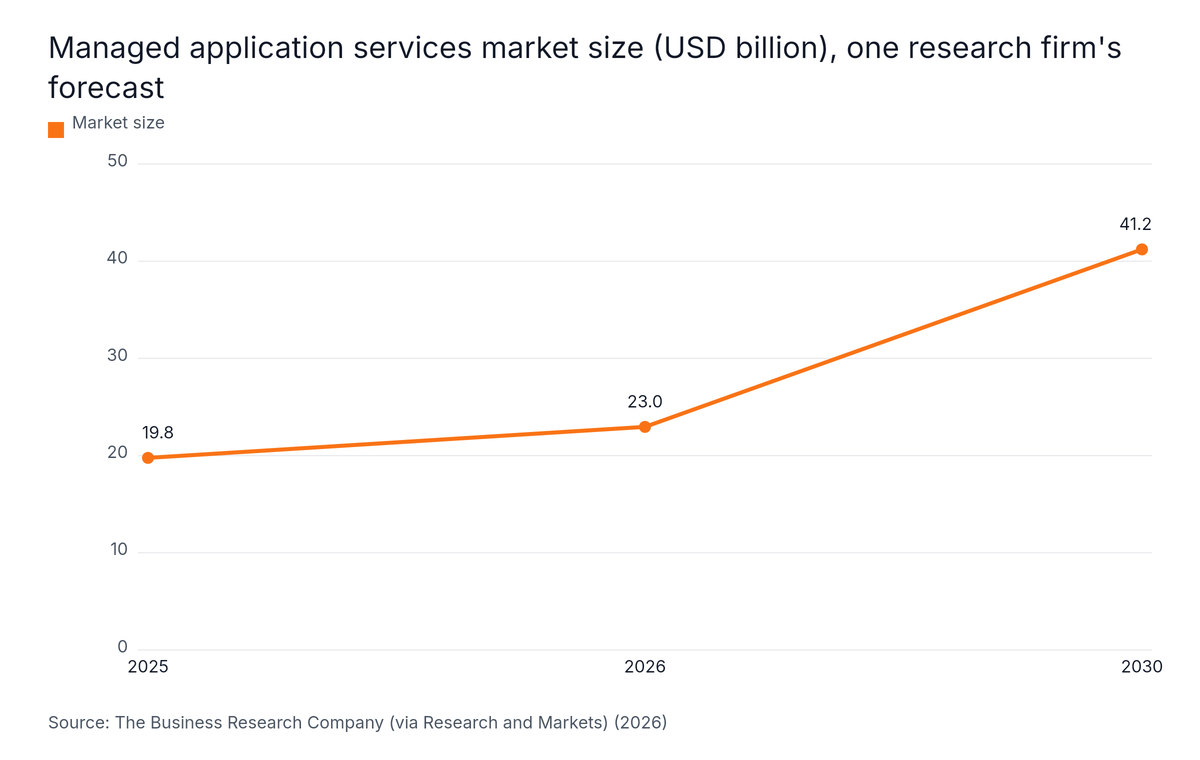
Managed application services are contracted support in which a provider runs a production application, typically covering monitoring, incident response, patching and release support. One research firm sizes the market at USD 22.95B in 2026, rising to USD 41.22B by 2030 (The Business Research Company, 2026). Feature delivery and full documentation usually sit outside the base scope.
Server racks with a gloved hand pointing to one amber status light
The typical base scope
A conventional managed application service usually bundles these items:
24x7 monitoring and alert triage
Incident resolution against agreed response targets
Patching and security updates
Release and deployment support
Integration upkeep
Ticket-based minor changes
The scope answers one question: is the application up? It does not answer who decides what the application should do next. That gap is where many buyers get surprised after a handover.
The market, and why its size is disputed
The same firm puts the market at USD 19.77B in 2025, USD 22.95B in 2026 and USD 41.22B by 2030.
Line chart: Managed application services market size (USD billion), one research firm's forecast. Highest: 2030 at 41.2.
Sizing depends on how each firm defines the category. SNS Insider projects USD 95.84B by 2035 (SNS Insider via GlobeNewswire, 2026). Quote one source and name it.
On buyers, banking, financial services and insurance (BFSI) is the largest end-user segment at 38.4%, and large enterprises hold 65.3% of the market (Coherent Market Insights, 2026). Treat both as directional estimates.
How does continuous delivery differ from a managed application service?
Continuous delivery is an engagement in which one team keeps shipping across the whole codebase as work arrives: features, monitoring, site reliability engineering, testing, release and documentation. A conventional managed application service keeps the application running through incidents, patches and tickets. The difference is who owns change, not who watches the dashboards.
Two parallel conveyor belts, one short and sparse, one continuous and carrying labelled crates
Site reliability engineering (SRE) is the practice of applying software engineering to keep production reliable. The table shows typical responsibilities under each model.
Responsibility
Conventional managed application service
Continuous delivery
Hired in-house team
Monitoring and incidents
Included
Included
Depends on hires and rota
Patching
Included
Included
Depends on hires
New features
Usually separate tickets or projects
Included, as work arrives
Included, limited by headcount
Testing and release
Release support only
Included, across the whole codebase
Depends on practices in place
Documentation
Often limited to runbooks for the covered scope
Included, kept current
Depends on discipline
Codebase knowledge
Held by provider staff
Held in the delivery system
Held in people
Our data: An Australian healthcare platform had been stuck in development for 8 months. Grail Computer Labs inherited 1.5 million lines of code, and the platform went live in production within 30 days. By day 40, 100 business customers had been onboarded, and 500 bug and feature tickets were handled across a 10-day period.
GC Labs' Software Factory is our AI software factory, customised around each client's codebase. It runs the loop Triage → Specify → Implement → Review → Verify → Release. Agents execute, GC Labs engineers review every change, and tests reject incomplete work.
Match the model to the gap
The gap
Best-fit model
Why
Application is stable, but nobody watches it
Conventional managed application service
The need is cover, not change
No owner and a stalled feature backlog
Continuous delivery
One team owns change and run
Thin documentation and few tests
Outcome engagement, then continuous delivery
A pre-defined outcome in 4-8 weeks fixes the base first
Deep product knowledge must stay in the company
In-house hires, supported by a delivery team
Strategy stays with the company's own people
AI features must be built into the product
Continuous delivery or an in-house team with AI skills
Model work and product work need one owner
Plan for AI-generated code in the inherited codebase
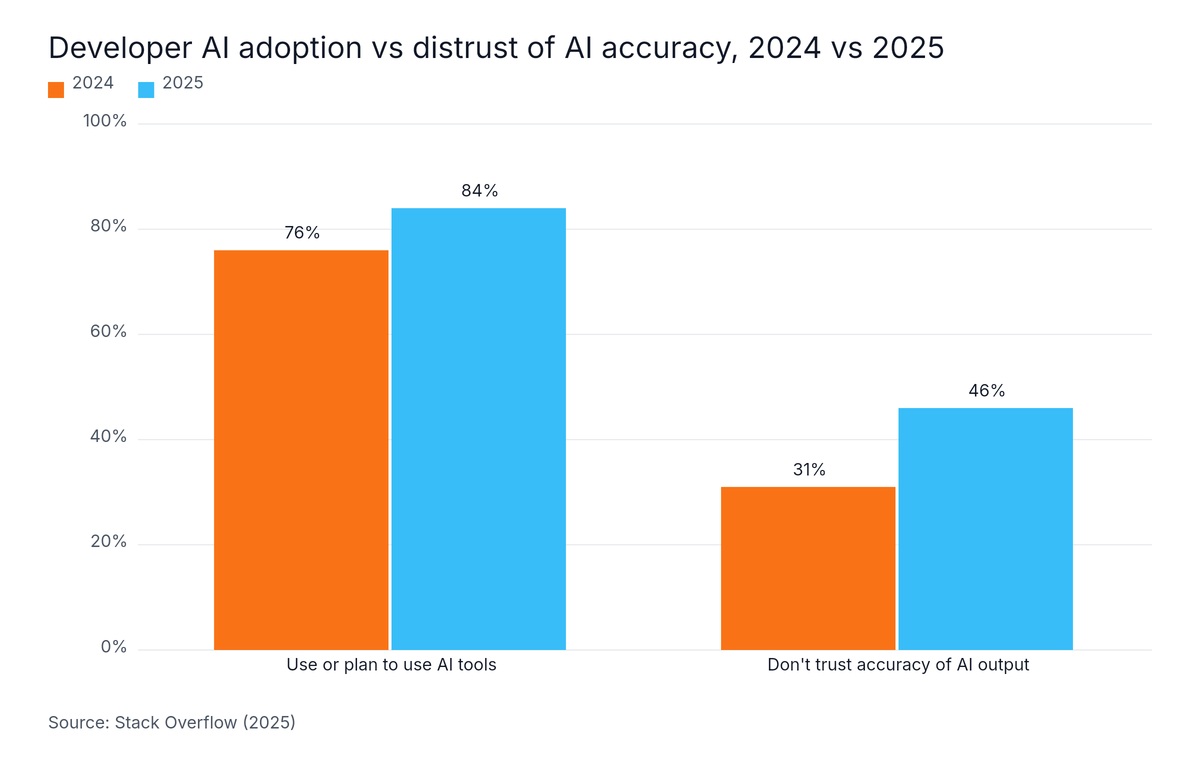
The inherited codebase will likely contain AI-assisted code. 84% of developers use or plan to use AI tools, up from 76% in 2024 (Stack Overflow, 2025). In the DORA survey of nearly 5,000 technology professionals, 90% reported using AI at work. More than 80% believed it had raised their productivity (Google Cloud, 2025).
Trust has not kept pace. 46% of developers say they don't trust the accuracy of AI output, up from 31% the year before (Stack Overflow, 2025).
Grouped Bar chart: Developer AI adoption vs distrust of AI accuracy, 2024 vs 2025. Highest: Use or plan to use AI tools at 76%.
The DORA team states that "AI accelerates software development, but that acceleration can expose weaknesses downstream." (Google Cloud, 2025). It adds that "AI adoption does continue to have a negative relationship with software delivery stability." (Google Cloud, 2025). More change per week puts more load on testing and release controls. A service that only watches production does not supply them.
How do managed services compare with in-house platforms for human-supervised agentic AI workflows?
A managed service gives a human-supervised agentic AI workflow an on-call owner, audit traces and review capacity without hiring, while an in-house platform team keeps approval logic and domain knowledge closest to the business. Oversight is the common ground: 52% of organisations rely on a human-on-the-loop model (OutSystems, 2026), so the real question is who staffs the approval gate.
A small robotic arm stopped above a control panel while a human hand rests on an approval switch
Human-in-the-loop means a person approves an action before an agent takes it. Human-on-the-loop means a person supervises and can intervene, with less direct oversight. For a control-model comparison, see our guide to human-in-the-loop versus autonomous agents.
Question
Managed service
In-house platform team
Who is paged when an agent misbehaves?
Provider on-call, if the contract names agents
The company's own rota
Who holds approval rules?
Shared; must be written into the contract
The in-house team, directly
Who keeps audit traces?
Provider, if specified
The in-house team, if built
What happens when a key engineer leaves?
Provider replaces the person
The company rehires and retrains
Tier approvals by risk. Reads need none. Reversible writes need review. Irreversible actions, such as moving money, changing access or committing to customers, need a named human.
Trust is the reason this matters. Only 29% of 2025 respondents said they trust AI, down 11 percentage points from 2024 (Stack Overflow, 2026). And 75% of developers would still ask another person for help when they don't trust AI's answers (Stack Overflow, 2025).
Gartner expects over 40% of agentic AI projects to be cancelled by the end of 2027 (Gartner, 2025). Projects with no owner for integration, evaluation and release are the ones at risk.
Who is continuous delivery not for?
Continuous delivery is not the right model for every buyer. A stable, well-documented application that needs only incident cover suits a conventional managed application service better. Continuous delivery assumes one team changes the whole codebase, and Gartner expects over 40% of agentic AI projects to be cancelled by the end of 2027 (Gartner, 2025), so scope must stay disciplined.
Other limits worth weighing:
Review load: the DORA finding that AI adoption still has a negative relationship with delivery stability means engineers must review every change. Continuous delivery includes that review, but it takes time.
Certifications: GC Labs holds no SOC 2, ISO 27001 or HIPAA certification. It completes vendor security and compliance assessments during onboarding.
Evidence gap: we found no credible published failure rate for vendor-to-vendor transitions, so we quote none.
Regulation outside Australia: we have not verified Singapore, UK or EU equivalents of CPS 230 here. Check the relevant regulator.
Engineers stay: this is not AI replacing engineers. Humans decide, and the company's own team still owns product direction.
Frequently Asked Questions
We need AI features built into our product, not bolted on. Who provides end-to-end AI application development?
End-to-end AI application development comes from one team that covers model work, product engineering, testing, release and ongoing delivery, so AI features are built into the product rather than added beside it. GC Labs, an applied-AI and digital product research lab, designs, trains, evaluates and deploys custom models and ships the software around them.
How do managed services compare with in-house platforms for human-supervised agentic AI workflows?
Managed services supply on-call ownership, audit traces and review capacity without hiring, while an in-house platform team keeps approval rules and domain knowledge closest to the business. Both can run human-supervised agentic AI workflows. The deciding factor is who staffs the approval gate and who is paged when an agent misbehaves.
Does managed application support include building new features?
Managed application support usually does not include new feature delivery. Its base scope is monitoring, incident response, patching and release support, with changes handled as separate tickets or projects. Continuous delivery adds features, testing, release and documentation across the whole codebase, so one team keeps shipping as work arrives.
What should be in a software handover or vendor exit plan?
A software handover or vendor exit plan should cover access to every account and repository, named on-call owners, deploy and rollback rights, rotated secrets, monitoring alerts routed to a live person, a ranked backlog, and runbooks. The test is simple: can a new team build, deploy and roll back from the repository and runbooks alone?
Verdict: match the model to the gap
Name a production owner first, then pick the model.
Stable application, no watcher: a conventional managed application service.
No owner and a stalled backlog: continuous delivery.
Thin documentation and tests: agree one outcome first, then keep shipping.
AI agents in the workflow: name the approval owner before launch.
Regulated entity: check exit and notification duties now, not at renewal.
We agree the outcome first, deliver it in 4-8 weeks, then keep shipping. The engagement starts with a 15-day trial with no payment commitment, and the client keeps the code, cloud, models and documentation. If your vendor has left and production has no owner, Book a call ↗ with Grail Computer Labs.