Blog
Software Development Project Rescue: What the First 30 Days Involve
How software development project rescue works: triage, codebase inheritance, outcome agreement, stabilisation and release, anchored in a real 30-day case.

Manual workflow automation explained: why manual approvals stall as volume grows, what review costs, and a neobank's 44% to 90% automated approvals in testing.
How software development project rescue works: triage, codebase inheritance, outcome agreement, stabilisation and release, anchored in a real 30-day case.

Enterprise AI guardrails explained: instruction-based vs architecture-based controls, plus a go-live checklist for data access, action scope and fallback.
A legacy system is software that is hard to change safely. See the warning signs, the improve-or-rebuild test and a phased migration plan for real platforms.
Request a quote and our experts will contact you within 24 hours with tailored solutions and pricing.
You can also send us a quick email at [email protected].
Last updated: Nov 25, 2026
By Shiva Mangal
Manual workflow automation is the practice of replacing the hand-run steps in a business process, such as routing, checking and approving, with software that handles routine cases and sends only exceptions to a person. A Singapore-based neobank's transaction review took 30+ minutes per case, and only about 44% of cases were approved automatically. After a one-week build, automated approvals reached about 90% in testing. That gap is small at ten cases a day and expensive at ten thousand. This guide explains how the automation works, why manual approvals stall as volume grows, what a manual case costs, and which approvals should stay with a person.
Key Takeaways
- A manual approval step has fixed capacity (reviewer hours), so queues grow whenever case volume outpaces headcount.
- Invoice processing is the nearest sourced cost proxy for banks: Ardent Partners' 2025 benchmark, as tabulated by Aequo AP (a secondary source), shows $9.84 on average and $2.65 for Best-in-Class teams.
- A Singapore-based neobank raised automated approvals from about 44% to about 90% in testing in a one-week build, which shrinks the manual review load.
- Approvals that carry high risk or are hard to reverse should stay human, with sampling and audit trails to stop rubber-stamping.
Manual workflow automation is the automation of a process that people currently run by hand, usually a queue of requests, checks and approvals. Software handles routine cases against written rules. People keep the cases where judgement or risk sits. Ardent Partners' 2025 benchmark, as reported by Docsumo (2025), puts the average invoice exception rate at 18.4%, so people still handle a share of cases.

The phrase can read as a contradiction. The "manual" describes where the process starts, not where it ends. A team that approves requests by email, spreadsheet or a shared inbox has a manual workflow. Automating it means writing down the rules the reviewers already apply, then letting software apply them to every case.
| Step | Manual workflow | Automated workflow with human approvals |
|---|---|---|
| Intake | A person reads the request and copies details into a system | Software captures the request and its fields directly |
| Rule checks | A reviewer checks each rule by eye | Software runs every check on every case |
| Routine decision | A reviewer approves each case | Software approves cases that pass every check |
| Exceptions | Mixed in with routine cases in one queue | Routed to a named person with the failed checks attached |
| Audit trail | Reconstructed from emails and notes | Recorded automatically at each step |
It does not mean removing people. The working principle is that agents execute and humans decide: software does the repeatable checking, and a person owns each judgement call. The final section covers where that line sits.
A manual approval step becomes the bottleneck because its capacity is fixed by reviewer hours, while demand grows with case volume. Queues lengthen and waits compound. West Monroe's 2026 survey found 73% of leaders estimate slow decisions cost their organisations up to 5% of annual revenue (West Monroe, 2026).

The mechanism is simple. It has four parts:
The West Monroe survey covered 214 C-suite executives and 1,000 managers at US companies with at least $250M in revenue, fielded in November 2025. Managers named excessive approval layers and unclear decision rights as contributors (PR Newswire, 2026). The figures are self-reported estimates, and the survey is US-only.
Cycle time is where the queue shows up first. Ardent Partners' 2025 benchmark, as tabulated by Aequo AP, puts the average invoice at 8.2 days to process: 2.9 days for Best-in-Class teams and 13.5 days for everyone else (Aequo AP, 2025).
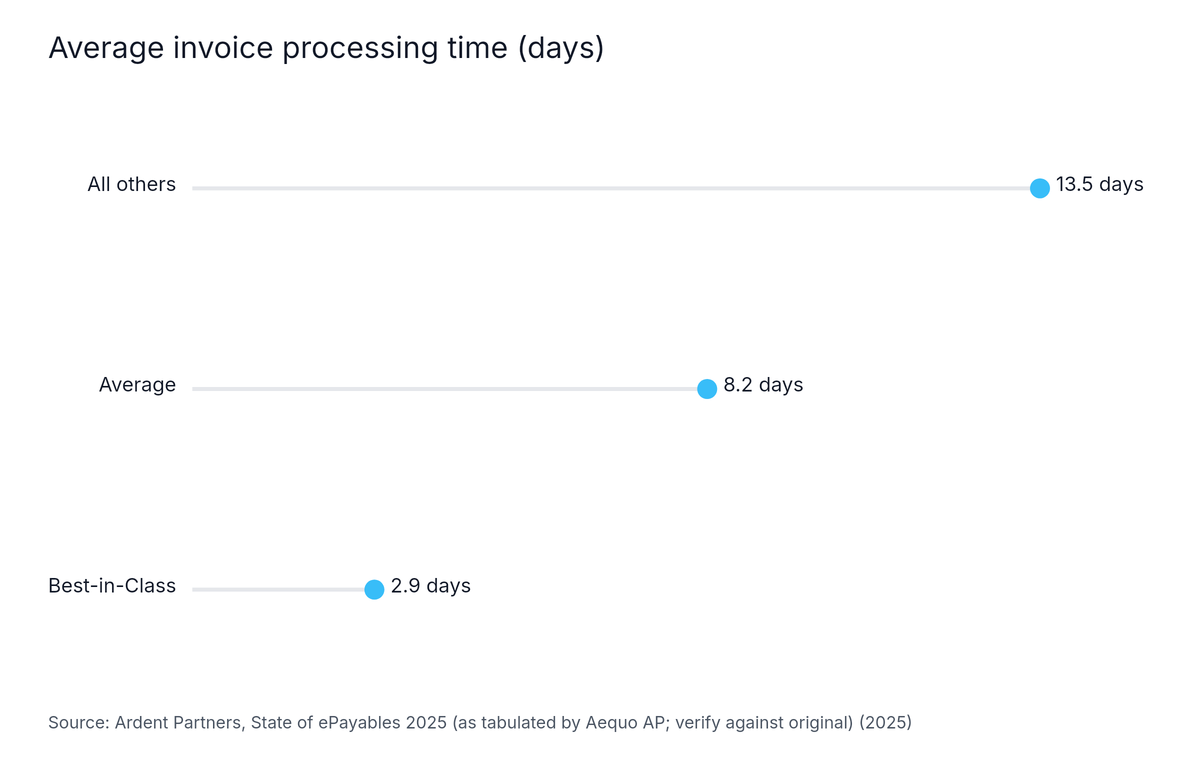
Source: Ardent Partners, State of ePayables 2025 (as tabulated by Aequo AP; verify against original), 2025
Exceptions drive much of the delay. Exception rate is the share of cases that fail the standard rules and need human review. Ardent's average invoice exception rate is 18.4% (Docsumo, 2025). A human review queue is, in practice, a queue of exceptions plus every routine case nobody has removed.
Healthcare shows the same arithmetic. Practices complete about 39 prior authorization requests per physician each week, taking physicians and staff about 13 hours (AMA, 2025). That is a fixed block of capacity spent on approvals before any new volume arrives.
The business cost shows in West Monroe's data too. In the CFO.com write-up of the study, 49% of C-suite leaders said slow decisions already cost them a major market opportunity in the prior 12 months, and 56% said competitors beat them to market occasionally or frequently (CFO.com, 2026). The report puts it bluntly: "Every request for ‘one more analysis’ extends timelines while opportunity windows close." (CFO.com, 2026)
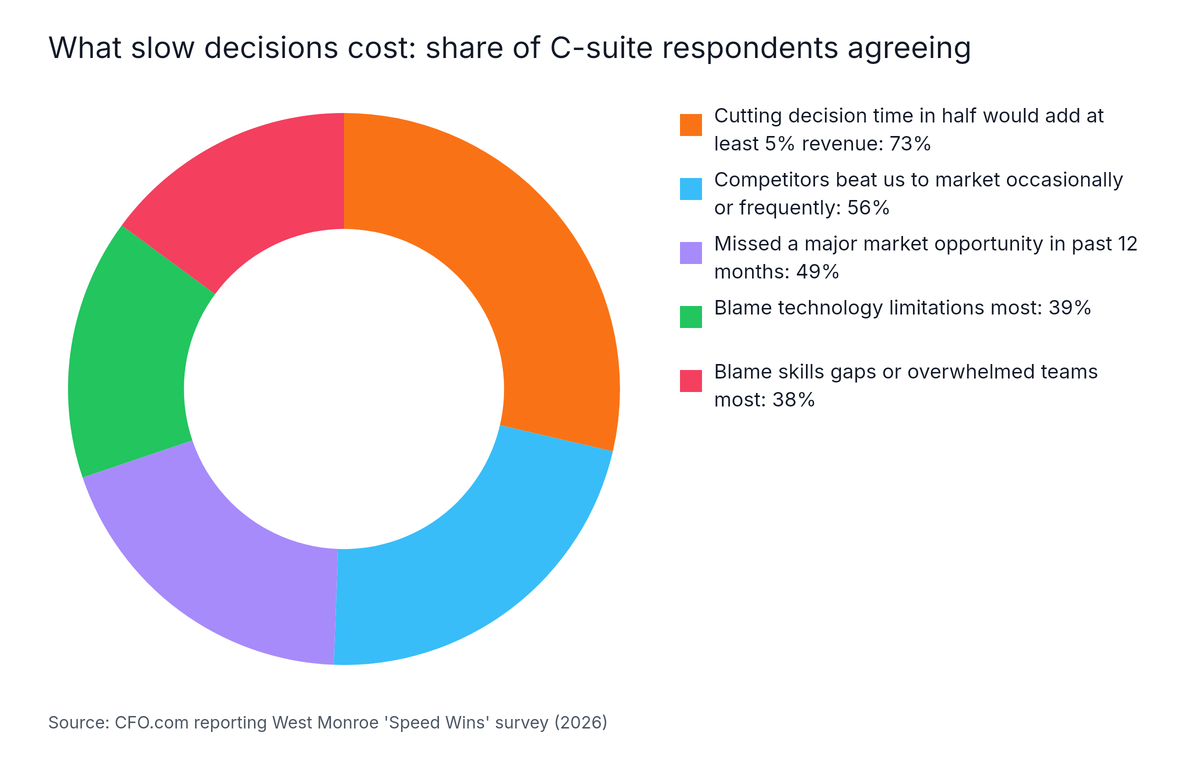
Source: CFO.com reporting West Monroe 'Speed Wins' survey, 2026
Speeding up individuals does not fix the structure. Approval layers and handoffs stay in place, so the queue stays as long.
No bank-specific cost-per-case benchmark for transaction review was found, so the closest sourced proxy is invoice processing. Ardent Partners' 2025 benchmark, as tabulated by Aequo AP, puts the average all-in cost of one invoice at $9.84, against $2.65 for Best-in-Class teams and $12.42 for all others (Aequo AP, 2025).

Treat these numbers as a proxy for banking workflow automation vs manual operations. An invoice and a payment alert are different cases with different risks. The pattern still carries over: the best 20% of teams pay a fraction of what the rest pay, and the difference comes from how many cases a person touches. Both Ardent figures reach this post through secondary sources, so verify them against the original report before relying on them.
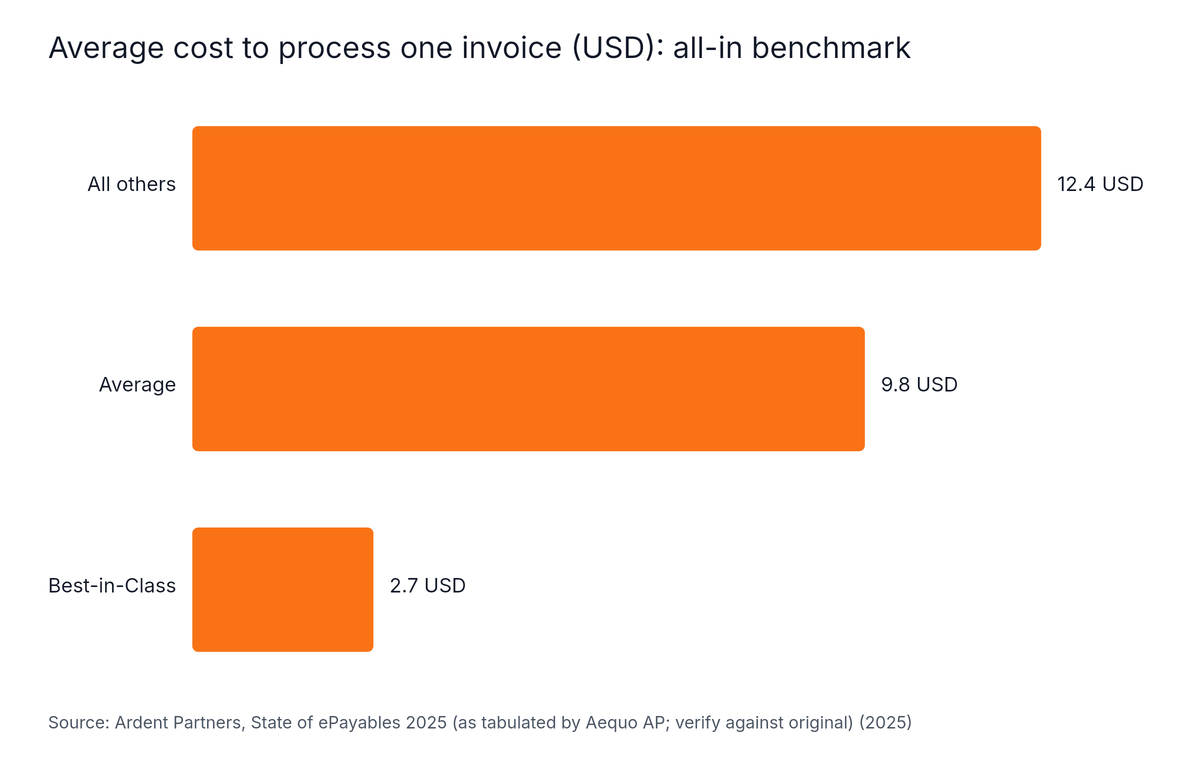
Source: Ardent Partners, State of ePayables 2025 (as tabulated by Aequo AP; verify against original), 2025
Sources disagree because they count costs differently. APQC's benchmarking database of 5,846 organisations gives a median of $6.00 per invoice, and Docsumo notes that APQC's cost definition differs from Ardent's survey-based figures (Docsumo, 2026). Compare one source at a time.
| Benchmark | All others | Average | Best-in-Class |
|---|---|---|---|
| Ardent Partners 2025, as tabulated by Aequo AP: cost per invoice | $12.42 | $9.84 | $2.65 |
| Ardent Partners 2025, as tabulated by Aequo AP: days to process | 13.5 days | 8.2 days | 2.9 days |
| APQC, as summarised by Docsumo: median cost per invoice | Not reported | $6.00 | Not reported |
Ardent also says its ePayables solutions can cut processing costs by as much as 60-80% against manual, paper-based methods (Docsumo, 2025). That claim comes from a sponsored analyst report, so read it as an upper bound.
Review work in banks sits inside a larger compliance bill. Oxford Economics, in a report commissioned by LexisNexis Risk Solutions, puts the annual compliance bill for UK banks and fintechs at £38.3bn (Oxford Economics, 2026). Manual case handling has to absorb a share of that load.
A Singapore-based neobank's manual transaction review took 30+ minutes per review, and automated approvals sat at about 44%. Grail Computer Labs built a human-reviewed know-your-transaction (KYT) workflow in a one-week build, and automated approvals rose to about 90% in testing. The same neobank had eight transaction checks live in under 30 days.

Our data: At a Singapore-based neobank, a transaction review took 30+ minutes, and automated approvals rose from ~44% to ~90% in testing in a one-week build.
Know-your-transaction (KYT) is the review of individual payments for signs of fraud or financial crime. Straight-through processing (STP) is the share of cases that complete without a person touching them. Here, automated approvals measure the same idea: the share of reviews that no longer need a person. For scale, Ardent's average invoice exception rate of 18.4% (Docsumo, 2025) shows how many cases in a typical finance queue still need a human.
The result is a testing figure, not a production figure. Rules that hold in a controlled test can meet new patterns in live traffic. We therefore treat 90% as the result of a one-week build, and the starting point for tuning.
The table below shows why the percentage matters. The 30-minute figure, the 44% and the 90% come from the neobank. The case volumes are hypothetical, and the model assumes 8 productive hours per reviewer.
| Scenario | Cases sent to a person (of 100) | Reviewer hours per day at 100 cases | Reviewers at 100 cases a day | Reviewers at 1,000 cases a day |
|---|---|---|---|---|
| Every case reviewed by hand | 100 | 50.0 | 6.25 | 62.5 |
| About 44% approved automatically | 56 | 28.0 | 3.5 | 35.0 |
| About 90% approved automatically | 10 | 5.0 | 0.63 | 6.3 |
Manual cost grows in a straight line with volume. Once routine cases are automated, the human queue shrinks to the exceptions. The model probably understates the load, because exceptions are likely to take longer than the 30-minute baseline, which was already a floor ("30+").
Grail Computer Labs applied the same approach to other operations work. A small financial-services operator had one live sales queue in 11 days, with 360 submissions processed in the first 10 days and approximately 2 hours per day of admin removed.
AI workflow automation saves the most time in a go-to-market process at the approval and handoff stages, not in the creative work. Adobe's 2025 marketing study, as reported by Bannerflow, found nearly 90% of marketers face three or more approval stages before publishing, and that overhead eats 41% of content-creation time (Bannerflow, 2025).

Bannerflow is a vendor blog and the original Adobe page was not retrieved, so use these figures as an illustration of approval-stage overhead, not a precise benchmark.
| Go-to-market step | Manual handling | What automation changes | Evidence |
|---|---|---|---|
| Lead intake and routing | Staff copy leads from several sources into one list | One live queue takes all sources | A financial-services operator: approx. 2 hours per day of admin removed, 360 submissions in 10 days (client data) |
| Content review | Three or more sign-off stages before publishing | Routine items pass rule checks, exceptions go to a named reviewer | Nearly 90% face three or more stages; 41% of creation time lost (Bannerflow, 2025) |
| Handoffs between teams | Status chased by email | Status and ownership recorded in the workflow | No sourced figure found |
No sourced benchmark compares AI-assisted and manual go-to-market time directly. We have a sourced picture of where the overhead sits, and client data on lead operations. Faster individual tasks do not make the organisation faster if the approval chain stays the same.
Approvals should stay with a person when a wrong decision is costly or hard to reverse, and move to software when cases are frequent, low-risk and rarely rejected. Low-volume or undefined processes should wait. Capgemini warns that "Human oversight is not automatically meaningful oversight." (Capgemini, 2026)
Cases that pass all four are candidates for automation. Cases that fail the first two stay with a person, supported by software that gathers the evidence.
Automation bias is the tendency to accept an automated suggestion without checking it. Capgemini describes the result: "At some point, “human in the loop” can become human just clicking approve." (Capgemini, 2026) It cites an experiment with 292 participants in which adding a human increased uptake of automation but decreased accuracy.
Three guardrails keep review meaningful: confidence thresholds that send uncertain cases to a person, sampling of auto-approved cases for quality checks, and an audit trail of every decision.
A manual approval step becomes the bottleneck because reviewer capacity stays fixed while case volume keeps rising. Each extra case adds queue time, and exceptions add more: Ardent Partners' 2025 benchmark, as reported by Docsumo, shows an average invoice exception rate of 18.4% (Docsumo, 2025). Removing routine cases from the queue restores capacity.
A manual case costs a bank minutes of skilled reviewer time, and no bank-specific benchmark was found for the exact figure. The closest proxy is invoice processing: Ardent Partners' 2025 benchmark, as tabulated by Aequo AP, shows $9.84 on average and $2.65 for Best-in-Class teams (Aequo AP, 2025). One Singapore-based neobank's manual transaction review took 30+ minutes per case.
AI workflow automation saves time in go-to-market work mainly at approvals, routing and handoffs. Adobe's 2025 study, as reported by Bannerflow, found approval overhead eats 41% of content-creation time (Bannerflow, 2025). A small financial-services operator's automated sales queue removed about 2 hours per day of admin. No sourced benchmark compares AI and manual go-to-market time directly.
Automation can make a bad process faster, because software applies the same rules at higher speed. Rules, approval thresholds and exception paths need to be agreed and written down before routine cases are automated. A pilot run in testing, as the Singapore-based neobank's one-week build was, exposes weak rules before they reach live customers.
Manual approvals stall because their capacity is fixed and volume is not. The fix is to take routine cases out of the human queue and keep people on the cases that carry risk.
Teams can start by listing their approval steps, measuring minutes per case and the exception rate, and picking the step with the most routine volume. To map one, Book a call ↗.
© 2026 Grail Computer All rights reserved.