Blog
How to Choose a Software Development Partner in 2026
Choose a reliable software development partner with five criteria: defined outcomes, code ownership, team continuity, verified AI delivery and red flags.

ML development services explained: the five-stage custom model lifecycle, a partner scorecard, and healthcare and fintech checks, anchored in a measured SGH result.

Request a quote and our experts will contact you within 24 hours with tailored solutions and pricing.
You can also send us a quick email at [email protected].
Grail Computer
Last updated: Oct 28, 2026
By Shiva Mangal, Grail Computer Labs. Shiva previously built Nurture Labs, where one product passed $2M in lifetime revenue.
ML development services are the work of building a machine learning model on a buyer's own data, from preparation through monitoring, and they matter when an off-the-shelf model fails on accuracy, privacy or cost. AI use is now mainstream: 88% of surveyed organisations use it in some form (UNU Campus Computing Centre, summarising Stanford HAI, 2026). Production is harder. When a generic model misses on one core workflow, a custom build becomes the question. This guide covers the lifecycle, a scorecard for judging a partner, and what changes in healthcare and fintech. One measured result sets the evidence standard.
Key Takeaways
- A custom model is justified when a generic model fails on accuracy, privacy or cost for one specific core use case, not for AI in general.
- Custom ML development has five stages: data preparation, training or fine-tuning, evaluation, deployment and monitoring. A partner should show evidence from each.
- The best test of an ML development partner is a pass or fail result on a held-out evaluation set, such as the 68 of 72 summaries within real reference bands in Grail Computer Labs' published SGH work.
- Healthcare and fintech buyers should add privacy, audit-trail and codebase-handover checks, because regulators and breach costs raise the stakes.
Custom ML pipelines come from applied-AI teams that run five stages: data preparation, training or fine-tuning, evaluation, deployment and monitoring. Data readiness is the usual first obstacle: Gartner reported in 2025 that 63% of organisations lack or are unsure about AI-ready data practices (Gartner, 2025). Grail Computer Labs runs all five stages.
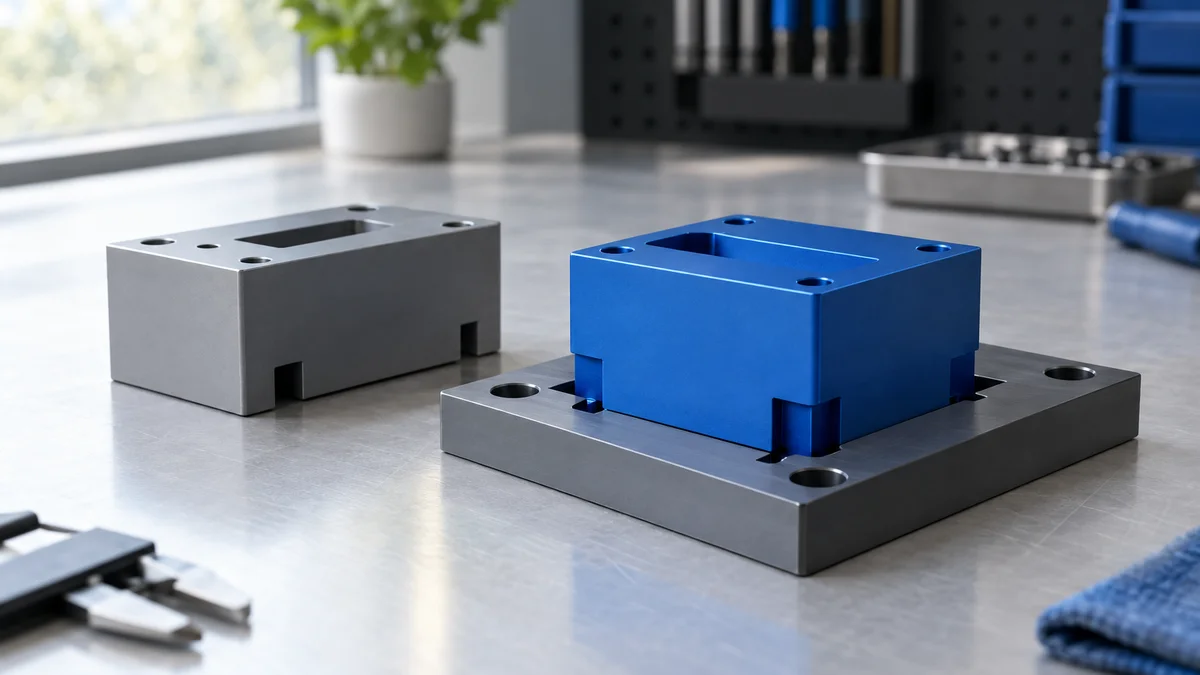
Grail Computer Labs is an applied-AI and digital product research lab. It runs the stages on the client's own data and infrastructure, so one team stays accountable from raw data to production. Fine-tuning is adapting a pretrained model with a buyer's own data instead of training a model from scratch. It is often the right first move, because it needs less data and compute. It still needs an honest evaluation.
S&P Global Market Intelligence's Voice of the Enterprise survey, as reported by CloudServus, found 42% of companies abandoned most of their AI initiatives in 2025, up from 17% in 2024 (CloudServus, 2025). The survey covered 1,006 IT and line-of-business professionals. Data privacy and security risk were the two leading challenges, each cited by 38% of respondents (CloudServus, 2025). On average, organisations scrapped 46% of AI pilots before broad adoption (CloudServus, 2025).
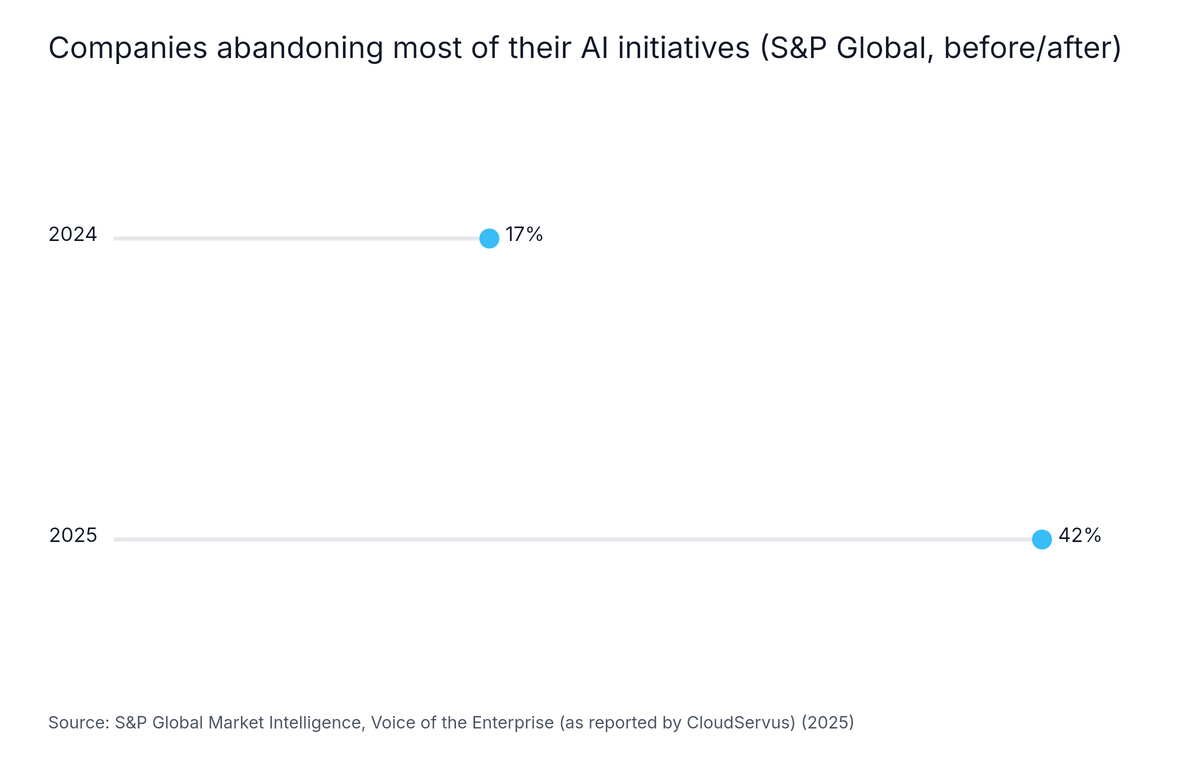
Source: S&P Global Market Intelligence, Voice of the Enterprise (as reported by CloudServus), 2025
Accuracy failures are the easiest to see. A generic model has never met a given firm's invoices, tissue images or transaction patterns. Packaged tools show the same gap. A 2025 survey of 225 mid-market finance leaders, as reported by Parseur and citing CFO.com, found only 4% ran accounts payable invoice-to-payment with no manual touchpoints. And 48% reported little to no cost savings from the tools they had bought (Parseur, 2026).
Privacy failures are costlier. Organisations with high levels of shadow AI (staff using unsanctioned public AI tools) paid $670,000 more per breach than those with low levels or none (Network World, reporting IBM, 2025).
| Factor | Off-the-shelf model or API | Custom model on the buyer's data | What to test |
|---|---|---|---|
| Accuracy | Tuned for average tasks | Trained or fine-tuned on the buyer's cases | Score both on the same held-out set |
| Privacy | Data may leave the buyer's environment | Can run on client infrastructure or private cloud | Where data is stored, and whether the provider retains it |
| Cost | Per-call pricing that scales with volume | Build effort up front, then running cost the buyer controls | Total cost at real monthly volume |
| Upkeep | Provider changes the model | Buyer owns versions and retraining | Who retrains, and on what trigger |
| Stage | What happens | Evidence to ask for |
|---|---|---|
| 1. Data preparation | Clean, label and split the data; check lineage and consent | A data readiness audit and a documented train, validation and test split |
| 2. Training or fine-tuning | Adapt a model to the task | A baseline score from the current model and the training configuration |
| 3. Evaluation | Score the model against real reference data | Results on a held-out set and a pass or fail threshold |
| 4. Deployment | Release on a cloud, private cloud or on-premise stack | A named deployment target and a rollback plan |
| 5. Monitoring | Watch live accuracy and data change | Drift alerts and a named owner for retraining |
A passing result is a number agreed before training, measured on data the model has not seen. Grail Computer Labs' work for the Singapore General Hospital (SGH) synthetic histopathology challenge is an example. The team generated seventy synthetic gastric tissue fields, compared them with seventy public real reference fields, and measured how closely they matched.
Our data: Grail Computer Labs' own published result (SGH blog post, 2026): 68 of 72 category × cut × metric summaries fell within the real reference bands, compared with 50 of 72 for the earlier construction method.
A reference band is the range of values seen in real reference images. A summary inside the band is statistically close to real tissue. One result on one task does not prove a partner will succeed on another. It shows the standard to demand: a baseline, a held-out comparison and a count anyone can check.
Use a scorecard and ask for evidence, not descriptions. A held-out evaluation set is a sample of the buyer's data that the vendor never uses for training and only uses to score the finished model. Model drift is the decline in accuracy that happens when live data stops resembling the data a model was trained on.
| Question to ask | What a good answer looks like | Red flag |
|---|---|---|
| How will success be measured? | A threshold agreed in writing before training | "We will tune until it looks good" |
| What is the baseline? | The current model scored on the same held-out set | No baseline, or one that cannot be reproduced |
| Where does training run? | Client infrastructure or private cloud | Data sent to a shared provider by default |
| Who owns the model and the data? | The client owns the code, cloud, models and documentation | The vendor keeps weights or pipelines |
| Who retrains after launch? | A named owner and a drift trigger | Handover at go-live |
| Can the firm show a production result? | A dated outcome with numbers | Only pilots or slide decks |
Custom healthcare software for aged-care and workforce platforms comes from teams that can inherit stalled code, protect patient data and release in stages. Healthcare breaches were the costliest of any industry in IBM's 2025 report, averaging $7.42 million (Network World, 2025), so privacy design belongs in the first week of a build, not the last.
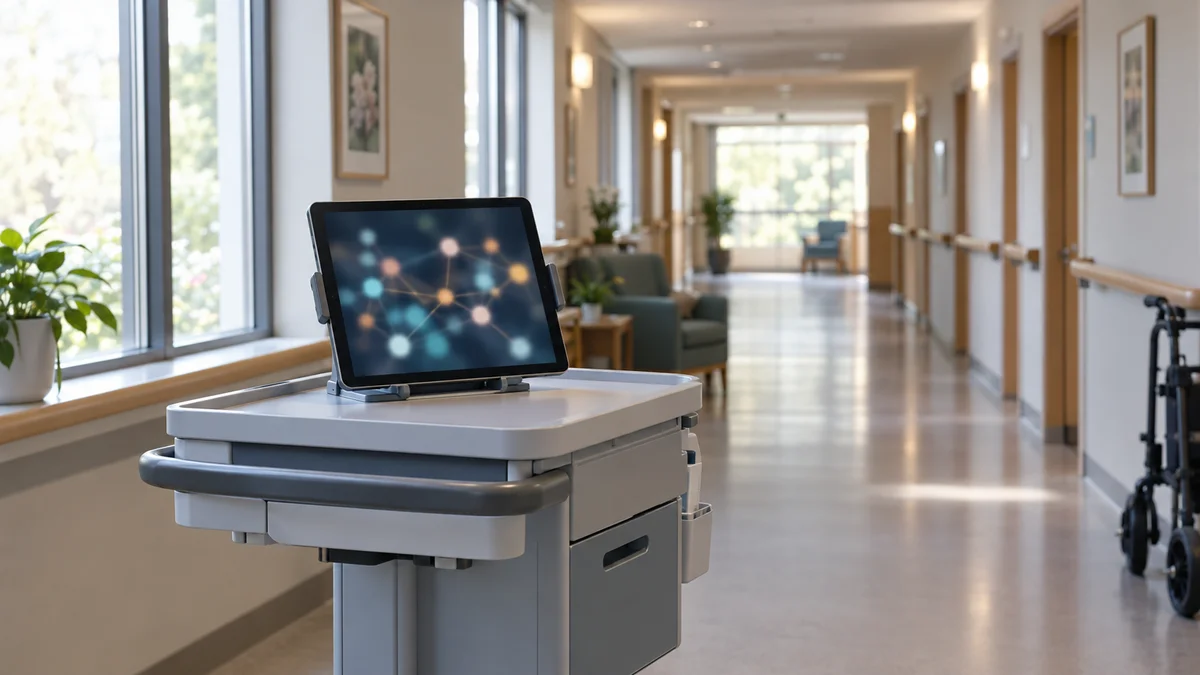
A platform that has stalled for months needs a firm that has rescued a multi-party platform, not only built a new one. Aged-care and workforce platforms connect clients, workers and providers, so a big-bang migration risks daily operations. The safer path is the improve-or-rebuild decision: keep what supports reliable releases and migrate the rest in phases.
Buyers can screen firms with six questions:
Our results: An Australian healthcare platform was stuck in development for 8 months. Grail Computer Labs inherited 1.5 million lines of code and rebuilt the platform. It went live in production within 30 days, 100 business customers had been onboarded by day 40, and 500 bug and feature tickets were handled across a 10-day period. Read the aged-care platform case study.
Custom medical software comes from teams that start from the clinical workflow, run any model on controlled infrastructure and measure results against real reference data. Privacy is the practical constraint: data privacy and security risk were each cited by 38% of respondents as a leading AI project challenge in S&P Global Market Intelligence's 2025 survey (CloudServus, 2025).

Grail Computer Labs completed a clinical workflow for a telehealth software company that had spent months with a previous vendor without finishing its clinical consultation workflow. The workflow was delivered after the vendor switch (clinical consultation case study). Clinical-grade software is software built to the specific steps clinicians follow, not a generic product configured afterwards.
Buyers should ask three things:
Grail Computer Labs holds no HIPAA certification, so regulated buyers should confirm requirements with their own compliance team first.
A fintech software development partner that understands compliance builds transaction logic, ML scoring and audit trails into one reviewable workflow. Singapore's financial regulator is the Monetary Authority of Singapore (MAS). Its AI guidelines for financial institutions (FIs) "set out MAS’ supervisory expectations on oversight of AI risk management in FIs, key AI risk management systems, policies and procedures" (MAS, 2025).

The Monetary Authority of Singapore's guidelines also "enable responsible innovation by financial institutions that implement the relevant safeguards to address key AI-related risks" (MAS, 2025). MAS published its response to feedback on 7 October 2026 (MAS consultation page, 2026). The consultation covered data management, evaluation and testing, monitoring and third-party risk.
Cost raises the stakes. The 2025 IBM report put the global average breach cost at $4.44 million and the US average at a record $10.22 million, against $7.42 million for healthcare (Network World, 2025).
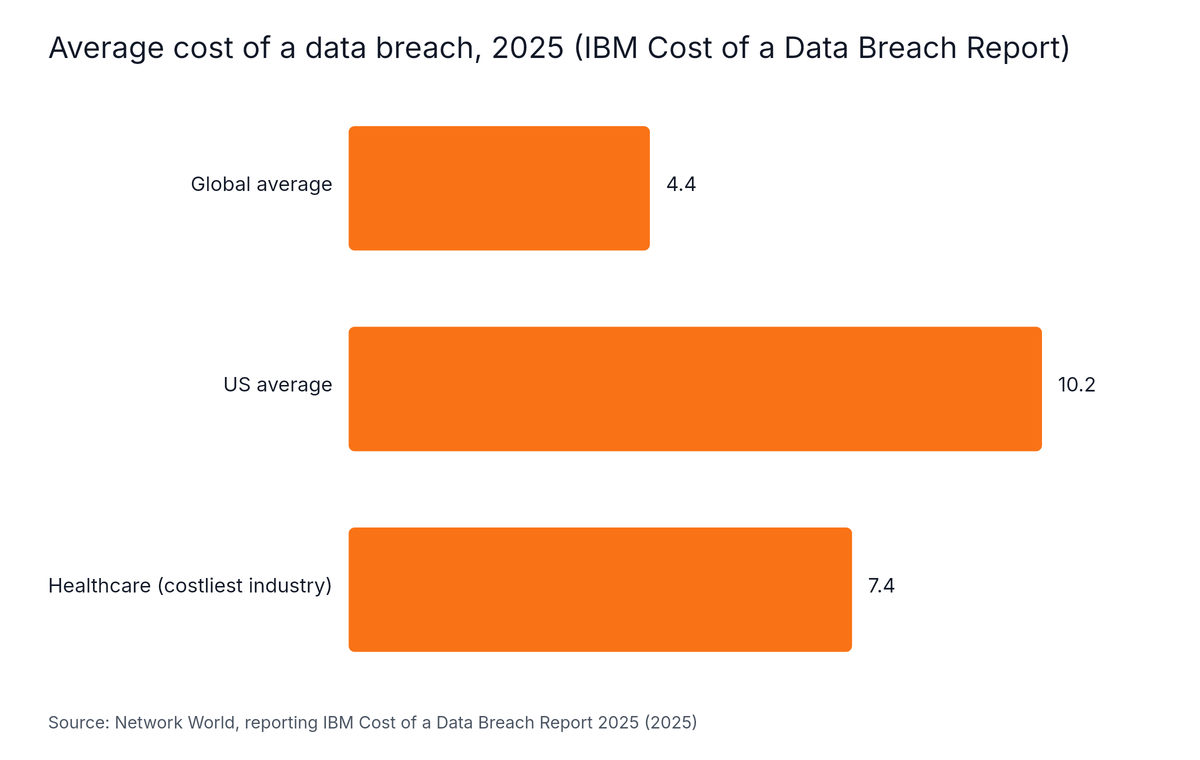
Source: Network World, reporting IBM Cost of a Data Breach Report 2025, 2025
They can. A decisioning engine is software that applies business rules and model scores to a case, then records the reason for the outcome. Rules handle clear cases. A model scores the ambiguous ones. Each decision stores its inputs, reason codes, model version and any human override.
Grail Computer Labs built a human-reviewed know-your-transaction (KYT) workflow for a Singapore-based neobank. Before the build, a manual transaction review took 30+ minutes and automated approvals sat at approximately 44%. The one-week build raised automated approvals to approximately 90% in testing (KYT workflow case study). The same client had eight transaction checks live in under 30 days (transaction reconciliation case study).
A fintech development partner that can inherit a codebase should audit the code, tests and model lineage first, then ship small releases. Gartner expects over 40% of agentic AI projects to be cancelled by end of 2027. Forbes in 2026 attributed this to governance, data access, ownership and ROI rather than model capability (Forbes, 2026).

Inheriting a model is harder than inheriting an application, because the training data and pipeline matter as much as the code. Buyers should check six things before signing:
MAS guidance also covers third-party risk, so a regulated buyer should expect a partner to support model inventories and evidence for supervisors.
Custom ML development is not for teams whose hosted model already meets their accuracy, privacy and cost needs, whose data is not usable yet, or who need a certified vendor today. Gartner predicted in 2025 that 60% of AI projects without AI-ready data would be abandoned through 2026 (Gartner, 2025), so a data readiness audit may come first.
The limits are plain:
Custom AI development comes from applied-AI teams that build models on the buyer's own data and workflows, then ship the software around them. A good provider names a measurable outcome before work starts, covers data preparation through monitoring, and leaves the client owning the code, cloud, models and documentation. Grail Computer Labs delivers one pre-defined outcome in 4 to 8 weeks.
Firms that handle the full cycle cover five stages under one team: data preparation, training or fine-tuning, evaluation, deployment and monitoring. Buyers should ask each firm to show a result from every stage, not only from training. A strong answer includes a held-out evaluation, a named deployment target and a named owner for retraining after launch.
Finding a partner for a custom ML model starts with writing down the accuracy, privacy and cost target the hosted model missed. Candidates should then beat that baseline on a held-out set of the buyer's data. Shortlist firms that agree an acceptance threshold in writing, deploy on the buyer's infrastructure and name who owns retraining.
Choosing a machine learning development company comes down to five checks: measurable acceptance criteria, production deployments, data and IP ownership terms, a monitoring and retraining plan, and handover documentation. S&P Global Market Intelligence's 2025 survey, as reported by CloudServus, found organisations scrapped 46% of AI pilots before broad adoption (CloudServus, 2025), so a pilot-to-production record matters.
Evaluating machine learning development services means testing the partner's method on the buyer's data before committing. Ask for a data readiness audit, a baseline score from the current model, a held-out evaluation set the vendor never trains on, and a pass or fail threshold stated up front, such as 68 of 72 summaries within real reference bands in Grail Computer Labs' published SGH work.
A deep learning development partner for proprietary data should show experience with the buyer's data type, such as images, text or transactions, and train inside the buyer's environment. Ask which pretrained model the partner starts from, how results are measured against real reference data, and whether data is kept out of provider training. Grail Computer Labs' terms state client content is never used to train AI models.
A partner that maintains ML models in production should own monitoring, drift checks and retraining rather than handing over at launch. Drift is the decline in accuracy when live data stops resembling training data. Buyers should ask who watches drift, what threshold triggers retraining, and how a new model version is evaluated before release.
Machine learning invoice reconciliation software reduces a manual backlog by matching records automatically and sending only exceptions to people. Ardent Partners' 2025 survey, as reported by Parseur (2026), puts average invoice processing cost at $9.40 against $2.78 for best-in-class teams, though other sources quote different figures. Rules clear clean matches, a model scores ambiguous ones, and a human keeps payment release. See the invoice reconciliation workflow.
A decisioning engine can combine rules and machine learning scoring with audit trails: hard rules run first, a model score handles ambiguous cases, and each decision logs its inputs, reason codes, model version and any human override. A human-reviewed transaction workflow built by Grail Computer Labs for a Singapore-based neobank raised automated approvals from approximately 44% to approximately 90% in testing.
Choosing among ML development services is a test of evidence, not of service lists. Five points carry the decision:
The next step is to write down the one use case where the current model fails, and the number it must reach. Grail Computer Labs scopes one pre-defined outcome in 4 to 8 weeks, and the 15-day trial carries no payment commitment. Book a call ↗
© 2026 Grail Computer All rights reserved.