how do you move ai from pilot to productionhow to move from ai pilot to production sydneywhy ai pilots stall
How Do You Move AI from Pilot to Production?
How do you move AI from pilot to production? Define the outcome, name a production owner, phase the rollout. Includes Australian data and an 8-month-to-30-day case.
By Shiva Mangal, Grail Computer Labs. Last updated 28 October 2026. Healthcare and finance examples are limited to what Grail Computer Labs has published.
Moving AI from pilot to production means turning a working experiment into a system with a named owner, a defined outcome and a phased rollout, so the business can run it every week without the original team. Most pilots never get there. In Australia, only 21% of CIOs are strongly confident their organisation can scale AI beyond pilots (Consultancy.com.au, 2026). The causes are structural: no defined outcome, no production owner, no phased scope. This guide explains each cause, sets out four steps that fix it, and walks through an Australian healthcare platform that went from 8 months stalled to live within 30 days. For the day-to-day view of operating changes after an AI pilot, see our existing guide.
Key Takeaways
AI pilots stall for structural reasons: no defined outcome, no production owner and no phased scope.
Moving an AI pilot to production takes four steps: exit criteria, a named production owner, a phased rollout and early compliance review.
An Australian healthcare platform stuck for 8 months went live in production within 30 days, according to Grail Computer Labs' own case study.
The MIT NANDA finding that 95% of generative-AI pilots showed no measurable P&L impact is directional, not a precise benchmark.
Why do AI pilots stall before they reach production?
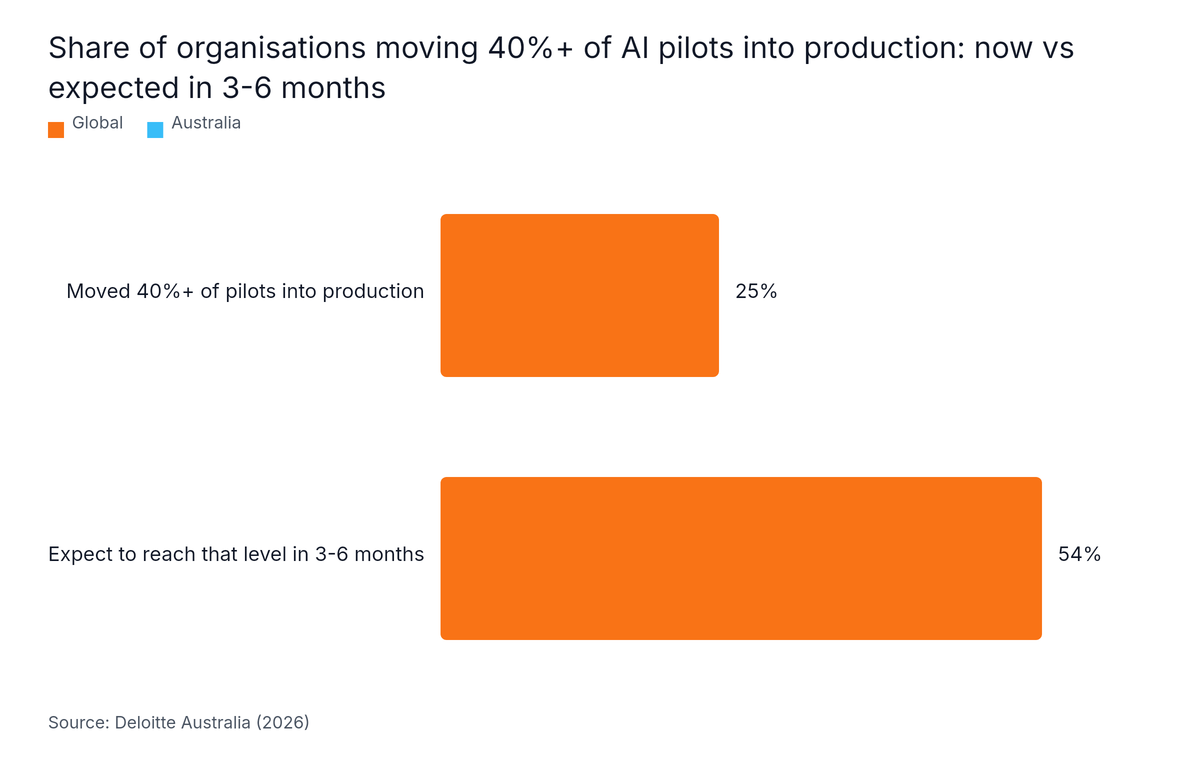
AI pilots stall because nobody owns the path from demo to release. A pilot is a time-boxed test showing that an AI workflow can work, while production asks whether a team can run it every week. Deloitte found only 25% of global respondents, and 28% of Australian respondents, have moved 40% or more of their pilots into production (Deloitte Australia, 2026).
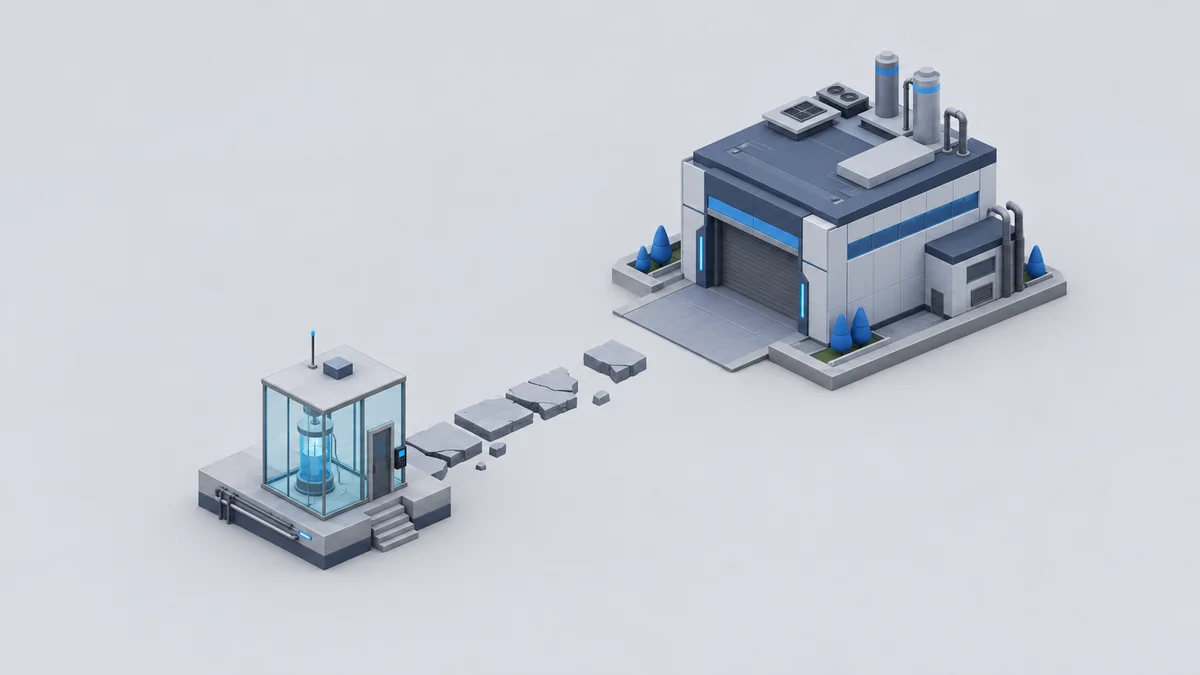
Isometric scene of a small test chamber disconnected from a larger production building by a gap in the path
The same survey of 3,235 business and IT leaders in 24 countries found 54% of global and 57% of Australian respondents expect to reach that 40% level within three to six months (Deloitte Australia, 2026). Those are self-reported expectations, not outcomes. The gap between 25% now and 54% expected is the size of the problem.
Horizontal Bar chart: Share of organisations moving 40%+ of AI pilots into production: now vs expected in 3-6 months. Highest: Expect to reach that level in 3-6 months at 54%.
Deloitte's Stuart Scotis described the wider issue: "Many are seeing productivity gains, but few are using AI to go beyond productivity and into growth." (Scotis, Deloitte Australia, 2026) Three structural gaps explain most stalls.
No defined outcome
A pilot with a goal like "see what the model can do" has no finish line. Nobody can say it succeeded, so nobody can fund the next stage. The pilot drifts, and the sponsor ends up explaining why months of work produced a demo.
No production owner
Pilots usually belong to a project team. Production belongs to nobody until someone is named. Without that person, integration, evaluation and release work has no home.
No phased scope
Teams jump from a controlled demo to full volume, or never leave the demo at all. Both fail the same way: the first real exception has no safe place to land.
How do you move AI from pilot to production?
Moving an AI pilot to production takes four changes: agree one measurable outcome with exit criteria, name a production owner, phase the rollout from shadow mode to full volume, and bring compliance reviewers in at the start. Grail Computer Labs delivers a pre-defined outcome in 4 to 8 weeks. The sequence matters because each change removes one cause of stalling.
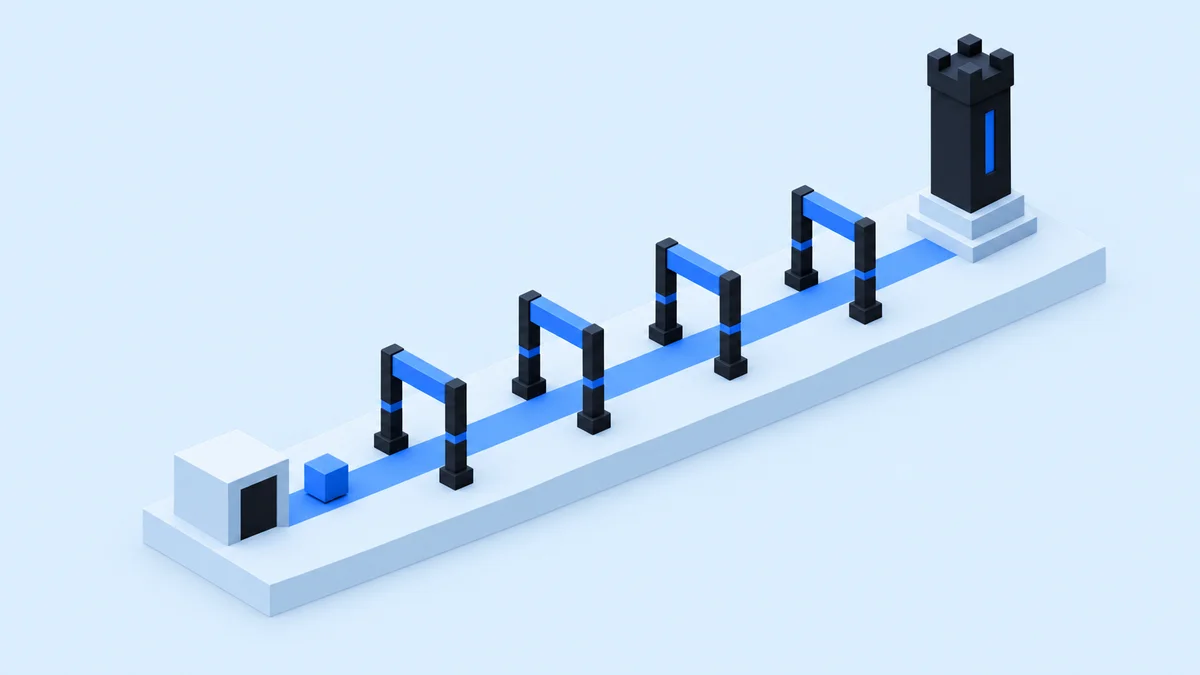
Isometric staged pathway with four checkpoint gates leading from a pilot box to a production tower
Step
What to decide
How to verify it worked
Stall cause removed
1. Define the outcome
One metric, a quality threshold, a cost ceiling
A written go/no-go test that a third party could run
No defined outcome
2. Name the owner
Who signs go/no-go, who is on call
One name, not a committee, in the runbook
No production owner
3. Phase the scope
Shadow mode, a slice of live traffic, full volume
A rollback tested at each gate
No phased scope
4. Bring reviewers in early
Security, privacy and model-risk sign-off
Reviewer approvals dated before build starts
Late compliance blockers
Step 1: Define one outcome and its exit criteria
Exit criteria are the conditions a pilot must meet before it earns production budget, and the team writes them before the pilot starts. Include one business metric, a quality threshold, a cost ceiling per transaction and the name of the person who decides. To verify the step, hand the criteria to someone outside the team and ask whether that person could score the pilot today.
Step 2: Name a production owner
A production owner is the named person who signs go/no-go, is on call when the system breaks and answers for the business metric after the demo. Structure predicts success here. Adobe research, reported by CFOtech Australia, found only 5.2% of ANZ organisations qualified as AI Leaders, and organisational structure was the strongest indicator of whether AI moved beyond pilots (CFOtech Australia, 2026). The survey covered 465 senior executives in Australia and New Zealand.
Step 3: Phase the scope
Phasing the scope means moving through shadow mode, a slice of live traffic and full volume, with a rollback at each gate and the production owner approving each move. Shadow mode is running the AI alongside the existing process without acting on its output. It lets the team compare AI answers with human answers on real work at no risk. The gates run in this order:
Run in shadow mode until the quality threshold holds on real inputs.
Route a small slice of live traffic, with a human reviewing the output.
Move to full volume only when the exception rate meets the exit criteria.
Keep a tested rollback at every gate.
Tie each gate to a budget release. Teams often fear a big-bang migration, and gates answer that fear with evidence at each stage. Scope discipline is also rare. In Singapore, enterprise agentic AI adoption rose from 22% in 2025 to 51% in 2026, but only 10% have reworked processes so AI completes multi-step business tasks end to end (IT Brief Asia, 2026).
Step 4: Bring reviewers in at the start
Bringing reviewers in at the start means naming the security, privacy and model-risk reviewers in week one and giving them the exit criteria. Teams usually treat compliance as a final gate, which makes it the last surprise. Integration is a common wall in healthcare: only 4% of health systems have scaled AI with measurable outcomes (Qventus, 2026), and 45% struggle to move beyond pilots because of EHR dependency, meaning reliance on the electronic health record (Healthcare IT News, 2026). That is a phased-scope problem: a shadow-mode gate against the live record system exposes integration faults before any patient-facing volume, and the production owner decides when to move on. We have not researched specific APAC regulations for this post, so each team should confirm the rules for its sector with its own reviewers.
If a pilot has stalled and the team wants one outcome agreed and delivered, Book a call ↗.
What does going from 8 months stalled to live in 30 days look like?
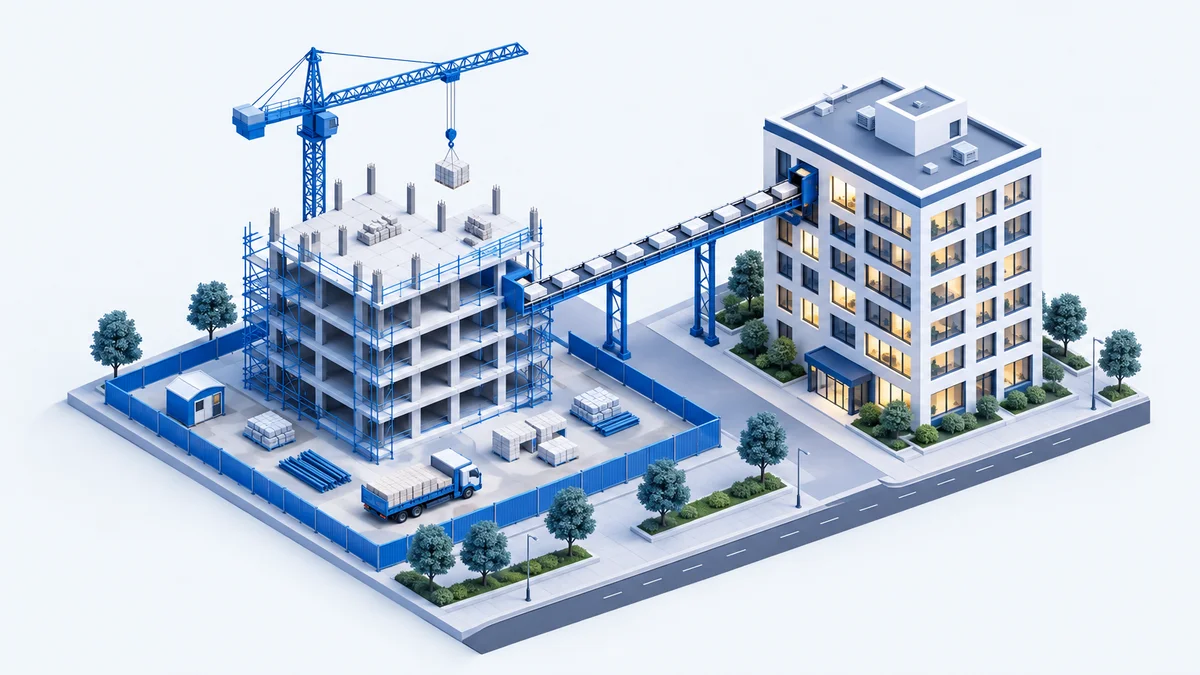
Grail Computer Labs' own case study records an Australian healthcare platform, stuck in development for 8 months, that went live in production within 30 days. Deloitte's survey puts the wider norm at 25% of global respondents having moved 40% or more of their pilots into production (Deloitte Australia, 2026). The platform had 100 business customers onboarded by day 40.
Isometric stalled construction site beside a finished building with a crane between them
Our data: An Australian healthcare platform stuck in development for 8 months was live in production within 30 days. By day 40, 100 business customers had been onboarded, and 500 bug and feature tickets were handled across a 10-day period. This is Grail Computer Labs' own case study data, not independent research. (Grail Computer Labs case study)
What the case records
The platform was a managed-service business running a multi-party healthcare platform, with no clear deadline in sight when GC Labs took over from the previous vendor. That is a delivery system with no safe release path, which is the same gap a stalled AI pilot has.
Milestone
What the case study records
Before
Stuck in development for 8 months, no clear deadline
Start
1.5 million lines of code inherited from the previous vendor and rebuilt
Within 30 days
Live in production
Day 40
100 business customers onboarded
A 10-day period
500 bug and feature tickets handled
We have not published a week-by-week timeline for this engagement, so we do not state one.
How GC Labs' approach maps to the stall causes
The mapping below is GC Labs' own approach set against the recorded case. It is our interpretation, not a recorded outcome or an independent finding. The improve-or-rebuild decision is GC Labs' framework: keep what can support reliable releases, and migrate the rest in phases.
Stall cause
Recorded in the case
GC Labs' approach (not a recorded outcome)
No defined outcome
No clear deadline after 8 months
An outcome is agreed with stakeholders before work starts
No production owner
Previous vendor had not delivered
A senior GC Labs team is accountable for delivery
No phased scope
A big-bang migration felt risky
Phased migration, keeping what worked
Other outcomes from the same method
Engagement
Outcome
Timeline
Small financial-services operator
One live sales queue; 360 submissions processed; about 2 hours per day of admin removed
11 days to go live; 360 submissions in the first 10 days
Singapore-based neobank (transaction checks)
8 transaction checks live
Under 30 days
Singapore-based neobank (KYT workflow)
Automated approvals raised from about 44% to about 90% in testing
One-week build
KYT means know-your-transaction, the review of individual transactions for risk. The neobank approval result is a testing result, not a production result.
How to move from AI pilot to production Sydney?
Moving from AI pilot to production in Sydney uses the same four steps as anywhere, but the local starting point is weaker. Only 28% of Australian respondents have moved 40% or more of their pilots into production (Deloitte Australia, 2026), and only 21% of Australian CIOs are strongly confident they can scale AI beyond pilots (Consultancy.com.au, 2026).
Isometric map of two regional platforms with bar-shaped towers of different heights joined by a bridge
Region
Finding
Source
Australia
28% have moved 40% or more of pilots into production
The Singapore survey of more than 700 business leaders named trust and reliability (43%) and data quality and integration (37%) as the top barriers (Mission Media, 2026). Several of these figures come from vendor-commissioned research reported by trade media, so they work as indicators, not precise benchmarks. They agree on one point: adoption is wide and production is narrow.
Deloitte's David Alonso gave the direction of travel: "Australian leaders who pull ahead will move decisively from pilot to production" (Alonso, Deloitte Australia, 2026). For a Sydney team, the practical step is to name local security and privacy reviewers early and give one person ownership of the metric.
Is the MIT 95% AI pilot failure statistic accurate?
The MIT NANDA figure, that 95% of generative-AI pilots produced no measurable P&L impact, is directional rather than precise. P&L impact is the effect on a company's profit and loss statement. Harvard Business Review reported the headline in 2025 (Harvard Business Review, 2025), but the underlying report is not peer-reviewed and its methodology has been publicly questioned.
Two cautions apply when using it:
A finding of no measurable P&L impact is not the same as a failed pilot. A pilot can improve a workflow without moving the income statement within the study window.
The 95% figure measures returns, not production rates. For production rates, the Deloitte survey of 3,235 leaders is the better-sampled number (Deloitte Australia, 2026).
We use the 95% figure as a prompt to ask hard questions of a pilot, not as a benchmark to quote in a board paper.
Who is the four-step pilot-to-production method not for?
The four-step pilot-to-production method is not for teams exploring AI with no project that matters. A pre-defined outcome, a named production owner and a phased rollout suit stalled AI or software projects that matter, not early experiments still looking for a use case. Only 4% of health systems have scaled AI with measurable outcomes (Qventus, 2026).
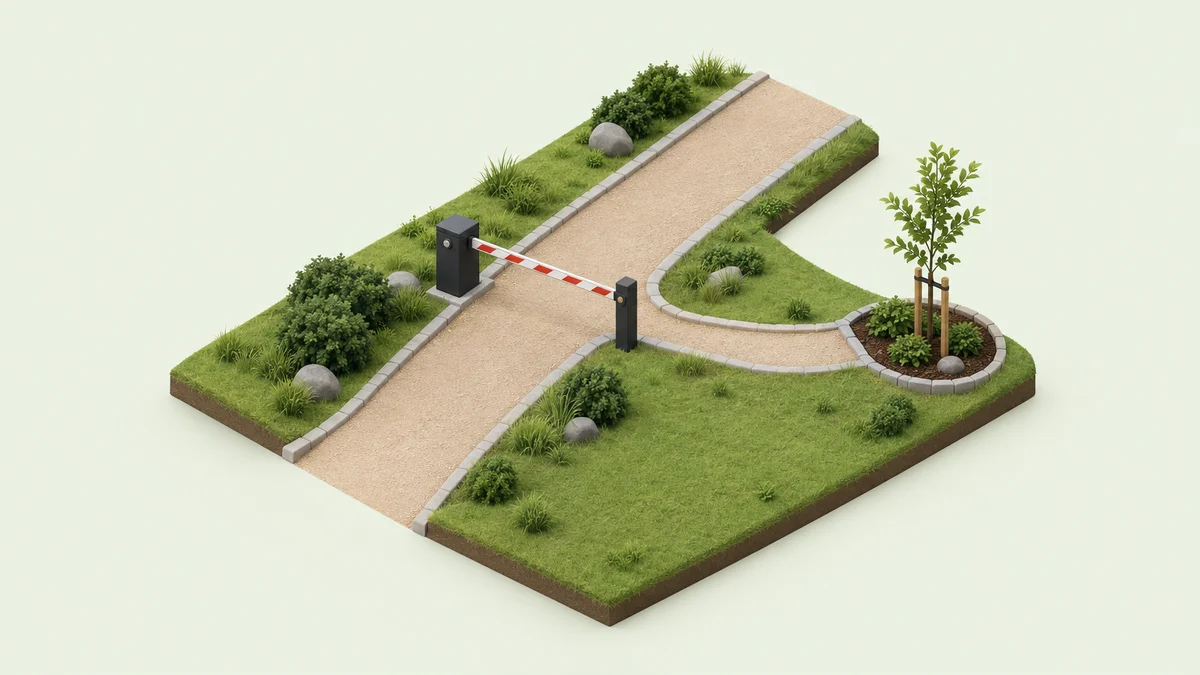
Isometric scene of a path forking at a closed barrier gate with one branch blocked
These limits apply before starting:
Exploratory work. If no outcome can be written down, run discovery first. Exit criteria need something to measure.
No one to own it. A named production owner has to exist on the client side. An outside team can deliver the system but cannot answer for the business metric.
Scoped results are not universal results. The healthcare platform result is one engagement. Each codebase, data set and approval chain sets its own timeline.
Testing is not production. The neobank approval figures come from testing. Confirm them against live volume before relying on them.
Reviews still apply. The method does not replace the organisation's own security and compliance reviewers. As Deloitte's Dr Elea Wurth put it, "Agentic AI forces Trustworthy AI out of theory and into operation." (Wurth, Deloitte, 2026)
Frequently Asked Questions
How to move from AI pilot to production Sydney?
A Sydney team moves an AI pilot to production with four steps: one measurable outcome, a named production owner, a phased rollout and early compliance review. Local reviewers for security and privacy should be named in week one. Only 28% of Australian respondents have moved 40% or more of their pilots into production (Deloitte Australia, 2026).
Who should own an AI project once it is in production?
One named production owner should own an AI project in production: the person who signs go/no-go, is on call when it breaks and answers for the business metric after the demo. Adobe research reported in 2026 found organisational structure was the strongest indicator of whether ANZ organisations moved AI beyond pilots (CFOtech Australia, 2026).
How long does it take to move an AI pilot to production?
Timelines depend on scope, but Grail Computer Labs' outcome engagements deliver one pre-defined outcome in 4 to 8 weeks, and an Australian healthcare platform went live in production within 30 days after 8 months stalled. Deloitte's 2026 survey found 57% of Australian respondents expect to reach 40% of pilots in production within three to six months (Deloitte Australia, 2026), an expectation, not a result.
What percentage of AI pilots reach production?
Only a minority of AI pilots reach production at scale: 25% of global respondents have moved 40% or more of their pilots into production (Deloitte Australia, 2026). The widely quoted 95% MIT NANDA figure measures a lack of measurable P&L impact, not production rates, and should be treated as directional.
Conclusion
Pilots stall for structural reasons, and each has a specific fix. These five points belong in the next pilot review:
Write exit criteria before the pilot starts: one metric, a quality threshold, a cost ceiling and a go/no-go decision-maker.
Name one production owner who is on call and answers for the metric.
Phase the rollout through shadow mode, a slice of live traffic and full volume, with rollback at every gate.
Bring security, privacy and model-risk reviewers in during week one.
Treat the 95% MIT NANDA figure as directional and use a better-sampled survey, such as Deloitte's 3,235 leaders (Deloitte Australia, 2026), as the working benchmark.
We agree the outcome first, deliver it in 4 to 8 weeks, then keep shipping. If a pilot has stalled, Book a call ↗ to agree one outcome.