Request a quote and our experts will contact you within 24 hours with tailored solutions and pricing.
What Operations Automation Software Replaces, and Where to Start
By Shiva Mangal, Grail Computer Labs. Shiva previously built Nurture Labs, where one product passed $2M in lifetime revenue.
Operations automation software replaces repetitive manual steps in back-office workflows, such as data entry, routing, reconciliation and routine approvals, while leaving judgement-heavy and irreversible decisions with people. Teams feel the manual work as backlogs, rework and missed service levels. The harder question is sequencing. Which process goes first, and which approvals stay human? Gartner expects over 40% of agentic AI projects to be cancelled by the end of 2027, as reported by Forbes (2026). Order matters. This guide gives a scoring method, an oversight model and the evidence behind both.
Key Takeaways
Operations automation software replaces repetitive, rule-based back-office steps; exceptions and high-risk decisions still need a person.
Before buying, a team should name one measurable problem, such as a backlog, rework or a missed service level.
Scoring processes on volume, rule clarity, cost of error and integration difficulty shows which one to automate first.
Decision automation software should match human oversight to reversibility: the harder a decision is to undo, the more a person should own it.
Gartner expects over 40% of agentic AI projects to be cancelled by the end of 2027, as reported by Forbes (2026), so the order of automation is a survival issue.
What does operations automation software actually replace?
Operations automation software replaces the repetitive, rule-based steps inside back-office workflows: copying data between systems, routing requests, matching records and approving routine cases. Frends' 2026 survey of 611 decision-makers found European workers lose 7.6 hours a week, or 44 working days a year, to manual tasks (Frends, 2026). Judgement calls and exceptions stay with people.
Paper request forms stacked in a tray beside a laptop showing a routing queue
Operations automation software is software that carries out defined workflow steps without a person touching each item. It does not replace the owner of the workflow. It replaces the keystrokes, the chasing and the queue between steps. Frends sells integration software, so its figures are directional.
The table shows what typically moves to software and what typically stays with a person.
Manual step today
What the software does
What a person keeps
Re-keying data between systems
Passes the record across automatically
Fixing records that fail validation
Sorting and routing requests
Routes by rule to the right queue
Unusual or ambiguous requests
Matching and reconciling records
Matches clean pairs and flags mismatches
Resolving the mismatches
Approving routine, low-value cases
Approves by rule within set limits
Approving anything above the limits
Status chasing and updates
Sends updates and reminders
Conversations with customers
Decision automation is the use of rules or models to approve routine, low-risk cases automatically and send exceptions to a person. It changes who approves what. The oversight section below covers how to keep it safe.
We are scaling fast and our operations are breaking: what should automation software actually solve before we buy it?
Before buying, operations automation software should solve one measurable problem: the backlog, rework or missed service level that breaks as volume grows. Docxster's 2026 survey of 310 leaders found 73.5% of operations teams are partially automated or worse for document handling, against a 56.8% survey average (Docxster, 2026). Pick the problem first, then the tool.
A row of paper tickets in a rack with one ticket carrying a blue tab
Scaling exposes weak points in order. Volume rises and handoffs multiply. Each manual step becomes a queue. Four problems are worth solving before any purchase:
A named backlog. A queue that grows faster than the team clears it, counted weekly.
Rework.Rework is work done a second time because the first pass contained an error. Re-keying between systems is a common source.
Missed service levels. Requests that wait for a person to approve a routine case.
Broken handoffs. Steps where one system or team passes work on with no integration.
Docxster is a vendor, so its survey is directional. It still signals that operations teams sit further from full automation than most.
Fix the process before you automate it. Deloitte Insights names the common mistake: "Many organizations attempt to automate current processes rather than reimagine workflows for an agentic environment." (Deloitte Insights, 2025). If an approval has never produced a rejection, remove it. The same goes for an approval that exists only because two systems do not talk.
The payoff is real but not automatic. CPA Australia surveyed 1,679 finance professionals in 2026. Of businesses with increased profitability, 63% said AI was widely used or deeply embedded, against 50% of those with flat or declining profitability (CPA Australia, 2026). CPA notes this is a correlation, not proof of cause.
Which process should operations teams automate first?
Operations teams should automate first the process that scores highest on volume and rule clarity and lowest on error cost and integration difficulty. Frends estimates a typical 1,000-employee European business loses €10.7 million a year to manual work (Frends, 2026). Score each candidate from 1 to 5 on four criteria, then start with the highest total.
A printed scoring grid with four columns and pencil ticks on a clean desk
The cost figure is a modelled estimate from vendor research. Treat it as scale, not a forecast for your business.
The criteria below are our own working framework, not an industry standard. Every candidate gets the same scoring, and the totals are compared.
Criterion
Question to ask
A high score (5) means
Volume
How many items pass through each week?
Hundreds of items, so time savings add up fast
Rule clarity
Can a new hire follow written rules to decide?
Rules are explicit and rarely change
Cost of error
What does a wrong decision cost to undo?
Errors are easy to reverse
Integration difficulty
Can the systems involved exchange data cleanly?
Systems have usable interfaces, so connecting them is simple
Score "cost of error" and "integration difficulty" so that easy is high. The best first candidate then has the highest total. Revenue operations handoffs, such as lead intake, often score well because volume is high and rules are clear.
A worked example with three illustrative processes
The scores below are invented for illustration. They show how totals compare, not real measurements.
Candidate process
Volume
Rule clarity
Cost of error
Integration
Total
Lead intake routing (revenue operations)
5
4
4
4
17
Vendor invoice approvals above set limits
3
3
2
3
11
Changes to customer contract terms
2
2
1
2
7
Lead intake routing wins. Volume is high, rules are explicit and a misrouted lead is easy to fix. Contract changes score lowest because each case is rare, judgement-heavy and hard to undo. They should wait until the oversight model below is in place.
Our data: Grail Computer Labs built a single live sales queue from three scattered lead sources for a small financial-services operator in 11 days. The queue processed 360 submissions in the first 10 days and removed approximately 2 hours per day of admin. A separate build for a Singapore-based neobank put eight transaction checks live in under 30 days.
Both examples share the profile the scoring rewards: high volume, clear rules and checks that can be tested before launch. Small, bounded outcomes also make progress visible within weeks. That protects the project's sponsor.
Which human-oversight checkpoints should decision automation software keep?
Decision automation software should keep a human checkpoint wherever a decision is hard to reverse or needs someone's consent, and automate the rest. Deloitte's 2026 survey of 501 senior leaders found 75% agree that human collaboration with AI agents creates more value than AI-agent-powered automation alone (Deloitte, 2026). Oversight should match how reversible the decision is.
A row of mechanical toggle switches with one switch flipped to a different position
Two oversight patterns
Human-in-the-loop is a design in which a person approves each consequential action before it happens. Human-on-the-loop is a design in which software acts on its own while a person monitors results, samples decisions and can step in. Most operations workflows need both, applied to different steps.
A reversibility model for approvals
This tiering is our own model. It sorts approvals by how hard a wrong decision is to undo.
Reversibility tier
Illustrative approval
Oversight pattern
Freely reversible
Routing a ticket to a queue
Fully automated, sampled after the fact
Reversible with effort
Approving a low-value refund within limits
Automated within limits, human-on-the-loop review of samples
Needs consent
Changing a customer's contract terms
Human-in-the-loop approval before action
Irreversible
Releasing a payment that cannot be recalled
Human-in-the-loop approval, with a recorded reason
Why trust and governance support this model
Capgemini's 2025 survey of 1,500 executives found that 27% of organisations trust fully autonomous AI agents, down from 43% a year earlier (Capgemini Research Institute, 2025). Its research arm wrote: "Organizations are discovering that AI agents deliver the greatest impact when humans remain actively involved." (Capgemini Research Institute, 2025)
Governance lags behind. Deloitte's State of AI in the Enterprise survey of 3,235 leaders found 21% of firms report a mature governance model for agentic AI, as reported by GRC Report (2026). Checkpoints belong in the design before the first workflow goes live, not after the first error.
Our data: In a one-week build of a human-reviewed know-your-transaction (KYT) workflow for a Singapore-based neobank, GC Labs raised automated approvals from approximately 44% to approximately 90% in testing. Each review had previously taken 30+ minutes.
That result is from testing, not production, and the remaining cases still go to a reviewer. To map one workflow with human approvals placed where risk sits, Book a call ↗.
Why does sequencing decide whether an automation project survives?
Sequencing decides survival because most agentic projects fail on governance, ownership and return, not model capability. Gartner expects over 40% of agentic AI projects to be cancelled by the end of 2027, as reported by Forbes (2026). Capgemini's 2025 survey of 1,500 executives found only 2% of organisations have fully scaled AI agents (Capgemini Research Institute, 2025).
A stone path across shallow water with the first stones solid and later ones missing
Forbes revisited the Gartner forecast in July 2026. It framed the failures as governance, ownership, data-access and return-on-investment problems (Forbes, 2026). Those are sequencing failures. A team that starts with a high-error-cost process, no named owner and no checkpoint design has built the conditions for cancellation.
The gap between using AI and embedding it is wide. CPA Australia's 2026 Business Technology Report found 88% of Australian businesses use AI, but only 10% have it widely and deeply embedded (CPA Australia, 2026). Its Business and Investment Lead, Gavan Ord, said: "The message from the data is clear: AI adoption alone isn't enough." (CPA Australia, 2026)
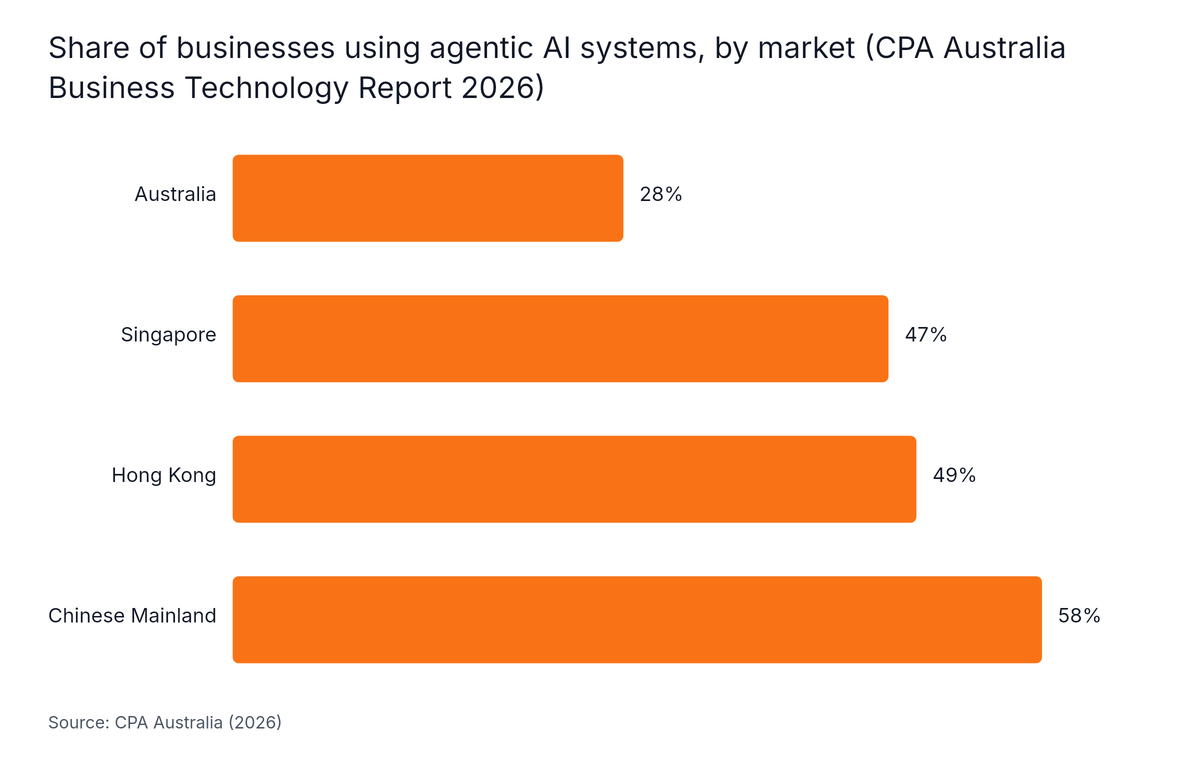
The same report shows agentic AI use varies by market: 28% in Australia, 47% in Singapore, 49% in Hong Kong and 58% in Chinese Mainland (CPA Australia, 2026).
Horizontal Bar chart: Share of businesses using agentic AI systems, by market (CPA Australia Business Technology Report 2026). Highest: Chinese Mainland at 58%.
Adoption is not the target. One process in production, with an owner, a metric and a checkpoint, is a better first milestone than five pilots.
Who is operations automation sequencing not for?
Grail Computer Labs' scoring method and reversibility model are not for teams that need a product comparison or a one-off tool purchase, or that cannot name a process owner and a measurable outcome. The evidence has limits too: Docxster's 2026 survey of 310 leaders is vendor-run research (Docxster, 2026), and CPA Australia calls its profitability link a correlation, not proof of cause.
These limits matter before relying on the method:
No independent revenue operations benchmark. We found no current, independent figure for time saved on revenue operations handoffs, so each team should measure its own baseline.
Small, anonymised examples. The case results above come from individual engagements. Results will differ with other systems and data.
Testing is not production. The neobank approval rates are testing results.
The scoring and reversibility tiers are working models. They are a practical way to decide order, not a validated standard. The worked example scores are illustrative.
Regulated work needs more. Healthcare, finance and custom-model workflows add privacy and compliance checks that this guide does not cover.
Frequently Asked Questions
Our ops team still approves everything manually: how does decision automation change that without removing human oversight?
Decision automation lets software approve routine, low-risk cases by rule and sends only exceptions and high-risk cases to a person. Oversight shifts from reviewing every item to reviewing exceptions and sampling the rest. In one Singapore-based neobank's human-reviewed workflow, automated approvals rose from approximately 44% to approximately 90% in testing, according to Grail Computer Labs' own project results.
We're losing hours to manual revenue operations handoffs: what automation software gives us measurable time back?
Revenue operations automation software that connects lead intake, qualification and onboarding handoffs removes re-keying and returns measurable time. Grail Computer Labs' own project results show one financial-services operator removed approximately 2 hours per day of admin after a single live sales queue replaced three scattered lead sources. Independent benchmarks are scarce, so measure your baseline first.
Which business process should we automate first?
Automate first the process with high volume, clear rules, low cost of error and easy integration. Score each candidate from 1 to 5 on those four criteria and start with the highest total. A repetitive, reversible workflow gives measurable time back quickly and limits the damage if the automation gets a case wrong.
Conclusion
Operations automation software removes repetitive steps, not accountability. Teams that avoid cancellation choose the first process deliberately and design oversight before launch.
Name one measurable problem, such as a backlog, rework or a missed service level, before evaluating any tool.
Score candidate processes on volume, rule clarity, cost of error and integration difficulty.
Keep a person on decisions that are hard to undo or need consent.
Fix or remove a step before automating it.
Track one metric for the first workflow, such as hours returned or approval rate, and review it weekly.
The next step is to pick the highest-scoring process and write down who owns it. GC Labs delivers a pre-defined outcome in 4 to 8 weeks, and a call is the quickest way to scope one: Book a call ↗.