
Blog
ML Development Services: When Off-the-Shelf Models Fail
ML development services explained: the five-stage custom model lifecycle, a partner scorecard, and healthcare and fintech checks, anchored in a measured SGH result.

Choose a reliable software development partner with five criteria: defined outcomes, code ownership, team continuity, verified AI delivery and red flags.
Request a quote and our experts will contact you within 24 hours with tailored solutions and pricing.
You can also send us a quick email at [email protected].
Grail Computer
Last updated: Oct 28, 2026
By Shiva Mangal, Grail Computer Labs · October 28, 2026
A software development partner is an external team that takes accountability for building, shipping and maintaining software to an agreed outcome, not just supplying developers who work the hours a buyer pays for. When the last vendor missed every deadline, that distinction is the whole search. A January 2026 update from PM World Journal (2026) found IT project failure rates essentially unchanged since 2017, and flagged AI projects as a new, higher-failure tier. Choosing well means testing a partner against failures already lived through. This guide maps five selection criteria to the failure each one prevents, shows how to test each in the sales process, and covers what changes in 2026 when AI agents sit inside the delivery stack.
Key Takeaways
- A reliable software development partner is chosen on five tests: a defined outcome, code ownership, team continuity, verifiable AI-assisted delivery and proof on a similar codebase.
- Acceptance criteria written before work starts turn a missed deadline from an argument into a measurable fact.
- Code, cloud, models and documentation should belong to the buyer from the first commit, with a written exit checklist.
- In 2026, 90% of surveyed software professionals use AI at work, so "we use AI" no longer separates one partner from another.
- A short, bounded first engagement lets a buyer judge a new partner on results before a long commitment.
To choose a reliable software development partner after a vendor failed, test five things before signing: a measurable outcome, code ownership from day one, a named team that stays after delivery, verifiable AI-assisted delivery, and proof on a similar codebase. Outcome-based models are now common, with 67% of surveyed business and technology leaders adopting them (Deloitte, 2026). Each criterion maps to a failure buyers have already lived through.
The table below pairs each criterion with the failure it prevents and a way to test it in the sales process.
| Criterion | Failure it prevents | How to test it before signing |
|---|---|---|
| Outcome defined first | Missed deadlines with no shared definition of "done" | Ask for one measurable result, an acceptance test and a date in writing |
| Code ownership | Lock-in and a stalled exit | Ask for repository and CI/CD access on day one and read the IP clause |
| Same team after delivery | Restarting with a new vendor every quarter | Ask for named people, key-person terms and a post-delivery model |
| AI-enabled delivery that can be verified | AI-written code nobody reviewed | Ask to see review gates, test rejection and recorded agent activity |
| Proof on a similar codebase | A partner learning on the buyer's budget | Ask for a dated case that started stalled and ended in production |
Most buyers compare vendors on price, location and a portfolio. Those are weak predictors. The failures that hurt are structural: nobody owned the path from idea to production, the vendor was paid for effort rather than results, and product context lived in people's heads. The PM World Journal update suggests the failure pattern has not improved with better tooling, so the fix sits in how a buyer chooses and contracts, not in which tool the vendor uses.
Treat the first call as a test. A partner worth hiring asks what is stuck, what "done" looks like and who accepts it, before it talks about its team.
Before a software development partner writes any code, the buyer and partner agree one pre-defined outcome in writing: what will be live, how it is measured, who accepts it and by when. Acceptance criteria are the testable conditions that decide whether work is done. A first outcome of 4 to 8 weeks keeps the target small enough to test; without criteria, a missed deadline becomes an argument about scope.

A usable outcome has four parts:
An outcome engagement is a first engagement scoped to one measurable result delivered in 4 to 8 weeks. It lets a buyer judge a new partner on results, not promises. A 15-day trial with no payment commitment, where the client can stop within the first 15 days without paying, lowers the risk further.
Our data: In Grail Computer Labs' published case study, an Australian healthcare platform, stuck in development for 8 months, was live in production within 30 days, and by day 40, 100 business customers had been onboarded.
Other case studies from the same company show a range of defined outcomes:
| Customer | Starting point | Defined outcome and result |
|---|---|---|
| Australian healthcare platform | Stuck in development for 8 months | Live in production within 30 days |
| Small financial-services operator | Three scattered lead sources, about 2 hours a day of admin | One live sales queue in 11 days; 360 submissions processed in the first 10 days |
| Singapore-based neobank | Transaction checks done manually | Eight transaction checks live in under 30 days |
| Singapore-based neobank | Automated approvals at approximately 44% | Approximately 90% in testing after a one-week build |
A client should own the code, cloud accounts, models and documentation from the first commit. Ownership means repository and CI/CD (continuous integration and delivery) access on day one, IP assignment in the contract and a written handover checklist. In a Deloitte survey, 70% of leaders had brought work previously done by external providers back in-house within five years (Deloitte, 2026).
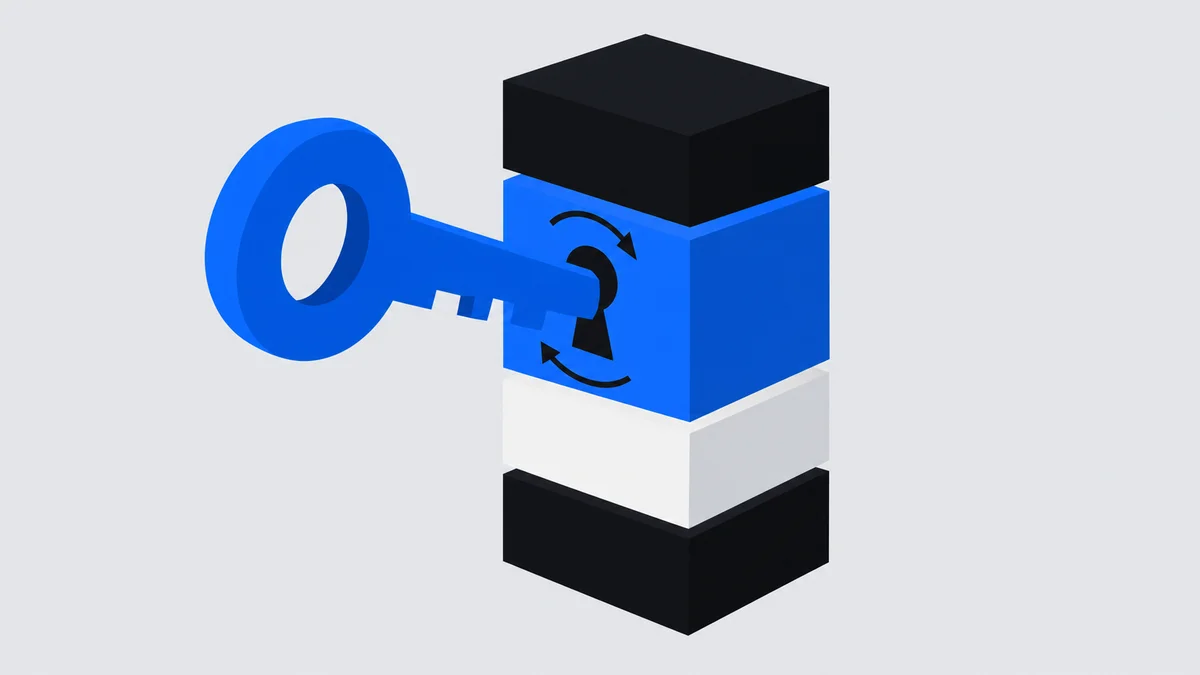
A software development partner that holds these assets can raise prices or stall an exit, which is how buyers get locked in a second time. Bringing work in-house, or moving it to a new team, is far easier when the buyer already holds the code.
Step-in rights and escrow arrangements are also worth raising when the system is critical. A vendor that refuses to put ownership in writing has answered the question.
A failed vendor's codebase needs an independent audit before any new feature work. Then stabilise it, rebaseline the scope and make an improve-or-rebuild decision: keep what can support reliable releases, and migrate the rest in phases. A big-bang migration is the risk operations leads name first, and phasing is the answer.
In the Australian healthcare platform case, the team inherited 1.5 million lines of code and handled 500 bug and feature tickets across a 10-day period. That is the scale to ask a rescue partner about.
The same team keeps shipping when the contract names that team and moves from a one-off build to continuous delivery after the first outcome. Continuous delivery means the team handles features, changed requirements, monitoring and releases across the whole codebase as work arrives. In one documented rescue of an Australian healthcare platform, one team handled 500 bug and feature tickets across a 10-day period.
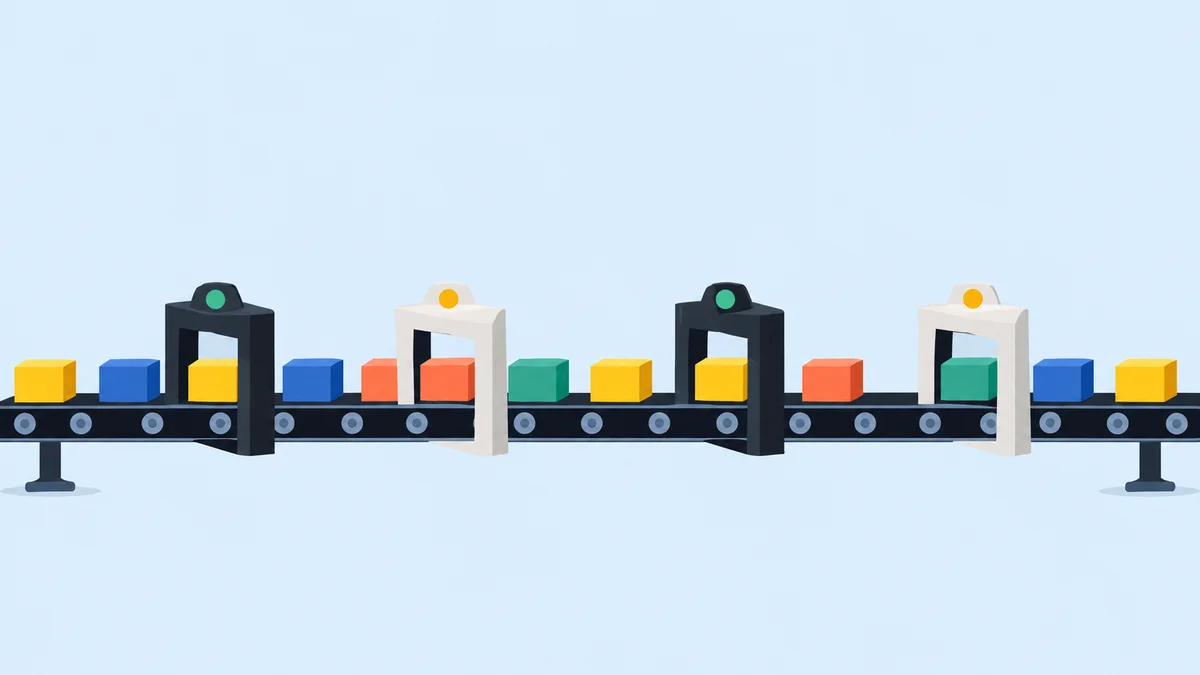
One partner should own the full build, from discovery through deployment. In practice that covers:
Ask who will work on the product in month six, and ask for their names. Check the contract for key-person terms: what happens if a named engineer leaves. Ask how context is stored. If the answer is "in our engineers' heads", every departure resets the project. If it is "in the delivery system, configured around the codebase and release process", the team can change without the product being explained twice.
A telehealth software company that spent months with an underperforming vendor had its clinical workflow completed after the switch. The lesson is not the switch itself. It is that the new team could carry the work forward without a long re-briefing.
An AI-enabled development process in 2026 uses AI agents to speed up work while engineers review every change and tests reject incomplete work. AI use alone proves little: 90% of surveyed software professionals use AI at work (Google Cloud DORA, 2025). Ask how a partner verifies AI output, not whether it uses AI.
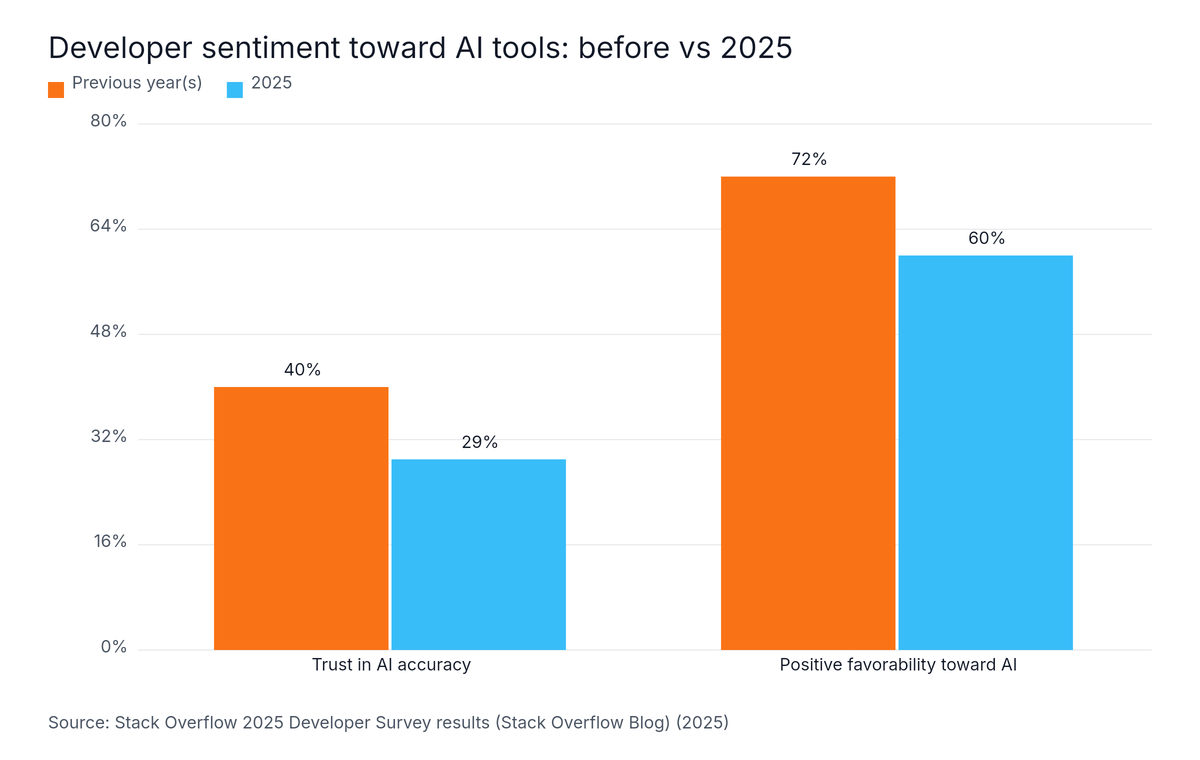
Source: Stack Overflow 2025 Developer Survey results (Stack Overflow Blog), 2025
The software development life cycle (SDLC) is the sequence of planning, building, testing, releasing and maintaining software. AI now touches every stage, and trust in its output is falling. In the 2025 results, developer trust in AI accuracy fell from 40% to 29%, and positive favourability fell from 72% to 60% (Stack Overflow Blog, 2025). The survey page itself reports that 46% of developers distrust the accuracy of AI tool output, against 33% who trust it (Stack Overflow, 2025).
The speed evidence is mixed. In a randomised trial of 16 experienced developers on 246 real issues, early-2025 AI tools made them 19% slower, while they believed they were 20% faster (METR, 2025). METR's February 2026 update says that finding is now outdated and speedups now seem likely, though its newer results are unreliable. The lead author described the problem plainly: "the suggestions were often directionally correct, but not exactly what's needed" (Joel Becker, METR, via Reuters, 2025).
Tooling does not fix delivery on its own. In Atlassian's 2025 survey, 68% of developers saved 10 or more hours a week with AI, while 50% lost 10 or more hours a week to organisational inefficiencies (Atlassian, 2025). The DORA team put it this way: "AI doesn't fix a team; it amplifies what’s already there." (Google Cloud DORA, 2025). A partner with weak review and test discipline will ship weak code faster.
Agentic AI is software in which AI models plan and take multi-step actions with tools, rather than only answering prompts. Gartner expects over 40% of agentic AI projects to be cancelled by end of 2027, a forecast first made in June 2025 and revisited by Forbes (2026). That analysis argues the cause is governance, ownership, data access and ROI, not model capability.
The principle to look for is simple: agents execute, humans decide, customers see progress.
Outcome-first selection of a software development partner is not for buyers who want the lowest hourly rate, a fully open scope, or a partner paid purely for time spent. It also does not replace an in-house team where engineering is the core product. It suits stalled or high-stakes projects with a definable result, where failure stays common: IT project failure rates are essentially unchanged since 2017 (PM World Journal, 2026).
Four limits are worth stating before any search starts:
To choose a software development partner, define the outcome needed, then test candidates on five points: measurable acceptance criteria, code ownership from day one, a named team that stays after delivery, verifiable AI-assisted delivery and proof on a similar codebase. Ask each for a dated case with a stalled start and a measured result, and pay for a short first engagement before any long commitment.
An early-stage startup should look for a software development partner that ships a defined first release, not one that only advises. Check that the partner builds, tests and releases in one team, hands over the code, cloud accounts and documentation, and agrees a measurable outcome with a date. Ask for a short first engagement with a clear exit if results do not appear.
A software development partner that can handle an enterprise codebase starts by reading it, not rewriting it. Look for an independent code audit, a test harness built before changes, and an improve-or-rebuild decision that keeps what supports reliable releases. In one documented rescue, an Australian healthcare platform's rebuild began with 1.5 million lines of inherited code, so ask for a case of similar size.
A development partner that can ship AI into production owns evaluation, deployment and monitoring, not just the demo. Gartner expects over 40% of agentic AI projects to be cancelled by end of 2027 (Forbes, 2026), so ask for governance, rollback controls, human approvals and a production case with a date. Treat a partner that only shows prototypes as unproven.
A custom software development partner should start by agreeing one measurable outcome, then build in accounts the buyer controls, with code, models and documentation owned by the buyer. Check for a team that builds, tests and releases together, reviews every AI-written change and keeps shipping after the first release. Ask for a dated case where the partner took over a stalled build.
A launch delivery partner should commit to a pre-defined outcome, a dated first release and named people, rather than open-ended effort. Ask for acceptance criteria written before work starts, visible weekly progress, testing and release included, and a documented exit. In one documented build, one live sales queue replaced three scattered lead sources in 11 days.
A software development partner for a scale-up should add delivery capacity without adding coordination overhead: one accountable team, visible weekly progress and continuous delivery across the whole codebase. Atlassian's 2025 survey found 50% of developers lose 10 or more hours a week to organisational inefficiencies (Atlassian, 2025), so ask how the partner removes handoffs rather than adding people.
A delivery partner for a company with no internal engineering team should own the build end to end: discovery, build, testing, release, documentation and monitoring, with the buyer holding the code and cloud accounts. Ask for a named team, a dashboard showing requests and release history, and a written handover checklist so an in-house team can take over later.
A software development partner for a 3PL (third-party logistics) platform should first deliver the one bottleneck that blocks growth, such as a manual workflow or a stalled integration, as a measured outcome. Map the workflow end to end, automate it with human approvals where risk sits, then continue across the codebase. In a comparable lead-operations build, automation removed approximately 2 hours per day of admin.
A stalled Canadian platform needs a delivery partner that starts with an independent code audit and one dated outcome, whatever the partner's location. Confirm where data is hosted and which privacy rules apply, ask for read-only access first, and require ownership of the code, cloud and documentation. Time zones matter less than named people and visible weekly progress.
A proper AI testing partner owns verification before release, not a last-step check. Stack Overflow's 2025 survey found 66% of developers name output that is almost right but not quite as their top AI frustration, and 45% say debugging AI-generated code takes longer (Stack Overflow, 2025). Expect test suites that reject incomplete work, evaluation sets for AI features and recorded agent traces.
Choosing a software development partner after a failed vendor comes down to five checks, each tied to a failure buyers have already seen:
Teams with a stalled project can test a new partner on one agreed outcome. Book a call ↗ with Grail Computer Labs and bring the software everyone is tired of explaining.
© 2026 Grail Computer All rights reserved.