Blog
Enterprise AI Guardrails: What They Are and How Production Teams Actually Enforce Them
Enterprise AI guardrails explained: instruction-based vs architecture-based controls, plus a go-live checklist for data access, action scope and fallback.
How software development project rescue works: triage, codebase inheritance, outcome agreement, stabilisation and release, anchored in a real 30-day case.
Enterprise AI guardrails explained: instruction-based vs architecture-based controls, plus a go-live checklist for data access, action scope and fallback.

Legacy platform blocking AI or integrations? Decide what to keep, wrap, migrate or retire, then move in phases without stopping the business. Worked example.

ML development services explained: the five-stage custom model lifecycle, a partner scorecard, and healthcare and fintech checks, anchored in a measured SGH result.
Request a quote and our experts will contact you within 24 hours with tailored solutions and pricing.
grail.computer
Last updated: Nov 6, 2026
By Shiva Mangal, Grail Computer Labs
Software development project rescue is the process of taking a stalled build out of the hands of an underperforming team, securing its code and environments, agreeing a measurable outcome, and getting a dependable release into production. Most owners have never seen one from the inside. One client described the starting point: "Even a small bug fix could take days or a week, and fixing one problem often broke something else." This guide follows the sequence we use, anchored in one anonymised case: an Australian healthcare platform, stuck in development for 8 months, that went live in production within 30 days. Stage lengths vary with the codebase, so we give the order each stage runs in and the markers the case records, not a fixed day count per stage.
Key Takeaways
- A software development project rescue runs in five stages: triage, codebase inheritance, outcome agreement, stabilisation and release.
- Codebase inheritance is finished only when a new team can build, test and deploy the system without help from the people who wrote it.
- An outcome agreement defines done as one measurable, verifiable result before delivery work starts.
- The Australian healthcare platform case went from 8 months stuck in development to live in production within 30 days, with 1.5 million lines of code inherited and rebuilt.
- Software rescue does not suit exploratory pilots, projects with no accessible code, or teams that want advice without delivery.
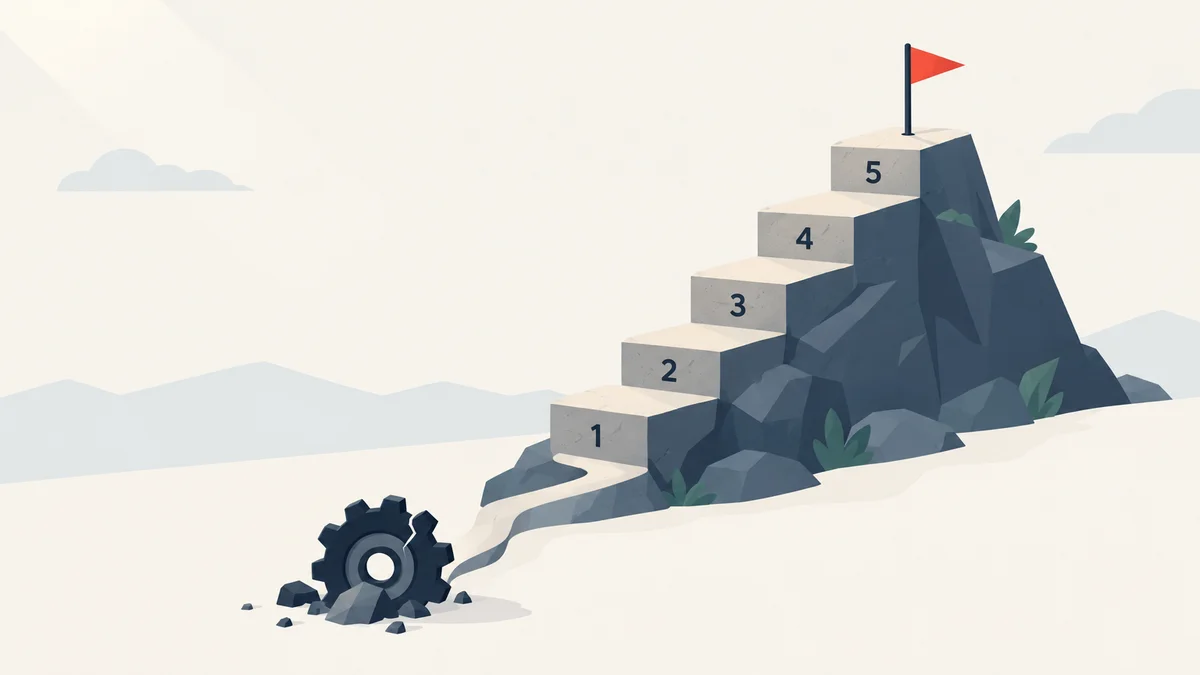
Software development project rescue involves five stages in order: triage to stop the damage, codebase inheritance to secure code and environments, an outcome agreement that defines done, stabilisation to make releases dependable, and a production release. In the Australian healthcare platform case, a project stuck in development for 8 months went live in production within 30 days.
The stakes are real. PMI's 2026 Pulse of the Profession reports that 31% of complex projects miss their intended benefits, more than twice the rate for projects overall (PMI, via Zawya, 2026).
The stages overlap in practice, but the order matters. Each one produces something the next one needs.
| Stage | What happens | What exists at the end |
|---|---|---|
| Triage | Freeze risky changes, secure access, test what works | A written picture of what is live, broken and urgent |
| Codebase inheritance | Move repositories, credentials and environments to the new team | A system the new team can build, test and deploy alone |
| Outcome agreement | Define one measurable result with stakeholders | A written definition of done and the checkpoints to it |
| Stabilisation | Fix blocking defects, add tests, decide keep, refactor or rebuild | A codebase that releases reliably |
| Release | Deploy to production with a rollback path and documentation | A live system and a handover the owner can read |
The case gives us four dated markers. We do not publish a day count for each stage, because the codebase sets the pace and a different platform will move faster or slower.
| Point in the case | What the case records |
|---|---|
| Before the rescue | Stuck in development for 8 months with no clear deadline |
| Within 30 days | Live in production, after 1.5 million lines of code were inherited and rebuilt |
| By day 40 | 100 business customers had been onboarded |
| A 10-day period | 500 bug and feature tickets handled |
The commercial order is fixed even where stage lengths are not. The outcome and quote are agreed before the 15-day trial begins, and the pre-defined outcome is delivered in 4 to 8 weeks.
Grail Computer Labs (GC Labs) is an applied-AI and digital product research lab whose speciality is software rescue. Its method is the Software Factory, GC Labs' AI software factory, which runs the loop Triage → Specify → Implement → Review → Verify → Release. The principle is short. Agents execute, humans decide, and customers see progress. Our engineers review every change, and tests reject incomplete work. This is not AI replacing engineers.
Software projects stall when nobody owns the path from idea to production, complexity outgrows the plan, and the vendor is paid for effort rather than results. PMI's 2026 research found that 81% of project professionals say projects are becoming more complex (PMI, via Zawya, 2026). BCG reported in 2024 that two-thirds of large tech programmes miss time, budget or scope targets (BCG, 2024).
Stalls are rarely sudden. They build up through a few repeatable causes:
IT is a hard category for cost control. A 2026 peer-reviewed study of 5,360 IT projects found that the severe-overrun group averaged 453% over budget (Flyvbjerg et al., 2026). The figure describes the worst tail, not a typical project, but it shows why waiting rarely helps.
For the Australian healthcare platform, the symptom was plain: 8 months in development with no clear deadline. The platform connected several parties, so a delay did not stay inside the software. It reached the managed-service business running it and the customers waiting on it.
In a software development project rescue, triage is the first stage: freezing risky changes, securing access, and finding out what works before new code is written. It matters because the debt it uncovers is large: CAST's 2025 study of 10 billion lines of code puts global technical debt at 61 billion days of repair time (CAST Software, 2025). Triage stops the damage; it does not yet fix the product.

A code freeze is a pause on all non-essential changes to the codebase. It lets the team measure a stable system instead of a moving one. In triage we do three things in this order:
We distrust progress percentages from the previous team. A feature marked "90% done" means nothing until it runs in an environment we control. The test is simple: does it build, deploy and behave as described?
A project health check is a structured review of what a codebase contains and whether it runs. The people who will do the rescue work should run it, because they must live with its findings. It looks at five things: whether the system builds, which tests pass, what is deployed where, who holds access, and which defects block the business.
Triage ends with a short written finding, not a long audit. It lists what is live, what is failing, which defects block the business, and which risks need an owner's decision. If the finding is bad, we say so. A project can be beyond saving, and an honest triage is the cheapest place to learn that.
In a software development project rescue, codebase inheritance is the transfer of a project's source code, credentials, environments and documentation from the previous team to the rescue team. It is complete when the new team can build, test and deploy the system without help from anyone who built it. The Australian healthcare platform case involved inheriting 1.5 million lines of code.

Handover fails in small gaps: a cloud account registered to a developer's personal email, a deployment script on one laptop. This table lists what we secure and how we know it is done.
| Item | Why it matters | Done when |
|---|---|---|
| Source repositories with full history | History explains why code looks the way it does | The new team holds a complete clone and write access |
| Cloud accounts and admin access | Production cannot be changed or recovered without it | Ownership sits with the client, not an individual |
| Credentials and secrets | Old keys remain live after people leave | Secrets are rotated and stored in one controlled place |
| Environments (development, staging, production) | A bug cannot be reproduced without a matching environment | Each environment can be rebuilt from documented steps |
| Build and deploy pipeline | Releases depend on it | A release runs end to end without manual rescue |
| Databases and backups | Data is the hardest thing to recreate | A backup restores successfully in a test |
| Third-party integrations and licences | Integrations are where multi-party platforms break | Each is listed with its owner and contract status |
| Intellectual property and documentation | Without clear ownership the client can be locked in again | The client owns the code, cloud, models and documentation |
Access can begin read-only. We share an access plan up front, and likely secrets are masked before they reach an agent. Agent traces are recorded.
Technical debt is the cost of choosing speed over quality in software. CAST defines it as "extra work developers must do to fix or improve software that was built quickly at the expense of quality" (CAST Software, 2025).
In the US, repairing tech debt takes 2.07 workdays per 1,000 lines of code (IBM, citing CAST, 2026). That figure shows scale, nothing more. We do not apply it to any single codebase, because debt varies with the code.
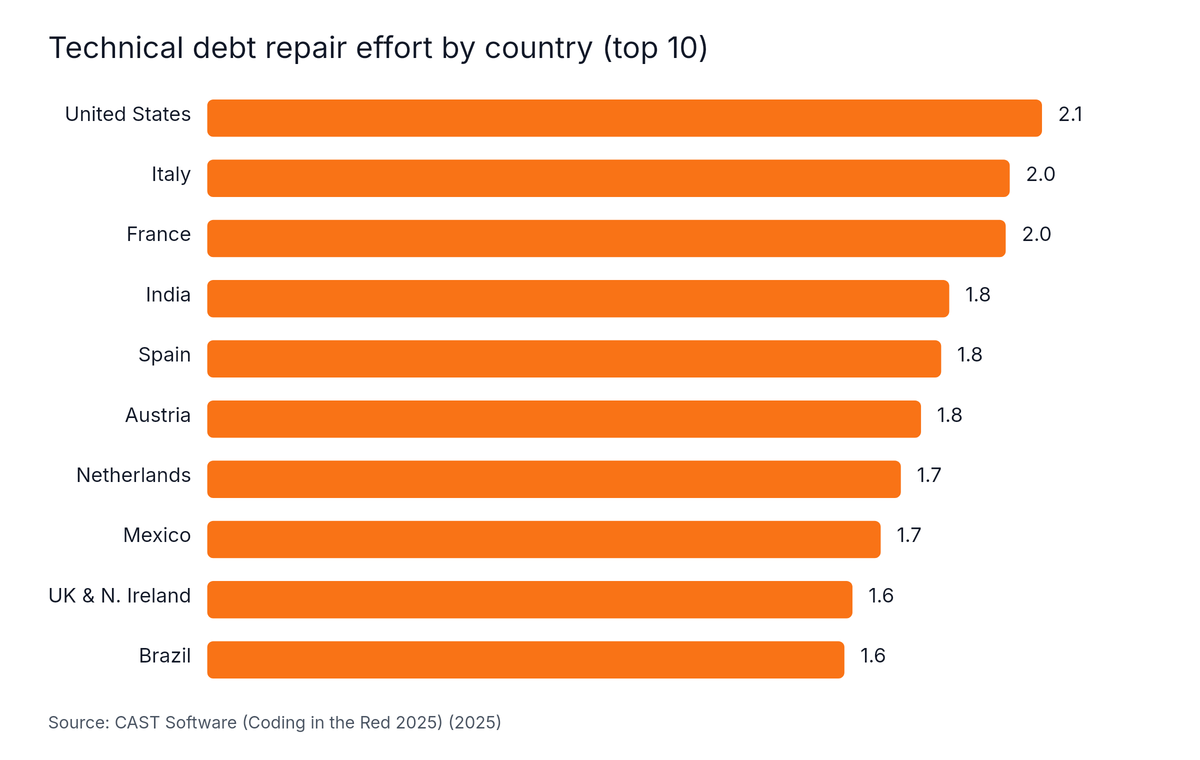
Source: CAST Software (Coding in the Red 2025), 2025
The chart shows the United States highest of the top ten countries at 2.07 workdays per 1,000 lines, and Brazil lowest of the ten at 1.58 (CAST Software, 2025).
In a software development project rescue, an outcome agreement is a written definition of done: one measurable, verifiable result, agreed with stakeholders before delivery work starts. PMI's 2026 research reports an 88% project success rate for teams that manage complexity effectively, against 14% for teams that struggle with it (4Hoteliers, reprinting PMI's 2026 Pulse of the Profession, 2026). A clear outcome is one way to manage complexity, but the figures do not isolate it as the cause.

Most rescue guides jump from audit to fixes. That is how a second stall begins. A team that fixes bugs without an agreed finish line can work for weeks and still not know whether it is done.
A usable outcome has four parts:
An outcome engagement is GC Labs' first engagement: one pre-defined outcome, delivered in 4 to 8 weeks. The order is fixed. An NDA is signed, we hear the key technology problem on a call, and we propose the best deliverable in 4 to 8 weeks. The outcome and quote are agreed. A 15-day trial then begins, with no payment commitment, so the client can stop within the first 15 days without paying.
Continuous delivery is the same team shipping across the whole codebase as work comes in, once the outcome is delivered. We agree the outcome first, deliver it in 4 to 8 weeks, then keep shipping.
In a software development project rescue, stabilisation is the stage that makes releases dependable: fixing the defects that block the agreed outcome, adding automated tests, and deciding what to keep, refactor or rebuild. IBM reports that 69% of executives say technical debt can make some initiatives financially untenable by adding 15% to 22% to delivery timelines (IBM, 2026).

The improve-or-rebuild decision keeps what can support reliable releases and migrates the rest in phases. We make it in the early weeks, on evidence from the inherited code, not on taste. A big-bang migration feels very risky to the people who run the platform day to day, and they are right to worry. A phased approach protects daily operations.
| Signal | Points to refactor | Points to rewrite |
|---|---|---|
| Automated test coverage | Tests exist and mostly pass | Few or no tests, and failures nobody can explain |
| Stack support | Languages and frameworks still supported | Core components at end of life |
| Business rules | Recoverable from code, data or documents | Buried in code nobody can read or run |
| Release history | Past releases ran with manageable fixes | Each release breaks unrelated features |
| Data model | Sound, with fixable gaps | Inconsistent, with data that cannot be trusted |
Most real codebases mix both columns. The rubric is applied module by module, so a rescue can refactor one area while rebuilding another.
Regression testing is re-running automated checks after each change to confirm that old behaviour still works. It is the main defence against the pattern in the client quote above, where fixing one problem breaks another. We also set up continuous integration and delivery (CI/CD), which is a pipeline that builds, tests and deploys every change the same way each time.
Our engineers review every change. Agents execute, and tests reject incomplete work.
In a software development project rescue, a release is the first dependable production deployment of the agreed outcome, backed by tests, a rollback path and documentation. In the Australian healthcare platform case, the platform went live in production within 30 days, and by day 40, 100 business customers had been onboarded.
Our data: For an Australian healthcare platform stuck in development for 8 months, we inherited 1.5 million lines of code and rebuilt the platform. It went live in production within 30 days. By day 40, 100 business customers had been onboarded, and 500 bug and feature tickets were handled across a 10-day period.
The sector context explains the care. More than 1.35 million Australians are believed to access some level of aged care (ABC News, 2026), so a stalled or unstable platform in that field has a real service impact.
A release is dependable when five conditions hold:
Speed does not mean skipping controls. Access starts read-only, and the access plan is shared up front. Likely secrets are masked before they reach an agent, and agent traces are recorded. Deployment can run on client infrastructure or a private cloud under the client's AI and security policies, with zero data retention where required. Regulated work needs its privacy and compliance questions settled during inheritance, not after launch.
The post-release step is the one most guides leave out. The first release is a baseline, not an ending. The regression safety net stays in place, the handover is checked against the inheritance table, and feature work resumes only once releases are routine. The 500 tickets handled in a 10-day period show why: once customers arrive, requests arrive in volume.
Under continuous delivery the same team keeps shipping: features, changed requirements, monitoring and site reliability engineering (SRE), which is the discipline of keeping a live system available and fast. There is no handover after the build.
| Case (anonymised) | Starting point | Result |
|---|---|---|
| Australian healthcare platform | Stuck in development for 8 months | Live in production within 30 days; 100 business customers onboarded by day 40 |
| Telehealth software company | Months of stalling with a previous vendor | Clinical workflow completed after the vendor switch |
| Small financial-services operator | Three scattered lead sources | One live sales queue in 11 days; 360 submissions processed in the first 10 days |
A software development project rescue is not for every stalled project: it suits projects that matter to the business, have accessible source code, and have an owner who can agree an outcome. It is a poor fit for exploratory pilots, projects with no code, or teams wanting advice without delivery. Speed also depends on the codebase, and we do not treat 30 days as a promise.
A stalled software project rescue takes as long as the agreed outcome requires, and the codebase sets the pace. In the Australian healthcare platform case, a project stuck in development for 8 months went live in production within 30 days. Grail Computer Labs' outcome engagements deliver one pre-defined outcome in 4 to 8 weeks.
Inherited code should be refactored when it has working tests, a supported stack and recoverable business rules, and rewritten when it has none of these. The decision is made early in a rescue, on evidence from the code itself. A phased approach keeps what can support reliable releases and rebuilds the rest in stages, so the business keeps running.
Taking over a codebase after the developers have left means securing source repositories with full history, cloud admin access, credentials, environments and the deployment pipeline before any new work starts. The goal is that a new team can build, test and deploy the system alone. Anything only a departed developer knows is a risk to list.
A software rescue team needs source repositories, cloud account access, the environment list, database schemas and backups, third-party integration details, any existing documentation, and written confirmation of who owns the intellectual property. Access can begin read-only. The rescue team shares an access plan up front, so the owner knows what is opened and why.
A software project is beyond saving when the code cannot be built, no business rules can be recovered from it, and its stack is out of support. Few projects reach that point. Triage tests it directly: if the rescue team cannot build and deploy the system, that finding goes to the owner, with a rebuild option.
A project health check, or code audit, is a structured review of what a codebase contains and whether it runs: the reviewer builds the system, runs existing tests, and lists what is live, failing and risky. The team that will do the rescue work should run it, because that team must live with the findings. It ends in a short written report for the owner.
A stalled platform goes live safely when access is controlled and tests gate every release. Grail Computer Labs starts access read-only, shares an access plan up front, masks likely secrets before they reach an agent, records agent traces, and can deploy on client infrastructure with zero data retention where required. Its engineers review every change, and tests reject incomplete work.
The cost of a software project rescue depends on the codebase and the outcome, so it is scoped and priced after a first call under NDA, not from a published rate. Grail Computer Labs agrees the outcome and quote before work starts, and begins with a 15-day trial with no payment commitment. Comparing against a rebuild needs the triage finding first.
Software development project rescue replaces status meetings with a sequence of five stages: triage, codebase inheritance, outcome agreement, stabilisation and release. Each stage produces something the next one needs, and the Australian healthcare platform case shows the sequence can end in production within 30 days. These are the points to carry away:
The next step is a list. Write down who holds admin access, where the code lives, and what "done" would mean. If that list has gaps, Book a call ↗.
© 2026 grail.computer All rights reserved.