Blog
Software Development Project Rescue: What the First 30 Days Involve
How software development project rescue works: triage, codebase inheritance, outcome agreement, stabilisation and release, anchored in a real 30-day case.

Six months stalled with no launch date? Learn how software implementation rescue differs from an AI implementation partner or advisory consultant.
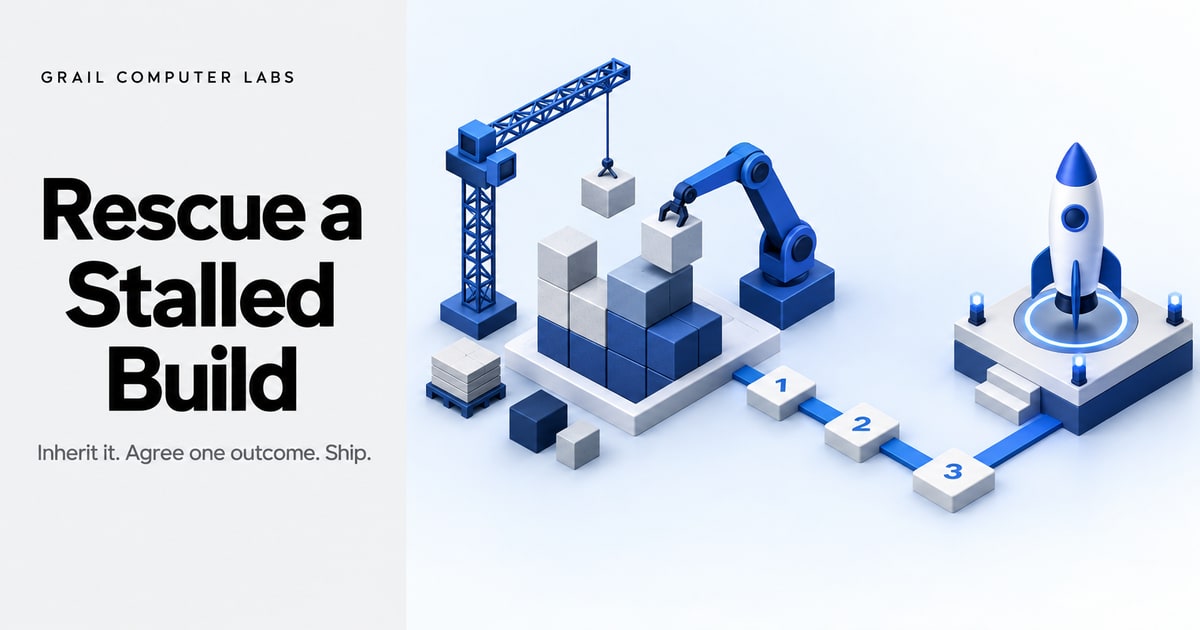
How software development project rescue works: triage, codebase inheritance, outcome agreement, stabilisation and release, anchored in a real 30-day case.
Enterprise AI guardrails explained: instruction-based vs architecture-based controls, plus a go-live checklist for data access, action scope and fallback.
A legacy system is software that is hard to change safely. See the warning signs, the improve-or-rebuild test and a phased migration plan for real platforms.
Request a quote and our experts will contact you within 24 hours with tailored solutions and pricing.
You can also send us a quick email at [email protected].
Last updated: Nov 18, 2026
By Shiva Mangal. Shiva writes for Grail Computer Labs, an applied-AI and digital product research lab whose speciality is software rescue.
Software implementation rescue means a team inherits a stalled custom build, agrees one measurable outcome, and delivers it in 4 to 8 weeks, which is a different job from advising on strategy or running a fresh implementation. Six months with no launch date is the typical trigger. The vendor keeps working, the status meetings continue, and nothing reaches users. That pattern is an execution problem, and it calls for a different partner than a strategy gap does. This post separates three partner types, maps each to the failure it fixes, and sets out how a 4 to 8 week rescue restarts delivery. It uses "rescue" for stalled custom software and AI builds, not off-the-shelf SaaS or ERP rollouts.
Key Takeaways
- Software implementation rescue fits a stalled build with no launch date; an advisory consultant fits a missing plan; an implementation partner fits a clear plan with no builders.
- A software rescue and stabilisation engagement inherits the codebase and delivers one agreed outcome in 4 to 8 weeks.
- An execution gap (a plan exists, delivery has stopped) needs engineers, not another roadmap.
- Software implementation rescue is the wrong tool when there is no concrete outcome to deliver or the outgoing vendor will not release the code.
Software implementation rescue is the takeover of a stalled custom software or AI build, with one agreed outcome delivered in 4 to 8 weeks. An AI implementation partner builds new work from an agreed plan, and an advisory consultant produces strategy and roadmaps without shipping software. S&P Global found 42% of companies abandoned most of their AI initiatives before production (FactoryJet, 2025).

| Role | Failure it fits | Main deliverable | Starts from | Ends when |
|---|---|---|---|---|
| Rescue and stabilisation team | Build stalled, no launch date, vendor underperforming | One working outcome in production | An existing codebase and accounts | The agreed outcome is live |
| Implementation partner | Plan agreed, nobody to build it | New software or AI feature released | A defined scope | The scope is released |
| Advisory consultant | No agreed direction, unclear priorities | Strategy, roadmap, vendor review | A business question | The report is accepted |
The S&P figure was up from 17% a year earlier. It covers 1,006 respondents in North America and Europe, and the FactoryJet page is a secondary summary of the original S&P Global Market Intelligence survey.
Two more definitions keep the terms straight. An advisory consultant is a specialist who produces strategy, roadmaps and assessments but does not build or release software. An implementation partner is a delivery team that owns the path from an agreed plan to a production release.
An execution gap is a situation where a plan exists but delivery has stopped, while a strategy gap is a situation where nobody has agreed what to build or why. Six months with no launch date and a codebase nobody can explain point to an execution gap. Among Singapore firms running autonomous AI agents, 42% cite legacy system limits as a barrier (Mission Media Asia, 2026).
If the first list fits, the team needs delivery. If the second fits, it needs advice first. Many teams see both, and the sensible order is to stabilise delivery, then plan the next phase on working software.
A HubSpot and Lonergan Research survey of more than 700 Singapore leaders found that, among firms already running autonomous agents, legacy system limits were cited by 42%, data integration by 41% and skills gaps by 39% (Mission Media Asia, 2026). The original report was not retrieved, so these figures come from trade press.
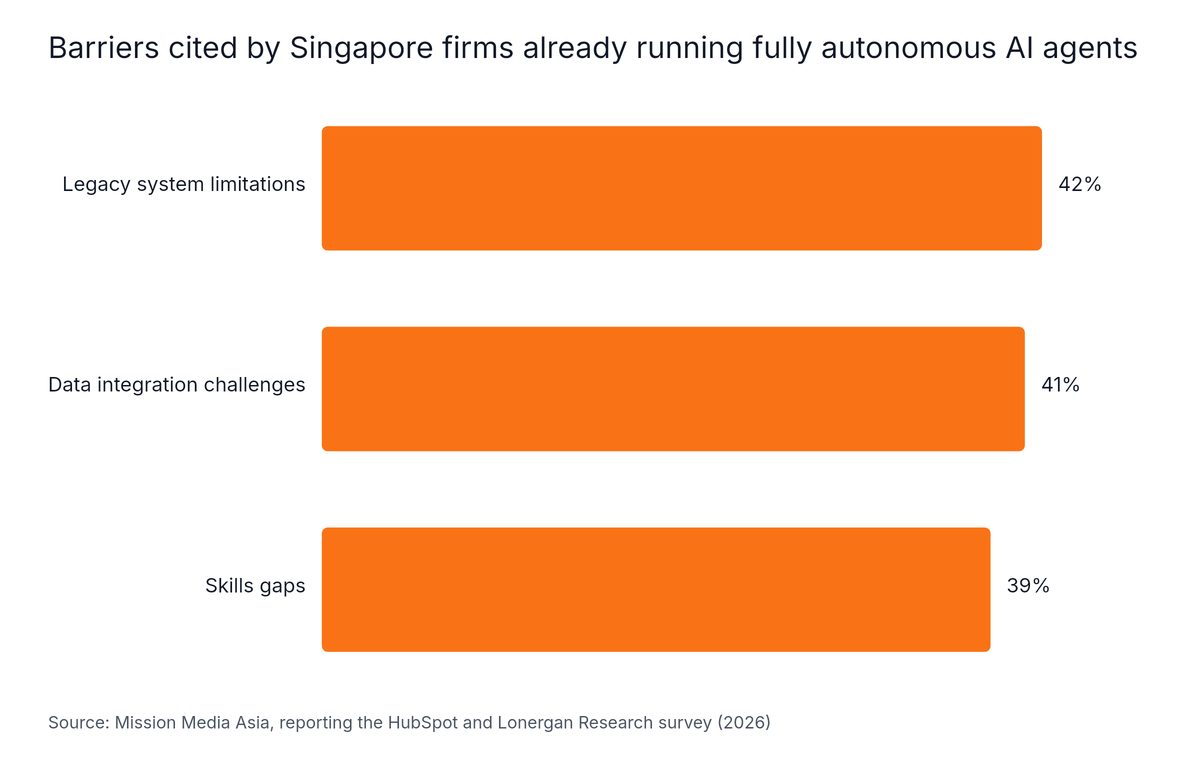
Source: Mission Media Asia, reporting the HubSpot and Lonergan Research survey, 2026
AI pilots stall mostly between pilot and production, where integration, ownership and legacy systems block release. Globally, only a quarter (25%) of organisations have moved 40% or more of their AI pilots into production, and Singapore is higher at 32% (Deloitte Southeast Asia, 2026). In Australia the figure is 28% (Deloitte Australia, 2026).
| Region | Share that moved 40%+ of AI pilots into production | Source |
|---|---|---|
| Global | 25% | Deloitte Southeast Asia, 2026 |
| Australia | 28% | Deloitte Australia, 2026 |
| Singapore | 32% | Deloitte Southeast Asia, 2026 |
The Singapore sample in that survey is small (75 leaders), so the regional gap is indicative only.
It shows an intent gap. Only 12% of Australian leaders say generative AI is already transforming their business or industry, against 25% globally. Australia's 65% intent to raise AI investment compares with 84% globally (Deloitte Australia, 2026). Deloitte's own summary reads: "Australian AI ambitions are strong, but it is time to turn intent into action." (Deloitte Australia, 2026)
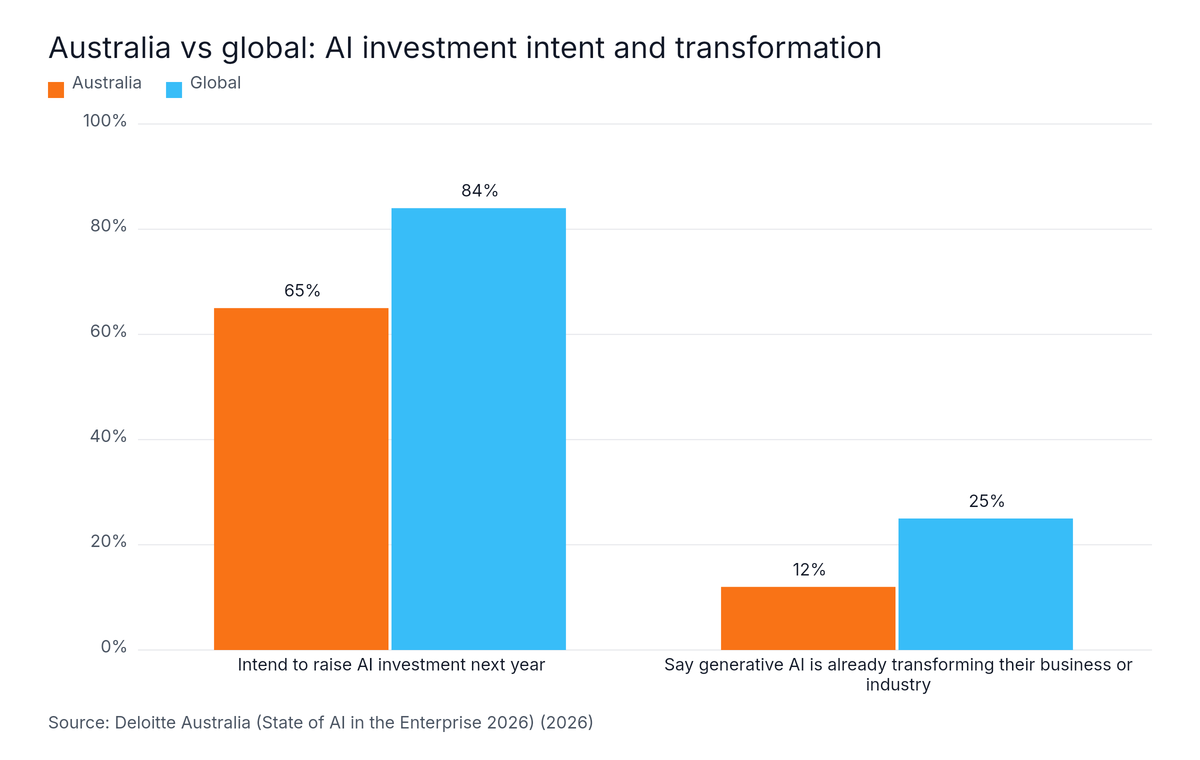
Source: Deloitte Australia (State of AI in the Enterprise 2026), 2026
To stabilise and restart delivery, a rescue team takes ownership of the repository, cloud accounts and documentation, agrees one measurable outcome, and delivers it in 4 to 8 weeks. Grail Computer Labs' customer data shows an Australian healthcare platform, stuck in development for 8 months, went live in production within 30 days.

The cost of waiting is real. Gartner expects over 40% of agentic AI projects to be cancelled by the end of 2027 (IHL Services, reporting Gartner, 2026). A stalled build that matters is easier to save in month six than in month eighteen.
The sequence runs in six steps:
Our data: An Australian healthcare platform was stuck in development for 8 months with no clear deadline. GC Labs inherited 1.5 million lines of code and rebuilt the platform. It went live in production within 30 days, 100 business customers had been onboarded by day 40, and 500 bug and feature tickets were handled across a 10-day period.
Ownership comes first. The client should ask for these items in the company's own name:
The improve-or-rebuild decision is the call on which parts of a codebase can support reliable releases and which must be rebuilt. Keep what works. Migrate the rest in phases so the business keeps running. Clients tell us a big-bang migration feels very risky, and it is rarely necessary.
A stalled AI initiative needs an implementation partner when delivery has stopped and the missing capability is engineering, not planning. An implementation partner owns the path from agreed plan to production release, while an advisory consultant defines direction. Australia's 65% intent to raise AI investment compares with 84% globally (Deloitte Australia, 2026), so intent is rarely the scarce part.

Advice has real value when direction is unclear. Chris Lewin, AI & Data Capability Leader at Deloitte Asia Pacific, made the advisory case this way: "they will need a clear roadmap to guide their transformation beyond incremental optimisation" (Deloitte Southeast Asia, 2026). A roadmap is a document, though. It does not clear a backlog or release a build.
| Situation | Best fit | Reason |
|---|---|---|
| Six months stalled, no launch date, vendor underperforming | Rescue and stabilisation team | Needs the codebase inherited and one outcome shipped |
| Several pilots, no agreed priority | Advisory consultant | Needs direction before more building |
| Approved scope, no engineering capacity | Implementation partner | Needs delivery against a defined plan |
| Rescued product now live, work keeps arriving | Continuous delivery | Needs the same team to keep shipping without rescoping |
Software implementation rescue is the wrong fit when there is nothing concrete to deliver, when the outgoing vendor holds the code and accounts and will not release them, or when the real gap is strategy. Exploratory pilots are a poor fit too: 64% of Singapore businesses use AI in daily workflows, but only 18% have reached fully autonomous deployment (Mission Media Asia, 2026).
Other limits are worth stating plainly:
Yes, a stalled AI initiative needs an implementation partner when delivery has stopped and the missing piece is engineering. An implementation partner owns the path from agreed plan to production release, while an advisory consultant defines direction and recommendations. With no launch date, the problem is usually execution, so the team must read the code, ship changes and answer for a release date.
A software rescue and stabilisation engagement typically delivers one pre-defined outcome in 4 to 8 weeks. The outcome is scoped after a call under NDA, and the work begins with a 15-day trial with no payment commitment, so the client can stop within the first 15 days without paying. Continuous delivery follows once the outcome is live.
Before a software rescue starts, get the source repository, cloud and hosting accounts, domain and DNS access, credentials, database backups and any documentation or ticket history. Ownership should sit in the company's own name. Without repository and account access, a rescue team has nothing to inherit and cannot agree a deliverable.
Yes, an implementation partner can take over a codebase built by another vendor, provided the client can hand over the repository, cloud accounts and documentation. The partner reads the code, tests and deployment process first, then agrees one outcome. In one Australian healthcare platform engagement, 1.5 million lines of code were inherited and rebuilt.
Software implementation rescue suits a stalled custom build with no launch date. Deloitte found only a quarter (25%) of organisations globally have moved 40% or more of AI pilots into production (Deloitte Southeast Asia, 2026), so a stall is common, not a sign of failure alone. Four takeaways:
If a build matters and has stopped moving, Book a call ↗ and agree one outcome first.
© 2026 Grail Computer All rights reserved.

