Last updated: Nov 17, 2026
Software Project and Application Rescue: Who Handles Both Rescue and Ongoing Delivery?
By Shiva Mangal, Grail Computer Labs. Published 28 October 2026.

Stalled app and a vendor that isn't delivering? Compare four rescue options, see how engagements run stage by stage, and who keeps delivering after.
Last updated: Nov 17, 2026
By Shiva Mangal, Grail Computer Labs. Published 28 October 2026.
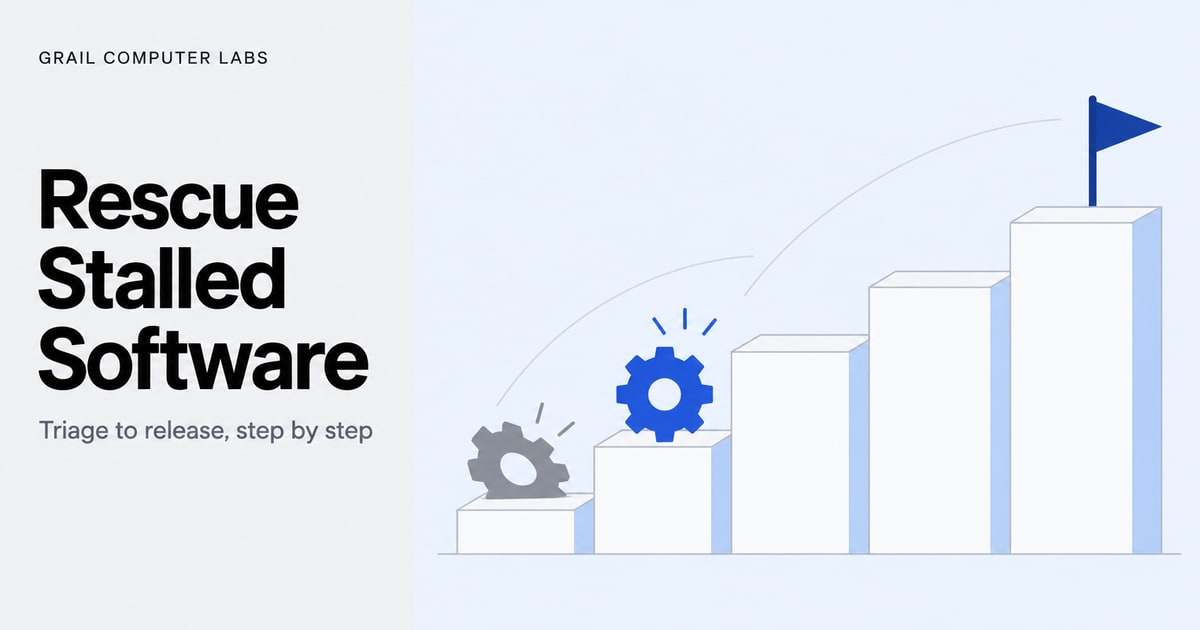
How software development project rescue works: triage, codebase inheritance, outcome agreement, stabilisation and release, anchored in a real 30-day case.
Enterprise AI guardrails explained: instruction-based vs architecture-based controls, plus a go-live checklist for data access, action scope and fallback.
A legacy system is software that is hard to change safely. See the warning signs, the improve-or-rebuild test and a phased migration plan for real platforms.
Request a quote and our experts will contact you within 24 hours with tailored solutions and pricing.
You can also send us a quick email at [email protected].
Software project and application rescue is the work of taking over a stalled application from an underperforming vendor, stabilising it and getting it into production, ideally with the same team then continuing delivery. In March 2025, Australia's DTA reported that a third of Australian Government digital projects, worth $3.5 billion, were not on track (The Canberra Times, 2025). The pattern is familiar to any CTO or founder. An application has no release date, and the vendor keeps explaining. A second failed partner looms on the sponsor's watch. This post compares the four real options and shows how a rescue runs stage by stage. It also sets out what to look for in a partner that does both rescue and ongoing delivery.
Key Takeaways
- Four options can rescue a stalled software project: an incumbent reset, a new vendor takeover, an in-house team, or a rescue-to-run partner.
- A software application rescue should move through gated stages: lock down assets, audit, decide, ship, hand over.
- An outcome engagement agrees one pre-defined outcome first, delivered in 4 to 8 weeks, before any longer commitment.
- Code, cloud, models and documentation should belong to the client at every stage of a rescue.
Software project and application rescue is the work of taking over a stalled software project and getting it into production. Four kinds of partner can do it: the incumbent vendor, a new vendor, an in-house team, or a rescue-to-run partner that also keeps delivering. Only 30% of companies fully meet timeline, budget and scope expectations in large tech programmes (BCG Platinion, 2025).

Stalls are common, not exceptional. In the same BCG-based analysis, over half of large programmes experience delays. Software rescue is the work of taking over a stalled or underperforming software project, stabilising it and getting it into production.
| Option | Who carries delivery after the fix | Main risk | Fits when |
|---|---|---|---|
| Incumbent reset | Same vendor | Repeat of the missed dates | Delay came from a clear, fixable cause |
| New vendor takeover | New vendor, then possibly another | Second handover | Capacity is needed now and insourcing is planned later |
| Insource | The company's own engineers | Slow hiring, key-person risk | Senior engineers with spare capacity already exist |
| Rescue-to-run partner | Same team that rescued it | Dependence on one partner | One accountable team is wanted, with code ownership retained |
A software application rescue engagement runs in stages: lock down code, cloud and credentials, run an independent audit, decide to rescue, rebuild or stop, ship a first working release, then hand over to a run-state team. Each stage ends with a decision gate, so the sponsor can stop when the evidence says to.

The point of the gates is control. Australia's DTA reports that 88.3% of its Tier 1 and Tier 2 digital projects carry independent delivery confidence ratings (DTA, 2026). A delivery confidence rating is an independent judgement of how likely a project is to deliver on time and on scope. Private teams can borrow the idea: ask for a plain status after every gate, not only at the end.
| Stage | Deliverable | Gate question |
|---|---|---|
| Asset lockdown | Access to code, cloud, credentials | Can anyone block the client from its own system? |
| Independent audit | Written findings on the codebase | Is the code worth keeping? |
| Rescue, rebuild or stop | A priced decision | Does the cost fit the value at stake? |
| First working release | Software in production | Does it run for real users? |
| Handover to run state | Named owners and a delivery cadence | Who ships the next change? |
Grail Computer Labs is an applied-AI and digital product research lab that handles both software rescue and ongoing delivery for stalled projects through two linked engagements. An outcome engagement delivers one pre-defined outcome in 4 to 8 weeks. Continuous delivery then keeps the same team shipping across the whole codebase, so a CTO or founder avoids a second vendor search.

An outcome engagement is one measurable, verifiable outcome agreed before work starts, such as a rebuilt platform or a platform ready to go to market. At Grail Computer Labs it begins after a call under NDA, with a 15-day trial and no payment commitment. Continuous delivery is what follows: features, new builds, changed requirements, monitoring and site reliability engineering, the way an in-house tech team works. Deloitte found adoption of outcome-based arrangements rose from 45% to 67% in two years (Deloitte, 2025). That points to buyers moving away from paying for hours.
Delivery runs through Grail Computer Labs' Software Factory, a loop of Triage → Specify → Implement → Review → Verify → Release. Agents execute. Our engineers make the decisions. Customers see progress.
Our data: An Australian healthcare platform was stuck in development for 8 months. After we took over from the previous vendor and inherited 1.5 million lines of code, the platform was live in production within 30 days. By day 40, 100 business customers had been onboarded, and 500 bug and feature tickets were handled across a 10-day period.
| Engagement | Starting point | Outcome |
|---|---|---|
| Australian healthcare platform | Stuck in development for 8 months | Live in production within 30 days |
| Telehealth software company | Months with a previous vendor without completing the clinical workflow | Clinical workflow completed after the vendor switch |
| Singapore-based neobank | Transaction checks to automate | 8 transaction checks live in under 30 days |
The improve-or-rebuild decision is a test of whether existing code can support reliable releases. If it can, the team keeps it and fixes it in phases. If every small fix breaks something else, the audit should price a rebuild alongside the repair. The decision belongs after an independent audit, not before it.

The improve-or-rebuild decision keeps what can support reliable releases and migrates the rest in controlled stages. This matters when downtime is unaffordable. In the Australian healthcare platform case, we used a phased approach, because a big-bang migration feels very risky to teams whose daily operations depend on the platform.
Complexity raises the stakes. PMI's 2026 research found that 31% of complex projects miss their full intended benefits, and that projects using a framework succeeded more often (72% against 61%) (PMI, 2026). A written decision framework gives a sponsor something concrete to approve.
In the first 30 days of a vendor switch, a team should secure code repositories, cloud accounts and credentials before telling the vendor, then commission an independent assessment, check contract and IP ownership, and make the rescue, rebuild or stop call. Doing these in order protects the ability to leave without losing the production environment.
Structure matters here. PMI's 2026 Pulse of the Profession found that 35% of professionals used no framework on their latest complex project (PMI, 2026). A switch without a sequence repeats that gap. A workable checklist:
If the incumbent holds the production environment, that needs resolving before any announcement. Regulated platforms need extra care: data residency, audit trails and compliance continuity should be confirmed before access changes hands.
A rescue-to-run partner does not suit every stalled project. It is built for software and AI projects that matter to the business but could not move, not for exploratory pilots. Its limits are specific: no published rescue success rate exists, and Grail Computer Labs holds no SOC 2, ISO 27001 or HIPAA certification.
Four caveats apply before any commitment:
A rescue-to-run partner such as Grail Computer Labs can both rescue a stalled project and run ongoing delivery afterwards. It delivers one pre-defined outcome in 4 to 8 weeks, then moves to continuous delivery, where the same team keeps shipping across the whole codebase as work comes in. Team continuity, release ownership and code ownership should be confirmed in writing.
A software application rescue through an outcome engagement delivers one pre-defined outcome in 4 to 8 weeks. Grail Computer Labs' Australian healthcare platform went live in production within 30 days after 8 months stuck in development. Timelines depend on the codebase, access to environments and how quickly the rescue, rebuild or stop decision is made.
A new vendor, an in-house team or a rescue-to-run partner can take over a software project that a vendor has stalled. The right choice depends on whether the project needs only a fix or also ongoing delivery afterwards. Whoever is chosen, the code, cloud accounts and credentials should be secured first, followed by an independent assessment.
Code ownership after a software rescue should sit with the client, and the contract should say so before signing. At Grail Computer Labs the client owns the code, cloud, models and documentation, with no lock-in. Any rescue partner should offer the same terms in writing, plus a handover checklist for a clean exit.
A stalled application is a decision problem before it is an engineering problem. Five points carry the argument:
We agree the outcome first, deliver it in 4 to 8 weeks, then keep shipping. For a platform everyone is tired of explaining, the shortest route is a conversation under NDA: Book a call ↗
© 2026 Grail Computer All rights reserved.