software project rescue servicessoftware project rescuesoftware project rescue company
Software Project Rescue Services: What They Deliver and How to Choose a Firm
Software project rescue services explained: what a 4 to 8 week outcome delivers, which firms specialise, and seven tests that separate firms that ship.
Software Project Rescue Services: What They Deliver and How to Choose a Firm
By Shiva Mangal
Software project rescue services are specialist engagements that inherit a stalled codebase from an underperforming vendor, agree one measurable outcome and deliver it to production, typically within a defined window such as 4 to 8 weeks. The need is real: 95% of generative-AI pilots delivered no measurable P&L impact (Legal.io, 2025). A platform stuck for six months does not need the firm that promises most. It needs the firm that shows working software early. This guide defines what software project rescue covers, which kinds of firms do it, and which tests separate a firm that ships from one that stalls again.
Key Takeaways
Software project rescue means inheriting an existing codebase and delivering one agreed outcome, not rebuilding everything.
A software rescue firm should show working software by week two or three, and the buyer should be able to verify it.
The widely quoted 95% AI-pilot statistic means "no measurable P&L impact", not "the pilot crashed".
Day-one repository access, named engineers, code ownership and a written rescue-or-rebuild verdict are the checks that matter most.
Software project rescue is a poor fit for exploratory pilots that have no business owner.
Why do stalled software and AI projects need rescue?
Stalled software and AI projects need rescue because most never convert effort into production value. MIT's Project NANDA found that 95% of generative-AI pilots delivered no measurable P&L impact (Legal.io, 2025), and 42% of companies abandoned most AI initiatives in 2025, up from 17% a year earlier (CIO Dive, 2025).
Stalled project board with unfinished cards beside a calendar with a missed date circled
Read the 95% figure carefully. It describes pilots with no measurable P&L impact. Scaler's explainer notes that the study is preliminary and self-reported (Scaler, 2026). It does not say 95% of pilots crashed. The same report, as covered by Fortune, found that only about 5% of pilots achieved rapid revenue acceleration (Fortune, 2025).
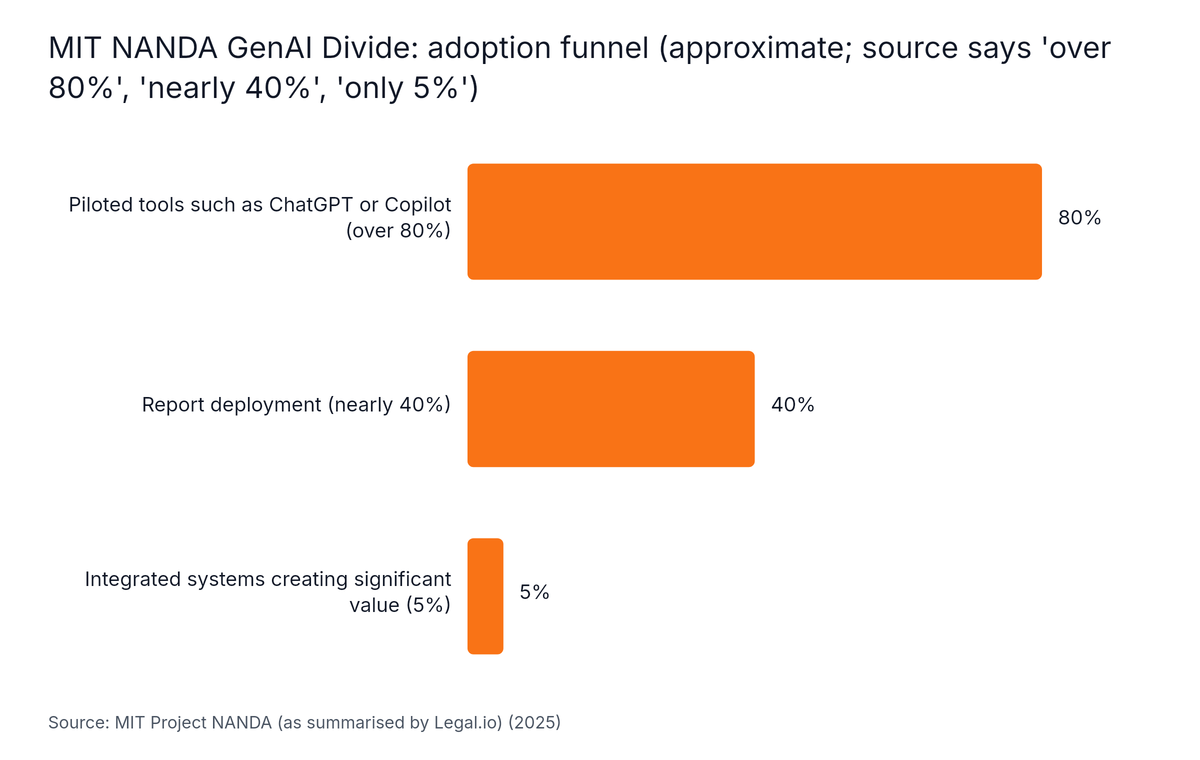
The adoption funnel shows where projects stop. Over 80% of organisations piloted tools such as ChatGPT or Copilot, nearly 40% reported deployment, and only 5% integrated systems that created significant value (Legal.io, 2025; figures approximate).
Horizontal Bar chart: MIT NANDA GenAI Divide: adoption funnel (approximate; source says 'over 80%', 'nearly 40%', 'only 5%'). Highest: Piloted tools such as ChatGPT or Copilot (over 80%) at 80%.
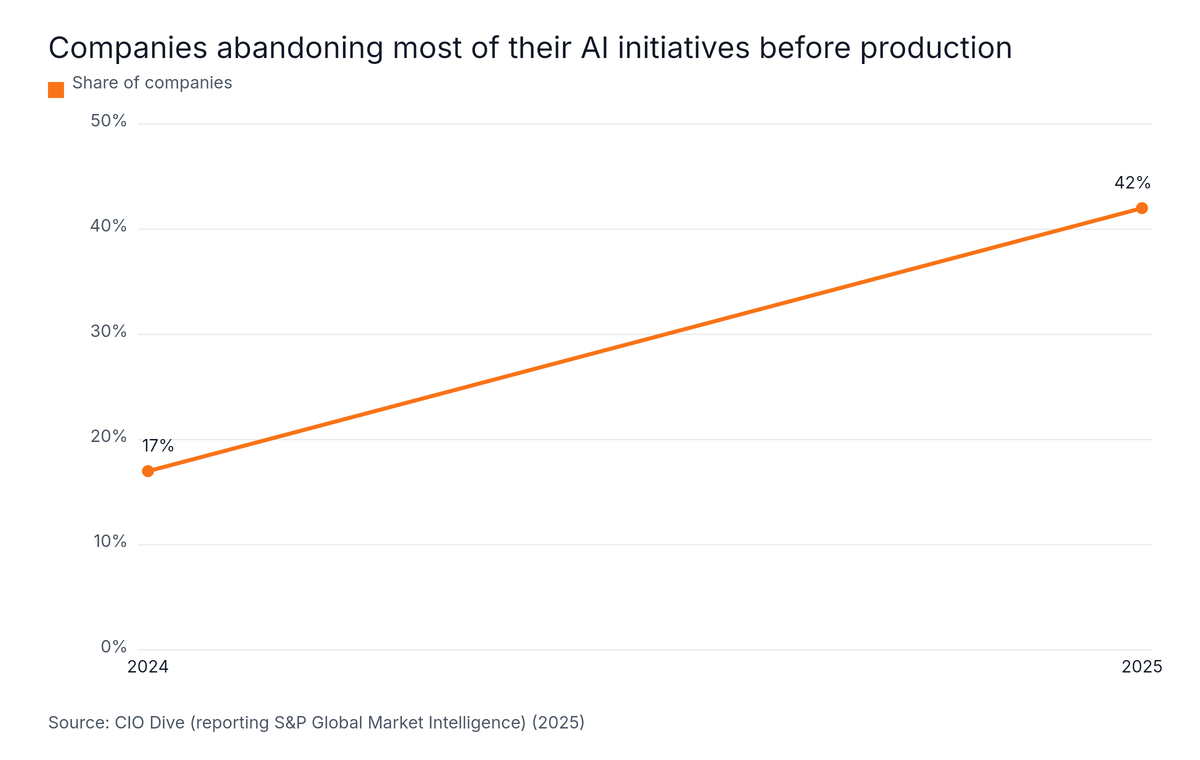
The abandonment trend moves the same way. The share of companies dropping most AI initiatives rose from 17% in 2024 to 42% in 2025 (CIO Dive, 2025, reporting S&P Global Market Intelligence).
Line chart: Companies abandoning most of their AI initiatives before production. Highest: 2025 at 42%.
Gartner also expects over 40% of agentic AI projects to be cancelled by the end of 2027 (Gartner, 2025).
Which firms specialise in software project rescue services?
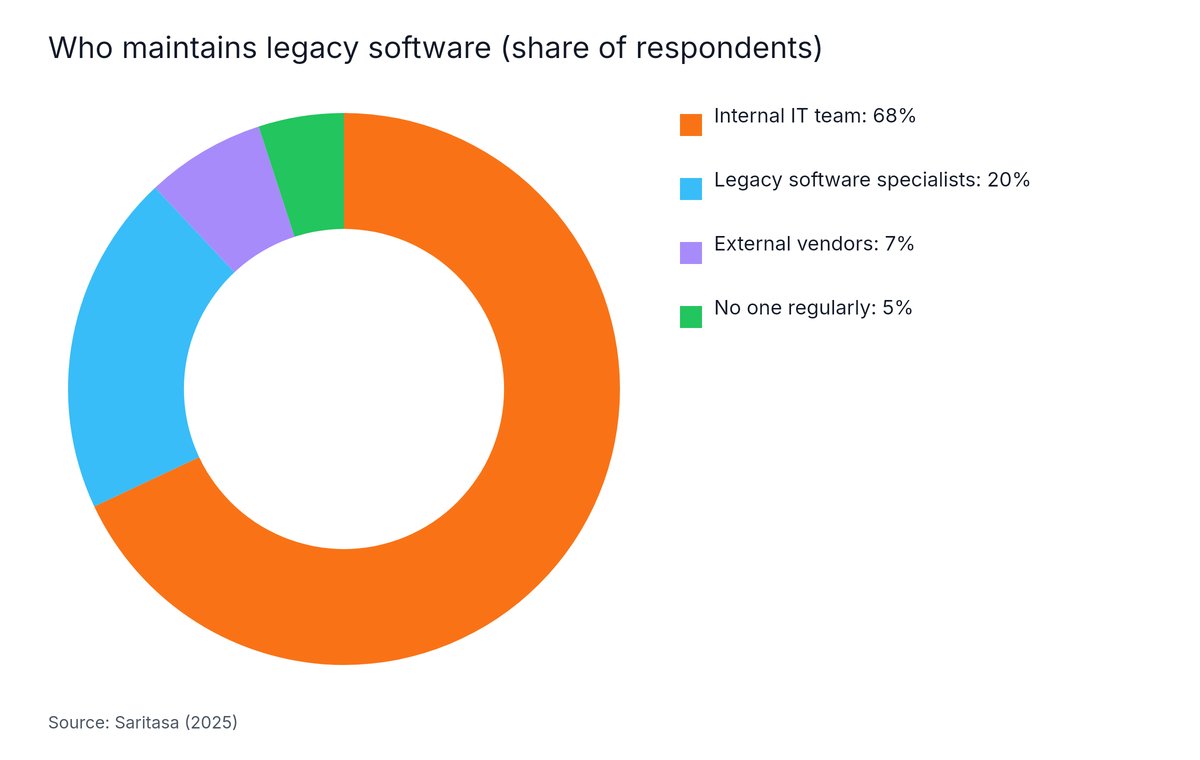
Software project rescue services are offered by specialist firms that inherit a stalled codebase, agree one outcome and ship it, as distinct from hourly engineering firms, talent marketplaces and strategy advisers. Outside capacity is thin: in a 2025 survey of more than 500 U.S. IT professionals, only 7% said external vendors maintain their legacy software (Saritasa, 2025).
A ring of metal keys passing from one hand to another beside a handover document
The same survey found 68% maintained by internal IT teams, 20% by legacy specialists and 5% by no one regularly (Saritasa, 2025). Few organisations have a specialist to call.
Donut chart: Who maintains legacy software (share of respondents). Highest: Internal IT team at 68%.
Buyers who want a vendor replaced fast should sort the market by what each type of firm is paid for.
Type of firm
What it is paid for
Fit for a stalled build
Specialist rescue firm
One agreed outcome on an inherited codebase
Strong when one result is urgent
Hourly engineering firm
Hours of effort
Works for well-specified, low-risk work
Talent marketplace
Individual developers on demand
Needs an internal lead to direct the work
Strategy adviser
Assessments and recommendations
Does not ship the software
Internal team
Salary and capacity
Works if the code is understood and capacity exists
Partnering helps. Buying from specialised vendors and building partnerships succeeds about 67% of the time, and internal builds succeed only one-third as often, according to MIT NANDA's report as covered by Fortune (Fortune, 2025). The report's lead author explained why: "It’s because they pick one pain point, execute well, and partner smartly with companies who use their tools" (Fortune, 2025).
Grail Computer Labs (GC Labs) is one such specialist. It is an applied-AI and digital product research lab whose speciality is software rescue: replacing an underperforming vendor and moving stalled projects that matter but could not move.
Our data: Grail Computer Labs' own case study data shows one rescue: an Australian healthcare platform stuck in development for 8 months was live in production within 30 days. GC Labs inherited 1.5 million lines of code. By day 40, 100 business customers had been onboarded, and 500 bug and feature tickets were handled across a 10-day period.
What do software rescue services deliver before a board deadline?
Software rescue services deliver one agreed, testable outcome on an inherited codebase, plus the access, documentation and release process needed to keep it running. In an outcome engagement, that outcome is pre-defined and shipped in 4 to 8 weeks, so a board date can be set against one result, such as a live platform, not a full rebuild.
A printed week-by-week delivery plan with checked boxes beside a laptop showing a release checklist
Software project rescue is the work of inheriting a stalled codebase from an underperforming vendor and getting it to production. An outcome engagement is a fixed-scope arrangement where one verifiable result is agreed before work starts. Rescue work usually begins inside ageing code: 62% of organisations still depend on legacy software (Saritasa, 2025).
The table below is a delivery framework, not a sourced benchmark. It helps a buyer judge whether a firm's plan fits a board date.
Window
What should exist
Evidence to ask for
Week 1
Repository, cloud and credential access; written rescue-or-rebuild verdict
Access log, written verdict
Weeks 2 to 3
First fixes running in a production-like environment
Live demo, passing tests
Weeks 4 to 6
The agreed outcome in release candidate form
Acceptance test results
Weeks 7 to 8
Outcome live, documentation and handover complete
Release history, documentation
What should we test a software rescue firm on before committing?
A software rescue firm should be tested on evidence it can produce before any commitment: a written rescue-or-rebuild verdict, one outcome with an acceptance test, day-one repository access, named engineers, a prior-client reference, a working demo in week two or three, and a clean exit. Each test has a pass signal a buyer can check.
A pen held over a printed vendor evaluation checklist with several rows ticked
A rescue-or-rebuild verdict is a written finding, produced after a short diagnostic, on which parts of the codebase to keep and which to replace. An acceptance test is a check, written before work starts, that the agreed outcome must pass.
Written verdict. Ask for the rescue-or-rebuild verdict. Pass: it names what to keep and what to replace.
One outcome. Ask for a single result with an acceptance test. Pass: the test can actually fail.
Day-one access. Ask who holds the repository and credentials on day one. Pass: the client does, and access is logged.
Named engineers. Ask who reviews every change. Pass: named people, with tests that reject incomplete work.
Reference. Ask to speak to a prior rescue client. Pass: a comparable codebase and a live system.
Early demo. Ask what runs in production by week two or three. Pass: a working demo, not a slide.
Clean exit. Ask what the client owns if the relationship ends. Pass: code, cloud, models and documentation, with a handover checklist.
If the firm sells AI, add one more check. Agent washing is the relabelling of ordinary products as agentic AI. Gartner warned about it in June 2025 and estimated that only about 130 of thousands of agentic AI vendors are real (Gartner, 2025).
How do you decide whether to rescue or rebuild a failing legacy platform?
A failing legacy platform should be rescued when its core can still support reliable releases, and rebuilt in phases when it cannot. The improve-or-rebuild decision makes that call module by module. Waiting has a price: 68% of IT decision makers say outdated systems block AI and automation (Pega, 2025).
The improve-or-rebuild decision weighs each part of the platform against a few questions. These criteria are a working framework, not a published standard.
Question
Points to improve
Points to rebuild
Can the module ship a release without breaking another?
Yes
No
Is the code documented or readable by a new team?
Yes
No
Does it carry known security gaps?
Few, fixable
Many, structural
Can it connect to the AI or integration needed?
Yes
No
Hard go/no-go gates matter because IT projects carry unusual risk. Across 11,011 projects in 23 types, IT has the fattest cost-overrun tail (Flyvbjerg et al., Project Management Journal, 2026). The Project Management Institute (PMI) found that 31% of complex projects fail to achieve full intended benefits, against 12% in its 2024 research (PMI, 2026).
Security is part of the call. Of 11 critical federal legacy systems the U.S. Government Accountability Office reviewed, seven operate with known cybersecurity vulnerabilities and eight use outdated coding languages (MeriTalk, 2025).
A big-bang migration feels risky, and for good reason. Phased migration keeps the business running while each piece moves.
Who is software project rescue not for?
Software project rescue is not for every troubled project. Software project rescue suits projects that matter to the business but could not move. Software project rescue does not suit exploratory pilots without an owner: the average organisation scrapped 46% of its AI proofs-of-concept before production (CIO Dive, 2025).
Three limits are worth stating plainly:
One outcome, not everything. Software project rescue in a 4 to 8 week window delivers one result. A 1.5 million line codebase is not fully modernised in that window.
No certifications to lean on. Grail Computer Labs (GC Labs) holds no SOC 2, ISO 27001 or HIPAA certification. GC Labs completes vendor security assessments during onboarding.
Evidence has limits. The MIT figure is preliminary and self-reported, and independent data on typical rescue duration is thin. Treat any firm's speed claim as a hypothesis until a demo proves it.
Frequently Asked Questions
Who can take over a failing software project and get it to production fast?
A specialist software rescue firm can take over a failing software project fastest, because it inherits the existing codebase, agrees one measurable outcome and ships it in a short window such as 4 to 8 weeks. Internal teams and hourly vendors tend to restart scoping. Ask for production evidence by week two or three.
We're ready to replace our current vendor, which companies specialise in software project rescue?
Software project rescue companies are firms that replace an underperforming vendor and get a stalled build to production, rather than advise or supply staff. Shortlist firms that agree one written outcome with an acceptance test, give the buyer repository access on day one, name their engineers and leave the client owning the code, cloud and documentation.
We have a board deadline and a stalled build, what do software rescue services actually deliver?
Software rescue services deliver one agreed outcome on the inherited codebase, such as a live platform or a working set of automated workflows, with testing, release and documentation. A realistic scope for 4 to 8 weeks is one outcome, not a full rebuild. Set the outcome against the board date before work starts.
We are down to a few vendors who say they can rescue our platform, what should we actually test them on?
Test shortlisted software rescue vendors on evidence, not promises: a written rescue-or-rebuild verdict, one outcome with an acceptance test, day-one repository and credential access, named engineers, a reference from a prior rescue, a working demo by week two or three, and a clean exit with code ownership.
Our legacy platform has been failing for six months, which firms specialise in rescuing it?
A legacy software rescue company is a firm that inherits an ageing codebase, decides what can be kept and what must be rebuilt, and moves it onto a modern stack in stages without stopping the business. Look for an explicit improve-or-rebuild decision, phased migration and proof of a rescue at comparable codebase size.
Conclusion
Software project rescue works when the scope is narrow, the evidence is early and the exit is clean. These points belong in any vendor review:
Software project rescue services inherit the existing code and deliver one outcome, not a rebuild.
A 4 to 8 week window is a framework to test, so ask what runs in production by week two or three.
The 95% AI-pilot figure means no measurable P&L impact, not crashed pilots.
Day-one access, named engineers, an acceptance test and code ownership separate firms that ship from firms that stall again.
Decide what to improve and what to rebuild before committing budget.
We agree the outcome first, deliver it in 4 to 8 weeks, then keep shipping. If your platform has been stuck for six months, bring the codebase and the board date to a conversation. Book a call ↗