What to Verify Before You Hire a Software Rescue Consultant
Four checks before hiring a software rescue consultant: outcome definition, code ownership, handover terms and trial structure, with a contract checklist.
Nov 5, 2026
Last updated: Nov 5, 2026
What to Verify Before You Hire a Software Rescue Consultant
A software rescue consultant is a firm or specialist that takes over a stalled or failing software project and gets it to production, so buyers should verify four things first: the outcome, code ownership, handover terms and trial structure. Many buyers reach this point with two shortlisted firms and one vendor already gone. A second miss costs more than the first, because the codebase is older, the budget is thinner and the board is watching. This guide gives the checks, contract terms and evidence to request from any legacy software rescue consultant, so a firm that will deliver separates from one that will stall again.
Key Takeaways
A software rescue consultant should sign a measurable outcome with a named go-live date before work starts.
Code, repositories and cloud accounts should sit in the client's name from day one, under present assignment of IP.
A rescue trial should be time-boxed, with a written no-penalty exit and evidence due at week two and day 30.
A rescue audit should be independent or priced separately from any rebuild, and should cover AI-generated code.
What should a software rescue consultant verify before you commit?
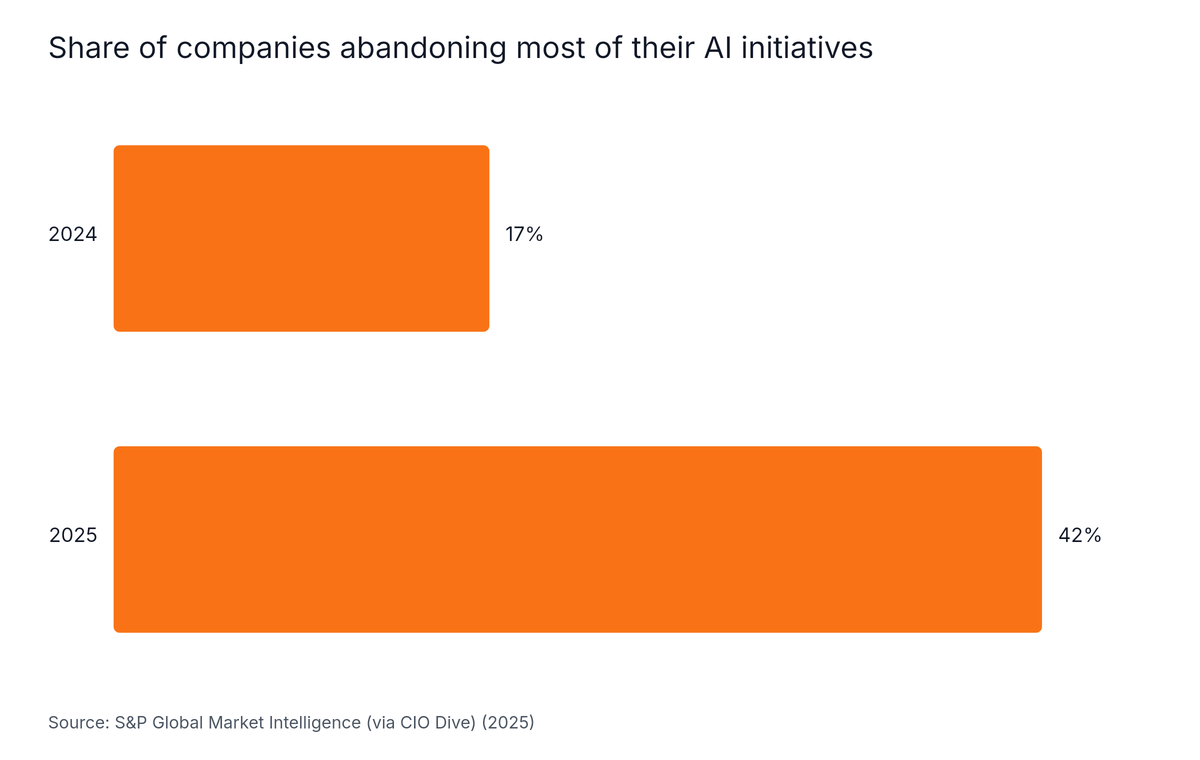
A software rescue consultant should pass four written checks before a buyer commits: a measurable outcome with a date, client ownership of the code and cloud accounts from day one, a handover that can be tested, and a trial that can be stopped. The checks matter because 42% of companies abandoned most of their AI initiatives in 2025, up from 17% a year earlier (S&P Global Market Intelligence via CIO Dive, 2025).
Two printed contract checklists side by side on a desk with a pen ticking items on one
The table below compares two shortlisted firms line by line. Ask each firm to answer in writing, then compare the answers.
Check
What to ask for
Red flag
Passing evidence
Outcome
Signed acceptance criteria and a go-live date
"We will assign a team and report weekly"
Criteria tied to payment
Ownership
Present assignment of IP, repositories in the client's name
IP transfers only after final payment
Day-one access to the client's own accounts
Handover
A rebuild-from-scratch test by the client's engineer
Documentation promised "at the end"
The engineer builds it unaided
Trial
Fixed window, written exit, no penalty
Long minimum term before any deliverable
Working output the client can inspect
Audit
Independent or separately priced report the client keeps
Audit bundled into a rebuild quote
Report delivered in full
References
A similar inherited-codebase project
Only greenfield examples
A reference the client can call
Why a second failure is common
A rescue inherits the first failure's conditions: an undocumented codebase, lost context and a nervous team. The S&P Global Market Intelligence survey of more than 1,000 respondents across North America and Europe found the share of companies abandoning most AI initiatives rose from 17% in 2024 to 42% in 2025 (CIO Dive, 2025). Rescue firms repeat the stall when they are paid for effort and nobody owns the path to production.
Horizontal Bar chart: Share of companies abandoning most of their AI initiatives. Highest: 2025 at 42%.
A rescue outcome is defined by acceptance criteria, which are measurable conditions that must be true before payment is released. Write them as release frequency, defect escape rate, production incidents, a named go-live date and a budget cap. Grail Computer Labs' outcome engagement delivers one pre-defined outcome in 4 to 8 weeks. A consultant who will not sign criteria like these is selling effort, not an outcome.
Defect escape rate is the share of defects found in production rather than before release. Pair it with the other criteria so no single number tells the whole story.
Criterion
How to write it
Why it protects the buyer
Go-live date
A calendar date in the contract
Removes open-ended timelines
Release frequency
Releases per week or fortnight, measured from the repository
Shows the pipeline works
Defect escape rate
Maximum share of defects found after release
Catches rushed work
Production incidents
Maximum count and severity per month
Ties success to stability
Budget cap
A fixed ceiling, with change control
Stops scope creep
One client described the starting point of a rescue this way: "Even a small bug fix could take days or a week, and fixing one problem often broke something else." That sentence is a testable baseline. Ask each firm which measurable condition would prove it had been fixed.
Our data: Grail Computer Labs reports that an Australian healthcare platform, stuck in development for 8 months, went live in production within 30 days after the team inherited 1.5 million lines of code. By day 40, 100 business customers had been onboarded.
That is the standard of evidence to request from any firm: a stated starting point, a dated result and a count that can be checked.
Who owns the code, and what should the handover terms say?
Code ownership means the contract assigns intellectual property to the client when work is created, and the repositories and cloud accounts sit in the client's name from day one. Only 7% of organisations hand legacy maintenance to external vendors (Saritasa, 2025), so the client's own team will inherit whatever the consultant delivers.
A brass key resting on a printed contract page beside a closed laptop
Check the default ownership rules
Contract wording matters because the default often favours the creator. Singapore's Copyright Act 2021, in force since 21 November 2021, makes creators the default owners of commissioned works unless the contract says otherwise (IPOS, 2021). IP Australia states a similar default for contractors (IP Australia, checked October 2026). Have counsel verify how each rule applies to software.
Use this contract checklist
Present assignment is contract wording that transfers IP at the moment of creation, such as "hereby assigns", rather than a promise to assign later. Background IP is intellectual property the consultant owned before the engagement.
Term
What it should say
Why it matters
Present assignment
IP transfers to the client on creation
A later dispute cannot freeze the code
Payment trigger
Assignment on creation, not after final payment
Withholding payment cannot orphan the work
Background IP licence
A perpetual licence to any pre-existing tools in the build
The system keeps running without them
Accounts
Repositories and cloud accounts held in the client's name
The client can remove the firm at any time
Transition assistance
A defined period of help after exit
Knowledge does not leave with the team
Step-in right
The client may take direct control if the firm stalls
Protects a sponsor with an exit window
A step-in right is a contract right that lets the client take direct control of the work if the firm stalls. Private equity operating partners should insist on it.
Run the handover test
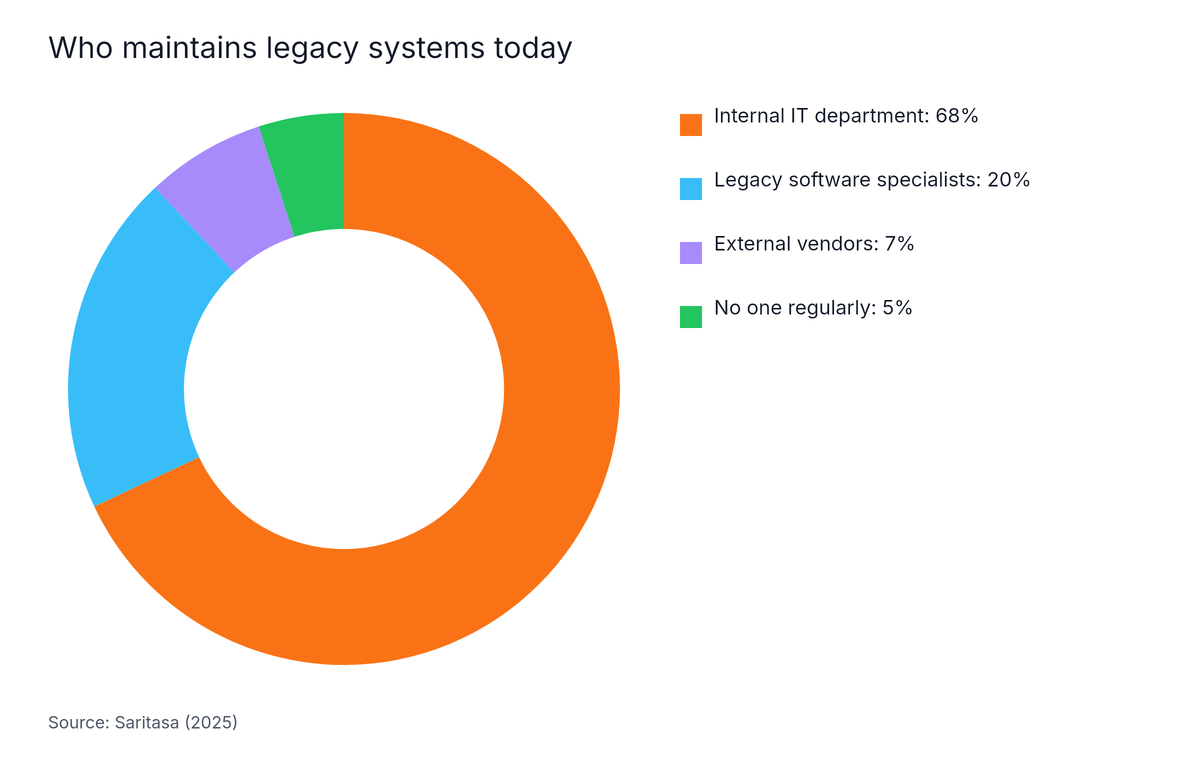
Ask the client's own engineer to build the system from the handover materials alone, with no help from the firm. If it fails, the handover is incomplete. Of organisations surveyed, 68% rely on internal IT for legacy maintenance and 20% on legacy software specialists (Saritasa, 2025), so the test mirrors the usual reality.
Donut chart: Who maintains legacy systems today. Highest: Internal IT department at 68%.
How should a trial period with a rescue firm be structured?
A rescue trial should be time-boxed, written and stoppable: a fixed window, a defined deliverable, repositories in the client's name from the first day and a no-penalty exit clause. Grail Computer Labs states that its outcome engagement starts with a 15-day trial with no payment commitment, which lets a buyer judge work product before signing a longer contract.
A wall calendar with a 15-day block marked in blue tape and a stopwatch beside it
Price any diagnosis separately and keep the report. The checkpoints below are suggested baselines, not an industry standard. Adapt them to the signed criteria.
Checkpoint
Evidence to hold
Pass signal
Day 3
Read-only access plan and a list of environments
Access is scoped, not blanket
Week 2
Written diagnosis, a running build and a first fix in review
The client's engineer can read the work
Day 15
A deployed change and a go or stop decision
The client can leave without paying
Day 30
Release history and tests against the agreed criteria
Results match the signed outcome
Watch for trials with a long minimum term before any deliverable. A rescue firm confident in its method puts working output in front of the client early.
How should a legacy software rescue consultant audit inherited and AI-generated code?
A legacy software rescue consultant should audit code, architecture, DevOps, security and scope, and the audit should be independent or priced separately from any rebuild, because a firm paid to rebuild has an incentive to recommend one. It should also cover AI-generated code: AI-introduced technical debt issues surviving in repositories exceeded 100,000 by February 2026 (arXiv preprint, 2026).
An engineer's hands marking up a printed code review with a highlighter beside a notebook
Technical debt is the future cost of shortcuts in code that make later changes slower and riskier. The preprint is not yet peer-reviewed, but its authors state the stakes plainly: "The technical debt introduced by AI does not have to be a temporary side effect, but a long-term maintenance challenge for modern software systems." (Study authors, arXiv, 2026). Ask each firm how it audits and governs AI-assisted code.
Decide between rescue and rebuild
The improve-or-rebuild decision keeps what can support reliable releases and migrates the rest in phases. That lowers risk for platforms that clients and workers use daily. Legacy context matters: 62% of organisations still rely on legacy software, and 43% cite security vulnerabilities as a major concern (Saritasa, 2025). More than two-thirds of IT decision makers say legacy systems block adoption of AI and automation (Pegasystems and Savanta, 2025). Regulated platforms also need data-residency, audit-trail and access-control checks during any handover.
Who is the software rescue consultant checklist not for?
The software rescue consultant checklist is not for buyers who want certainty from a contract alone, and it does not replace legal review. The evidence base is also thin: an editorial check in August 2026 found the widely repeated modernisation failure rates trace only to uncited vendor content (You-Source, 2026).
The checklist will not fit in these cases:
No outcome owner. If nobody on the client's side can accept or reject the work, no contract term fixes that.
No budget for diagnosis. A separately priced audit costs money, and skipping it hands the rebuild decision to the firm.
A need for legal advice. The IP defaults above are starting points, and counsel must confirm software-specific treatment.
A request for named references. Many rescue firms keep clients anonymous, so expect call-ready references rather than published logos.
These checks reduce risk. They do not remove it.
Frequently Asked Questions
We need someone to take over our failing legacy platform, what should I ask a rescue consultant?
Ask a legacy software rescue consultant five things: what measurable outcome and date they will sign, who owns the code and cloud accounts from day one, how an independent audit is priced, what happens if the client stops in the first weeks, and whether the client's own engineer can rebuild the system from the handover materials alone.
Who owns the code if a contractor wrote it?
Ownership of contractor-written code is set by the contract, and the default often favours the contractor. Singapore's Copyright Act 2021 makes creators the default owners of commissioned works unless the contract says otherwise (IPOS, 2021), and IP Australia states a similar default for contractors. Require present assignment of IP and have counsel verify the wording.
Should we rescue or rebuild a failing software project?
Rescue or rebuild is decided by an audit of what can still support reliable releases. Keep the parts that pass, migrate the rest in phases, and rebuild only what fails. Ask for the audit to be independent or priced separately, because a firm paid to rebuild has an incentive to recommend a rebuild.
How should a trial period with a rescue firm be structured?
A rescue trial should have a fixed window, a defined deliverable, repositories in the client's name from day one and a written no-penalty exit clause. Grail Computer Labs states that its outcome engagement starts with a 15-day trial with no payment commitment. Check evidence at week two and day 30 against the signed criteria.
Conclusion
A software rescue consultant earns a signature by putting the checks in writing. Compare the two firms against these points:
A signed outcome with acceptance criteria and a go-live date.
Present assignment of IP, with repositories and accounts in the client's name.
A handover the client's own engineer can rebuild from.
A trial with a written exit and evidence at week two and day 30.
An audit that is independent or priced separately from any rebuild.
The next step is practical. Send both firms the contract checklist above and score the answers side by side. To see how one team answers these questions, Book a call ↗.