Software Rescue Help: Who Can Step In When a Build Stalls
By Shiva Mangal, Grail Computer Labs. Published 28 October 2026.
Software rescue help means bringing in a team that can take over a stalled build from a vendor that has left, recover access, audit the code and get one agreed outcome into production. Most founders and CTOs arrive here the same way: the launch date slipped, then slipped again, and the vendor stopped answering. One client described the earlier stage plainly: "Even a small bug fix could take days or a week, and fixing one problem often broke something else." (Grail Computer Labs client, 2026). This guide covers who can step in, what to do in the first 72 hours, what an audit finds, and how to choose between fixing and rebuilding.
Key Takeaways
Five groups can take over a stalled build: the original vendor's team, a boutique rescue firm, a systems integrator, a fractional CTO with contractors, or an in-house rebuild.
Software rescue starts with access: repositories, cloud accounts, domains and credentials must be secured in the first 72 hours, before any code is read.
Inherited codebases now often hold unreviewed AI-written code: a 2026 arXiv study found 24.2% of tracked AI-introduced issues still survived at the latest repository revision (arXiv, 2026).
Fix-or-rebuild calls should rest on audit evidence, with phased migration where live operations depend on the platform.
An Australian healthcare platform went from 8 months stuck in development to live in production within 30 days, according to Grail Computer Labs' case study.
Who can step in when a build has stalled and the vendor is gone?
Software rescue is the work of taking a stalled build back from a departed or underperforming vendor and getting it to production. Five groups can do it: the original vendor's team, a boutique rescue firm, a large systems integrator, a fractional CTO with contractors, or an in-house rebuild. BCG found more than two-thirds of large tech programmes are not expected to land on time, on budget and in scope (BCG, 2024).
A technical lead and a founder compare handwritten notes of rescue options at a glass wall in a bright office
The table compares the five options on the questions that decide most rescues. The ratings are editorial judgment, not measurements. They come from three factors (who controls access, how firm the deadline is, who owns the system afterwards) and from rescue experience at Grail Computer Labs, so test them against the platform in question.
Option
Best fit
Main risk
Speed to a first release
Original vendor's team (if reachable)
Code is clean and the problem was management, not engineering
The same delivery habits that caused the stall
Fast to start, unreliable to finish
Boutique software rescue firm
A platform that matters, with unclear code quality and a deadline
Needs full access and a clear outcome before work starts
Medium to fast, depending on audit findings
Large systems integrator
Big programmes with many workstreams and formal governance
Slow mobilisation and heavy process for one stalled build
Slow to medium
Fractional CTO with contractors
Technical leadership is missing and an in-house team will own the code
Depends on finding and holding good engineers
Medium, driven by hiring
In-house rebuild
Long-term product with stable funding and a clear specification
Resets the delivery date and loads work onto a team that must first be hired
Slowest
Boutique firms vary widely in quality. Ask for references, a written audit and a list of the access they need before work starts.
What the decision turns on
Three questions narrow the field quickly.
Does the business control the code and accounts? If not, nobody can start until that is fixed. The next section covers it.
Is there a date that cannot be missed? A funding round, a customer launch or a regulatory deadline favours teams that begin with an audit and one defined outcome.
Who will own the system afterwards? If in-house engineers will keep it, choose a partner that hands over documentation and does not retain the code.
A stalled build is a common failure, not a personal one. BCG's 2024 research found no improvement in large-scale tech programme delivery since its 2015 study (BCG, 2024).
What should be done in the first 72 hours after a vendor leaves?
In the first 72 hours after a vendor leaves, secure access before touching any code. Recover repositories, cloud accounts, domains and API keys, rotate shared credentials, and confirm in writing who owns the intellectual property (IP). Nobody can audit what they cannot open, and PMI found 31% of complex projects miss intended benefits (PMI via Business Wire, 2026).
An engineer ticks items on a printed access checklist next to a laptop showing a cloud account login page
We found no verified statistic on how often vendors abandon custom builds, so this sequence rests on rescue experience, not on a published rate. Each step unlocks the next.
Inventory every asset. List repositories, cloud accounts, domain registrars, app-store accounts, CI/CD pipelines (the automated build and deploy tooling), payment and email services, and third-party API keys. Note who is the account owner on each.
Take ownership of the accounts. Move each account to a business-owned email address and add at least two named admins from the business. Do this before any password changes, to avoid a lockout.
Rotate credentials.Credential rotation is replacing passwords, tokens and keys so that former contractors can no longer use them. Rotate database passwords, cloud keys and service tokens, and revoke former staff access.
Snapshot the system. Take a full copy of the repositories, databases and configuration. Store it somewhere the previous vendor cannot reach.
Check the paperwork. Read the contract for IP assignment, handover duties, notice terms and unpaid invoices. A lawyer should confirm who owns what before a new team builds on the code.
Keep the live system running. Do not redeploy anything yet. Record current uptime, open incidents and who depends on the platform.
If the previous vendor is uncooperative, the business's own accounts are the fastest route. Code often sits in a repository host or cloud console that the company registered, even when the vendor administered it.
What will a rescue team find in the inherited codebase?
An inherited codebase often contains AI-written code that nobody reviewed. A March 2026 arXiv study of 304,362 AI-authored commits across 6,275 GitHub repositories found that 24.2% of tracked AI-introduced issues still survive at the latest repository revision (arXiv, 2026). A rescue audit should therefore expect a meaningful share of unreviewed AI output.
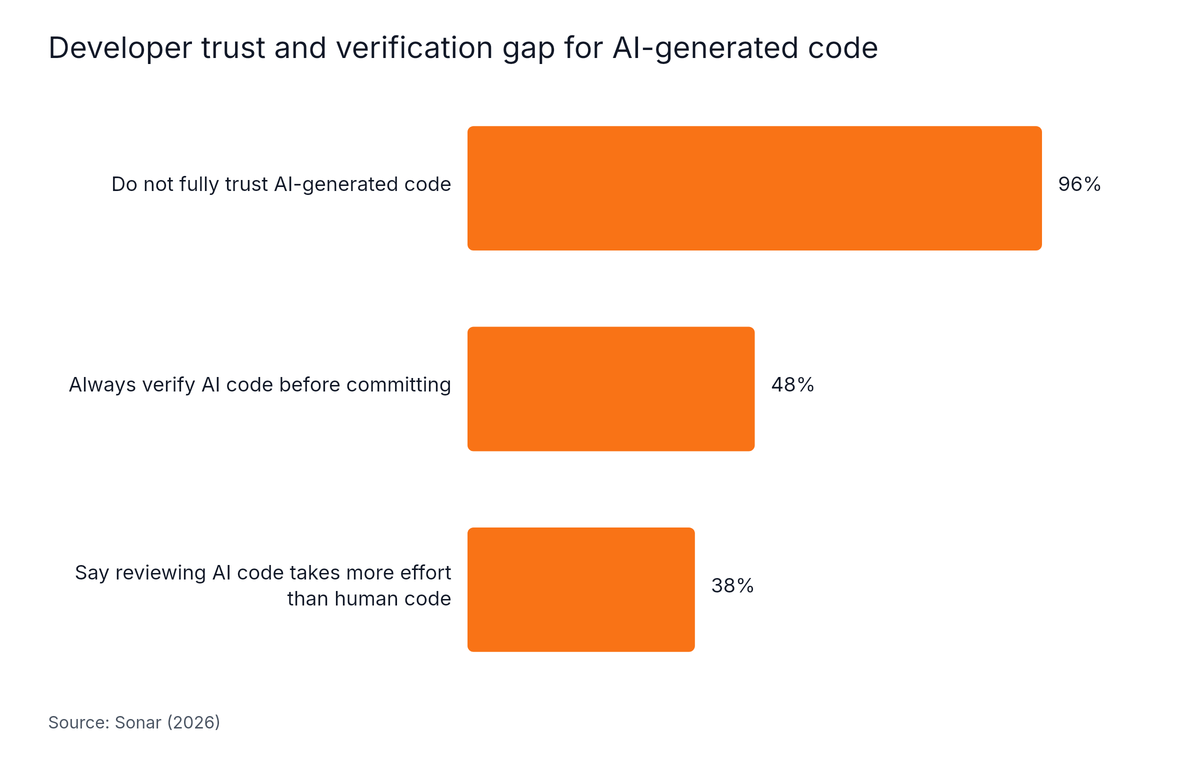
Horizontal Bar chart: Developer trust and verification gap for AI-generated code. Highest: Do not fully trust AI-generated code at 96%.
Sonar's 2026 State of Code survey of more than 1,100 developers found that 96% do not fully trust AI-generated code, yet only 48% always verify it before committing (Sonar, 2026). The same survey reports that 38% of developers say reviewing AI-generated code takes more effort than reviewing code from human colleagues (Sonar, 2026). Sonar sells code verification tools and the figures are self-reported, so they show direction, not measurement.
How much AI-written code is in the repository?
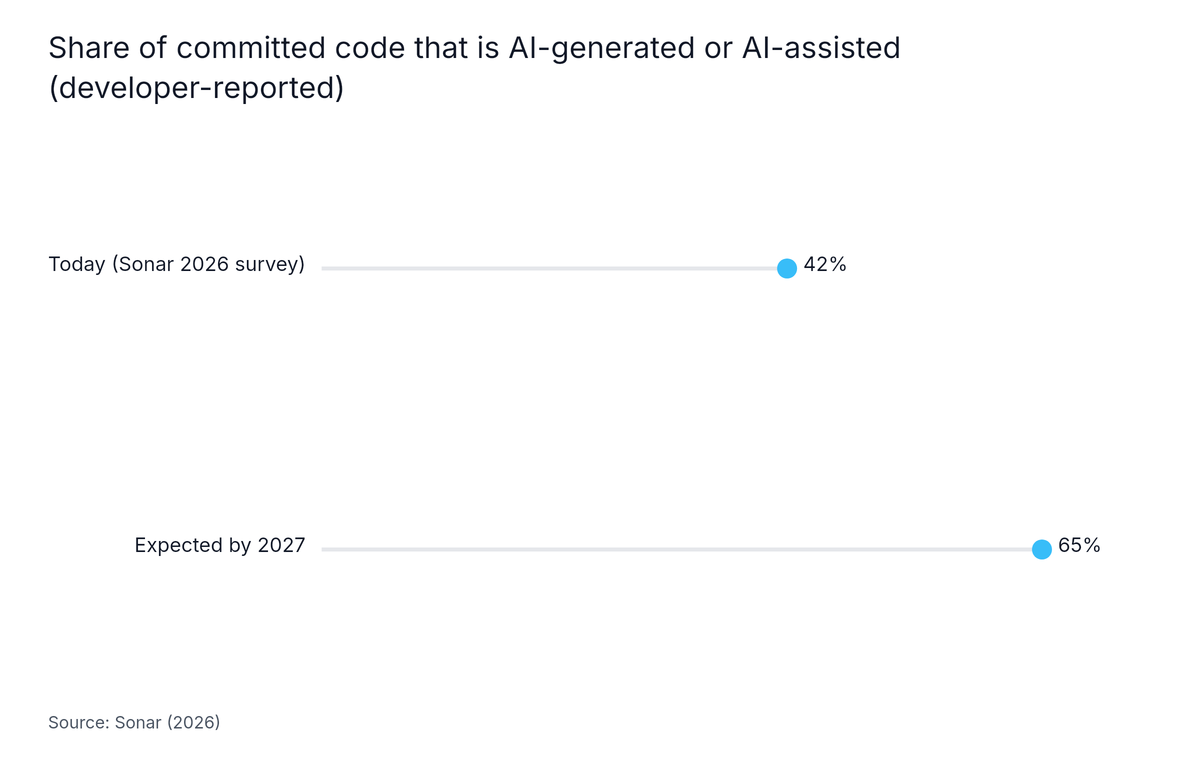
Developers in the Sonar survey said AI accounts for 42% of committed code today and expect 65% by 2027 (Sonar, 2026). Trade coverage of the same survey reports that 72% of developers who have tried AI coding tools use them every day or multiple times a day (The Register, 2026). A build that stalled in 2025 or 2026 probably includes some of this code.
Lollipop chart: Share of committed code that is AI-generated or AI-assisted (developer-reported). Highest: Expected by 2027 at 65%.
The arXiv study also tracked accumulation. Technical debt is the future cost of shortcuts and unreviewed code that make software harder to change. The researchers found the volume of unresolved AI-introduced debt climbed from a few hundred issues in early 2025 to over 110,000 surviving issues by February 2026 (arXiv, 2026). Their abstract states the concern directly: "AI-generated code can introduce long-term maintenance costs into real software projects" (Study authors, arXiv preprint, 2026).
Audit the repository before planning the fix
A useful audit produces a written report that any team can pick up. These checks cover the usual failure points, including the AI-specific ones.
Check
What to look for
Why it matters
Test coverage and CI
Do tests exist, run and fail when they should?
Without tests, every change risks breaking something else
Dependency age
Outdated libraries, unsupported frameworks, known vulnerabilities
Drives security risk and upgrade cost
Duplicated code
Near-identical blocks pasted across files
Common in AI-assisted code and multiplies bug fixes
Unreviewed merges
Commits with no pull-request review
Shows where nobody checked the logic
Hidden assumptions
Hard-coded values, undocumented business rules
These break at the first change in scale or data
Bus factor
Bus factor is the number of people whose departure would stop the project. Check who understands each module
A bus factor of one explains many stalled builds
Documentation and environments
Setup steps, architecture notes, staging and production parity
Decides how fast a new team can contribute
Should the team fix, refactor or rebuild the inherited code?
The improve-or-rebuild decision is the call on whether an inherited codebase can support reliable releases. Keep the parts that can, migrate the rest in phases, and rebuild only where the audit shows the code cannot be tested or changed safely. The audit evidence, not the previous vendor's reputation, should drive that call.
Two engineers review a printed architecture diagram spread on a table, marking sections to keep and sections to replace
Review effort matters here. If 38% of developers find AI-written code harder to review than human code (Sonar, 2026), a codebase full of it may cost more to verify than its line count suggests. The table sorts each module.
Signal in the audit
Points toward fixing
Points toward rebuilding
Tests
Exist and mostly pass
None, or tests that cannot run
Structure
Clear modules, readable boundaries
Tangled dependencies, changes break unrelated features
Dependencies
Supported versions, patchable
Abandoned frameworks, no upgrade path
Business rules
Documented or easily recovered
Hidden in code nobody understands
Live usage
Customers depend on it today
Not yet launched, or little usage
Rebuilding everything at once is the riskiest option for a platform people already use. One objection operators raise is "A big-bang migration feels very risky." That is why phased moves work better: keep what works, replace the weak modules in stages, and release at each stage. Write the decision down per module, with the evidence beside it, so the board or investors can see the reasoning.
What does a software rescue look like in practice?
A software rescue has four parts: recover access, audit the inherited code, agree one measurable outcome, and deliver it to production. Grail Computer Labs applied that sequence to an Australian healthcare platform stuck in development for 8 months, which went live in production within 30 days, with 100 business customers onboarded by day 40 (Grail Computer Labs case study, 2026).
Our data: In Grail Computer Labs' case study of an Australian healthcare platform run by a managed-service business, the platform was stuck in development for 8 months. GC Labs inherited 1.5 million lines of code and rebuilt it. The platform was live in production within 30 days, and 500 bug and feature tickets were handled across a 10-day period.
How the engagement is structured
An outcome engagement is a call under NDA followed by one measurable, verifiable outcome, delivered in 4 to 8 weeks. It starts with a 15-day trial with no payment commitment, so the client can stop within the first 15 days without paying. After the outcome is live, continuous delivery keeps the same team shipping across the whole codebase. We agree the outcome first, deliver it in 4 to 8 weeks, then keep shipping.
How the work runs
GC Labs' Software Factory is our AI software factory, configured around the client's codebase, release process and operating model. Its loop is Triage → Specify → Implement → Review → Verify → Release. Agents execute. GC Labs engineers make the decisions. Customers see progress. Engineers review every change and tests reject incomplete work, so AI speeds up delivery without replacing engineering judgement. The client keeps the code, cloud, models and documentation, which removes the lock-in that often contributed to the last failure.
A second case followed the same pattern. A telehealth software company had spent months with an underperforming vendor without completing its clinical workflow, and the workflow was delivered after the vendor switch.
Teams with a stalled platform can book a call with Grail Computer Labs to describe what is stuck and hear which outcome is realistic.
How long does software rescue take and what does it cost?
Software rescue timelines and costs depend on code quality, access, scope and deadline, and no verified public benchmark sets a standard figure. BCG found no improvement in large-scale tech programme delivery since 2015 (BCG, 2024), so early quotes deserve caution. Grail Computer Labs prices its outcome engagement, delivered in 4 to 8 weeks, after a first call under NDA.
The Australian healthcare rescue went live in production within 30 days. Audit length and cost move with the same factors:
Factor
Effect on audit and rescue time
Effect on cost
Access to repositories and cloud accounts
Missing access delays the start until it is recovered
Delay adds cost through idle teams
Codebase size and structure
Larger, tangled code takes longer to map
Rises with the amount to review or replace
Tests and documentation
Good tests and notes shorten the audit
Lowers the cost of safe changes
Live users and compliance duties
Phased releases take longer than a single cutover
Adds planning and verification work
Fixed external deadline
Shortens the schedule
Can narrow the scope to one outcome
Treat any quote given before an audit as provisional. The audit shows what is wrong, and the cost to finish only becomes reliable after it.
How is a regulated platform kept compliant during a vendor change?
A regulated platform stays compliant during a vendor change when live operations keep running while code, accounts and data access move to a new owner under the same privacy and reporting obligations. The Project Management Institute (PMI) found 31% of complex projects miss intended benefits (PMI via Business Wire, 2026).
A compliance lead and an engineer review a printed data-flow map of a care platform together
Aged care and health data
Australia's new Aged Care Act 2024 and the Support at Home programme took effect on 1 November 2025, replacing Home Care Packages. Government Provider Management System (GPMS) updates went live on 3 November 2025, and providers were told to work with software vendors or ICT teams on API solutions for reporting and claiming (Australian Department of Health, 2025). For an aged-care platform, a stalled build now carries a hard compliance deadline.
A handover checklist for any regulated platform
Map data flows first. Know where personal and health data sits, and which parties connect to the platform, before anyone gets access.
Grant access in stages. Start read-only, share the access plan, and record every action.
Keep integrations alive. Multi-party platforms depend on links to clients, workers, providers and partners. Map them before changing anything.
Keep data where policy requires. Ask whether the new team can work on the business's own infrastructure or private cloud, with no data retained by AI providers.
Take legal advice. Privacy, health-record and financial-services rules differ by country and sector, so the business's lawyer should confirm which obligations apply during the transition.
Grail Computer Labs holds no SOC 2, ISO 27001 or HIPAA certification, and completes vendor security and compliance assessments as part of onboarding. Ask any rescue partner the same question and get the answer in writing.
Who is software rescue not for?
Software rescue is not the right move when the product idea is unvalidated, when no one inside the business can make decisions, or when the code is small enough that starting again costs less than an audit. A rescue team also cannot recover code or accounts that nobody can lawfully access.
PMI's 2026 research found that 81% of professionals say projects are getting more complex (PMI via Business Wire, 2026), which makes a clear decision owner more necessary, not less. Be honest about these limits before spending anything:
Unvalidated products. If customers have not asked for the product, a faster build only reaches the wrong answer sooner.
No decision owner. A rescue needs one person who can agree the outcome and approve trade-offs. Without that, a new vendor stalls for the same reasons as the last.
Missing legal rights. If the contract leaves IP with the vendor or a payment dispute is open, resolve that first.
Exploratory pilots. Grail Computer Labs' rescue work targets projects that matter but could not move, not experiments.
Wanting fixed certainty on day one. An audit can show what is wrong, but the cost and timeline of a fix are only reliable once the audit is done.
Frequently Asked Questions
Can another developer take over a half-finished software project?
Yes, another developer or team can take over a half-finished software project if they can get access to the source code, cloud accounts and any documentation. They start with an audit to learn what exists, then decide whether to fix, refactor or rebuild. Without code access, the first task is recovering it.
How do I get the source code from a vendor that has disappeared?
Start by checking which accounts the business already controls, such as its own repository host, cloud console, domain registrar and app-store accounts, because the code often lives there. Then review the contract for IP assignment and handover clauses, and ask a lawyer to send a written demand. Do this before any rebuild is scoped.
Who owns the code if the vendor goes out of business?
Ownership depends on the contract, not on who wrote the code. If the agreement assigns intellectual property to the client and the client has paid, the code is normally the client's even if the vendor closes. If the contract is silent or payments are disputed, get legal advice before a new team builds on it.
How long does a code audit of an inherited codebase take?
A code audit of an inherited codebase takes as long as the codebase is large and the access is complete, and no verified industry benchmark exists. Grail Computer Labs scopes the audit and the first outcome after a call under NDA, and delivers a pre-defined outcome in 4 to 8 weeks. Missing access delays any audit until it is recovered.
How much does it cost to rescue a failing software project?
No verified public benchmark gives a standard cost for rescuing a failing software project, because the price depends on code quality, scope and deadline. Grail Computer Labs scopes and prices its outcome engagement after a first call under NDA, starting with a 15-day trial with no payment commitment, so the client can stop within 15 days without paying.
Conclusion
A stalled build with no vendor is recoverable, and the order of work matters more than the speed of the first move. Five points to carry forward:
Pick who steps in by access, deadline and long-term ownership, not by size.
Secure repositories, cloud accounts, domains and credentials in the first 72 hours.
Audit for AI-written code, weak tests and a bus factor of one before planning the fix.
Decide fix or rebuild module by module, and migrate in phases where live users depend on the platform.
Agree one measurable outcome before work starts, and keep ownership of the code, cloud, models and documentation.
The next step is a list of every account and repository the business can reach today. Bring that list to the call, and Grail Computer Labs will propose the outcome it can deliver in 4 to 8 weeks.