Blog
Software Development Project Rescue: What the First 30 Days Involve
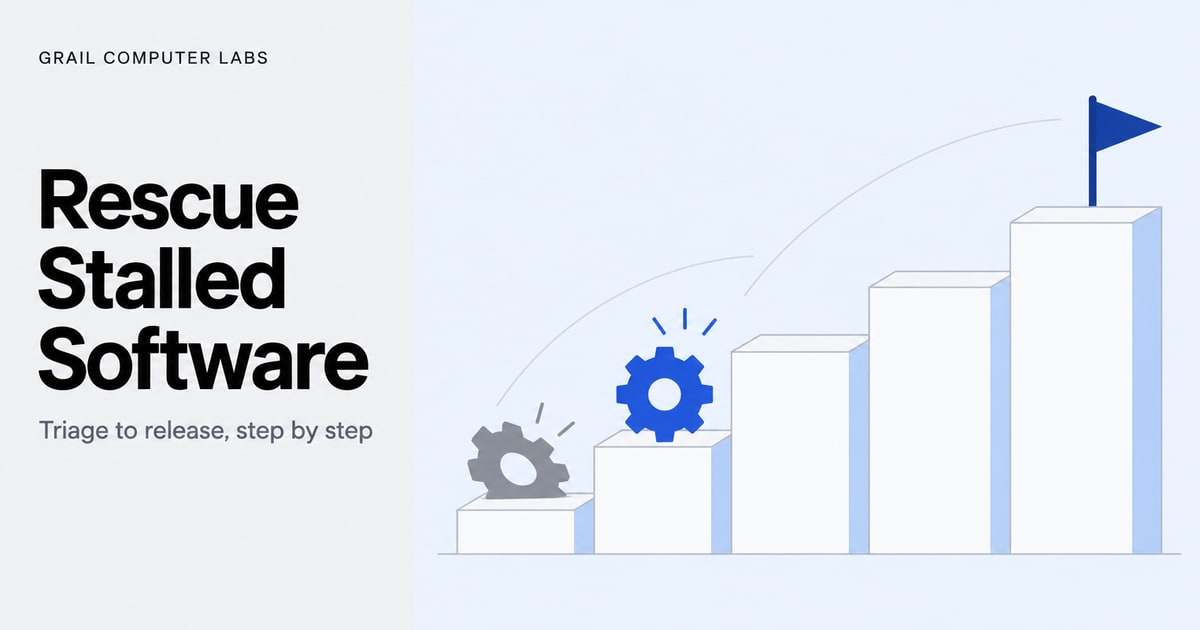
How software development project rescue works: triage, codebase inheritance, outcome agreement, stabilisation and release, anchored in a real 30-day case.
What software rescue support looks like after a lead developer leaves: access, code mapping, release cadence and a 1.5M-line healthcare case.
How software development project rescue works: triage, codebase inheritance, outcome agreement, stabilisation and release, anchored in a real 30-day case.
Enterprise AI guardrails explained: instruction-based vs architecture-based controls, plus a go-live checklist for data access, action scope and fallback.
A legacy system is software that is hard to change safely. See the warning signs, the improve-or-rebuild test and a phased migration plan for real platforms.
Request a quote and our experts will contact you within 24 hours with tailored solutions and pricing.
Last updated: Nov 9, 2026
By Shiva Mangal, Grail Computer Labs
Software rescue support is a structured takeover of a stalled codebase in which a new team secures access, maps what works and what does not, and ships a first controlled release, typically within two to four weeks. When a lead developer or CTO leaves mid-build, hiring is not the first problem. Understanding code nobody can explain is. One Australian healthcare platform sat in development for 8 months, then went live in production within 30 days of a rescue by Grail Computer Labs. This article covers what a rescue team does week by week, which artifacts it hands over, which release rhythm is realistic, and when rescue is the wrong move.
Key Takeaways
- Software rescue support starts with access and control (repositories, cloud accounts, credentials), not with a rewrite.
- A rescue team replaces guesswork with written artifacts: an architecture map, a dependency audit, a risk register and a test baseline.
- Our recommended release cadence by week four is one small, tested change shipped on a repeatable path, then a weekly rhythm, not daily deploys.
- An Australian healthcare platform stuck in development for 8 months reached live production within 30 days after a rescue.
- Software rescue support does not fit teams that only need extra headcount or cannot freeze scope.
Software rescue support in the first few weeks runs in four stages: secure access in week one, map architecture and dependencies in weeks two and three, agree keep, fix or replace verdicts, then ship one bounded change through a repeatable release. Wavect's practitioner guidance from August 2026 puts that first change at about day 30 (Wavect, 2026).

The table below is the four-week outline we use as a planning frame. It is an illustration, not a measured result from a study.
| Week | Focus | Output | Exit check |
|---|---|---|---|
| 1 | Access, credentials, frozen scope, local build | Access inventory, working local build | The team can build and run the system |
| 2 | Architecture, dependencies, test baseline | Architecture map, dependency audit | Risks are ranked |
| 3 | Keep, fix or replace verdicts | Risk register, agreed first change | The owner signs off the first change |
| 4 | One bounded change through a repeatable release | Release notes, runbook, rollback plan | The change is live and recovery is rehearsed |
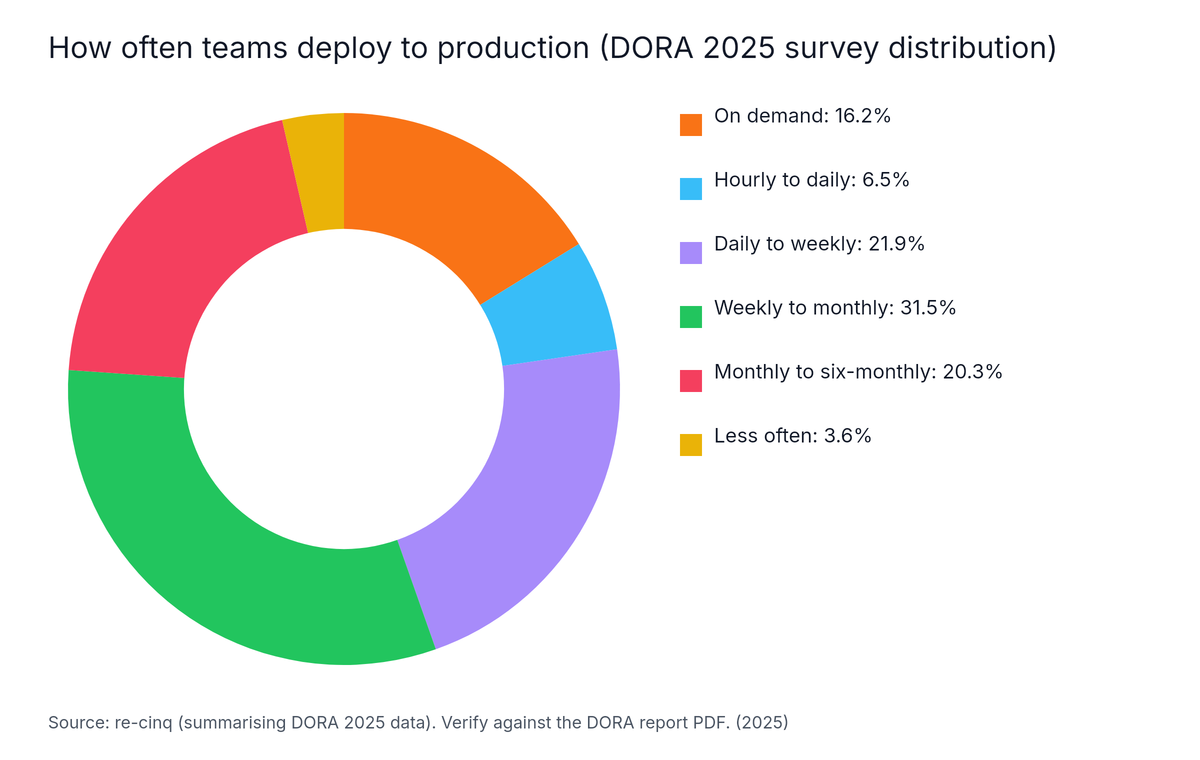
A release cadence is the repeatable rhythm at which a team ships changes to production. In DORA's 2025 survey only 16.2% of respondents deployed on demand, while 31.5% deployed between weekly and monthly, as summarised by re-cinq (2026). DORA is Google Cloud's annual research programme on software delivery performance.
Our recommendation is a weekly rhythm. It sits inside that weekly-to-monthly band, which covers teams of every kind, so it is our judgement and not a DORA target. Daily deploys are not a rescue goal.
Source: re-cinq (summarising DORA 2025 data). Verify against the DORA report PDF., 2025
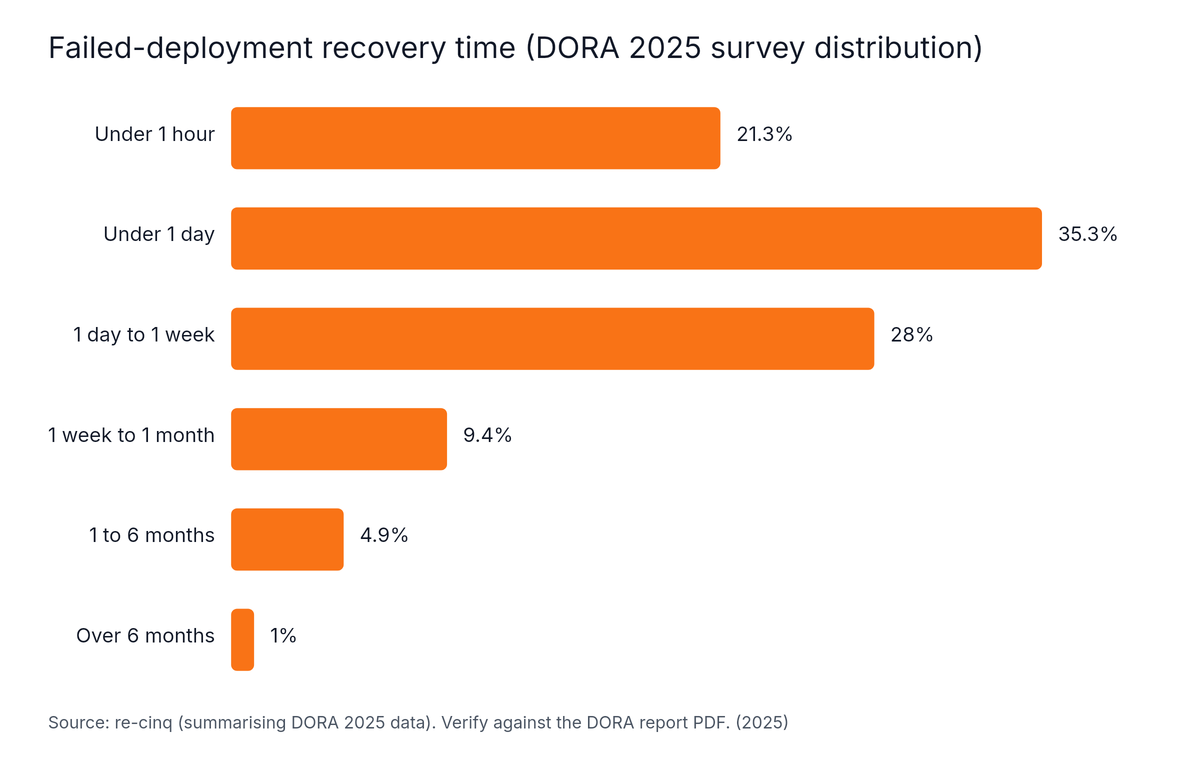
Release speed means little if a bad release cannot be undone. DORA's 2025 distribution shows 21.3% of teams restore service in under 1 hour and 35.3% in under 1 day. That is 56.6% recovering within a day (re-cinq, 2026). A rescue team writes the rollback steps before the first release, not after it.
Source: re-cinq (summarising DORA 2025 data). Verify against the DORA report PDF., 2025
A technical rescue team first takes control of access, not code. In the first 72 hours it inventories every repository, cloud account and credential, rotates secrets, freezes new scope and confirms what is running in production. The 2025 DORA survey found 90% of technology professionals use AI at work (DORA / Google Cloud, 2025), so the inventory also flags code nobody wrote by hand.

The first days follow a fixed sequence:
Access begins read-only. That keeps the live platform safe while the team learns it.
A rescue team does not rewrite, refactor or re-platform in week one. Changes to the live system wait until the team can build and run the code locally. This order protects production while the team learns what it inherited.
A codebase nobody can explain is the real crisis because every later decision, whether to hire, rewrite or release, depends on knowing what the code does. Technical debt is the accumulated cost of shortcuts and undocumented design in software. CAST's 2025 analysis of more than 10 billion lines of code puts global technical debt at 61 billion days of repair time (CAST Software, 2025).
A new lead engineer cannot decide anything about a system they cannot read. Hiring one before the system is mapped often adds another person who cannot explain it.
The wider data points the same way. InformationWeek reports that a Forrester survey found 75% of technology decision-makers expect technical debt to reach a "severe" level in 2026 (InformationWeek, 2026).
Bus factor is the number of people who would have to leave before nobody understands a part of the system. A bus factor of one means a single person holds that knowledge. When that person leaves, the factor drops to zero.
The stall then looks the same everywhere. One client described it this way: "Even a small bug fix could take days or a week, and fixing one problem often broke something else." Each change carries unknown risk, so changes slow down and the release date moves.
Software rescue support maps an inherited codebase by running it, testing it and recording findings in written artifacts: an architecture map, a dependency audit, a risk register and a test baseline. On the Australian healthcare platform, that meant 1.5 million inherited lines of code. Each component then gets a keep, fix or replace verdict, which the owner reviews before any change ships.

| Artifact | What it contains | Why the owner needs it |
|---|---|---|
| Architecture map | Services, data stores, integrations and how they connect | Shows what the system is made of |
| Dependency audit | Libraries, versions, end-of-life components, licences | Flags security and upgrade risk |
| Risk register | Ranked list of fragile areas, with an owner for each | Turns "it feels risky" into a worklist |
| Test baseline | What is tested, what passes, what is untested | Defines what "safe to change" means |
| Runbooks | Build, deploy, rollback and recovery steps | Removes dependence on one person's memory |
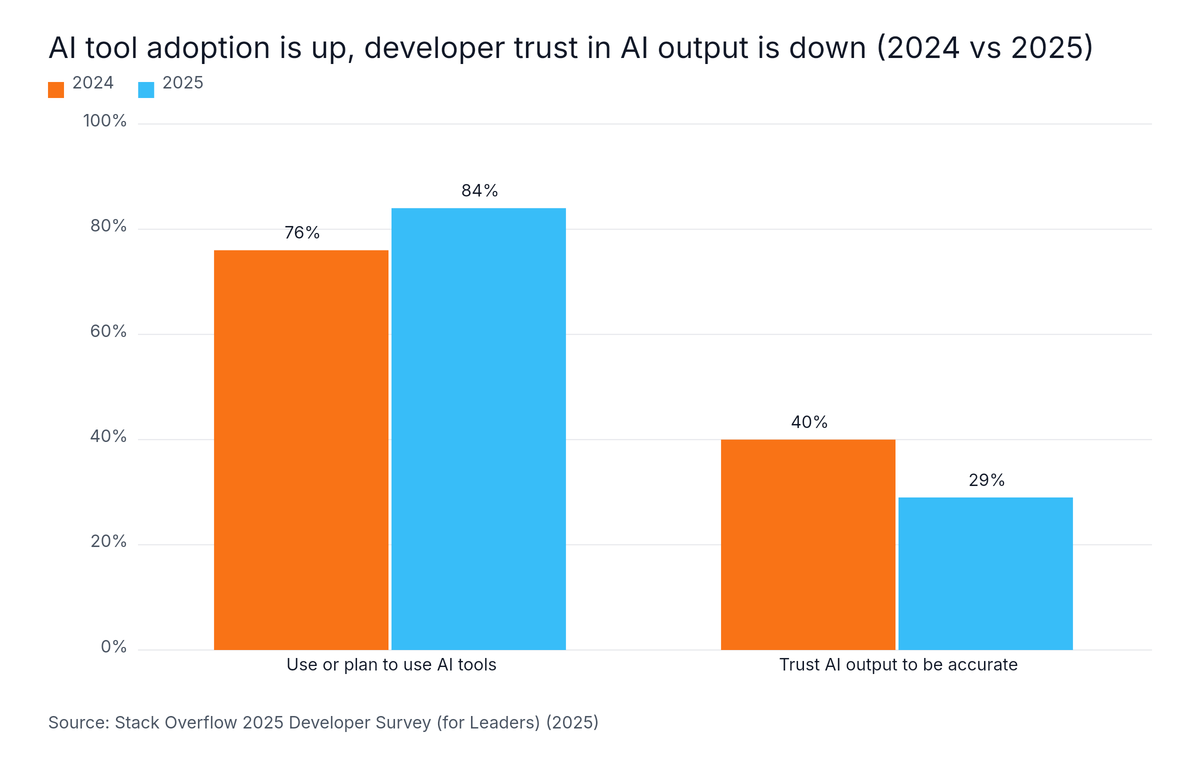
An inherited repository may contain code nobody on the team wrote by hand. Trust has not kept pace with use. In Stack Overflow's 2025 survey, 84% of developers use or plan to use AI tools, up from 76% in 2024, while only 29% trust the output to be accurate, down from 40% (Stack Overflow, 2025). The chart shows the 2024 values, 76% and 40%, which the 2025 figures moved away from.
Source: Stack Overflow 2025 Developer Survey (for Leaders), 2025
In the same survey, 66% of developers say they spend more time fixing "almost-right" AI-generated code (Stack Overflow, 2025). The survey notes that "When the code gets complicated and the stakes are high, developers turn to people." (Stack Overflow Blog, 2025) With the author gone, tests become the substitute for that person.
DORA's research team describes AI as something that "magnifies the strengths of high-performing organizations and the dysfunctions of struggling ones." (Google Research, 2025) An inherited repository with no tests is a clear case of the second kind.
Each component gets one verdict. The improve-or-rebuild decision keeps what can support reliable releases and migrates the rest in phases.
| Signal | Keep | Fix | Replace |
|---|---|---|---|
| Tests | Cover core flows and pass | Partial coverage, can be extended | None, and behaviour cannot be pinned down |
| Dependencies | Supported versions | Upgradeable in steps | End-of-life stack |
| Readability | A new engineer can follow it | Needs documentation | Nobody left who understands it |
| Release path | Builds and deploys repeatably | Manual steps can be scripted | Cannot be built reliably |
On an Australian healthcare platform, Grail Computer Labs (GC Labs) took over from the previous vendor, inherited 1.5 million lines of code and rebuilt the platform after 8 months stuck in development. The platform went live in production within 30 days, and by day 40, 100 business customers had been onboarded, according to the case study page.
Our data: The Australian healthcare platform was stuck in development for 8 months. After we took over, it went live in production within 30 days, 100 business customers had been onboarded by day 40, and 500 bug and feature tickets were handled across a 10-day period.
The client runs a managed-service business with a multi-party healthcare platform, so a failed migration would have disrupted real operations. We applied the improve-or-rebuild decision to the 1.5 million inherited lines: keep what could support reliable releases, rebuild the rest. A big-bang migration feels very risky to buyers, so the migration moved in phases.
For context only, not as a like-for-like comparison: in DORA's 2025 survey 31.5% of respondents deployed between weekly and monthly (re-cinq, 2026). Teams in that band release regularly. A platform with no release in 8 months was well outside it.
The case is one engagement, and the client is anonymised. It shows that a 1.5 million line inherited codebase can reach production in 30 days. It does not show that every codebase will. Test coverage, documentation and the state of the stack change the timeline.
Software rescue support is not for teams that want to fill a headcount gap, teams without authority to switch vendors, or teams unwilling to freeze scope while mapping runs. It also does not remove regulatory duties: APRA's CPS 230 presumes core technology services are material, so a departed key developer still needs to be recorded as a dependency (APRA, 2025).

Rescue is the wrong tool in these cases:
Regulated businesses carry extra work. CPS 230 requires that "An APRA-regulated entity must identify and maintain a register of its material service providers" (APRA, 2025). A rescue team can produce the technical inventory. The compliance team still owns the register and the regulator conversation.
A technical rescue team first secures access and confirms what is running in production. It inventories repositories, cloud accounts and credentials, rotates secrets, freezes new scope and starts reading the code with read-only access. Rewrites wait until mapping is finished, because a verdict on keeping or replacing each component needs evidence from running and testing the system.
In the first 72 hours after a lead developer quits, a rescue team secures control of the system. It lists every repository, cloud account, domain and third-party service, rotates the passwords, tokens and keys the developer held, checks git history for secrets, freezes new scope and confirms backups and monitoring work. Reading and mapping the code begins after access is under control.
A team should keep, fix or replace an inherited codebase one component at a time, not rewrite it wholesale by default. Components with passing tests and supported dependencies stay. Partly tested ones get fixed in steps. A rewrite is justified for an end-of-life stack with no tests where nobody left understands it. The verdict comes after mapping, not before.
A rescue team should freeze scope on a live platform in the early weeks of a takeover. Freezing new features lets the team map the system and ship one small change safely before the roadmap restarts. Critical bug fixes can still proceed, but each one goes through review so the system stays a stable target while it is mapped.
A live production system can keep running while a rescue team maps its code. Access can begin read-only, the team confirms backups and monitoring first, and changes reach production only after testing and review. The mapping work happens on copies and local builds, not on the running system.
A departed lead developer turns a software project into a knowledge problem. The first weeks of software rescue support solve it in a fixed order.
We agree the outcome first, deliver it in 4 to 8 weeks, then keep shipping. The engagement starts with a 15-day trial with no payment commitment. Teams whose platform stalled after a departure can Book a call ↗ and show us what is stuck.
© 2026 grail.computer All rights reserved.