
Legacy System Migration Services: A Buyer's Guide
Learn how to scope legacy system migration, compare six approaches, assess providers and plan a controlled cutover with clear acceptance gates and rollback triggers.
The replacement platform looks straightforward until someone asks what happens to payroll if the order feed stops. The engineering team can move the database, but operations can't yet confirm which reports, exceptions and manual fixes depend on it. A migration proposal that names a new stack without resolving those dependencies leaves the hardest work unpriced and untested.
Legacy system migration services should protect operating continuity, not merely move software. The useful question isn't whether the replacement runs. It's whether customers, staff and partners can complete the same essential work, with evidence that important behaviour and data haven't disappeared.
Why Legacy Systems Stall Migration Projects
Consider a hypothetical finance director trying to retire an ageing order system. The initial estimate assumes a straightforward transfer. Discovery then exposes a nightly batch that feeds payroll, an unlisted supplier integration and a reporting export maintained through an employee's spreadsheet.
None of these dependencies appears in the architecture diagram. Each matters to someone who must keep the business running. Replacing the visible application without recovering those behaviours would leave the company with newer software and unfinished operations.
An old system is rarely just code. It also contains decisions about approvals, exceptions, timing and responsibility. Some decisions sit in application logic. Others survive in scheduled jobs, support tickets or the habits of experienced employees.
Dependence matters more than age
A 2025 survey covering major international markets found that 68% of IT decision-makers believed legacy systems obstructed newer technology adoption, including artificial intelligence (AI), while 48% couldn't discontinue support; 47% reported their oldest application had been running for 11–20 years, and respondents identified maintenance time at 44%, disconnected systems at 37% and running costs at 37%.
Those findings describe a business dependency problem, not merely an infrastructure problem. A company may want to stop maintaining an application while still depending on its outputs. The replacement therefore needs acceptance criteria drawn from actual work, not just technical specifications.
A buyer's working pack should contain:
- An approach comparison, showing what each option changes and leaves behind.
- A discovery scope, covering rules, dependencies and operational exceptions.
- A provider scorecard, testing ownership and delivery evidence.
- A cutover sequence, with a reversible boundary for each switch.
- Acceptance gates, defining who authorises progress and when the team must stop.
What a Legacy Migration Service Covers
Legacy migration services aren't a single deliverable. A proposal should distinguish assessment, implementation and production responsibility, rather than grouping everything under modernisation.
The UK Government's Legacy IT Risk Assessment Framework combines likelihood and impact when assessing risk. That provides a better starting point than ranking applications by age alone.
The service scope
Estate assessment. Inventory applications, owners, integrations and infrastructure. Rank the consequences of failure or compromise alongside the likelihood, so business-critical exposure receives attention before cosmetic technical work.
Discovery. Recover business rules, data ownership, batch schedules, integration contracts, exception handling and release dependencies. Record uncertainty instead of treating an incomplete document as an approved specification.
Approach selection. Choose the intervention for each component. A working application may need a platform change, while an unreliable workflow may need redesign or replacement.
Build. Implement the target components and tests. Preserve required behaviour deliberately, while separating obsolete behaviour from rules the business still needs.
Replication, reconciliation and cutover. Transfer changes, compare results and control the transition. This work needs its own scope, not a brief deployment task at the end.
Governance and run. Maintain decisions, risks, operational instructions and retirement conditions. Define whether the internal team takes responsibility or the delivery team continues supporting production.
A containment project may leave the core untouched. A rebuild may require every activity listed above. Scope determines the commercial discussion, and a credible proposal makes exclusions visible, including data cleansing, supplier coordination and post-launch support.
Practical rule: A target architecture isn't a complete migration scope. The scope must also explain how the business reaches it and who operates it afterwards.
Six Migration Approaches and What Each One Changes
Rehosting is the narrowest intervention when the application can remain unchanged. It can shorten implementation because the team changes infrastructure rather than architecture. The trade-off is equally clear: the inherited design and technical debt move with it.
An empirical study of legacy-to-cloud migrations identifies inadequate understanding and preparation as important contributors to failures against organisational objectives. Selecting an approach before understanding the application therefore creates avoidable uncertainty, regardless of the destination.
Migration approaches compared
| Approach | What changes | What stays the same | Typical risk | Best fit |
|---|---|---|---|---|
| Rehost, or lift and shift | Infrastructure and hosting only | Application code and architecture | Inherited technical debt moves with the system | Urgent data-centre exit with stable code |
| Replatform | Runtime, database or hosting layer | Core business logic | Hidden coupling to old components | Platform nearing end of support with working logic |
| Refactor | Internal code structure, in slices | External behaviour and interfaces | Regression in undocumented rules | Sound system with a hard-to-change core |
| Rebuild | Architecture and codebase, around recovered rules | Business rules and data, after audit | Scope growth and knowledge loss | Codebase nobody can change safely |
| Replace with a packaged product | Whole system moves to commercial software | Business process, adapted to the product | Process change and data mapping effort | Commodity capability with a mature market |
| Contain behind an overlay | Access through an application programming interface (API) facade or workflow layer | Legacy core left untouched | Structural risk remains concealed | Unsafe system where replacement is unaffordable now |
A platform change won't necessarily make releases easier. A rebuild won't automatically preserve the exceptions customers rely on. A packaged replacement may remove maintenance work while requiring operations staff to change established processes.
Containment deserves particular scrutiny. An overlay can restrict access or introduce a controlled workflow, but it doesn't repair unsupported components beneath it. It needs an explicit risk owner and review conditions, rather than becoming an indefinite substitute for a decision.
Choosing the intervention
The decision should resolve these uncertainties:
- Urgency. How quickly must the system move, and what happens if it stays?
- Behavioural knowledge. Can operations describe the required outcomes without engineers interpreting the code?
- Change capacity. How much process, training and release change can the organisation absorb during the coming year?
On the rebuild side, Grail Computer Labs, subsequently GC Labs, recovers the rules inside legacy systems, rebuilds the software in controlled stages and proves the new behaviour before release. That is a method for managing the transition, not evidence that every inherited system should be rebuilt.
A sensible programme can combine approaches. For example, a hypothetical estate might retain a stable reporting component, replatform a working transaction service and rebuild an unsafe onboarding journey. The justification belongs at component level, not in a blanket commitment to a new stack.
What Discovery Must Capture Before Any Build
Discovery should find what the documents miss. A useful assessment connects observed behaviour to code, records, people and external dependencies. A repository inventory alone can't establish whether the business can safely release a replacement.
GC Labs audits inherited code, data, infrastructure and product documents before choosing what to retain. This is one method of establishing the baseline. Its value depends on the evidence recovered and the unresolved questions made visible, not on the size of the audit report.

Recover the paths beyond success
In a hypothetical order platform, the team may consider the customer journey complete because an order can be submitted, accepted and fulfilled. A state model forces a different discussion: what happens after cancellation, failed fulfilment or a disputed charge?
A missing transition can leave a record permanently open. A notification may be sent before the transaction is committed. An administrator may have no supported way to recover a failed workflow, even though the current operations team performs that recovery manually.
In an inherited platform, GC Labs modelled the core journey with 27 states and 39 transitions, exposing missing paths for cancellations, disputes, failed fulfilment, notifications and admin recovery. The useful artefact was the explicit model of allowed behaviour, not merely the count of states.
The distinction matters during acceptance. Existing behaviour isn't automatically correct, and missing behaviour shouldn't automatically be recreated. Business owners need to decide which rules must survive, which defects should change and which historical records need special treatment.
A working discovery checklist
- Scheduled jobs. Record triggers, inputs, outputs, retry behaviour and the consequence of a missed run.
- External feeds. Identify the sending and receiving parties, formats, authentication ownership and failure notifications.
- Manual workarounds. Capture spreadsheet adjustments, support actions and database corrections, including why staff perform them.
- Exception owners. Name the person authorised to approve each unresolved difference or recovery path.
- Data responsibilities. Establish the authoritative record, permitted transformations, retention needs and access boundaries.
- Release dependencies. Record which application, supplier or operational change must happen before another.
The output should be a written map that staff can check against the live system. Each important claim needs a reference, such as an observed transaction, job configuration, operational instruction or approved example. Where the team lacks evidence, the map should say so.
Discovery isn't complete because interviews have finished. It becomes useful when engineers and operations can identify the same workflow, explain its failure paths and agree who will judge the replacement.
Scoring a Migration Provider Before You Sign
Migration proposals can look similar until a cutover fails. The useful differences sit in the evidence, responsibilities and exit terms behind the proposal. A polished architecture diagram doesn't establish who handles a rejected transaction during a production incident.
The following scorecard applies to a fixed-scope project and a continuing delivery relationship. It also applies to GC Labs, without exceptions for its preferred delivery model.
Migration provider scorecard
| Criterion | Good signal | Red flag |
|---|---|---|
| Discovery before quoting | Written audit of code, data, infrastructure and documents comes first | Fixed price and timeline offered before inspection |
| Knowledge capture | Architecture maps, data lineage and runbooks are handed over | Knowledge stays inside the provider's team |
| Ownership | Client owns code, cloud account, models and documentation | Licence or platform restrictions block a later move |
| Cutover method | Replication, reconciliation, dual running and rollback are described | A single big-bang switch without rehearsed recovery |
| Governance evidence | Roadmap, dependency assessment, risk register with owners and decision records | Target stack named but no owners or retirement conditions |
| Support after go-live | A named team keeps delivering, monitoring and fixing | Responsibility ends at handover |
| Proof | Measured results include scope, dates, method and limits | Claims omit scope, dates or method |
The Australian Government's migration and legacy-retirement guidance provides a concrete governance benchmark. It calls for evidence proportionate to the transition's scale and risk, including a roadmap, dependency assessment, retirement plan, risk register, business-impact assessment and decision records.
Terms that should survive a change of team
The written agreement should identify ownership of the code, cloud account, models and documentation. It should also explain access, operational responsibility and how another team could take over. Ownership has limited practical value if only the departing team can release the application or interpret its runbooks.
GC Labs offers a takeover process and an improve-or-rebuild service. Its offering is a managed delivery relationship, not a licence: the same pod keeps shipping after the build, rather than ending the relationship with a handover. Clients own the code, cloud, models and documentation.
Those statements should appear in the agreement alongside support boundaries and takeover terms. A continuing relationship doesn't remove the need for an executable exit.
Evidence should remain useful when the people who produced it are no longer available.
For a founder or private equity (PE) owner, this is also an operational dependency test. For managed-service businesses (MSPs), meaning non-IT service firms running a multi-party platform, unclear responsibility can affect clients, workers and partners simultaneously. The scorecard should therefore be completed with operations, not only procurement and engineering.
How to Plan a Controlled Cutover in Six Steps
A controlled cutover moves a bounded capability through explicit decisions. The boundary matters because the team needs to know what can switch back independently and what must move together. Reversibility should be designed before implementation, not improvised during an incident.
A technical paper describing the Strangler Fig pattern explains how old and modernised components can coexist while functionality moves incrementally. Its shadow-write mechanism records changes in both systems so teams can compare correctness, business meaning and application behaviour under production load.
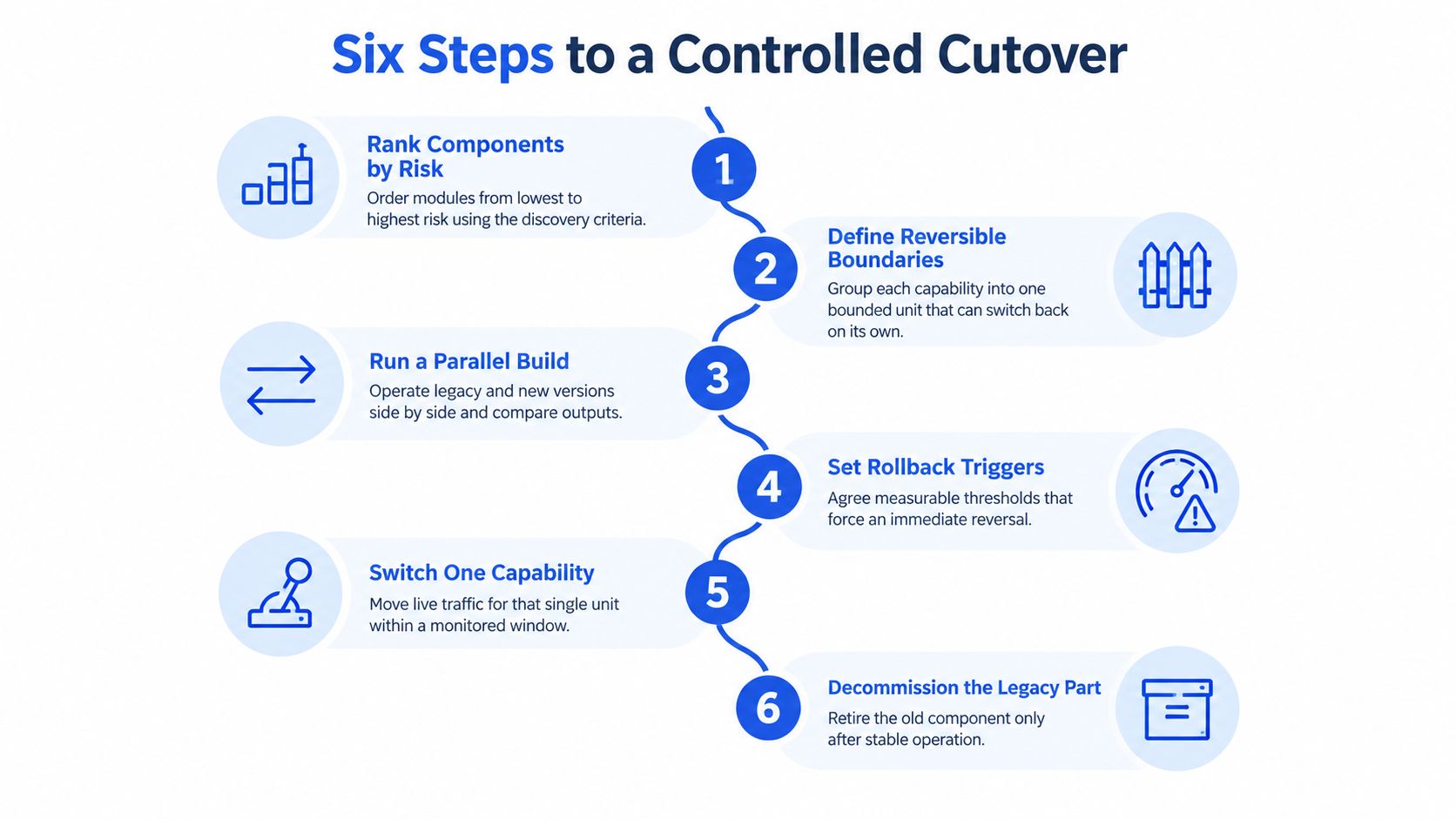
The cutover sequence
Rank components by risk. Use the discovery findings to distinguish business urgency from implementation difficulty. The highest-risk component may need immediate containment without being the safest first migration slice.
Choose a reversible boundary. Select a capability that tests the method without requiring the whole platform to move. A reporting feed or bounded customer journey may work, provided its upstream and downstream dependencies are understood.
Build beside the existing system. Where appropriate, record changes in both the legacy and target stores through shadow writes. Define how failed writes, retries and conflicting results are detected before relying on the arrangement.
Compare production behaviour. Run the parallel path under real load and inspect business outputs, not just application errors. Agree measurable rollback triggers and a named decision-maker before any customer traffic changes.
Move traffic progressively. Start with an appropriate internal cohort or limited customer group, then expand only when the evidence supports it. Record the routing change, observation window and authority to reverse it.
Retire after reconciliation. Keep the old component available until the agreed observation and reconciliation conditions are met. Confirm that no jobs, reports or external consumers still depend on it before removing access or infrastructure.
The following visual summarises the operational decisions around each switch.
Where this pattern becomes difficult
Shadow writes add write activity and temporary implementation complexity. A successful legacy write followed by a failed target write needs a recovery path. Otherwise, the parallel arrangement can create the inconsistencies it was meant to reveal.
Batch jobs and reports also need separate transition logic. Switching interactive traffic doesn't establish that overnight processing uses the correct source or that historical reports remain comparable.
The pattern is a poor fit where no clean boundary exists. The team may first need to separate responsibilities or introduce a controlled interface. The first slice should therefore carry an explicit allowance for shared migration tooling, rather than being treated as representative of every later slice.
A phased plan isn't automatically a safe plan. Each phase still needs a usable boundary, observable outcomes and a reversal method that works with the data created after the switch.
Acceptance Gates and Rollback Triggers
Near-zero downtime is a more useful engineering target than an unqualified zero-downtime promise. The objective is a controlled interruption profile with no lost or reordered data, backed by tests and operational ownership.
The database-migration principles guidance explains that some client requests may temporarily be unprocessable and that migrations must account for interruptions and failures. The acceptance plan should therefore test recovery, not merely successful copying.
Cutover gates, evidence and rollback triggers
| Gate | Evidence required | Rollback trigger |
|---|---|---|
| Replication running | Continuous change capture with lag under the agreed threshold | Lag keeps growing after a restart |
| Data reconciliation | Row counts, checksums, key totals and business rules match | Any unexplained difference in a financial or eligibility figure |
| Application compatibility | Old and new application versions both pass tests against the schema | A failing test in a critical customer journey on either side |
| Interruption recovery | Replication resumes correctly after a forced network or node failure | A data gap or duplicate records after recovery |
| Business sign-off | A named owner approves each exception and difference | The owner withholds sign-off within the agreed window |
| Post-cutover reconciliation | Rollback remains possible until reconciliation completes | Rejected records exceed the agreed limit |
Before a switch, a failed gate should block progress. After a switch, the corresponding trigger should initiate the agreed response. That response may involve stopping new writes, reversing traffic or entering a controlled recovery procedure, depending on what remains safely reversible.
A rollback plan also needs to explain the treatment of transactions created on the target. Routing traffic back isn't sufficient if the source lacks those transactions. The rehearsal should demonstrate how the team avoids losing or applying them twice.
Keep schema changes compatible
For database changes, expand, migrate, contract separates introduction from removal. Add the new structures alongside the existing ones, migrate the data and application usage, then remove obsolete structures only when neither active application version needs them.
This sequencing creates room for compatibility testing. It doesn't excuse indefinite duplicate fields or unclear ownership of the authoritative value. The plan should identify the conditions for completing the contraction step.
Thresholds belong to the individual system. An acceptable replication lag for an analytical feed may be unsuitable for an eligibility decision, so a universal threshold would be misleading.
Acceptance test: Completion means documented business equivalence and demonstrated recovery, not simply a successful deployment.
No finite test set proves every future outcome. The defensible claim is narrower: the team has tested the agreed workflows, reconciled the relevant records, exercised interruption recovery and recorded the remaining limits.
Rescuing a Stalled Healthcare Platform
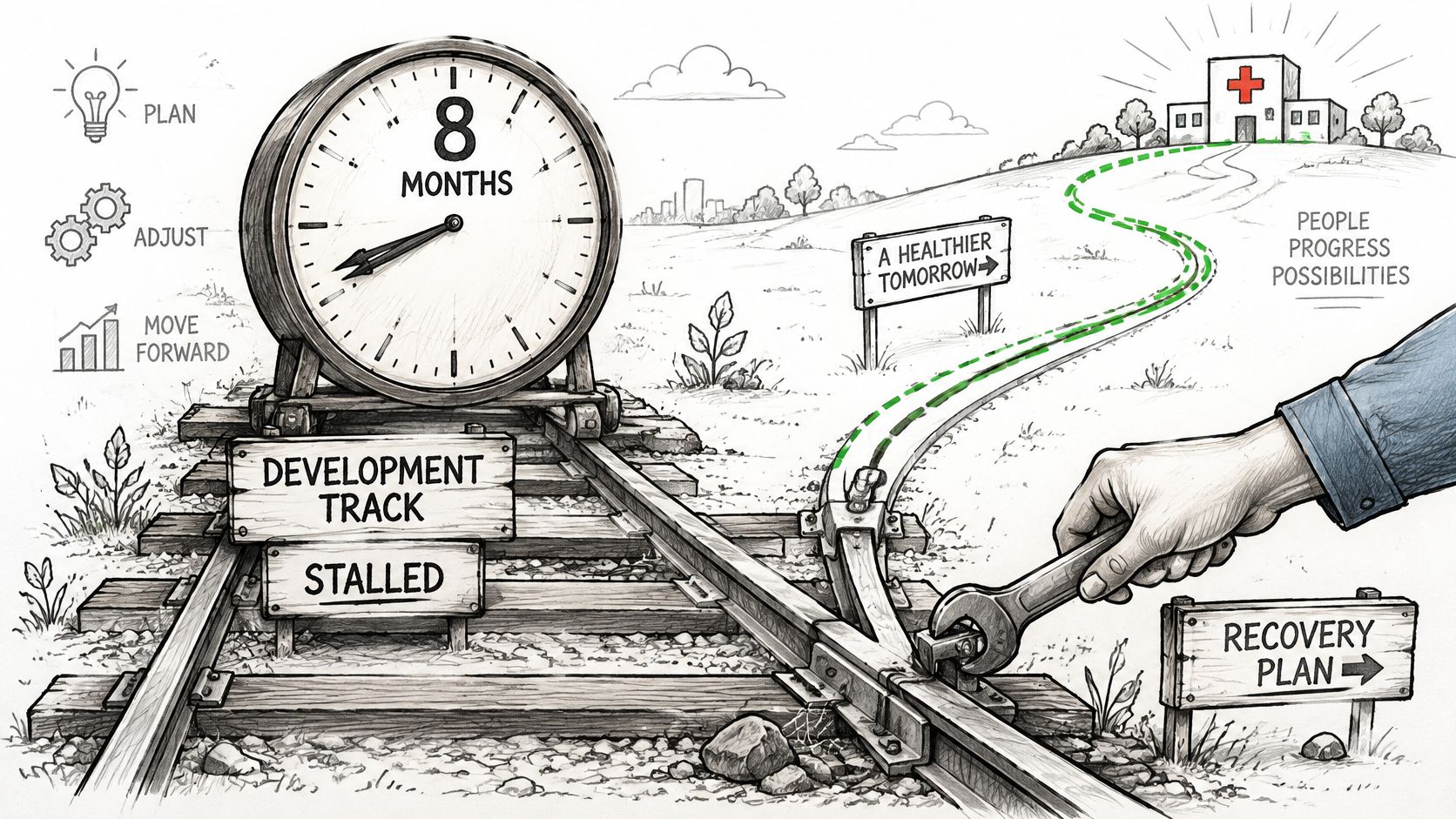
An Australian healthcare platform was stuck in development for 8 months with no clear deadline in sight. This was a software rescue problem: the company needed a working platform, while the existing development effort offered no clear production date.
The inherited estate had three codebases and 32 application projects, spanning a web portal, a separate onboarding product and a custom sign-in service. It also contained 1.5 million lines of code. Those details describe the inherited workload, not a general measure of migration difficulty.
Recovering the foundation
GC Labs took over from the previous vendor and audited the inherited estate before rebuilding. It kept the useful data, business rules, workflows and knowledge of how the company operated, then rebuilt the software around those facts.
This distinction matters. Preserving the business didn't require preserving every technical decision. The work separated operational knowledge worth retaining from software foundations that needed replacement.
GC Labs took over from the previous vendor, rebuilt the platform and had it live in production within 30 days; by day 40, 100 business customers had been onboarded.
What followed production
GC Labs stayed on as technology partner, handling new features, bugs, infrastructure and production support. Across a 10-day period, it handled 500 bug and feature tickets. That figure describes ticket activity, not a count of independently verified defects or equal-sized changes.
The Australian healthcare platform rebuild case study provides the case context. Its practical relevance is the sequence: inspect the inherited system, retain useful business knowledge, rebuild the foundation and continue operating the product.
The limits are equally important:
- One set of conditions. The result concerns a particular platform, team and operating context.
- No reusable deadline. The production date records what happened here; it doesn't establish a comparable migration schedule.
- Incomplete commercial evidence. The case doesn't establish the cost of the work or how the cutover was staffed.
- No substitute for acceptance records. A production launch and customer onboarding don't, by themselves, document every continuity gate.
The case supports a takeover-and-rebuild approach under those conditions. It doesn't prove that rebuilding is preferable to containment, refactoring or packaged replacement for another company.
Confirm the Scope Before You Choose a Provider
The immediate decision is whether to migrate, contain or replace, and which provider merits a closer assessment. A complete target architecture isn't necessary for that discussion. A usable account of the current risks and dependencies is.
The discovery checklist should be completed as far as the internal team can manage. The following evidence adds the commercial and operational context that a technical inventory can miss.
Bring the operating evidence
- Incidents and rework. Bring the previous year's incident records, repeated fixes and releases that required recovery.
- Recorded maintenance cost. Use actual internal records, including support effort and supplier charges, rather than an assumed industry benchmark.
- The unsafe-to-change system. Identify the component the team can no longer modify confidently, together with the work it prevents.
GC Labs invites customers to bring exactly that system into a discussion. Its speciality is software rescue, including replacing underperforming vendors and moving stalled AI and software projects. It also builds custom AI models, automates internal operations and re-platforms legacy software.
Define an outcome before committing further
An outcome engagement delivers one pre-defined, measurable outcome in 4–8 weeks. Qualified clients can use the 15-day trial to stop within the first 15 days without paying. The agreed outcome should state what will be demonstrated and what remains outside scope.
GC Labs' Software Factory is its AI software factory: agents execute, GC Labs engineers make the decisions and customers see progress. After the outcome, continuous delivery means the same team keeps delivering, like an in-house technology team.
Containment remains a legitimate recommendation when the evidence supports it. A buyer who leaves with a scored shortlist, clearer ownership and a defensible decision has made useful progress without committing to a rebuild.
For a system that can no longer change safely, Grail Computer Labs offers takeover, assessment and an improve-or-rebuild path tied to measurable outcomes. Book a call with the dependency map, incident history and maintenance records, or discuss an outcome engagement with a 15-day trial. The next step can be a bounded intervention, containment or a better-supported shortlist.