
Application Management Services: What Buyers Must Clarify
Learn what application management services should cover, how changes move from request to release, and which ownership, reporting and exit terms to clarify before choosing a provider.
An application is live, but the people who built it have moved on. Small fixes take weeks, nobody can explain every dependency, and each release feels like a risk. The immediate problem may look like support, but the bigger question is who owns the software well enough to keep changing it, and who can take over if that relationship ends.
That's the true test of application management services. They should keep software running and make change safer, while leaving the customer with the code, evidence and knowledge needed to continue without disruption.
Why Software Needs Ongoing Ownership After Launch
Launch changes the risk profile. The first production incident, the first dependency upgrade and the first urgent feature request all arrive after the build team has stopped living with the system every day. Response speed matters, but it can hide a thinner problem: nobody outside a small group can explain, change or safely replace what is running.
Application management services are the continuing work that keeps a business application running, safe to change and supported after launch. The scope now extends beyond maintenance into support, enhancement, monitoring, cloud migration and continual improvement. A building separates construction from facilities management; software needs the same split between delivery and operation.
Demand has moved in cycles rather than along a straight line. Surveys of IT organisations show application-management outsourcing falling, then recovering, as buyers adjusted scope. The figures describe adoption among surveyed organisations; total technology spend is a separate measure. The line moved because sourcing changed: software as a service (SaaS) and cloud platforms absorbed some routine work, internal product teams kept more systems close, and contracts narrowed around specific outcomes.
The practical conclusion is harder than a build-or-buy choice. Modern architecture still leaves version risk, access drift, unclear dependencies and releases that only a few people know how to run. Judge ongoing ownership by transfer readiness as much as by uptime: deployable repositories, current runbooks, tested rollback, named approvers and a rehearsed handover show whether another team can continue without disruption. Ask for that evidence before signing, while the seller still has incentive to produce it.
What Application Management Services Cover
A service may bundle operational support with planned maintenance, but the work still needs clear boundaries. Support responds to incidents; maintenance and enhancement make planned changes. Monitoring helps teams detect problems, while release management connects a change to a controlled production rollout. Some responsibilities may stay with an internal team, so scope should be written down area by area.
| Service area | What it includes | Question it answers |
|---|---|---|
| Incident and support | Triage, fixes, severity rules and service desk hand-offs | What breaks, who responds, and how fast? |
| Maintenance and patching | Dependency upgrades, runtime and library patches, security fixes | Which versions are exposed, and how quickly are they patched? |
| Enhancement | New features, changed requirements and backlog management | Who sets priorities, and how are requests accepted? |
| Monitoring and reliability | Alerts, dashboards, on-call cover and site reliability engineering (SRE) practice | How does the team know about a fault before customers do? |
| Release management | Builds, automated tests, staged rollout and rollback | How safely do changes reach production? |
| Documentation and knowledge | Runbooks, architecture decision records and access records | Could another team take over? |
| Modernisation | Re-platforming, cloud moves and component replacement | Which parts can change without downtime? |
Patching is a useful test of whether the service is operationally measurable. The National Institute of Standards and Technology (NIST) recommends tracking inventory coverage, how often teams check for missing updates, the time needed to patch defined shares of hosts, the share patched within deadlines, the share fully patched at a given point, and the degree of automation (NIST's patch-management guidance).
Each measure addresses a different failure point. An incomplete inventory can hide vulnerable applications. Infrequent checks delay prioritisation; slow deployment extends the exposure window; and manual execution adds inconsistency. Hypothetical example: a platform has many services, but a library remains unpatched on a server the team didn't know existed. A patch report that excludes that host can look reassuring without describing the actual risk.
Practical rule: Request the application and host inventory before reviewing the patch report. Without a current inventory, a provider can't report patch coverage honestly.
How a Change Moves Through the Service
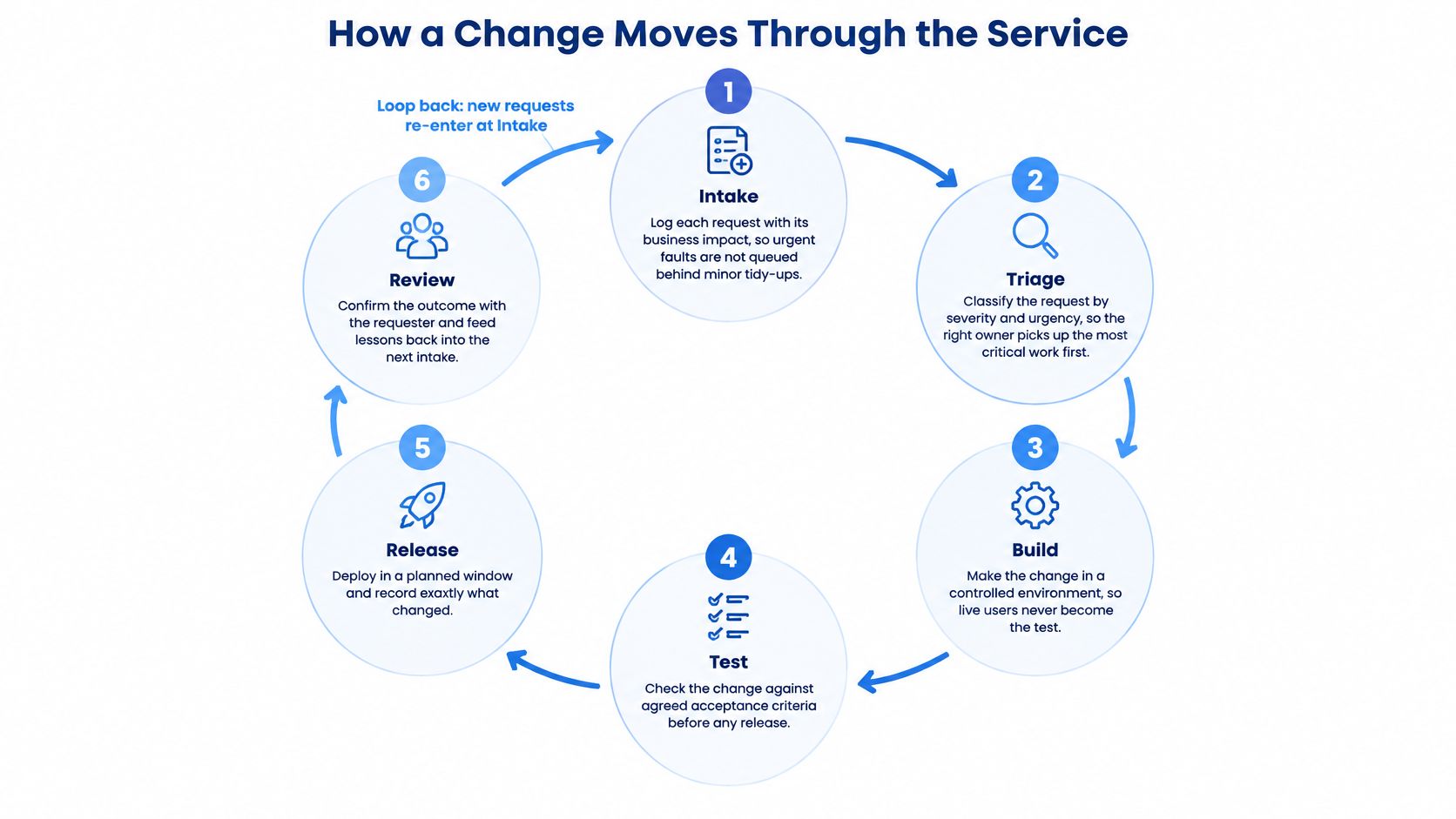
A service is easier to judge when its process can be traced through a real change. The names of the stages vary, but the record should show how a request became an approved, tested release and what happened afterwards.
Intake. Log each request with its business impact. This keeps an urgent production fault from sitting behind a minor tidy-up.
Triage. Classify the item as an incident, defect or enhancement, then set its severity. The classification helps the right owner pick up critical work first.
Specify. Agree the scope and acceptance criteria in writing before code changes begin. This makes the intended outcome clear to the requester and the engineers.
Build and review. Make the change in a controlled environment and have a second engineer review it before merge. Review catches issues that automated checks may miss.
Verify. Run automated tests and staging checks. A named owner should approve changes that affect customers, money or access, so the release decision reflects the risk rather than just a green test run.
Release. Roll out in stages with a tested rollback ready. Staged release limits exposure if the change behaves differently in production.
Observe and learn. Watch the monitors after release, record incidents and feed lessons back into the backlog. This closes the loop instead of treating deployment as the end of the work.
People should remain responsible for consequential decisions. Repeatable checks and routine tasks can be automated, but decisions affecting customers, money, privacy or compliance need human approval. For the Lobang agent, software handles repeatable checks and routine work, while people approve those decisions.
AI-enabled workflows need a release gate of their own. Define the intended task and measurable acceptance criteria, test the model against representative data, record residual risks, and name the owner who decides whether it ships. If testing shows inaccurate results for a material user group, exposure of sensitive information or behaviour outside the approved scope, the release stops until the risk is addressed. NIST's AI Risk Management Framework uses the functions Govern, Map, Measure and Manage to connect accountability, system context, testing and risk response across the lifecycle (NIST's AI RMF Playbook).
Providers may use different labels for these steps. Before judging the process, request a real change record showing its request, reviews, approvals, tests and release history.
Measures That Show Whether the Service Works
Ticket counts and engineering hours show activity, not health. A service can close many tickets while leaving releases risky, recovery slow or customer-facing performance poor. Buyers need measures that show both the pace of delivery and the stability of the application.
The DevOps Research and Assessment (DORA) programme defines two throughput measures and two stability measures. Read them together, by service, before agreeing improvement targets (DORA's delivery and reliability measures).
| Measure | What it captures | How to use it |
|---|---|---|
| Deployment frequency | How often changes reach production | Read it with change failure rate, never alone |
| Change lead time | Time from code commit to successful production deployment | Shorten it through smaller, independently deployable changes |
| Change failure rate | Share of deployments that cause a production failure | Set a baseline by service before any target |
| Time to restore service | How quickly service recovers after an incident | Compare it against the incident timelines the provider shares |
Rising deployment frequency isn't necessarily good news if change failure rate rises at the same time. That combination may mean the team is shipping more often but creating more operational risk. Smaller, independently deployable changes can shorten lead time while limiting the blast radius of a release, but the baseline matters: targets should reflect the product, its architecture and the team's starting point.
Reliability also means more than uptime. User-facing latency, performance and scalability affect whether the application works well for people using it. To verify delivery independently, a buyer should be able to review production telemetry, release history, rollback data and incident timelines, rather than relying only on the provider's summary.
DORA measures are benchmarks, not automatic targets. A service that keeps requirements, code, tests, approvals, monitoring and ongoing tickets connected makes its evidence easier to inspect. Grail Platform keeps those records connected throughout software modernisation work, helping link each release to the request that started it.
Examples of Application Management in Practice
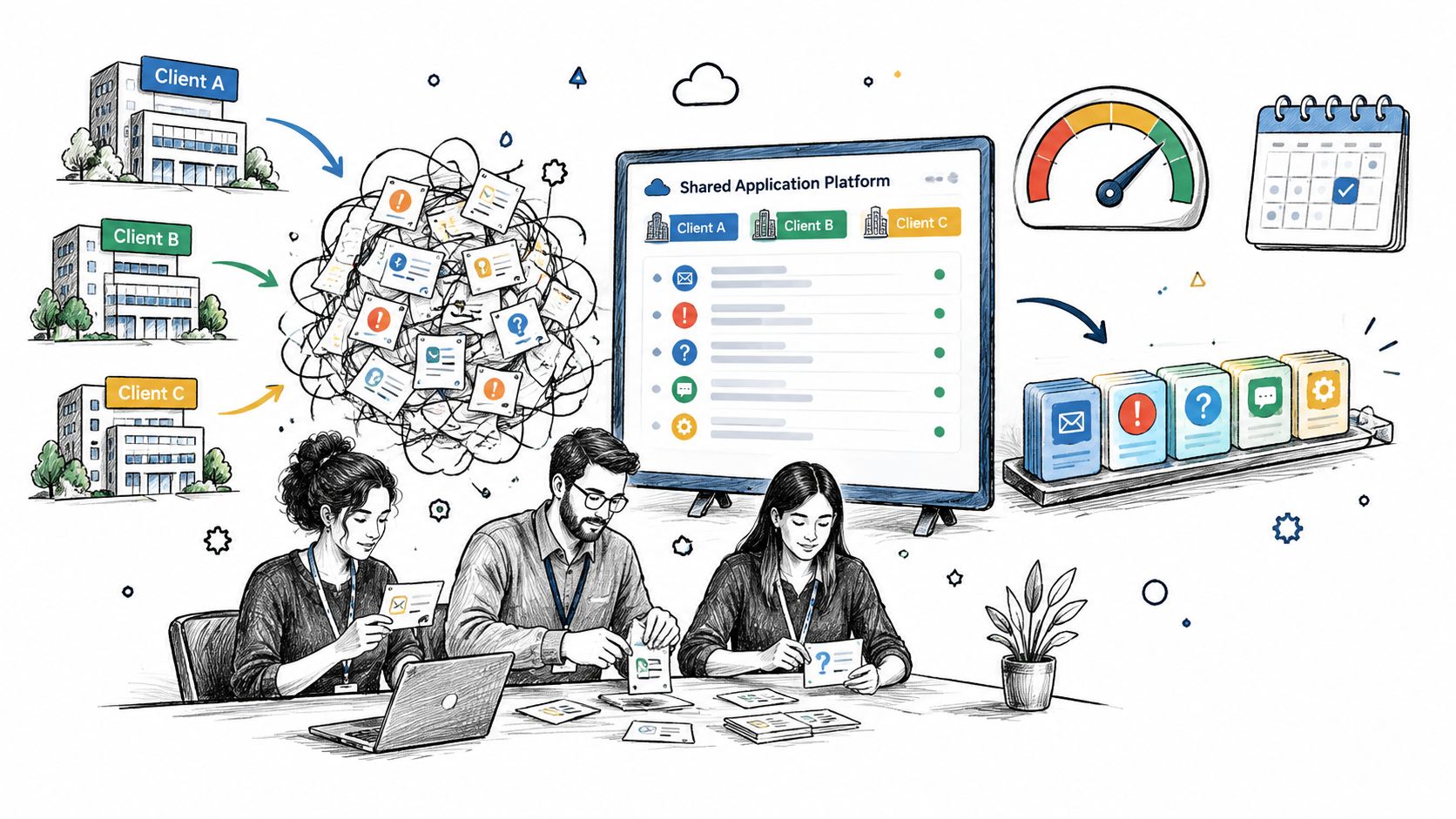
Hypothetical scenario: A private-equity-backed service business runs a workforce scheduling product used by several parties. Releases need manual checks, and no single owner can explain the codebase end to end. A cautious rescue starts with an audit of inherited code and infrastructure, freezes the riskiest changes, then ships fixes in small, tested stages. Live users should not absorb unverified changes.
The work is operational as much as technical. Map dependencies, replace components in controlled stages, validate data in parallel where needed, and keep rollback plans and production monitoring in place. Teams moving away from inherited systems can use legacy system migration services to frame that first stage.
GC Labs has one measured software-rescue example. An Australian healthcare platform had been stuck in development for 8 months with no clear deadline; GC Labs took over from the previous vendor, rebuilt the platform, and had it live in production within 30 days. By day 40, 100 business customers had been onboarded. That shows what explicit ownership can do; outcomes still depend on the platform, data quality and team access.
A Singapore-based neobank testing example raised automated approvals from 44% to 90% after a one-week build. Treat that as test evidence, with production risk still to be proven. A lead automation for a financial-services operator removed a manual routine that took about two hours of admin time each day.
Across these cases, uptime and ticket speed matter; transfer readiness is the harder test. Before signing, ask whether your team could take over in 90 days: who owns code, cloud accounts, CI/CD, credentials, runbooks, tests and incident history, and whether a timed handover drill is part of the contract.
Choosing Between an In-House Team, Project Vendor and Managed Service
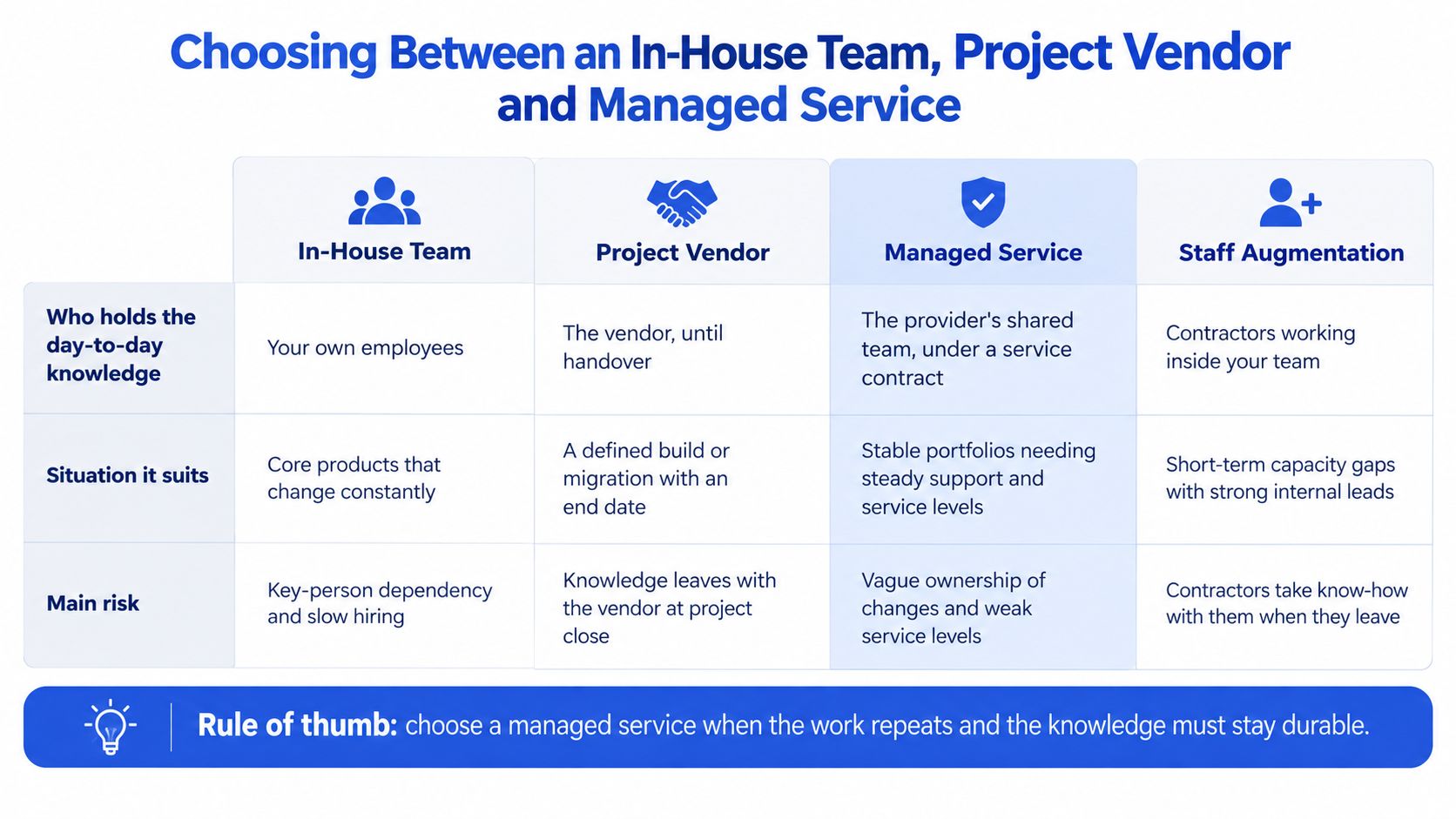
Labels don't tell a buyer who retains knowledge or what happens when the engagement ends. Compare each working model against those questions, then verify the ownership and transfer terms in the actual contract, because that paperwork decides whether another team could take over without disruption.
| Working model | Who holds day-to-day knowledge | Best fit | Main risk |
|---|---|---|---|
| In-house application team | Your own engineers | Long-running product with a steady roadmap and hiring budget | Key-person loss and slow hiring |
| Project-based vendor | The vendor, until the project ends | Fixed build with a clear end date | Knowledge leaves at handover if it isn't planned |
| Managed application service | The provider under contract, with agreed service levels | Steady running and change where internal skills are thin | Lock-in if the customer doesn't own code, cloud access and documents |
| Outcome engagement, then continuous delivery | GC Labs engineers, who keep delivering after the outcome | Stalled or inherited platform needing one accountable owner | Depends on ownership terms and fit with the platform |
A steady product with a long roadmap and the budget to hire engineers often suits an in-house team. The trade-off is concentration: when one or two people hold the system's history, a resignation becomes an operational incident. A project-based vendor can fit a fixed build, provided the handover is planned from the start. Otherwise, operational knowledge may leave with the team that delivered it.
A managed service can suit a product that needs steady operation and change while internal skills are limited. It works well only when the customer retains ownership of code, cloud accounts and documentation, and when the contract spells out how a transfer to another provider would run. Ask for those terms before signing, not when the relationship is already strained.
An outcome engagement fits a stalled or inherited platform that needs one measurable result delivered on a defined timeline, followed by continuous delivery. In GC Labs' model, the same team keeps delivering afterwards, like an in-house technology team. GC Labs describes this as a managed delivery relationship, with the same pod continuing to ship after the build. That is one option, and it suits some products better than others. Each model's risk sits in the contract, so comparing actual terms beats comparing names.
Confirm Ownership and Exit Terms Before You Engage
A service can meet uptime targets and still fail the test that matters at renewal or dispute: whether another team can take over without disruption. Response times show how the provider handles a bad day. Transfer evidence shows whether the customer stays in control after the relationship changes. That makes exit readiness a continuity control that belongs in the procurement review.
Ask for evidence on each item before signing, rather than accepting a general promise of documentation:
Repository and infrastructure ownership. Confirm the customer owns the source repository, cloud accounts and deployment credentials.
Reproducible environments and dependency inventory. Request instructions that allow another team to rebuild the environments, plus a current inventory of application dependencies.
Architecture decisions and runbooks. Ask for recorded design decisions and operational procedures that explain how the application runs and how common incidents are handled.
Tests and recent release evidence. Review test coverage and the test results from the latest release to see what the team verifies before deployment.
Model and data lineage. If the application includes AI components, request the records that show where data came from and how models are used.
Incident history. Ask for the last six months of incident records, including timelines, responses and follow-up actions.
Tested handover. Request a handover plan that another team has walked through in practice, with named roles, access steps and a fallback path if the first transfer stalls.
For regulated sectors, contracts and operating procedures should also address access, customer-information protection, resilience, auditability and exit arrangements. The regulated institution remains responsible for risk assessment and oversight, even when an external provider operates the application. The Monetary Authority of Singapore's guidance treats cloud computing within the outsourcing-risk framework rather than as an automatic prohibition, but it applies to MAS-regulated financial institutions, not every business (MAS guidance on outsourcing risk management). Requirements vary by jurisdiction and sector, so the organisation's compliance team should confirm the applicable rules.
A practical check is to request a sample handover plan and the release record from a recent change, then start with a bounded engagement. Qualified Grail Computer Labs clients can stop within the first 15 days without paying.
Grail Computer Labs handles software rescue for stalled or inherited applications, then offers continuous delivery so the same team can keep improving and operating the codebase. To assess whether that approach fits the platform's ownership and exit requirements, book a call with Grail Computer Labs or discuss an outcome engagement with a 15-day trial.