
10 AI Automation Examples and Where People Still Decide
Ten AI Automation Examples for internal operations, from invoice processing to IT tickets, with the review points where people should still decide.
Most AI automation advice starts with speed. Pick a task, model it, remove the person, count the hours saved. That framing sells tools and breaks processes. The examples that survive production are the ones where someone decided in advance which steps run unattended, which steps stop for a signature, and what evidence the team keeps when the model is wrong.
The pattern is old. A 17-country study of robot adoption between 1993 and 2007 estimated that automation lifted annual labour-productivity growth by about 0.36 percentage points and annual GDP growth by 0.37 to 0.40 percentage points, roughly a tenth of total growth, because firms reorganised production around the machines rather than bolting them onto existing tasks (the 17-country study of robot adoption).
Software follows the same rule. Gartner's September 2025 survey found 75% of organisations piloting, deploying or running some form of AI agent, but only 15% considering, piloting or deploying fully autonomous ones, and just 13% strongly agreeing they had suitable governance. Autonomy isn't the goal. A named owner, a measure and a visible approval point is.
The ten AI automation examples below are internal workflows, not demos. Each one names who owns it, what the team measures, and where the human decision sits. Where a figure comes from a vendor case study or a company announcement, the text says so. An approval that gets rubber-stamped is worse than no approval at all, which is why avoiding rubber-stamped agent escalations is a design problem rather than a policy statement.
1. Accounts payable invoice processing
Invoices arrive as PDFs, scans, email attachments and supplier portal downloads. Someone keys the same supplier name, line items and tax into an enterprise resource planning (ERP) system, matches the invoice to a purchase order and goods receipt, then chases whatever doesn't line up. The work is repetitive, rule-bound and easy to count, which is why it's usually the best first workflow in finance.
The automation itself is unglamorous. Optical character recognition (OCR) and document extraction models read supplier name, invoice number, dates, line items and tax. A matching step compares that output against purchase orders and the vendor master record. Clean matches post themselves. Mismatches queue for a named approver with the discrepancy already highlighted.
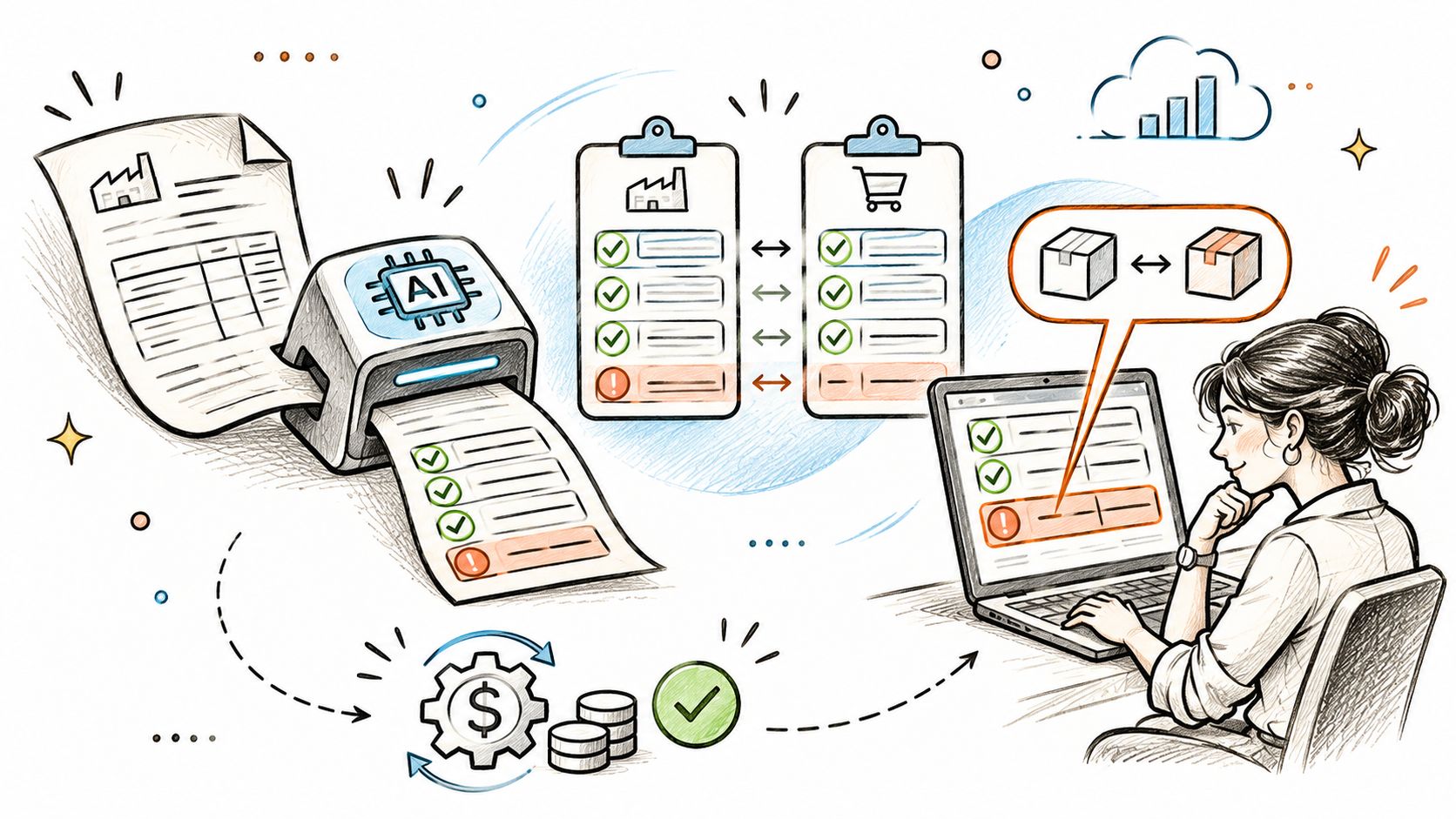
Owner: the financial controller owns the process and the exception queue. Measure: cost per invoice, average days to pay, exception rate by supplier, keying corrections per hundred invoices. Approval point: any payment above a set value, any change to supplier bank details, any invoice with no goods receipt.
The adoption gap is why starting small beats a broad programme. McKinsey's 2025 survey of 1,993 participants across 105 countries found 88% of organisations using AI in at least one business function and only 7% saying AI was fully scaled (McKinsey, The State of AI 2025). Invoice capture moves the second number because the denominator is obvious and the audit trail already exists.
Where the approval sits
Bank-detail changes are the fraud risk, not the invoice total. A model that reads an invoice perfectly still can't tell you that a supplier's account number changed last Tuesday. Route that to a person who has to call a known contact, and keep the evidence attached to the record.
Start with your highest-volume, most standard suppliers. Leave one-off, multi-currency and disputed invoices manual until the exception queue looks boring. If the ERP can't accept structured data without a fight, the constraint is the legacy platform, not the model, and legacy system migration services are often the unglamorous prerequisite.
2. Customer support ticket triage and drafted replies
Support queues contain recurring requests: order status, password resets and refund policy. Triage classifies each message by topic, urgency and customer tier, then routes it to the right queue. Drafting prepares a response using approved knowledge and order data. Triage is usually the safer first workflow. A drafted reply still needs a clear approval point.
Service leaders expect AI to handle a larger share of support work. In the Salesforce State of Service, respondents expected AI to resolve 30% of customer-service cases in 2025 and 50% by 2027. These are expectations, not measured results.
Field-study evidence offers a useful measure of agent assistance. An evidence summary of the support-agent field study reports 5,179 customer-support agents, a 14% increase in issues resolved per hour, and a 34% improvement for novice agents using AI assistance. Results varied by experience, so measure outcomes separately by agent tenure.

For drafted replies, keep the agent in control. The draft should not be sent automatically for requests involving money, complaints, legal terms or vulnerable customers. Set the boundary before launch, and route those cases for human review.
The head of support owns routing rules and reviews a weekly sample of errors. Track issues resolved per hour, first-contact resolution, escalation rate and rework. The approval point should cover refunds, compensation, account closure and legal threats. Clear escalation rules for support teams help keep those decisions with the right person.
3. Identity and onboarding document checks
Digital onboarding for banks, fintechs, marketplaces and healthcare platforms needs identity documents, proof of address and sometimes business registration. Manual review slows approval and produces inconsistent decisions between reviewers and between weeks.
Automated checks use document recognition, face matching and data cross-checks to read the document, test whether it looks authentic, and compare it against the application. Clear cases pass. Borderline or failed cases go to a trained reviewer with the reasons attached.

For a Singapore-based neobank, a one-week build raised automated approvals from 44% to 90% in testing. That's a test result delivered by Grail Computer Labs (GC Labs); production performance depends on live customer data, device signals and the controls around them.
Two numbers, not one
Approval rate alone flatters a system. Watch false rejections and false approvals separately, because a fast system with a high false-positive rate moves cost into the review queue and the contact centre, where it is harder to see.
The NIST AI Risk Management Framework gives a workable scaffold. It asks for human oversight processes to be defined, assessed and documented against policy, with review frequency, owners and monitoring for performance drift. In practice that becomes three tiers. Low-risk requests auto-approve. Medium-risk requests need an operator's confirmation. High-risk requests block or escalate, with the model output, evidence, decision owner and override reason all recorded.
- Set the threshold with risk, not with the product team's enthusiasm, and write down why it sits where it does.
- Provide an alternative route for applicants who can't complete automated checks, or you'll lose real customers in the gap.
- Sample both error types monthly and log the reasons in categories you can fix.
4. Insurance claims intake and triage
Claims handling starts with a notice, documents, photos, a policy check and a decision on payment. The early work is repetitive and rule-bound, which makes it a strong automation target and a risky one, because the decision touches money and someone's bad week.
Intake automation captures the claim through a form, chat or email, extracts facts from documents and photos, checks cover against the policy, then scores the claim for complexity and fraud risk. Simple, low-value claims settle within rules. Complex or suspicious claims reach an adjuster with the evidence already organised.
Lemonade has publicly described automated handling that settles some low-value claims within minutes. Those figures are company-published and cover a narrow claim type. The industrial version of the same discipline is instructive: Rockwell Automation's machine-learning test classified good and bad ball-grid-array connections earlier in assembly, cutting paste-related defects by 51% and reducing time to fix from hours to minutes, according to its own Rockwell Automation case study.
Catching a problem at intake is worth more than catching it at payment. That's as true of a missing policy schedule as it is of a bad solder joint.
Owner: the claims operations manager owns the rules; a named adjuster owns every escalated file. Measure: straight-through settlement rate, time to first decision, leakage, rework, complaint rate. Approval point: settlements above a value limit, total losses, anything flagged for fraud review.
Keep settlement rules narrow at launch, with explicit limits on claim value and claim type. Test fraud scores for bias across customer groups before go-live, not after a regulator asks. And give every automated decision a plain-language reason the customer can read without a translator.
5. Workforce shift matching and scheduling for managed-service businesses
Managed-service businesses (MSPs), non-IT service firms that run a multi-party platform, live or die on matching. Healthcare staffing, care coordination, employment screening and payroll all connect clients with workers, providers or partners, and somebody has to decide who gets the shift.
Coordinators hold the rules in their heads: who's qualified, who's available, who's within reasonable travel, whose licence or training certificate expires next month. Scheduling automation scores candidates on those criteria, proposes matches, sends offers, then tracks acceptance and fills the gaps.
Map the rules before you model them
The failure mode isn't the model. It's the undocumented rule that nobody wrote down, such as a client who won't accept agency staff on Sundays, or a region where two credentials are treated as equivalent in practice. Spend a week with coordinators capturing exceptions in plain language before anyone configures a scoring engine.
Owner: the operations lead owns the matching rules and the override log. Measure: fill rate, time to fill, offer acceptance, unfilled shifts at 24 hours, credential exceptions. Approval point: any allocation outside agreed rules, any worker without a verified credential, any coordinator override.
The platform underneath decides whether any of this ships. An Australian healthcare platform was stuck in development for 8 months with no clear deadline in sight. GC Labs took over from the previous vendor, rebuilt the platform and had it live in production within 30 days; by day 40, 100 business customers had been onboarded. Shift matching on a platform that can't release is a theoretical exercise.
Keep a human override on every automated allocation, logged with a reason. Test data quality before you add scoring, because weak master data makes matching errors almost impossible to trace once offers are going out.
6. Contract and compliance clause review
Legal and procurement teams handle NDAs, supplier terms and customer agreements in volume. The useful test is not whether a model can read a clause. It is whether it can compare the clause with the approved playbook and route exceptions to the right person.
A language model can extract key terms, check them against approved positions, and flag deviations with suggested alternatives. The lawyer still decides. The workflow makes the first review more consistent, while keeping consequential decisions with a named approver.
The reported LawGeex exercise compared its system's NDA reviews with lawyers' reviews on the same test set. Its figures do not establish how well a system handles other contract types, such as a long master services agreement with varied schedules. Treat results from a narrow test as evidence about that test, not a guarantee for your contract queue.
The playbook is the product
A model working from an outdated playbook can repeat outdated positions. The general counsel should own the playbook, review it regularly with the legal team, and use recurring deviation categories to identify where commercial policy needs attention.
Owner: the general counsel owns the playbook and escalation categories. Measure: review turnaround by contract type, deviation rate, playbook updates, and legal hours per hundred contracts. Approval point: a named lawyer signs off on any deviation affecting liability, indemnity, data protection or termination rights.
Start with NDAs and standard supplier terms, where volume is high and variation is limited. Bespoke enterprise agreements are less suited to routine automation because their terms vary more.
Clause analysis is available in legal workflow tools. The choice of tool matters less than defining what counts as a deviation, who resolves it, and how much work can wait in the review queue. Track the queue alongside turnaround: faster first-pass review has little value if exceptions accumulate without an owner.
7. Internal knowledge assistant
Staff lose hours hunting for policies, process notes, past decisions and technical context across wikis, shared drives and ticket histories. An assistant built on retrieval-augmented generation (RAG) answers from retrieved passages in approved sources and cites where each answer came from. That citation is the difference between a checked answer and a plausible one.
Demand isn't the constraint. Microsoft and LinkedIn's 2024 Work Trend Index, based on a survey of 31,000 workers across 31 markets, found 75% of global knowledge workers reporting they use AI at work (Microsoft Work Trend Index). Your people are already doing this with or without permissions. The work is making the answers traceable.
Permissions mirror the source
Access controls must match the source systems exactly. An assistant that can retrieve a board pack for anyone who asks is a data incident with good manners. Test the permission model with real users from different teams before launch, not with an administrator account.
Morgan Stanley has publicly described an assistant built with OpenAI that helps its financial advisers search internal research and its document library, built on the firm's own curated content. The curated content is the interesting part, not the model.
- Clean the top 100 most-used documents first. Everything downstream inherits their quality.
- Assign an owner per knowledge area who approves updates and answers escalations.
- Log unanswered questions weekly. They map exactly where documentation is missing.
Owner: a named knowledge owner per domain, coordinated by whoever runs internal systems. Measure: questions answered without escalation, citation accuracy on a weekly sample, repeat questions per team. Approval point: nothing customer-facing sends automatically; anything touching policy, pricing or legal terms routes to the owner. Pipeline work is where projects stall, and the agentic software development life cycle is a useful model for keeping retrieval, evaluation and release in one loop.
8. IT service desk ticket routing and resolution
IT service desks run on repeats: password resets, access requests, device faults, licence queries. Automation classifies each ticket, routes it to the right team, and resolves known request types through scripted workflows. Anything that doesn't match a known pattern reaches an engineer with a summary and the steps already attempted.
Multi-step agentic work is where the bigger claims live. McKinsey describes agentic AI as systems that plan and execute multiple steps across workflows involving several actors, and its analysis estimates time savings of 20% to 40% and backlog reductions of 30% to 50% in suitable workflows, while warning that coordination friction and limited adaptability can eat those gains (McKinsey on agentic AI). Those are estimates. Measure each stage separately: touchless completion, cycle time, rework, error rate, escalation volume, backlog.
Automate the top ten requests
Volume data tells you where to start, and it usually isn't the use case that excites anyone. Password resets, software licences and standard access grants are boring, high-volume and well-bounded, which is precisely why they work.
Owner: the service delivery manager owns routing rules and resolution scripts. Measure: share of tickets resolved without a human, mean time to resolve, misroute rate, reopen rate. Approval point: anything granting expanded access, anything touching production systems, anything a script can't verify against a system of record.
- Rank by ticket volume, not by how clever the use case sounds.
- Keep approvals on high-level access regardless of the time saved.
- Review misroutes weekly and adjust the rules while the pattern is still fresh.
ServiceNow's Now Assist features summarise tickets and suggest resolutions inside its platform, and Atlassian's Jira Service Management includes automation rules for routing and standard requests. Whichever you run, application management services work best when the routing logic is documented and owned rather than buried in a consultant's head.
9. Sales lead qualification and CRM data hygiene
Sales teams receive more leads than they can work, and CRM records decay as contacts change roles and companies. Automation enriches new leads with company data, scores them against an agreed ideal customer profile, drafts a first response, updates records, flags duplicates and reminds owners about stale opportunities. Reps still run the qualification call and the pricing conversation.
Score, don't decide
The approval point is the offer, not the ranking. Automation can order the queue and draft the outreach. A person decides who gets a discount, a pilot or a contract, because those decisions carry commitments the model can't see.
Owner: the head of revenue operations owns the scoring model and the enrichment sources. Measure: speed to first contact, conversion by score band, duplicate rate, share of records with a current owner, forecast accuracy. Approval point: any pricing, discount or contractual term, and any lead marked disqualified by the model without a human glance.
A score nobody tests is decoration. Compare conversion for scored and unscored leads every quarter, and retire the model when the lift disappears.
Salesforce Einstein offers lead scoring and opportunity insights inside its CRM, and HubSpot includes predictive scoring and duplicate management. Both inherit whatever data discipline your team already has. Check a sample of enriched records by hand before anyone forecasts from them, and revisit the ideal customer profile with sales leaders each quarter, because the market moves faster than the model.
10. Recruitment screening and candidate communication
A fast recruitment process can still make poor decisions. Teams handle application volumes, arrange interviews and send updates, but screening for interview invitations carries the risk of reproducing historical bias.
Reuters reported that Amazon scrapped an experimental CV screening tool after it penalised CVs containing the word “women's” (Reuters report). The EU AI Act classifies certain AI systems used in recruitment as high-risk, with obligations for relevant uses connected to EU hiring (EU AI Act text).
Automate the admin, not the decision
Owner: the head of talent acquisition owns the process and adverse-impact review. Measure: time to hire, interview-to-offer ratio, candidate drop-off, and differences in outcomes across gender, age and ethnicity. Approval point: a trained reviewer makes every shortlisting and rejection decision. Automation can schedule interviews, capture structured information and send status updates.
- Start with scheduling and communication. These tasks are frequent and have clear outputs.
- Check screening models for disparate outcomes before use and at regular reviews.
- Tell candidates when automated tools are used and provide a route to a human.
Unilever has described using AI-assisted assessments and video interviews in graduate hiring, reporting shorter hiring times. Keep an audit trail that records who made each hiring decision. The measure shows whether the process is faster; the reviewer retains authority over who progresses.
How the ten AI automation examples compare on decision points and measures
The headline benefit is only half the comparison. A useful test is what the first review step catches, and what measure should improve before the workflow expands. The table adds that comparison without repeating each example's owner, approval point, and outcome measure.
| Example | First review step | Early signal to check |
|---|---|---|
| Accounts payable invoice processing | Check extracted fields against the invoice before payment approval | Whether exceptions are caught before payment |
| Customer support ticket triage and drafted replies | Sample routed tickets and check drafts against approved knowledge | Whether incorrect or outdated answers are flagged |
| Identity and onboarding document checks | Review borderline documents and compare them with the evidence provided | Whether the review queue contains cases needing human judgement |
| Insurance claims intake and triage | Examine flagged claims for clear reasons and relevant evidence | Whether complex or suspicious claims reach a reviewer |
| Workforce shift matching and scheduling for managed-service businesses | Check proposed matches against worker availability and qualifications | Whether proposed shifts need frequent correction |
| Contract and compliance clause review | Compare flagged clauses with the relevant playbook and contract context | Whether reviewers identify missed or irrelevant flags |
| Internal knowledge assistant | Check answers against the approved source and access permissions | Whether users can resolve queries without relying on unclear sources |
| IT service desk ticket routing and resolution | Review ticket category, destination and any proposed access action | Whether tickets are misrouted or sensitive actions need approval |
| Sales lead qualification and CRM data hygiene | Check enriched records and lead scores against the underlying account context | Whether records need correction before qualification |
| Recruitment screening and candidate communication | Review candidate communications and structured data for accuracy | Whether updates are timely without automating shortlist decisions |
These checks reveal different failure patterns. Invoice review focuses on extracted evidence before money moves. Support and knowledge checks test whether answers match approved information. Identity, claims and recruitment need careful handling of borderline decisions, while contract review depends on context that a clause flag may miss.
For scheduling, routing, sales records and service requests, the first review should expose bad inputs or unsuitable recommendations before they affect allocation, qualification or access. Set the review step before go-live, then track the early signal alongside the workflow's existing measure. If reviewers cannot explain why an item was flagged, or repeatedly correct the same output, improve the evidence, rules or routing before widening use.
Choosing a First Workflow and Keeping Review Points Visible
A strong first AI workflow is repetitive, draws on clear evidence, has a visible owner and includes an obvious approval point. Invoice processing, support triage and service desk routing can meet these conditions. Their short feedback loops make it easier to review exceptions and measure results.
Choose a workflow the owner can explain in plain language. Keep the exception queue small enough to review and categorise, and make the approval boundary explicit to the business stakeholders who will use it. If any of these conditions is missing, resolve it before expanding the workflow. Otherwise, unclear steps and exceptions can become harder to manage at greater volume.
Measure the denominator before you automate
Record baseline cost per invoice, claim and ticket before go-live. Track error rates and false rejections by type as well, since one overall accuracy figure can hide specific failures. Compare the same measures at 30, 60 and 90 days. The workflow owner should also track whether the approval point is working as intended.
Adoption affects the outcome. Wavestone's 2025 global AI survey found only about 30% of users had meaningfully changed how they worked, with unclear return-on-investment measurement affecting 22% of organisations; where change management was weak, expected efficiency gains fell to 31% (Wavestone global AI survey 2025). Automating an unchanged process can add cost without delivering savings, so assign an owner to the process changes as well as the workflow.
Plan for employment effects alongside efficiency. Written evidence submitted to the UK Parliament reports that moving a US industry from zero to ten robots per 1,000 workers was associated with a 12.5% increase in value added, a 6.25% reduction in employment and a 5-percentage-point decline in labour share, while UK vehicle manufacturing tripled vehicles per person between 1984 and 2016 and still grew employment from about 124,000 in 2011 to over 150,000 in 2016 (written evidence to the UK Parliament). Outcomes differed across settings. Name an owner for the change, and plan governance and retraining alongside the workflow.
An outcome engagement can set one measurable, verifiable result for delivery in 4 to 8 weeks, with a 15-day trial for qualified clients. Start with a workflow that has a named owner, a measure and a reviewable exception queue.
A working workflow depends on a traceable evidence trail, a clear approval boundary and an owner for exceptions after launch. Grail Computer Labs' software rescue and Software Factory support work on software and AI projects, while preserving decisions and their reasoning. Clients own the code, models and documentation. Bring one workflow with a real owner and approval point to Grail Computer Labs to assess whether it is ready to automate.