
Application Delivery Solutions: A Plain-English Guide
Learn what application delivery solutions do, how their core functions and release pipelines work, and how to spot gaps in your platform.

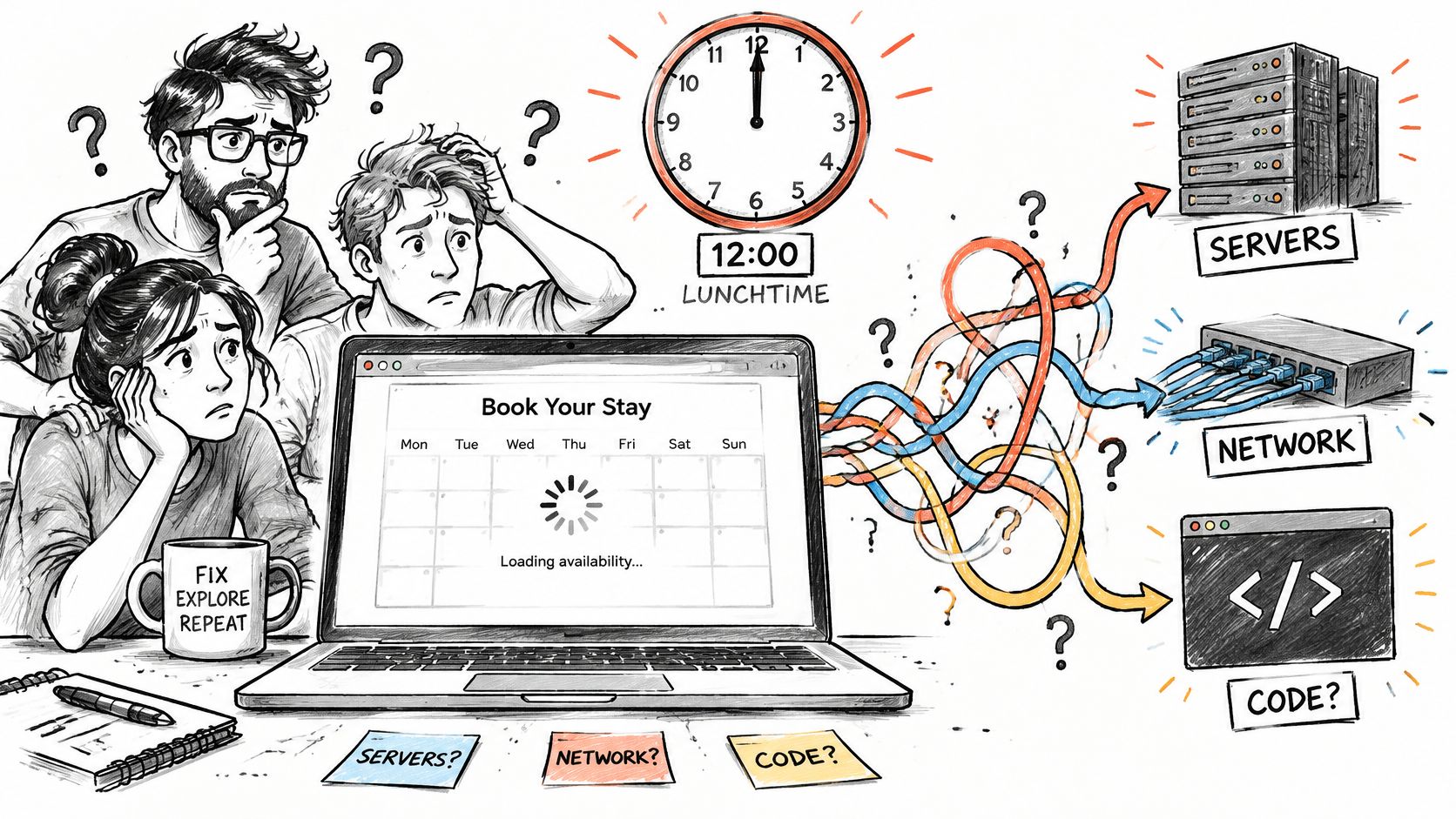
A booking page slows at lunchtime. Customers retry, operations staff field complaints, and the engineering team can't tell whether the bottleneck sits in the servers, the network or the application code. Buying more capacity might help, but nobody can explain which part needs it.
Application delivery solutions help teams control that path. For founders, technology leaders and operations owners, the important question isn't which product moves traffic fastest. It's which combination of infrastructure, release controls and accountable ownership keeps the application dependable while the team changes it.
What Application Delivery Solutions Do and Where They Came From
Consider that hypothetical booking platform. A customer submits a reservation, but the request reaches an overloaded server while another server sits available. The application might work correctly, yet the customer still experiences a failure because the delivery layer made a poor routing decision.
An application delivery solution sits between users and application servers. It decides how requests are routed, accelerated, secured and kept available. The airport analogy is useful: the control tower and gates coordinate movement, while the planes and runways do the underlying work.
From traffic distribution to application control
The layer has three practical jobs:
- Route requests: Send work to a server that can complete it.
- Protect access: Secure connections and filter requests before they reach application logic.
- Maintain a steady experience: Adjust routing as demand changes or components fail.
Early load balancers mainly distributed traffic across servers. As web applications became more important, teams added acceleration, protocol optimisation, encryption offload and web-application protection.
A milestone documented in F5's application delivery history came in 2004, when F5 introduced BIG-IP Local Traffic Manager on its TMOS platform as an integrated application delivery controller (ADC). Routing could use application-layer information, rather than network addresses alone, bringing performance, availability and security together in the traffic path.
Products need operating practices
The category now includes hardware appliances, virtual software, cloud deployments and distributed edge services. Those products still need people to define health checks, failover rules, security policies and release routing.
That distinction matters for managed-service businesses (MSPs), meaning non-IT service firms whose platforms connect customers with workers, providers or partners. A reachable server doesn't establish that the whole multi-party workflow works.
Practical test: If nobody can identify which layer handles a failing request, the delivery gap extends beyond server capacity.
Application delivery is therefore a control point, not merely a traffic divider. Its value depends on whether the team can understand and change what happens along the request path.
The Core Functions and When Each One Matters
The following map connects each function to an observable need. Secure Sockets Layer (SSL) and Transport Layer Security (TLS) refer to connection encryption. An application programming interface (API) lets another application call a platform's functions, while Hypertext Transfer Protocol (HTTP) carries web requests and responses.
Core functions, what they do and when they're needed
| Function | What it does | Needed when |
|---|---|---|
| Traffic distribution (load balancing) | Spreads requests across healthy servers | Two or more servers serve one application |
| Health checks and failover | Removes failing servers from rotation and reroutes requests | Failure of one node would hurt users |
| SSL/TLS offload | Handles encryption at the edge so servers focus on application logic | Encrypted traffic is high-volume or certificates are managed centrally |
| Web application firewall (WAF) | Filters malicious HTTP requests before they reach the application | The application is public or handles personal or payment data |
| Caching and compression | Serves repeated responses and shrinks payloads | Responses repeat often and bandwidth costs matter |
| Connection multiplexing | Reuses backend connections across many client requests | Backend connection limits cap throughput |
| Global server load balancing | Routes users to the nearest or healthiest region | Users or data centres span more than one region |
| API gateway and rate limiting | Applies authentication, quotas and routing to API calls | Partners or mobile apps call APIs directly |
Match the function to the failure
A sensible starting point for a replicated, encrypted application is traffic distribution, health checks and connection protection. Health checks deserve particular care. A process can be running while a dependency needed for bookings is unavailable, so a useful check should establish readiness without creating extra load.
Encryption offload centralises certificate handling, but the team must still decide whether traffic between the delivery layer and application servers also needs encryption. A firewall adds request filtering, not permission to skip application security testing.
Caching needs equally clear boundaries. A shared product catalogue may suit caching; a customer's private account response needs stricter handling. Compression helps with payload size, whereas multiplexing addresses the cost of opening and maintaining backend connections.
Add complexity only for a reason
Global routing becomes relevant when geography affects availability or response time. An API gateway becomes useful when external callers need consistent authentication, quotas and routing policies.
Products often bundle several functions. Buying the bundle doesn't mean every feature should be enabled immediately, particularly when nobody owns its configuration.
The operational side belongs alongside application management services, including monitoring, maintenance and incident responsibility. The useful ownership question is simple: which functions already exist on the platform, and who maintains each one?
Choosing a Deployment Model Without Overbuying
A booking service can move to a provider-run delivery service and still fail the same way it failed in the data centre. Routing works on day one. The certificate expiry, the capacity limit, and the failover call still land on whoever was named, or on nobody.
Deployment ownership matters more than deployment fashion. The same routing policy creates different operational obligations depending on where it runs. Treat that location as the control point for speed and stability together: faster releases only stay stable when patching, limits, and failure response already have an owner.
| Model | Where it runs | Patching and capacity | Failure ownership |
|---|---|---|---|
| Hardware appliance | An organisation's data centre | Internal team maintains the appliance; capacity changes require infrastructure planning | Internal infrastructure team |
| Virtual edition | A managed virtual environment or cloud account | Team patches software and adjusts allocated resources | Named platform or infrastructure team |
| Cloud or edge service | Provider-operated infrastructure | Provider maintains the service; customer configures policies and service limits | Shared responsibility, with explicit escalation |
A hardware appliance works like equipment you keep in your own building. Your team patches it and plans every capacity change. A virtual edition is closer to a rented room: you still patch the software and resize what you were allocated. A cloud or edge service is closer to a managed lobby. The provider runs the infrastructure. You still set the policies and the service limits, and you still need a named escalation path when customers are affected.
IMARC Group's market estimate valued the global ADC market at USD 3.9 billion in 2025. That figure describes category spending. Fit for one platform still depends on where the application runs and which team can carry failure.
A selection sequence
- Locate applications: Record where each application and dependency runs today.
- Identify essential functions: Separate immediate requirements from possible future needs.
- Assign ownership: Name the team responsible for certificates, configuration and failover.
- Test the fit: Match the model to that team's operating capacity, then test representative traffic.
During legacy system migration, the delivery layer may need to route between old and replacement components. That transitional route can matter more than the preferred final architecture.
AI-accelerated delivery sends more changes through this same control point. If certificates, configuration, and failover have no named owner, each faster release adds another unowned change. A managed service reduces some maintenance work. The customer still owns application policy and customer outcomes.
Reading Performance Figures Without Being Misled
The headline performance figure can be the least useful number on a specification sheet. Without test conditions, it describes a benchmark rather than the application's likely capacity.
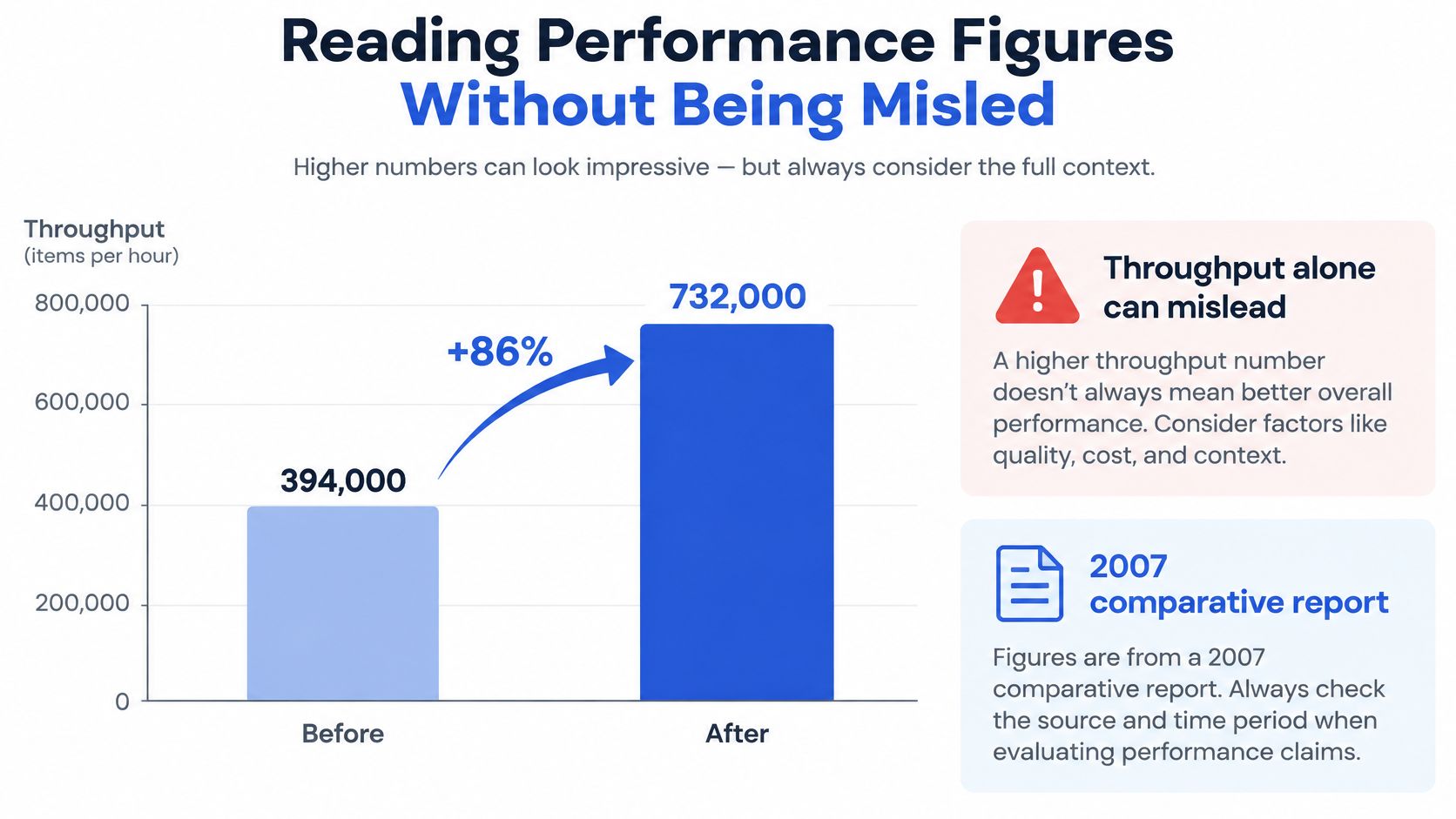
A 2007 comparative ADC performance report recorded the following results for an F5 BIG-IP 8800 under its stated configurations. These historical figures demonstrate trade-offs, not current product capacity.
Figures from a 2007 comparative test and what each depends on
| Test condition | Reported result | How to read it |
|---|---|---|
| HTTP, one request per connection, 128-byte response | 394,000 requests per second | Connection setup cost limits throughput |
| HTTP, 10 requests per connection | 692,000 requests per second | Reuse spreads connection setup work across requests |
| HTTP, unlimited requests per connection | 724,000 requests per second | Gains flatten once reuse is high |
| Largest response size | 7 Gbps | Bandwidth, not request count, can set the ceiling |
| New SSL transactions | Up to 48,300 per second | Encryption is a separate capacity limit |
The same device produced substantially different request rates when connections were reused. Opening a connection involves work; sending more requests over an existing connection changes how much of that work is incurred per request.
The large-response result measures another constraint. An application returning documents can run into bandwidth limits even when its request count looks modest. New encrypted connections introduce another workload again.
Test the application's workload
A useful capacity test includes:
- Response sizes: Realistic payloads, including larger responses.
- Connection patterns: A representative balance of new and reused connections.
- Encryption workload: The certificate and connection behaviour used in production.
- Enabled features: Security inspection, routing policies, compression and logging.
- Failure conditions: Traffic behaviour while a backend becomes unavailable.
The buyer should obtain full benchmark conditions rather than accept a headline figure. Then the engineering team should run a load test against representative application journeys, including the slower dependencies those journeys require.
A benchmark measures a configured system under a defined workload. It isn't a promise about an unfamiliar application.
The decision depends on a concrete description of peak traffic: payload size, connection reuse, encryption and required features. Without that description, extra nominal capacity may address the wrong bottleneck.
How a Safe Release Path Works, Step by Step
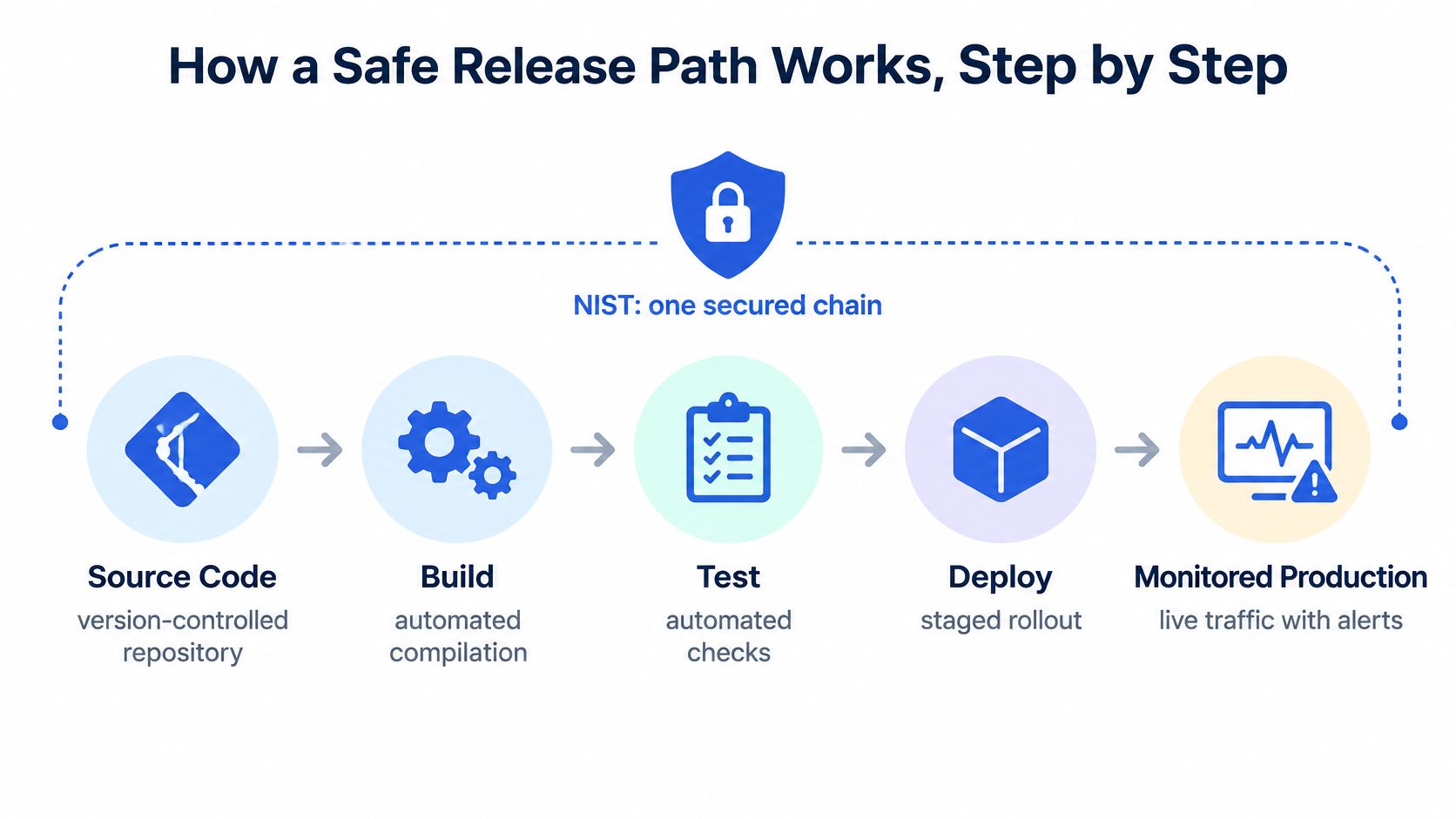
Delivery extends from versioned source code to monitored production, not just the moment traffic reaches a server. A safe release routine makes each transition repeatable and gives the team a controlled way to stop.
Build once and identify the artefact. Package the application and give the package an immutable identifier. The tested package should be the package released, rather than a fresh build assembled later.
Run automated checks before promotion. Execute application tests, dependency checks and security scans. A failing required check should stop the pipeline instead of becoming a note for someone to remember.
Separate database changes from application rollout. Use backward-compatible schema changes so the previous application version can continue working during transition. Destructive cleanup should wait until older code no longer relies on the affected structure.
Release to a controlled audience. A hypothetical canary might receive 1 to 5 per cent of eligible traffic; those percentages are illustrative, not a recommended benchmark. The initial audience should limit exposure while still exercising meaningful behaviour.
Compare the canary with the baseline. Examine error rates, latency, resource use and business correctness. A fast response that records the wrong booking is still a failed release.
Stop automatically when agreed thresholds fail. Otherwise, widen the rollout in stages. The team should establish the decision rules before deployment pressure makes judgement harder.
Keep the chain reproducible
The National Institute of Standards and Technology's DevSecOps guidance treats development, security and operations as a secured software-supply-chain workflow. Its guidance covers automated deployment, protected artefacts, configuration management and controls across the delivery pipeline.
For continuous integration and continuous delivery (CI/CD), reproducibility means preserving source versions, dependencies, infrastructure definitions, configuration and test evidence. An operator shouldn't need to reconstruct a release from memory.
Apply the same discipline to agent behaviour
When a release includes artificial intelligence (AI) agents, deployment checks also need to cover permissions, tool access and actions with external effects. DBotMaker's safe AI agent deployment guide provides a resource for teams examining that deployment boundary.
An agentic software development life cycle also needs clear separation between generated work and authorised release decisions. Generation alone isn't verification.
When a fault appears, traceability should identify the exact artefact, configuration and migration state involved. That evidence lets engineers investigate a specific change rather than debate which version might be running.
Choosing What to Measure for Each User Request
Infrastructure availability isn't the same as a completed customer task. In a hypothetical booking system, a data store may be reachable while the records needed to reserve an appointment remain unavailable. The infrastructure dashboard stays green, but bookings fail.
A service-level indicator (SLI) measures behaviour from the user's perspective. Google's guidance on implementing service-level objectives distinguishes successful responses, latency and response quality from infrastructure status; for pipelines, freshness, correctness and coverage are more appropriate.
Turn journeys into measurable objectives
- Select critical journeys: Begin with a small set, such as login, booking and payment, rather than every endpoint.
- Choose an indicator: Define what counts as a good outcome for each journey. Include correctness where a technically successful response could still mislead the customer.
- Agree an objective: A service-level objective (SLO) sets the target share of good outcomes over an agreed period. The business owner should help define acceptable behaviour.
- Connect release decisions: Use the same user-visible indicators when deciding whether a canary should proceed.
- Review the baseline: Revisit results monthly, changing targets only with evidence about actual traffic and business consequences.
Working assumption: Initial SLO targets are hypotheses to test, not universal benchmarks.
Separate objectives may be needed for customer-facing workflows, critical APIs and asynchronous jobs. A background report can tolerate a different delay from an interactive payment confirmation.
An error budget expresses the reliability headroom available under an objective. When changes consume that headroom, the team should reduce release scope or frequency until service recovers. This turns reliability into an operating decision rather than a general aspiration.
Tracking Speed and Stability Together
An inherited platform ships every day but spends most of the week repairing release failures. The calendar looks busy. Customers still wait on the same unfinished work, because each deploy is followed by another repair cycle.
Treat delivery as a control point, not a speed contest. Throughput and stability have to move together. If those controls are thin, faster coding, including AI-assisted coding, feeds more change into the same weak path. The release rate rises, and the repair load rises with it.
The DORA delivery metrics framework groups five measures into throughput and instability, and added deployment rework rate in 2024 to separate unplanned bug-fixing work from planned change. Those findings support improving speed and stability as one system rather than as opposing goals.
DORA delivery metrics and the question each one answers
| Metric | Group | Question it answers |
|---|---|---|
| Change lead time | Throughput | How long does a change take from commit to successful production deployment? |
| Deployment frequency | Throughput | How often do changes reach production? |
| Failed-deployment recovery time | Throughput | How quickly is service restored after a failed deployment? |
| Change-fail rate | Instability | What share of deployments cause production failures? |
| Deployment rework rate | Instability | What share of deployments are unplanned bug fixes? |
Read the measures as a set
A dashboard with one green number works like a speedometer with no fuel gauge. Deployment frequency can climb because work was split into smaller releases, while the product outcome stays flat. Short lead time looks strong until repeated failures pull engineers into emergency repair.
Recovery time tells a different story. One team ships a bad change and restores service through a practised path. Another ships rarely and still takes a long time to recover.
Rework shows the effort a release count hides. When engineers keep repairing behaviour they just shipped, priorities slip and delivery dates become guesses.
Establish a usable baseline
Before changing an inherited codebase, define how each metric will be captured and what counts as a production failure. Then set targets across both groups and review the trends monthly.
Release records, incident timelines, and production telemetry make those numbers usable. Continuum Solutions' resource on application performance monitoring for enterprises helps when a team needs to connect runtime behaviour with investigation and debugging.
Keep the comparison inside the same team and service. Its own history is more useful than a ranking against teams with different architectures, risks, and release duties.
For a buyer, the healthy pattern is rising deployment frequency with falling failure and rework rates, and recovery that does not slow down. Frequent deployments only count as better delivery when failure and rework rates fall.
Why Faster Delivery Can Mean More Incidents
A common leadership assumption is that AI coding tools make development faster, so delivery problems should disappear. That skips the controls between producing code and operating a dependable service.
According to Google's summary of the 2025 DORA report, 90% of technology professionals reported workplace AI use, and more than 80% perceived productivity gains, yet AI adoption remained negatively associated with delivery stability. Association doesn't establish that AI causes incidents, but it challenges the idea that faster code production automatically improves production outcomes.
Examine what existing controls miss
In a hypothetical team, merge volume rises while review attention stays fixed. Reviewers spend less time checking business assumptions, and defects reach production despite passing tests.
The missing safeguards may be:
- Escaped-defect tracking: Record which failures were discovered only after release.
- Test adequacy: Check whether tests cover business rules, not merely executable code.
- Observability coverage: Confirm that critical journeys produce enough evidence to detect incorrect behaviour.
The NIST AI Risk Management Framework offers a useful operating structure: Govern assigns responsibility, Map documents intended use and risks, Measure evaluates behaviour, and Manage organises mitigation and incident response. Applied to delivery, these functions keep accountability attached to AI-assisted changes.
Treat exposure as an operating risk
IBM's global breach report reported an average breach cost of USD 4.44 million in 2025, down 9% from USD 4.88 million in 2024. These averages describe surveyed incidents, not a forecast for an individual company.
For healthcare, IBM's sector findings put average breach cost at USD 7.42 million, with an average 279 days to identify and contain a breach.
Breach costs aren't measurements of release quality. They establish why access controls, monitoring and recovery deserve operating attention. AI acceleration can increase the consequences of weak ownership and verification, so control design should precede promises of faster delivery.
Check Your Delivery Gaps Before You Choose a Setup
A release board looks fine on Friday. On Monday an AI-assisted change reaches production faster than last quarter, and the on-call engineer cannot name who approved the route, the failover, or the rollback. The faster path did not invent that gap. It exposed a missing control while users were already on it.
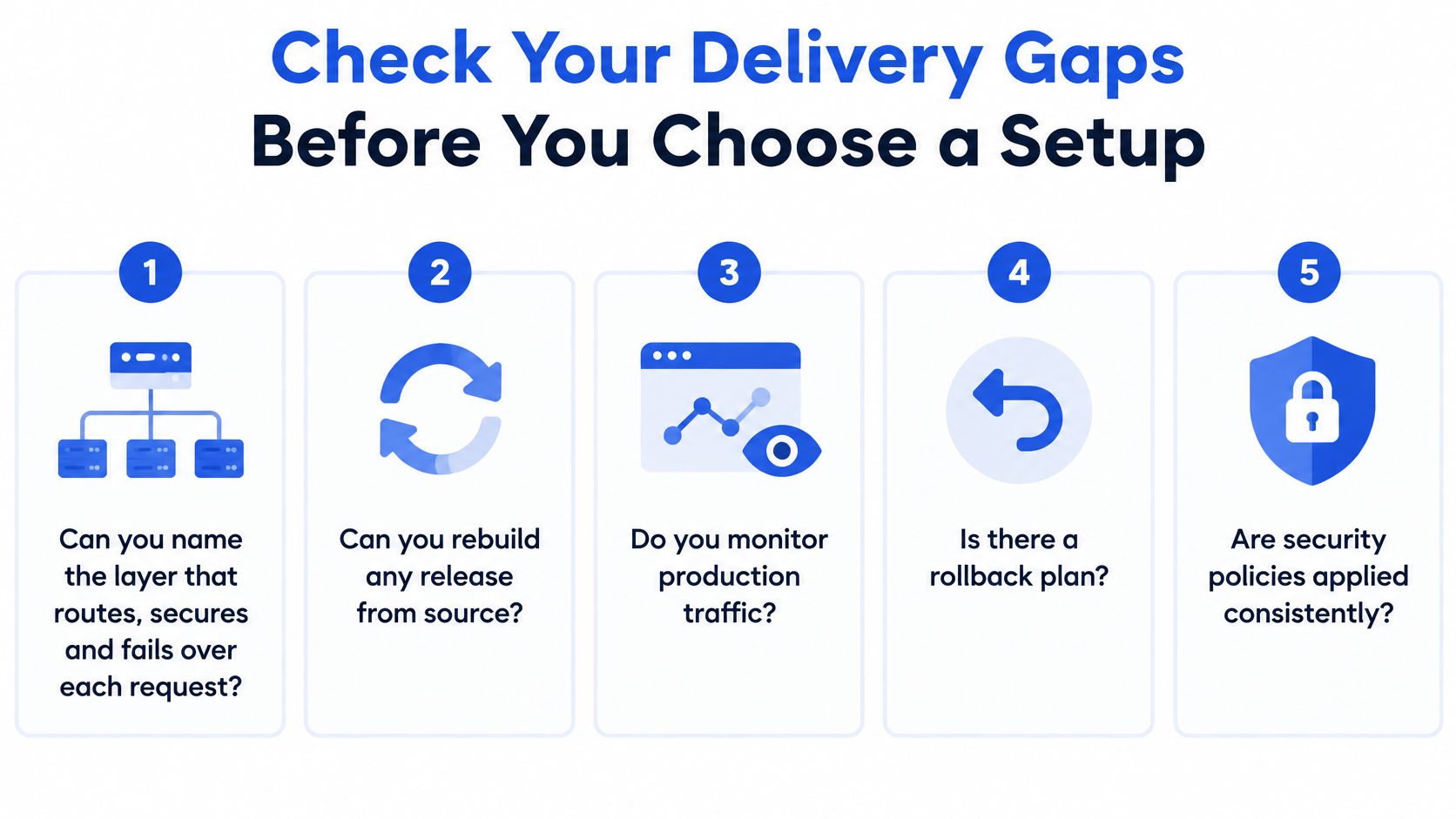
A readiness review gives founders, engineering leaders, and private equity operating teams a better starting point than a product shortlist. Each answer should name an owner or point to evidence, not a verbal assurance. Treat the list like a pre-flight check: a faster aircraft still needs a named pilot and a tested way back to the gate.
- Request ownership: Can the team name the layer that routes, secures, and fails over each request?
- Reproducibility: Can a production release be rebuilt from versioned artefacts and configuration?
- Delivery visibility: Are delivery metrics tracked for each relevant team or service?
- Recovery readiness: Can a release be rolled back in minutes, and has that capability been tested recently?
- Production accountability: Is responsibility for incidents assigned in writing?
- Business verification: Do tests cover business rules and complete user journeys?
Resolve responsibility before adding products
Several negative answers show an ownership problem as much as a tooling problem. A new controller will not clarify requirements, repair weak architecture, or decide who may change production.
Speed and stability share one control point: the path from a request to a live release. When product context sits in meetings, release responsibility is unclear, and nobody controls that whole path, an AI-accelerated loop ships unclear changes more often. It does not make them safer. Some gaps the internal team can close, such as written incident ownership or a rollback drill. Others need a change in who is responsible for the product, codebase, infrastructure, testing, and production.
Grail Computer Labs takes over an existing build in that second case, including work stalled with a previous vendor, and becomes responsible for that path to production.
Separate those two kinds of gap before you choose a setup. Product selection follows that decision.
For organisations with unresolved delivery gaps, Grail Computer Labs offers an outcome engagement: one pre-defined, measurable outcome delivered in 4–8 weeks, with a 15-day trial during which qualified clients can stop without paying. Visit Grail Computer Labs to book a call about the stalled workflow, production risk, or ownership gap that needs resolving.