
Business Process Management: A Practical Guide for 2026
Business process management explained: its lifecycle, governance model and how teams use it for ongoing operational improvement in 2026.
The operations lead says customer onboarding takes five working days. The account manager says three weeks. Both are describing the same workflow, and neither is making it up. One is reading the system of record, the other is counting the days until the customer can log in.
That gap is where business process management begins. Not with a modelling tool or a software licence, and not with a slide titled target operating model. It begins with agreeing what happens, in what order, who owns each step and which steps keep going wrong.
Teams that skip that agreement often buy software instead. The software then runs an undefined process at speed, and the arguments get faster too.
Business Process Management Defined in Plain Terms
A supplier invoice arrives. Accounts payable codes it, a procurement reviewer checks it against the purchase order, the budget holder signs it off, someone keys it into the finance system, and it waits for the next payment run. Every person in that chain is doing their job properly. The invoice still takes three weeks to pay.
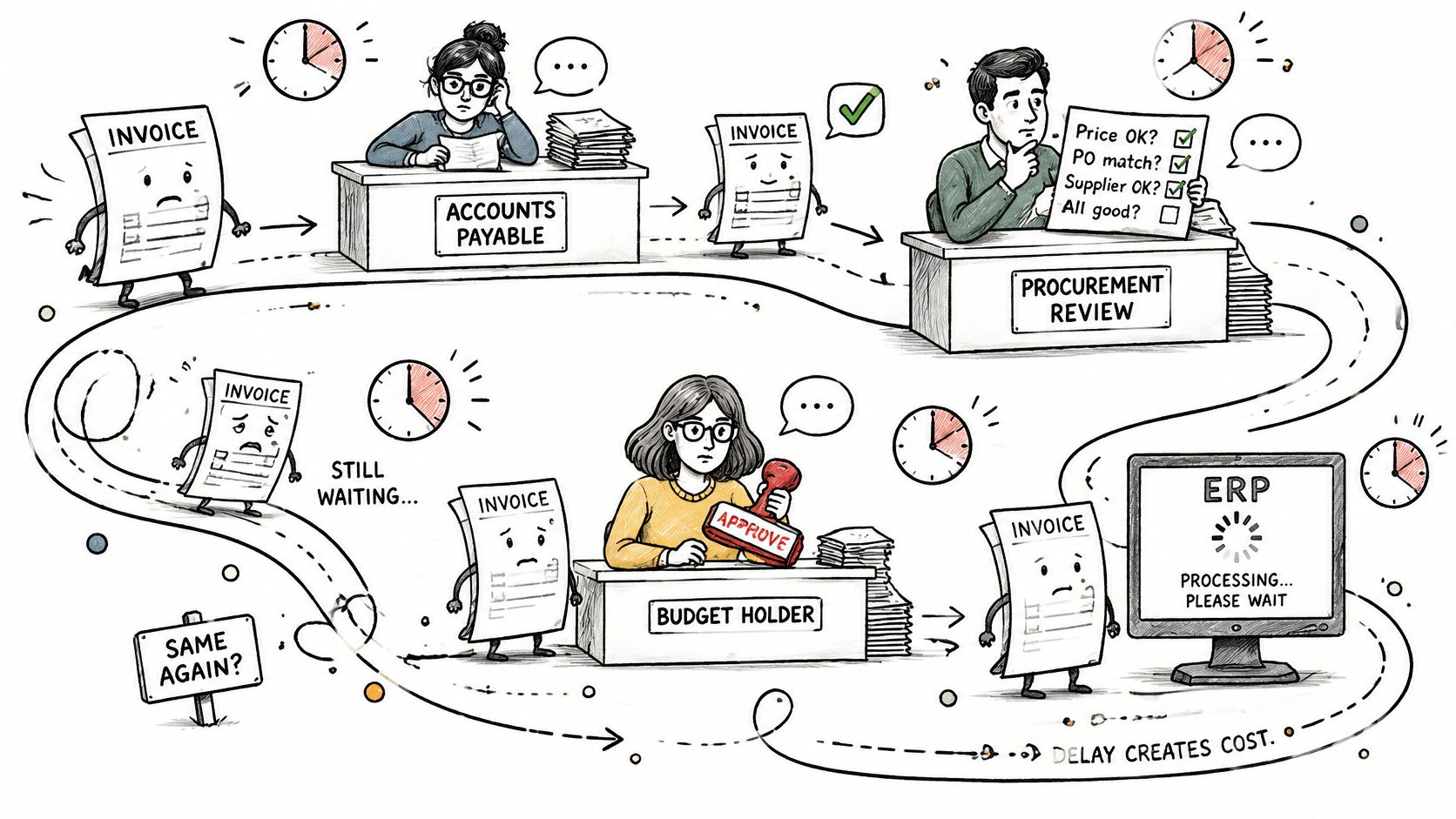
Nothing in that chain is broken on its own. The delay lives in the hand-offs, in the queue between one desk and the next, and in the exception nobody wrote down.
Business process management (BPM) is the ongoing practice of defining, running, measuring and changing how recurring work moves across people and systems. The word carrying the weight is ongoing. A project ends at go-live. BPM keeps going, because the work keeps going.
Six terms do most of the work in practice:
- Process: a recurring sequence of steps that produces something a customer, internal or external, can use.
- Owner: one named person who can change the process and answers for its results.
- Hand-off: the point where work leaves one person or system and waits for another.
- Exception: a case that doesn't follow the standard path and needs a decision.
- Cycle time: how long one case takes end to end, including all the waiting.
- Throughput: how many cases finish in a given period.
A process is a river. It keeps its course only because someone maintains the banks. A project dredges the channel once. BPM is the crew that comes back.
A tool can execute a process. It can't decide what the process should be, who answers when it fails, or whether a step should exist at all. Those are decisions about the business, and they stay with people.
Not every workflow needs a programme. A three-step task run by two people needs a shared checklist and a named owner, not a BPM function. The discipline earns its overhead once work crosses teams, systems or suppliers and the delays stop being visible to any single person. If you run a one-person business, the same logic applies at smaller scale, and workflow automation for solo founders covers the lighter version of it.
One test before moving on. Can you name a recurring workflow, the person who owns it, and its three biggest hand-offs? If any of those answers takes more than a minute, that's the first thing to fix.
The Six Stages of the BPM Lifecycle
BPM runs as a loop of six stages. Skipping any one of them is how teams end up automating a process they don't understand.
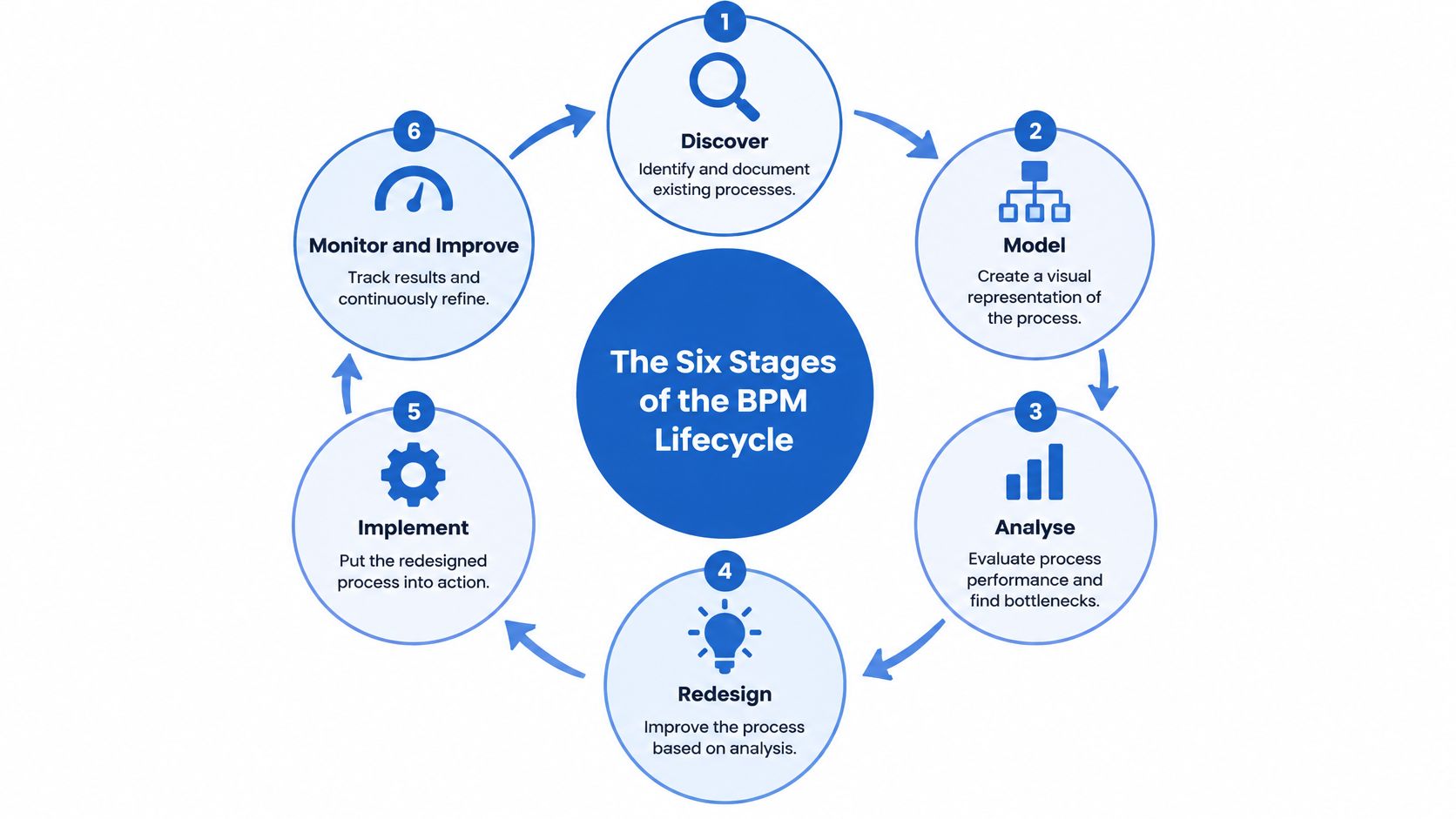
Each stage produces something a reader can hold up in a meeting and argue with, which is the point. A stage without an artefact is a conversation.
| Stage | What happens | Output | Typical owner |
|---|---|---|---|
| Discover | Map the process as people actually run it | Current-state map and list of hand-offs | Process owner |
| Model | Draw the flow in BPMN with hand-offs, approvals and exceptions | Shared diagram read by business and engineering | Process analyst |
| Analyse | Mine event logs and set baselines for cycle time, rework and exceptions | Baseline metrics and ranked problems | Operations lead with data team |
| Redesign | Remove avoidable steps before adding automation | Target process with defined approval points | Process owner and risk owner |
| Implement | Automate deterministic steps and keep human approval where risk sits | Released change with acceptance thresholds | Delivery team |
| Monitor and improve | Track cycle time, throughput, rework and intervention rate each cycle | Review findings and next change | Process owner |
Discover and model
Discovery means watching the process run, not reading the manual. The current-state map should carry the exceptions too, because the exception path is usually where the cost sits. Model the flow in a shared notation once the steps are agreed.
Business Process Model and Notation (BPMN) exists so a business analyst, a developer and a manager can look at one diagram and see the same thing. The notation working group behind it formed in August 2001 with 35 companies, organisations and individuals, and published BPMN 1.0 in May 2004, with the Object Management Group adopting it as a standard in February 2006. Standard notation matters for a plain reason: ambiguity at the modelling stage becomes an argument at the implementation stage.
Analyse and redesign
Analysis sets the numbers before anyone claims an improvement. Cycle time, rework rate and exception rate all get measured from logs or a manual sample, and the problems get ranked so the team isn't fixing the loudest complaint.
Redesign then removes what shouldn't be there. Deleting an approval is cheaper than automating it, and far cheaper than automating it and discovering two years later that it never prevented anything.
Implement and monitor
Implementation automates the deterministic segments and keeps human approval at risk-bearing decisions. The change goes out behind acceptance thresholds so a bad release can be spotted and rolled back without a debate.
Monitoring uses the same measures on the same definitions as the analysis stage. That consistency is what turns the next cycle into evidence rather than a fresh opinion.
Why the loop never closes
Every release moves the baseline. A payment approval that drops from three days to four hours creates new queues downstream, and someone has to look at those too. Teams that treat BPM as a one-off mapping exercise end up with a diagram that's accurate for a quarter and ignored afterwards. Software delivery follows the same logic, which is why agentic software development lifecycle practice assumes the process, the code and the measures keep changing together.
Measuring How Work Really Runs Before You Change It
Last month's first fifty cases, traced by hand from trigger to finish, will tell you more than a polished dashboard. Note every wait you can see. If the dashboard reports four days of average cycle time and the sample says nine, the sample wins until someone can explain the gap.
That afternoon is the cheapest assurance in a BPM programme. Process mining does the same job once the volume is too large for a notebook. Process mining research describes it as turning operational event data into an evidence-based picture of how a process runs in practice, rather than how its documentation says it should. Where the ERP, the ticketing system and the CRM already stamp events, the practical job is joining those stamps into one case trail.
An event log works like a parcel's scan history. The printed label is the documented route. The scans show which depot the parcel passed, and in which order. Modelling tools come later. If the scans are incomplete, a neat diagram only makes a bad route look official.
The minimum an event log needs
Three fields for every event: a case identifier, an activity name and a timestamp. Richer logs add resource, status, cost and channel. Discovery algorithms infer a process model from the log. Conformance checking compares recorded traces with the intended model and quantifies deviations such as skipped approvals, rework loops or unauthorised paths.
| Event log field | Why it matters | Distortion when it is missing or wrong |
|---|---|---|
| Case identifier | Links each event to one order, claim or customer | Duplicate or missing IDs split one case into several |
| Activity name | Records which step happened | Inconsistent labels hide the actual sequence |
| Timestamp | Gives cycle time and the order of events | Mixed time zones or batch entry distort delays |
| Resource | Shows who or what did the work | Missing resource data hides hand-off bottlenecks |
| Status | Shows approval, rejection or rework | Rework loops look like normal progress |
| Cost or channel | Links effort and channel to outcome | Often absent in systems; estimate through sampling |
The trade-off between fitness and precision
A model with high fitness explains nearly every recorded trace. It can also overfit, reproducing noise as if it were policy. A highly precise model may ignore legitimate variation and describe a process nobody runs.
Fitness without precision works like a street map that draws every wrong turn a driver once took. Precision without fitness is a motorway map that pretends the side streets do not exist. Leaders get confused here because both maps look professional. One is cluttered with accidents. The other is tidy and wrong.
The Split Miner method handles the trade-off by filtering the directly-follows graph and modelling concurrency, conflict and causal relations, so a one-off trace does not automatically become a new branch.
Check before you trust it: a model that explains every case has learned the exceptions. Ask what the model refuses to allow, and whether that refusal is correct.
The harder limit sits upstream of the algorithm. Real-world logs commonly contain missing, incorrect or redundant events, or omit facts the analysis needs, as a review of business process management problems reports. Analysts who miss that can take corrective action on a map that only looks precise. In a managed-service business, a non-IT firm running a multi-party platform, the gaps usually sit between systems rather than inside any one of them. No single provider's log shows the whole case. Change the work only after that joined picture exists, or the redesign will follow a route the scans never confirmed.
Governance That Gives Every Process an Owner
A model without an owner describes work. It cannot change it. Ownership is not a job title on a diagram, it's a set of decision rights: who may alter a step, who signs off a threshold, and who reviews the exceptions each month.
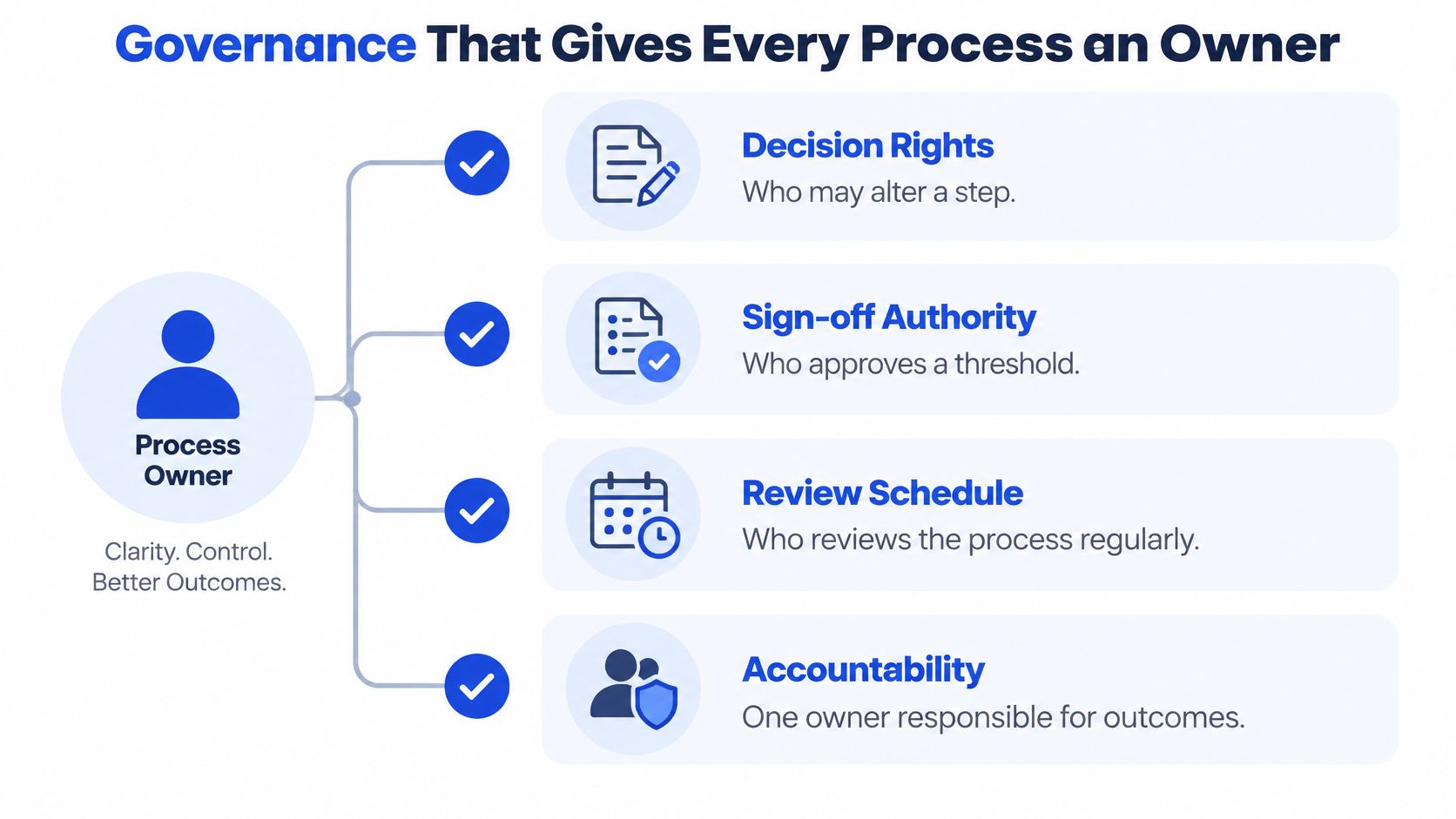
The evidence points the same way. A study of BPM implementation at the State Audit Court of Mato Grosso, using 141 observations and structural equation analysis with partial least squares, found that governance, performance management and people-related factors each had a positive effect on the organisation's process-oriented culture. That's one government agency, not a universal effect size for a commercial business, but it supports a practical rule: ownership, measurement and adoption get designed together or they don't work.
A longitudinal study of a business process management system introduction estimated a positive effect on process maturity ratings, with a coefficient of 0.54 and a 95% credibility interval of 0.32 to 0.75 on the logit scale. Read it carefully. It measures maturity ratings, not financial return, and it concerns an implementation that went well, so treat it as directional. Installing software without changing how the organisation decides things rarely moves the number.
Where human sign-off belongs
Grail Computer Labs states that threshold decisions, exception handling, policy overrides and judgement calls affecting customers, spend, security or compliance should stay with a human owner. That boundary is the useful part of governance, because it tells a delivery team exactly which steps they may never fully automate.
The failure mode is a signature nobody reads. Reviewers shown two hundred items a week approve all two hundred, and the control becomes theatre. Set amount and risk thresholds so only the meaningful cases reach a human, then sample the ones that passed to test whether the judgement was real.
Ownership also gets harder when the process runs across applications your team didn't build, which is where application management services come into scope.
Practical rule: if a process has no named owner who can change it, the first deliverable isn't a model. It's the owner.
Five things worth settling this week:
- A named owner for each core process, with the authority to change steps, not just document them.
- Written decision rights, covering who may alter a step, who approves a threshold and who reviews exceptions.
- Approval thresholds expressed in money, risk or customer impact, so reviewers see a manageable volume.
- An approval log recording who approved what, when and on what evidence.
- A review date for each process, so governance happens on a rhythm rather than after an incident.
Automating Only the Work Worth Automating
Redesign first, automate second. Automating an unnecessary approval preserves the waste and removes the pause where somebody might have questioned it.
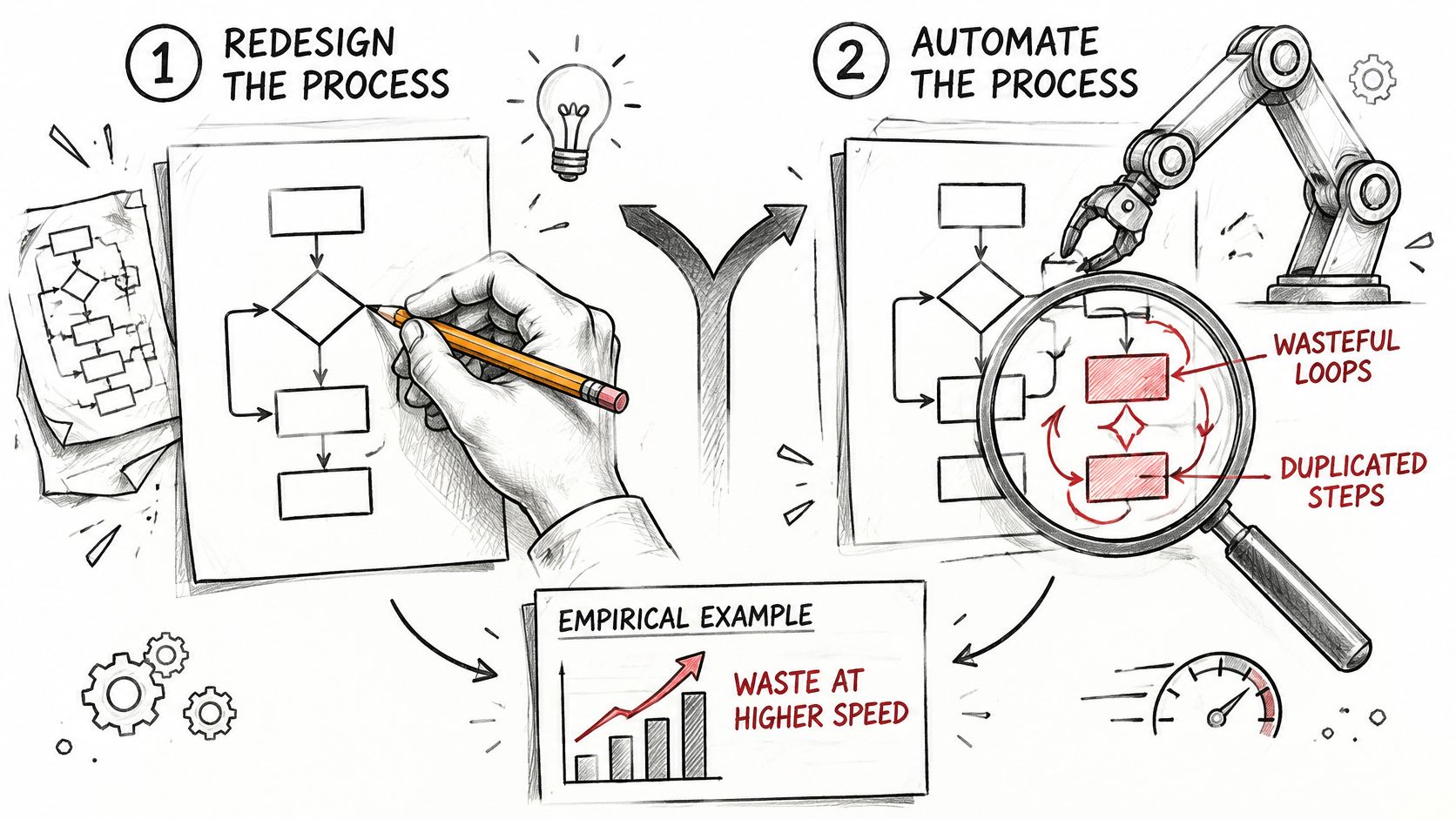
The gains are real where the conditions are right. One empirical study of robotic process automation measured 100 requests at approximately 1,000 minutes when processed manually versus 135 minutes after automation, a reduction of roughly 7.5 times in elapsed processing time in that setting. That is one setting. The effect depends on transaction volume, rule stability, system latency, exception frequency and how much of the work needs human judgement.
The same source reports that applying BPM redesign heuristics before automation produces substantially greater cycle-time and workload reductions than unstructured automation. Sequence beats tooling.
A ladder for autonomy
| Autonomy level | What the software does | Human role | Use when |
|---|---|---|---|
| Recommend | Suggests the next action with its evidence | Decides and acts | Low-risk, exploratory work |
| Draft | Prepares a packet, reply or summary | Reviews and sends | Documents with customer or legal exposure |
| Execute with approval | Carries out steps after sign-off | Approves each gated step | Money, access or customer commitments |
| Execute and monitor | Runs routine steps alone | Samples output and handles exceptions | Deterministic steps with stable rules |
Pick the lowest rung that works and stay there until the exception rate justifies moving up.
The control pattern matters as much as the level. Connect to the system of record so the automation reads and writes the actual data, make each hand-off explicit rather than implied, keep approvals inside the team's existing rhythm so nobody has to remember a separate portal, and log enough context that the next reviewer can see why the system acted as it did.
Grail Computer Labs applies this to its own workflow agents. Its pricing approval agent runs as a controlled flow, requiring approval on steps that move money, change access, alter customer commitments or create legal exposure.
Separate straight-through cases from exceptions before you measure anything. Then track cycle time, throughput, failure or rework rate, availability and human intervention rate on the same dashboard. Autonomy rises only after the exception rate has been tested against a human baseline on real volume, not on a demo.
Where BPM Falls Short and How to Spot It
Process mining looks backwards. It analyses executions after a process has run, so it cannot prove that a process you are designing for the first time meets every policy or regulatory requirement. Research on contemporary business-process compliance identifies design-time checking as outside the capability of current commercial process-mining solutions.
That leaves a separate control to build. Translate each requirement into an explicit rule, review the proposed design with the accountable owners, and test compliance before release rather than after. In regulated environments, finding non-compliance in transactions that already happened costs more than fixing the model beforehand.
Three other failure modes show up often:
- Automation at speed over a bad design. A step that adds no value runs faster and at larger volume, and the rework arrives sooner.
- Tools without changed governance. Software installed while decision rights stay where they were rarely changes how work gets done, because the same people still approve the same things the same way.
- Evidence gaps that look like efficiency. Approval chains, phone calls and spreadsheet workarounds leave no trace, so the dashboard reports a process that nothing downstream recognises.
Consider a hypothetical claims team. It automates its approval chain, the dashboard shows faster throughput, and three months later a review finds weekend claims skipped a required check because the log never recorded that check. The fix isn't a new tool. Recheck the event definitions, sample the cases the log misses, add the missing gate and test it before the next release. For a complementary view on tying process work to shared objectives, The OKR Hub process alignment playbook is worth reading alongside this.
Early warning signs are usually visible before the incident: rework rising while throughput holds steady, a cycle time that nobody can reconcile with the system report, and approvals that never reject anything. When the constraint turns out to be the platform itself rather than the process, the answer is often staged replacement rather than another round of process work, which is what legacy system migration services exist to handle.
Pick One Workflow and Confirm Its Owner First
A finance lead asks for a cleaner quarterly pack. Three teams send slides. Nobody can say who may change the checklist or reject a late number, and the pack still arrives late. One workflow, measured on a second run, teaches more than a portfolio review that never names an owner.
- Choose a recurring workflow that repeats on a fixed rhythm and mostly collects, checks and summarises information. Quarterly review packs, renewal preparation and vendor onboarding fit. A one-off migration does not.
- Name the owner, the person who can change the steps and approve exceptions, rather than someone who attends the meetings.
- Map the approval path, including every gate that moves money, changes access or alters a customer commitment.
- Pull a baseline for cycle time, rework and exception rate, from logs if they record the actual path, and from a manual sample of recent cases if they do not.
- Choose one measurable outcome and a review date, then hold the tool, the vendor and the team to that outcome.
Grail Computer Labs recommends evaluating AI workflow tools against one real workflow, one real owner, one real approval path and one measurable business outcome. Everything else is a demo.
The sequence works like a relay. The case is the baton. The owner is the only runner allowed to change the route when an exception appears. If the log misses a handoff, the baseline is a story, not a measure, and the review date has nothing solid to judge.
Grail Computer Labs works on the point where process work stops being a documentation exercise and becomes a delivery problem: a workflow that has to be rebuilt, an inherited platform that no longer matches how the business runs, or a project that matters and couldn't move. GC Labs takes over from an underperforming vendor, recovers the operating model and puts the rebuilt system live, with a defined outcome delivered in 4–8 weeks and a 15-day trial in which qualified clients can stop without paying. If one workflow is visibly costing you time and nobody can say where the delay lives, bring it to a call at Grail Computer Labs.