Internal tool
Development agents for engineering work
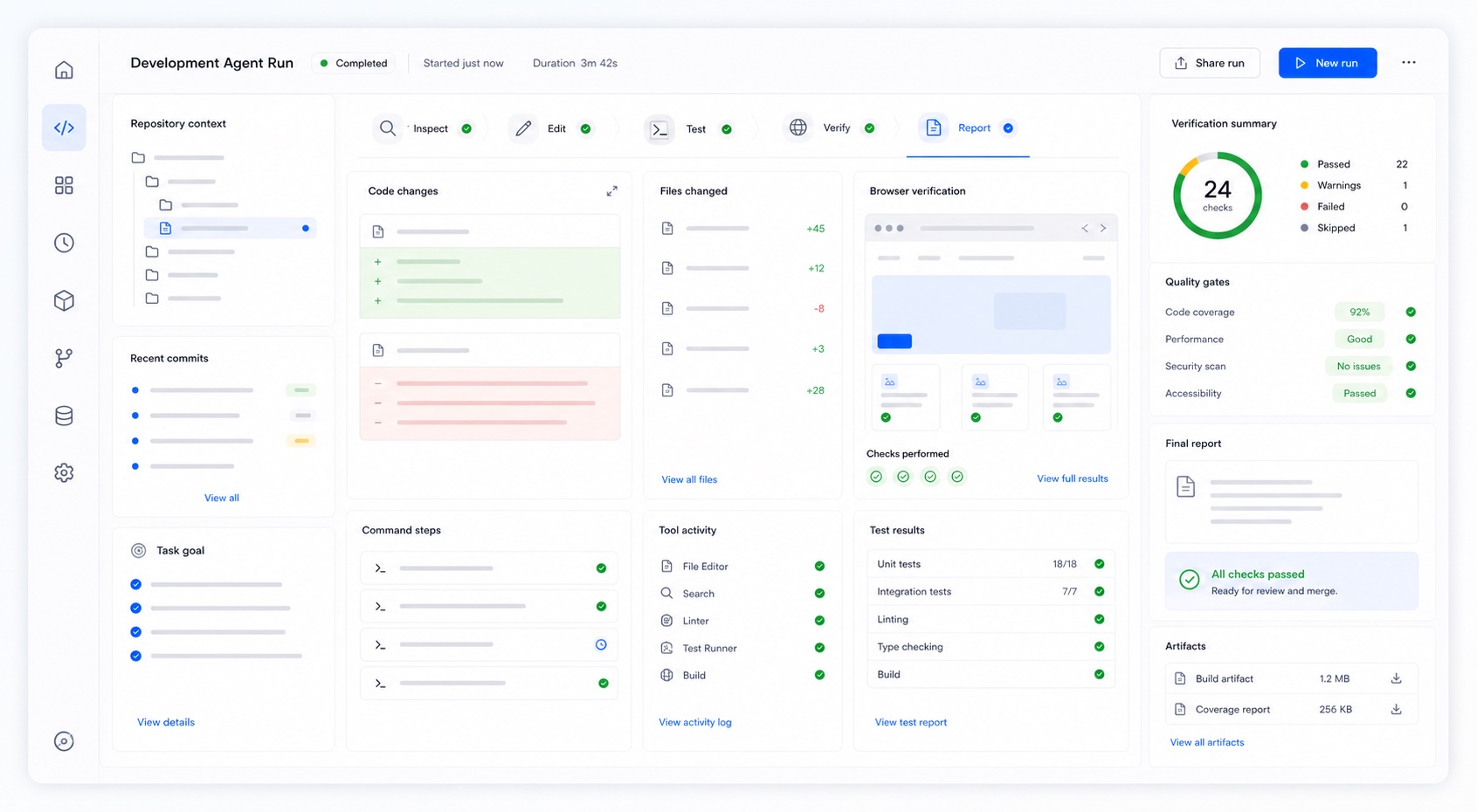
Engineering work often spans repo inspection, code edits, browser checks, and verification. Grail’s development agents carry that loop end to end and report back with the checks they ran.
The challenge
Engineering tasks often require reading repo rules, editing code, running commands, checking browser behavior, and reporting what changed. A single chat response cannot safely hold that much state or finish the work end to end.
What Grail built
Grail combined Codex-style workers, repo context files, browser control, command execution, verification loops, and long-running task support into a repeatable engineering workflow.
 Rust workersMCPBrowser automationOpenflow
Impact
The same development-agent loop now operates across the Grail workspace and informs platform work like Openflow and Grail AI OS.
Impact summary
| Primary result | Repo inspection |
|---|---|
| Operational result | Browser verification |
| Workflow scope | Long-running engineering threads |
How the workflow runs
The working loop is inspect, plan, patch, verify, and report, with context files preserving hard-won repo knowledge between tasks.
- A human gives an engineering task.
- The agent inspects the relevant files and repo rules.
- It makes a focused plan.
- It edits code or content.
- It runs targeted checks.
- It reports what changed and what validation passed or failed.
- Repo learnings can be preserved for future tasks.
Human control
The control points were specific to the workflow, so the agent could speed up the work without silently taking over sensitive decisions.
- Agents work inside repo-specific instructions.
- Changes are verified with targeted checks.
- Reports call out anything that could not be tested.
What shipped
The implementation centered on these shipped pieces:
- Repo inspection and code editing.
- Terminal command execution.
- Browser workflow support.
- Verification and reporting loop.
- Context files and repo guardrails.
- Long-running engineering thread support.