Internal tool
Slack AI employees for internal work
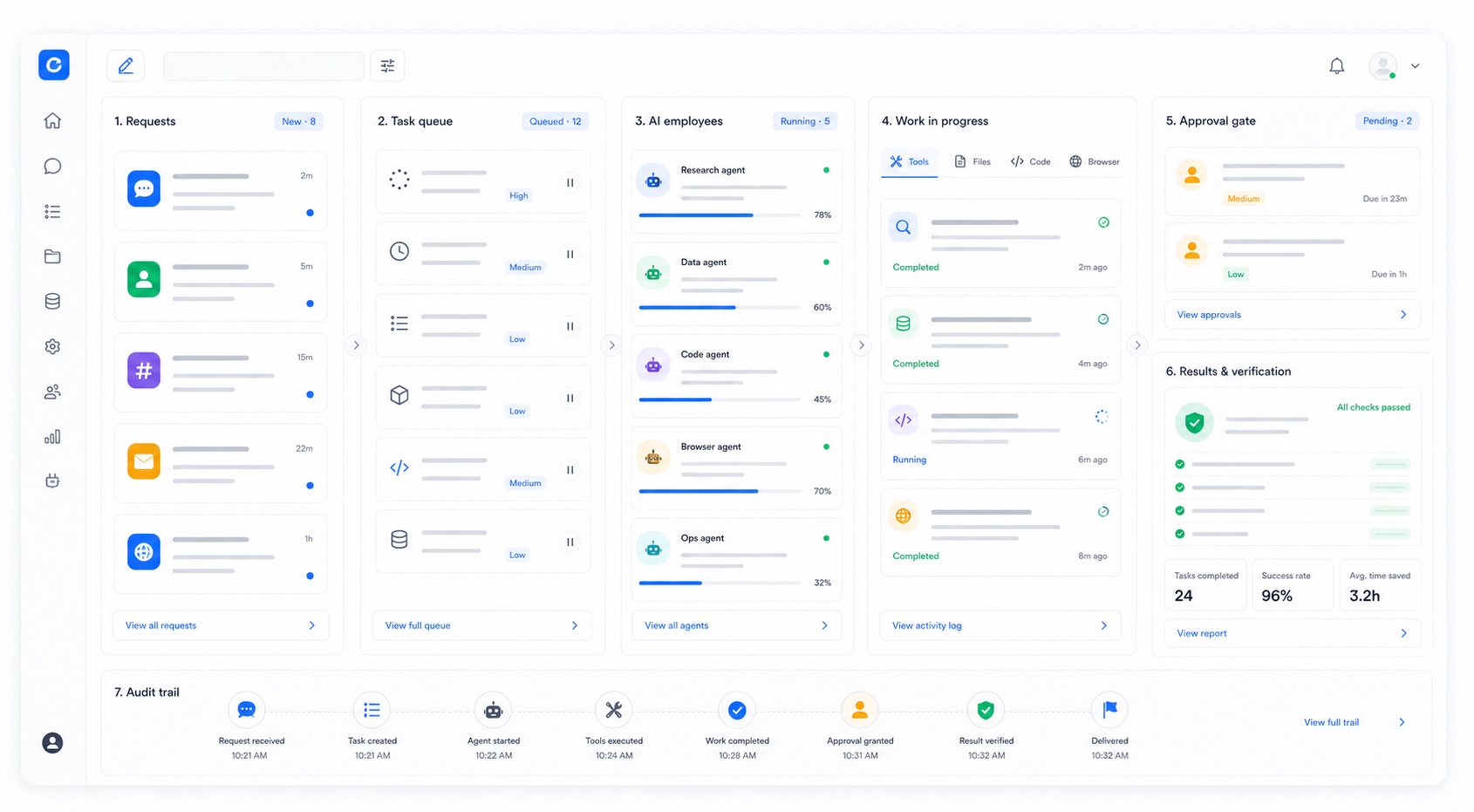
Grail teams ask for work where the conversation already happens: Slack. These AI employees read context, use tools, work on files and code, and report back with what changed and how it was checked.
The challenge
A normal chatbot can answer questions, but it cannot reliably carry multi-step work for a team. Grail needed agents that could work where the team already asks for help, keep context, use tools, and report back clearly.
What Grail built
Grail built Slack-based AI employees backed by a durable task runtime, Codex-style workers, browser and file tools, memory, approvals, and verification reports.
 RustAxum
 SQLiteCodex CLI
 Slack APIMCP
Impact
The agents now handle repeated internal work across code, research, browser workflows, reports, and team operations.
Impact summary
| Primary result | Slack-native requests |
|---|---|
| Operational result | Tool-using workers |
| Workflow scope | Reusable client-agent base |
How the workflow runs
Each turn becomes a durable task with thread context, files, and tool access. The agent does the work, checks it where possible, and posts the result back to the original Slack thread.
- A team member asks for work in Slack.
- The agent reads the thread and relevant project context.
- The task is queued and assigned to a worker.
- The worker uses code, terminal, browser, file, or document tools.
- The agent reports what changed, what it found, and what checks passed.
- Useful context is preserved for future work.
Human control
The control points were specific to the workflow, so the agent could speed up the work without silently taking over sensitive decisions.
- Risky actions can require approval.
- Agents explain what they did and how they checked it.
- Memory keeps useful context instead of blindly trusting every interaction.
What shipped
The implementation centered on these shipped pieces:
- Slack-based AI employee interface.
- Tool execution for code, browser, files, and reports.
- Queue for long-running work.
- Memory layer for useful project context.
- Approval paths for risky actions.
- Verification and reporting back into Slack.