AI Automation Companies: How to Compare Providers
Compare AI automation companies on capabilities, delivery models, governance and ownership terms, with a checklist to assess providers before you sign.
78% of organisations used artificial intelligence (AI) in 2024, according to the Stanford AI Index 2025. That measures adoption, not whether a workflow reliably reaches completion. For buyers comparing AI automation companies, the harder question is who takes responsibility when the demonstration ends, the exceptions arrive and the original provider needs replacing.
A useful comparison starts with delivery responsibility, not model features. Founders, chief technology officers (CTOs) and operations leaders need to know what will run in production, who controls it and whether another team could take over without reconstructing every decision.
Where AI Automation Companies Actually Differ
AI use is widespread, but enterprise-scale delivery remains uncommon: McKinsey's global surveys found that 88% of respondents reported organisational AI use in at least one business function in 2025, while only 7% said AI had been fully scaled across their organisations. That gap makes implementation responsibility more useful than a feature list when comparing providers.
An AI automation company designs, builds and runs AI-driven workflows inside a client's business. The work might cover an approval step or an operating process spanning documents, customer records, finance systems and human decisions.
Delivery models compared
| Delivery model | What you buy | Who owns the result | Where it tends to break |
|---|---|---|---|
| Tool licence and platform | Software access and a configuration service | Your internal team | Integration and evaluation left to you |
| Pilot or proof-of-value build | A time-boxed prototype with demo results | Often unclear after the pilot ends | The pilot never reaches production |
| Outcome engagement | One pre-defined, measurable outcome delivered in 4–8 weeks | Shared, written into the outcome definition | Scope set too broadly or handover not documented |
| Managed continuous delivery | An ongoing team that keeps shipping across the codebase | The provider under contract; check the exit terms | Dependency grows if code and context do not transfer |
| Software rescue | Takeover of a stalled or failing build | Set out in the takeover terms | Inherited code quality and missing documentation |
These are purchasing categories, not interchangeable promises. A licence can be appropriate when an internal team already owns integration, security and support. A prototype can answer a feasibility question, but it doesn't establish who will operate the resulting workflow.
Delivery responsibility isn't asset ownership
The table's ownership column concerns accountability for delivery. Legal ownership of source code, infrastructure and documentation needs separate contract terms. A provider can remain responsible for operating a system while the customer owns everything needed to move it elsewhere.
An outcome engagement works best when acceptance can be described narrowly. Managed continuous delivery suits a changing backlog, but buyers need visibility into releases and transferable operating knowledge. Software rescue starts with a different uncertainty: whether the inherited implementation should be improved, partly replaced or rebuilt.
Buying rule: Establish which delivery model the provider sells before comparing its technical capabilities.
The most revealing opening question is therefore contractual: which party is responsible for getting the workflow into production, and what happens afterwards? An impressive interface doesn't resolve that question. Neither does a long integration list.
For mid-market businesses and enterprises, the right model follows the missing capability. A capable internal engineering team may need software access. A business with unfinished code and no credible release plan needs someone accountable for recovery.
Capabilities to Compare Side by Side
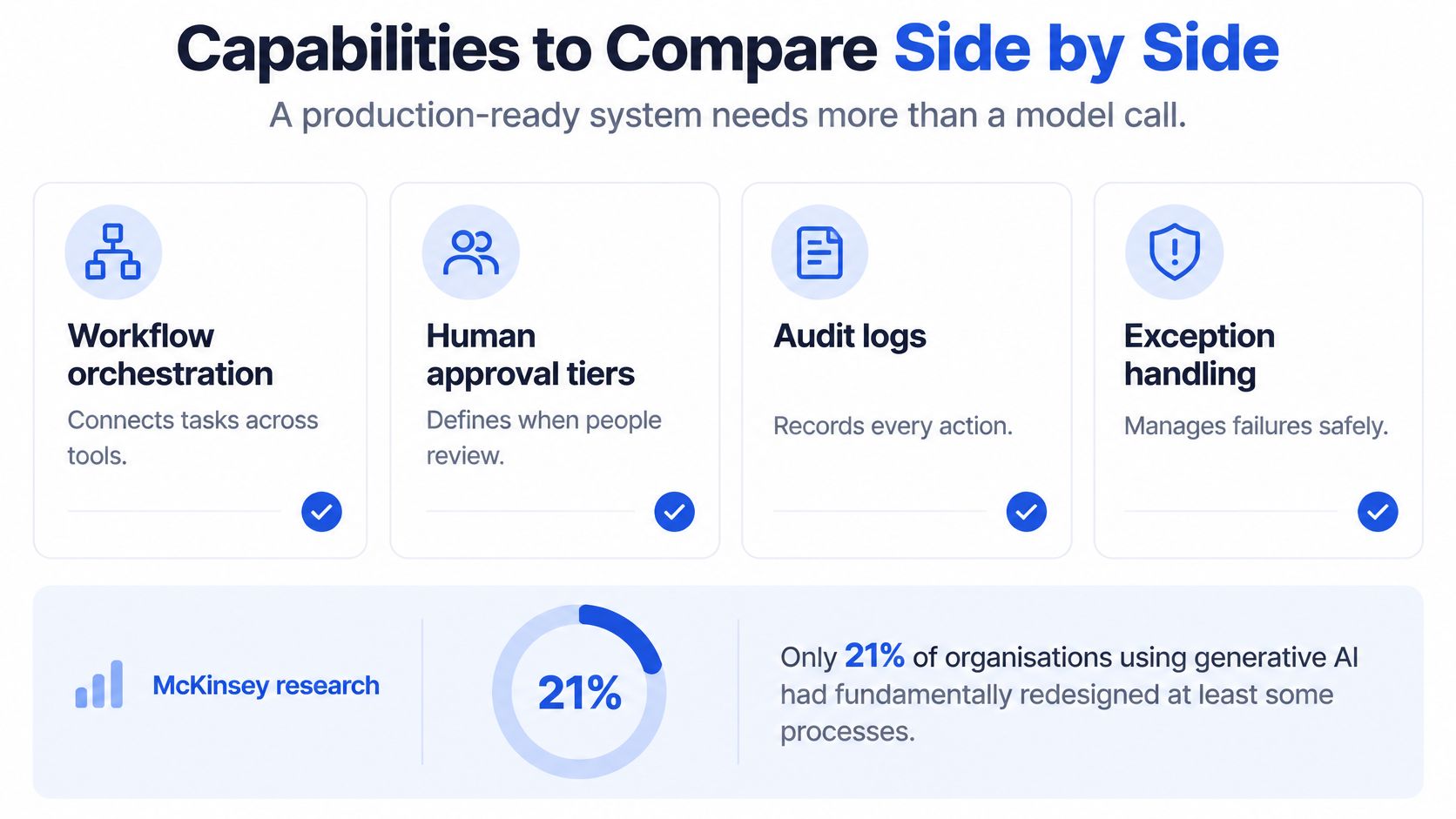
A production-ready system needs more than a model call. Only 21% of organisations using generative AI had redesigned at least some workflows, according to McKinsey's research on capturing AI value, which identified workflow redesign as the organisational attribute with the largest effect on earnings before interest and tax (EBIT) impact.
That finding concerns profit impact, not usage. A provider should therefore demonstrate how work moves from its initial trigger to a completed business outcome, including rejected requests, missing information and failed connections.
Evidence worth comparing
Capability checklist for providers
| Capability | Good evidence | Question to ask |
|---|---|---|
| Workflow mapping | A written end-to-end process with named owners for each step | Who signs off each step, and who owns exceptions? |
| System integration | Live connections to systems of record | Which systems are read, and which are written to? |
| Evaluation before release | A test dataset with accuracy measured against a baseline | Which cases were tested, and what error rate is accepted? |
| Exception handling | A queue for unresolved cases, categorised by reason | How large is the exception queue after the first month? |
| Monitoring and rollback | Dashboards, alerts and a rehearsed way to switch the workflow off | What is the rollback procedure, and who runs it? |
| Release discipline | Small batches, automated tests and engineer review before release | Who reviews each change before it ships? |
For workflow mapping, inspect the actual process document rather than a sales diagram. It should identify who supplies missing information and who can reject a recommendation. For integration, request evidence of authentication, failed-write handling and protection against duplicate submissions, not merely an available connector.
Evaluation needs representative difficult cases. An aggregate accuracy score can hide a serious mistake, such as approving a request that should have been escalated. The unresolved-case queue should distinguish missing data from policy conflicts and technical failures.
Monitoring evidence should include a rehearsed recovery procedure. Switching an automation off isn't enough if it has already written incorrect records. Release evidence should show who reviewed the change and which checks passed.
Match the implementation to the work
Grail Computer Labs, subsequently GC Labs, fits workflows where the hard part is gathering context, building the decision packet and routing approval before anything consequential happens. A trigger-and-action workflow tool fits teams that primarily want to connect events, actions and data movement directly.
Neither approach wins universally. Context-heavy work adds evaluation and approval requirements; straightforward routing may not justify a managed engineering relationship. For buyers assessing the underlying construction options, TopToolAdvisor's resource to compare AI agent builders can complement, rather than replace, a delivery assessment.
The comparison sheet also needs pricing mechanics and named team members. Record whether changes trigger separate estimates, who handles production incidents and which engineers retain operating context. Score supplied evidence consistently; a yes in a questionnaire isn't equivalent to a working artefact.
Governance Lines Every Provider Should Draw
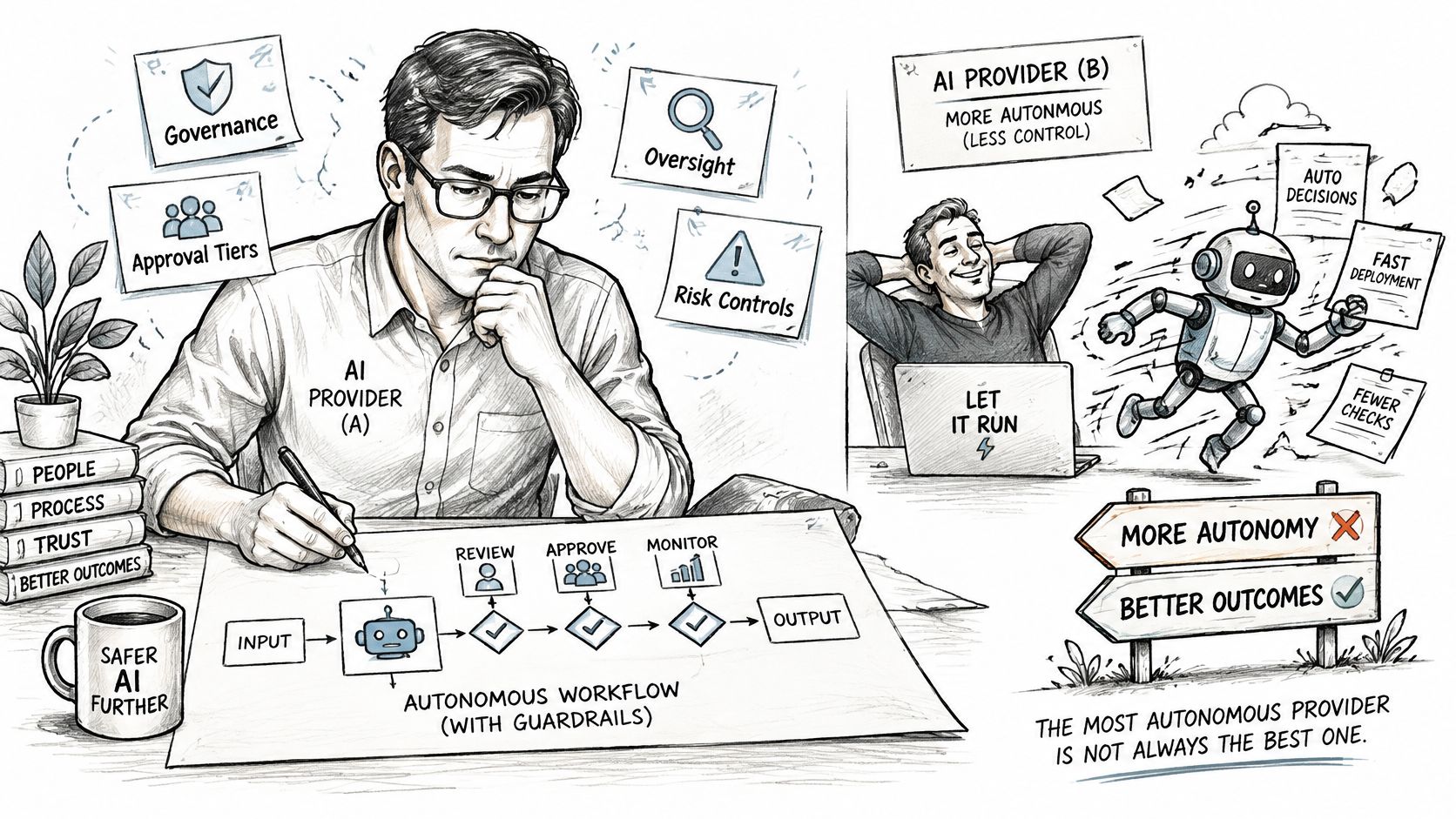
A 2025 Gartner survey found that 75% of application leaders were piloting, deploying or had deployed some form of AI agent, while 15% were considering, piloting or deploying fully autonomous agents. The figures describe different levels of adoption. Buyers should focus on what the system may do and what evidence it retains.
Approval tiers and required controls
| Tier | Typical action | Control required |
|---|---|---|
| 1. Low-risk, read-only | Reads and summarises records | Runs automatically; activity logged |
| 2. Internal record change | Updates a status or record in internal systems | Runs with sampled human review |
| 3. High-impact action | Moves money, changes access or contacts customers | Named approver before it runs |
Classify actions by their consequences, not by which system they affect. An internal status update that triggers a payment belongs in the high-impact tier.
Make permission executable
In a hypothetical employee onboarding workflow, the system prepares account requests and creates accounts after a named owner authorises access. It routes payroll changes for separate approval. The agent coordinates the work within those boundaries.
The audit trail should record inputs, tool calls, the decision, the approver and a timestamp. Set access restrictions and retention rules for logs; indiscriminately storing sensitive inputs creates additional exposure.
Policy needs to govern day-to-day practice. IBM's 2025 Cost of a Data Breach research found that 63% of breached organisations either had no AI governance policy or were still developing one. That figure applies to the breached organisations in the study.
For finance teams, workflow engines for finance operations offer context for reviewing routing and approval controls. Engineering leaders can use guidance on the agentic software development life cycle to examine how operational and development permissions should be handled.
Assign a named person to each consequential approval, and keep a record of the decision.
A governance review should test whether permissions match the workflow, exceptions reach the right owner, and the audit trail captures enough context to reconstruct a decision. Those checks make accountability part of the operating process.
Ownership and Exit Terms That Protect You
A provider relationship can outlast the original build, so agree on transfer rights before authorising further development. Managed-service businesses, private equity portfolio companies and enterprises should know who controls the code, infrastructure, operating context and decisions if the relationship ends.
Fortune's account of an MIT-linked report reported that only about 5% of organisations in its dataset achieved rapid revenue acceleration from generative-AI deployments. The finding describes the market, not any single stalled system.
Ownership terms to require
| Asset | Require in writing | Red flag |
|---|---|---|
| Source code | Full repository transfer into company-owned version control | Code remains only in the provider's account |
| Cloud infrastructure | Accounts and credentials in the company's name | The provider holds the only administrator access |
| Models and prompts | Ownership of fine-tuned models, prompts and evaluation sets | Models or prompts cannot be exported |
| Documentation | Architecture notes, runbooks and a decision log | Documentation supplied only on request |
| Operating knowledge | Recorded reasons for significant changes | Knowledge sits with named individuals only |
| Exit terms | A handover period and takeover support with a named start date | No exit clause or notice period |
Transfer the reasoning as well as the files
A repository shows what was built, but decision history explains why. Record rejected alternatives, known limitations, changes to approval thresholds and integration behaviour. A receiving team needs this context to maintain the workflow without repeating decisions or misreading its constraints.
During takeover, examine process ownership, integration quality, evaluation and whether a production deadline was defined. These categories help distinguish implementation problems from requirements that were never resolved.
Grail Computer Labs offers a takeover process and an improve-or-rebuild service for existing AI workflows. Put ownership of code, cloud resources, models and documentation in the signed agreement, and document licence and export limits for third-party components.
Continuing delivery makes exit terms more important
A managed delivery relationship can keep the same team shipping after launch, rather than ending with a handover after the build. Grail describes its offering as a managed delivery relationship, not a licence, with the same pod continuing to ship and no handover after the build.
Continuity still requires exit readiness. Buyers evaluating application management services should require current runbooks, accessible repositories and a defined transition process throughout the relationship. Specify who can provide access and support the transfer if the provider relationship ends.
Which Provider Type Fits Your Situation
A provider should fit the constraint that is slowing the work: an unusable product, risky releases, inconsistent internal processes, or decisions spread across several parties. The scenarios below are hypothetical, not client stories.
Stalled product with no release date
When a product cannot support real customers, start with a takeover assessment or a narrowly defined outcome engagement. Begin by checking the code, the customer journeys that work, and who controls production access. Adding features before those basics are clear can make recovery harder. Set the first outcome around one usable customer journey.
Inherited codebase with unreliable releases
A codebase can work in production and still be unsafe to change. Look for software rescue paired with release discipline across the software development life cycle (SDLC): small changes, automated tests, and review before release.
If the architecture blocks progress, assess legacy system migration services against a staged replacement with explicit rollback points. The decision should turn on whether the current system can support safe, incremental change.
Shared approvals across business units
For repeatable approvals across business units, start with a small group of workflows that share an owner or business domain. An outcome engagement can establish the operating pattern before continuous delivery extends it.
Keep local policy differences visible. Apply the same workflow only where the underlying process and approval rules are shared.
Decisions involving customers, workers, and service partners
An MSP coordinating customers, workers, and service partners needs clear rules about who can approve a booking, amend a record, or authorise a payment. A fast action sent to the wrong party can create a disputed commitment.
Evaluate how the provider will maintain those multi-party rules as the platform changes. The operating model needs clear responsibility for the rules, not just for execution.
Published results and their limits
Grail Computer Labs reports that it took over a healthcare platform from its previous vendor and brought it into production within 30 days. For a Singapore-based neobank, a one-week compliance review system build raised automated approvals from 44% to 90% in testing.
These are specific results, not forecasts for another product or workflow. The neobank figure is from testing, not a measured production approval rate. Before agreeing to a recovery plan, check dependencies, access rights, and acceptance conditions.
Shortlist Two Providers and Test One Workflow
A useful shortlist pairs two providers with different delivery models. Give each the same capability sheet, approval requirements and ownership terms, then record their answers in writing.
Use one real workflow, one business owner and one baseline for the evaluation. Keep test environments separate so neither provider can make competing changes in production.
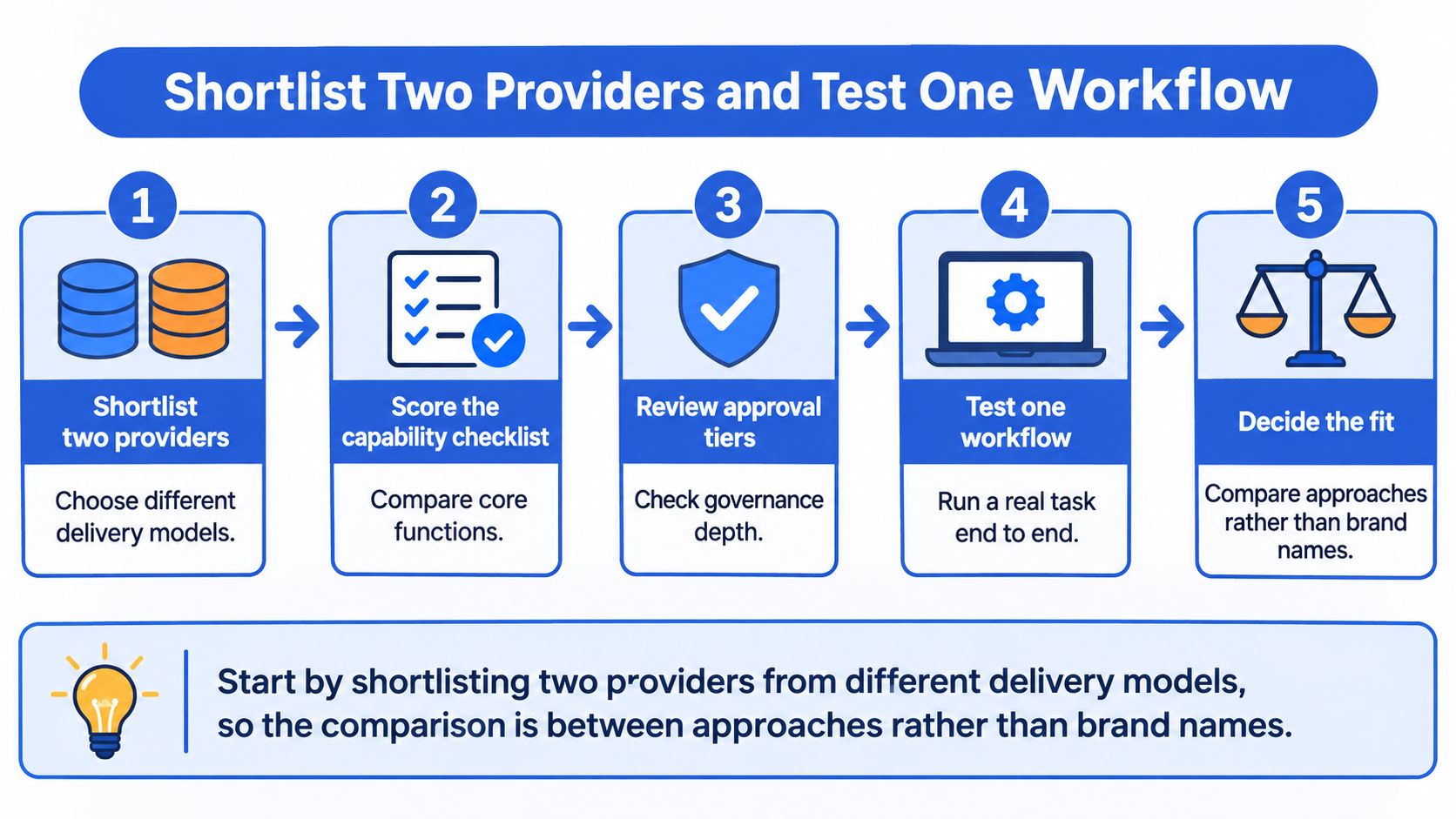
Run a bounded evaluation
Select a real workflow with a named owner and approval path. Include the awkward cases the business already handles. A demonstration task may not reveal missing permissions or unclear responsibility.
Choose a measurable outcome and record the baseline. Approval cycle time, exception rate and cost per completed case are possible measures. Define how each is calculated, so the comparison covers the full manual process rather than only the automated step.
Define acceptance conditions before work begins. Specify what counts as production-ready, which cases are excluded and who signs off. “Improve efficiency” is too vague to settle whether the work succeeded.
Review the evaluation dataset, release plan and rollback procedure before implementation. Include incomplete inputs and policy exceptions in the dataset. Identify dependencies outside the provider's control in the release plan.
Review delivered work against the baseline with the owner present. Trace completed cases into the destination system and inspect unresolved ones. A polished demonstration can hide a queue that the operating team must later clear.
Decide within the agreed trial window whether to continue, change scope or stop. Record the evidence behind the decision. If scope changes, update the acceptance conditions rather than leaving success undefined.
Judge delivery rather than code volume
Engineering activity alone does not show whether a workflow will perform reliably in operation. Google's 2024 DevOps Research and Assessment (DORA) research associated a 25% increase in AI adoption with a 3.1% improvement in code-review speed but a 7.2% reduction in delivery stability. The findings are survey-based associations, not predictions for an individual team.
GC Labs describes its Software Factory as a delivery loop from triage through release, with agents carrying out tasks and engineers making decisions. For a buyer, the useful evaluation question is whether the provider can show how a real workflow moves from request to reviewed, verified work, and where the owner can see its status.
Judge the result with the workflow owner. Did the agreed measure improve? Can the owner explain what the workflow does, which cases it leaves for review and who is accountable for those cases? These answers matter more than the volume of code produced.
A provider should also be able to explain how the workflow can be taken over. Check whether the delivered code, operating context and decision history will remain usable if the relationship ends. Refer to the engagement terms in the earlier comparison when assessing the trial and delivery commitment.
GC Labs offers software rescue, custom AI models, internal operations automation and legacy re-platforming, with customer ownership of code, cloud, models and documentation. Visit Grail Computer Labs to discuss a stalled project or workflow.