
Software Risk Analysis for Delivery Leaders
Software risk analysis that scores likelihood and impact across delivery, security, operations and vendors, then turns the register into a decision.
A release date slips again. The supplier can't name the next milestone, customers wait, and the team still ships because the deadline matters more than the known weakness. That's not a testing failure at the end. It's a software risk analysis failure at the start, when nobody priced the uncertainty, ranked it, or gave it an owner.
Why Late Testing Cannot Carry the Risk
Say a platform has run months late. The vendor reports progress in percentages but can't show a working path for onboarding, billing, or access control. Testing then becomes a search for reassurance. It finds defects, but it doesn't answer whether the estimate was credible, whether one supplier holds the knowledge, or whether the business can accept the delay.
The historical warning is stark. The 1994 CHAOS Report found that only 16.2% of surveyed software projects were completed on time, within budget and with the required functionality, while 52.7% were challenged and 31.1% were cancelled. Challenged and cancelled projects averaged 189% of original cost estimates and 222% of planned duration. Treat those figures as a dated baseline, not a forecast. Their value lies in translation. Requirements uncertainty, estimation error, weak governance and delivery dependencies become money, lost time and missed customers when they're scored after the build.
What Leaders Should Demand
A useful analysis covers four families: delivery, security, operations and vendors. For practical context on turning those families into delivery controls, leaders can read DevArmor on managing software delivery risk.
The output isn't a workshop or a heat map on its own. It's a ranked register.
- One finding, one owner: Name the person who can act.
- One deadline: Set the date for mitigation or review.
- One residual decision: Record whether the remaining risk is accepted, and by whom.
Likelihood and impact belong before architecture and release choices. Testing and recovery work matter, but they can't replace that early pass.
Four Risk Families and the Evidence for Each
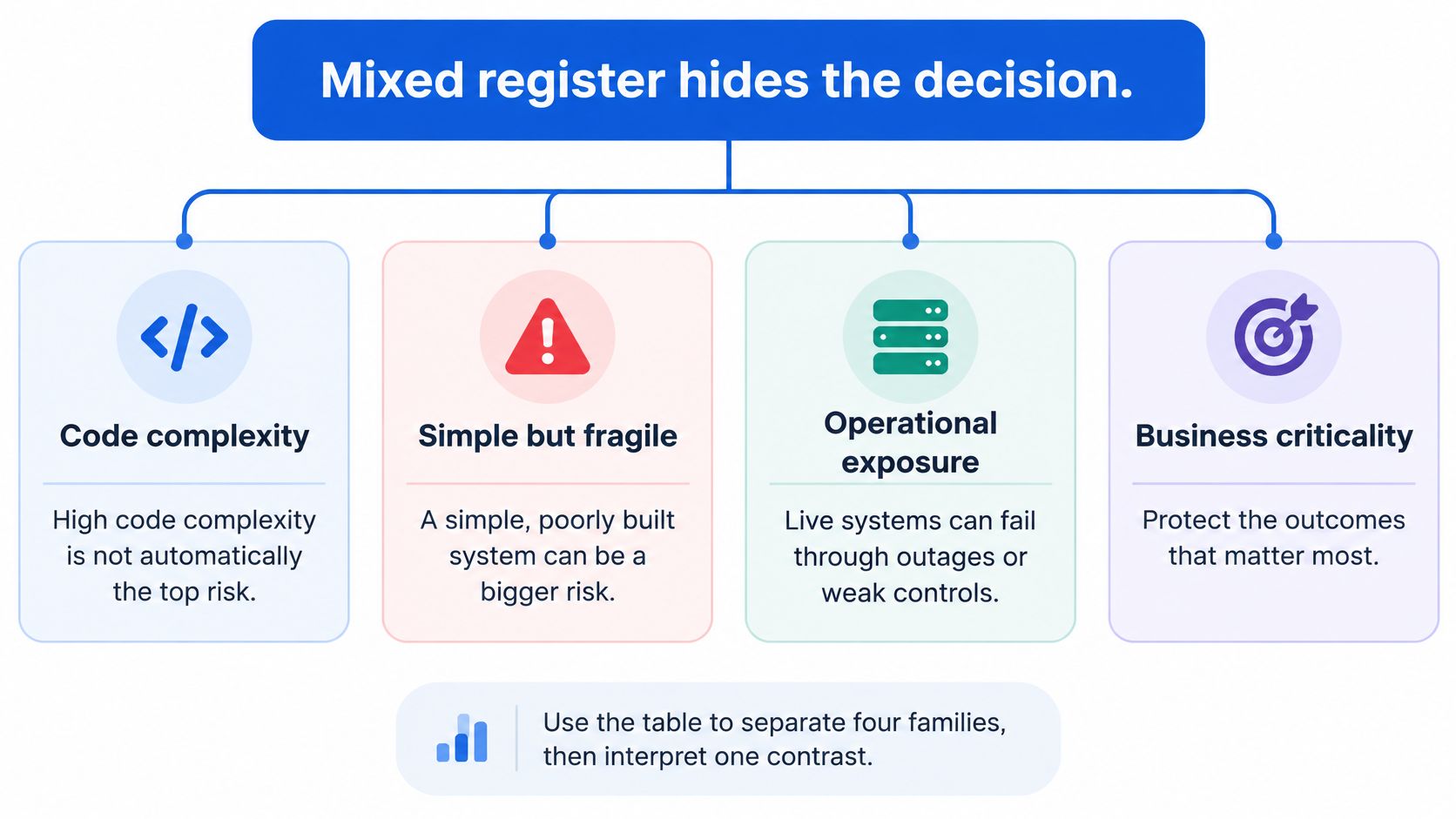
A mixed register hides the decision. Delivery delay, an exploitable weakness, a manual workaround and a supplier dependency don't fail in the same way, and they don't need the same evidence. Separate them first. Score them second.
What to capture before scoring
| Family | Signals to collect | Record on the finding | Usual owner |
|---|---|---|---|
| Delivery | Lead time, failed releases, defect escape, estimate error, missing date | Probability, schedule and cost impact, dependency | Head of engineering |
| Security | Reachable weaknesses, broken access control, exposed paths, exploitability | Affected versions, exposure, compensating control | Security lead with the product owner |
| Operations | Incidents, manual workarounds, undocumented rules, single-person knowledge | Customer, money or compliance consequence, fallback | Operations or platform owner |
| Vendor and pipeline | Stalled supplier, build tools, registries, embedded and unsupported components | Defect evidence, sub-supplier, residual-risk acceptance | Sponsor or CTO |
Complexity Isn't the Whole Story
High code complexity isn't automatically the top risk. A complex component with strong tests, clear ownership and stable change history may be safer than a simple integration that nobody fully understands. A short billing rule buried in a job, for example, can stop revenue if it's undocumented and only one contractor knows why it exists.
That contrast matters for technical debt. Research reviewing Google's work in a study of technical debt indicators examined 117 candidate indicators across dependencies, code quality, migration and code degradation, and found no individual measure predictive on its own. One metric can't carry the judgement. Leaders need several weak signals that point the same way.
Keep at least two independent signals for each family before a score is trusted.
Delivery evidence should show whether change reaches production. Collect change lead time, failed-release rate, defect escape rate and estimate error. Pressure changes behaviour. Cypress Data Defense's State of Application Security report reported that 62% of organisations knowingly deployed vulnerable code to meet delivery deadlines in 2025. That's survey evidence about pressure, not proof about a particular reader's team.
Security evidence must separate prevalence from harm. The 2025 OWASP data set reported that an average of 3.73% of tested applications contained one or more weaknesses in Broken Access Control, its leading category. Prevalence alone still doesn't set priority. A reachable, internet-facing path demands faster action than a severe flaw in code that users can't reach.
Operations evidence sits in incidents, manual fixes and concentrated knowledge. Vendor evidence sits beyond the contract, in build tools, registries, embedded components and support status. Put together, those signals show where a change, outage or supplier failure would hurt first.
Score Likelihood and Impact on One Scale
Start with the working rule: risk is likelihood multiplied by impact. A single severity label hides why a finding matters. Separate scores force the team to state how likely the event is, what happens if it occurs, and which evidence supports both judgements.
Three working scales for software risk
| Scale | Likelihood | Impact | Combined score | How to read it |
|---|---|---|---|---|
| OWASP risk rating | Bands: 0 to under 3 low; 3 to under 6 medium; 6 to 9 high | Same three bands | Likelihood multiplied by impact | A severe weakness that is hard to exploit can rank below an exposed, easier weakness |
| Threat-model library | 1 rare, about once in more than 10 years; 2 every 5-10 years; 3 every 2-5 years; 4 at least yearly; 5 several times a year | 1 to 5 | Cross product from 1 to 25 | 4 times 5 is 20; 2 times 5 is 10; record the evidence, because the bands are guidance |
| Earlier OWASP Top Ten method | Prevalence, detectability and ease of exploit, each 1 low to 3 high | Technical impact, 1 to 3, kept separate | Likelihood factors combined with average technical impact | Reject a register that uses one unexplained severity label |
Apply the Bands Consistently
OWASP's risk-rating method scores contributing factors from 0 to 9, then bands likelihood and impact as low from 0 to less than 3, medium from 3 to less than 6, and high from 6 to 9. Likelihood reflects how easily a weakness can be discovered and exploited. Impact reflects the consequences of a successful attack. The ranking can surprise teams. A technically serious issue that's difficult to exploit may sit below a less severe weakness that's exposed and easy to use.
The OWASP threat-model library uses five points for likelihood and impact and defines overall risk as their cross product, producing scores from 1 to 25. Its likelihood bands give operational meaning to the numbers, from rare at 1 to almost certain at 5. A likelihood of 4 and impact of 5 produces 20. A likelihood of 2 and impact of 5 produces 10. Same worst-case harm, different urgency.
Practical rule: Write the evidence beside the number, or the number will look more certain than it is.
The older approach adds a useful audit check. OWASP's earlier Top Ten risk methodology used prevalence, detectability and ease of exploit, each rated 1 to 3, alongside a separate technical-impact factor. A supplier register should therefore show how common a weakness is, how readily it can be detected, how hard exploitation is, and what technical harm could follow. A finding isn't urgent merely because it exists.
State the Limit Beside the Score
Both models are approximations. Factor choices need judgement, and frequency bands aren't measured probabilities. Technical impact also needs a second business reading for financial loss, contractual exposure, privacy harm, regulatory consequences and service interruption.
Teams should calibrate thresholds to their own systems, threat model and business exposure. The point isn't false precision. The point is a repeatable ranking that another leader can inspect, challenge and update when evidence changes.
How to Run the Analysis on a Live System
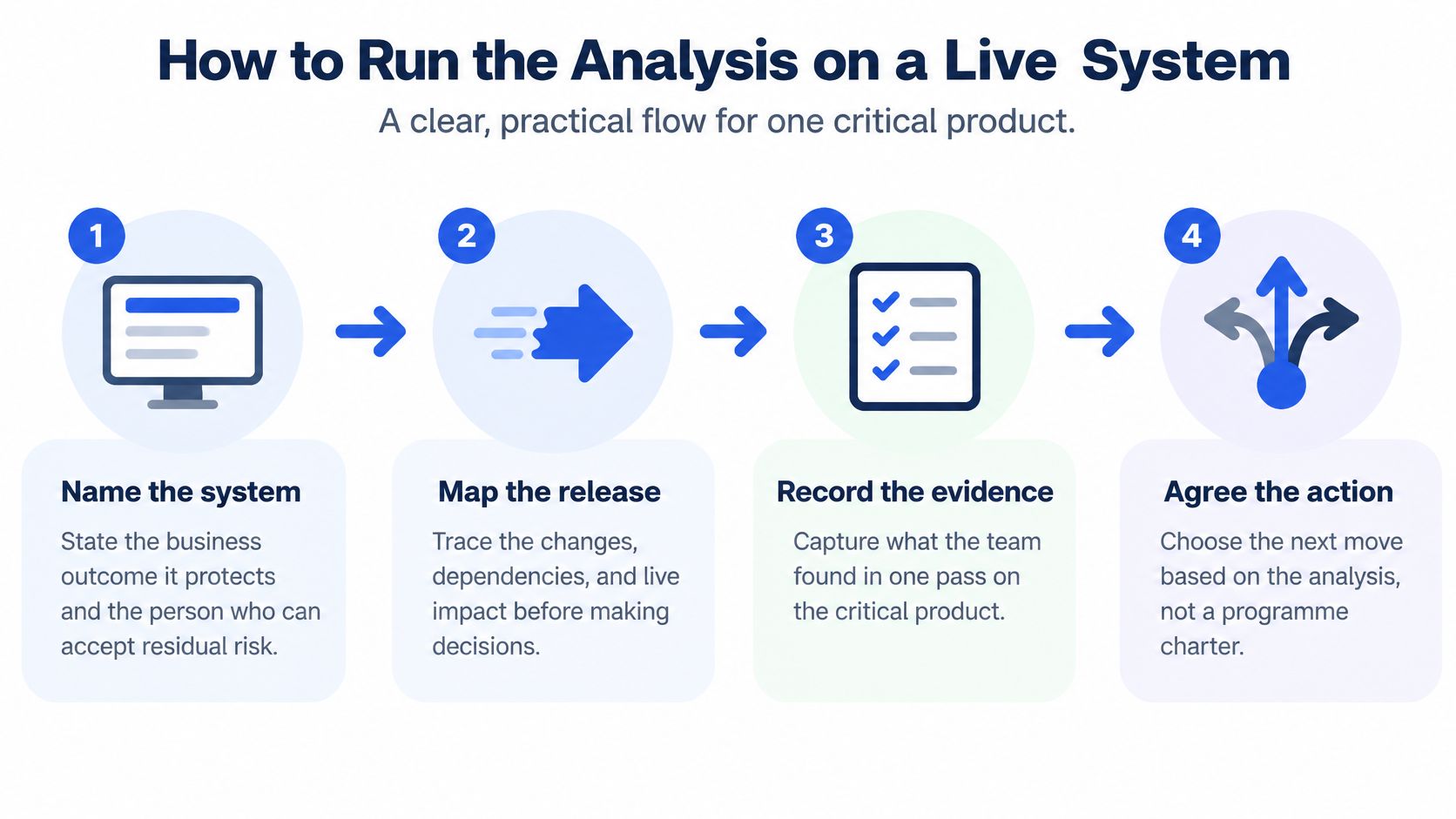
Run one pass on a critical product. Don't begin with a programme charter. Pick the system whose failure would stop customers, revenue, compliance or a core operation, then work through the register until each serious finding changes a decision.
Seven Moves in Order
- Name the system and decision owner: State the business outcome it protects and the person who can accept residual risk. Without that owner, findings collect comments instead of decisions.
- Map the release path: Trace a change from request to production, including build tools and third-party components. Mark trust boundaries, external interfaces and the attack surface.
- Pull the four-family signals: Use the delivery, security, operations and vendor evidence already defined. Don't invent a second checklist for the workshop.
- Score each finding: Apply one chosen scale and write the evidence beside likelihood and impact. Note assumptions, affected versions and compensating controls.
- Record the control decision: Assign an owner and deadline. State whether the risk will be mitigated, transferred or formally accepted.
- Change a design or release: Require a control, delay a shipment, narrow the release or relax a requirement only with the assumption written down.
- Separate reversible work from consequential work: Let low-risk, reversible actions proceed. Stage high-risk actions for human approval before execution.
The modelling step has established support. The NIST Secure Software Development Framework version 1.1 practice PW.1.1 names threat modelling, attack modelling and attack-surface mapping as acceptable forms of risk modelling, and expects teams to estimate exploitability and impact for individual vulnerabilities. NIST defines practices rather than one universal formula. The approval threshold therefore belongs to the company, documented in advance.
That distinction helps during operations. Grail Computer Labs recommends that for high-risk systems, the agent should gather evidence, build the queue, and stage the action for review; direct execution is fine only if the action is reversible and low-risk. Automated steps shouldn't move money, change access, alter a customer commitment or create legal exposure without approval.
Ongoing ownership matters after the first pass, which is why disciplined application management services keep the register, release evidence and incident record connected rather than treating analysis as a one-off document.
Keep the Audit Trail Current
Close the loop with detection, decision, remediation or signed acceptance. Re-score after each release, after a new supplier or dependency is added, and after any incident. Keep dated score history. A register that never changes doesn't show control. It shows nobody is looking.
Inherited Platforms and AI After Go-Live
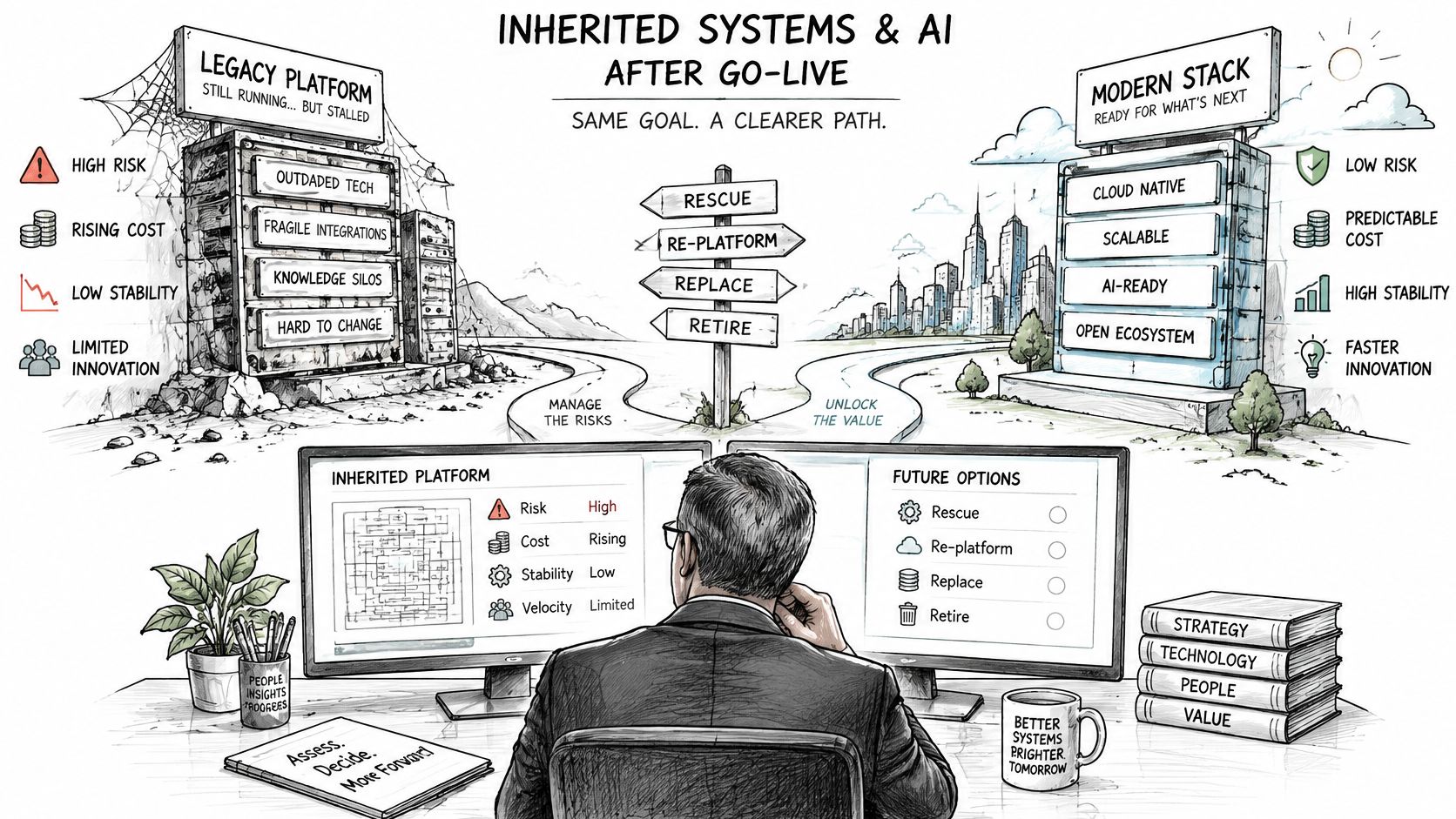
Inherited systems turn scoring into a decision with four exits: rescue, re-platform, replace or retire. The judgement rests on whether critical workflows are understood, whether changes can be tested, and whether the business keeps operating during repair. Untidy code on its own rarely settles that question.
What the Audit Has to Prove
Grail Computer Labs' audit process has four steps: map the whole platform, reconstruct how it worked, find where changes could fail, and work out what it would take to run. The audit covers code, data, infrastructure and product documents left by the previous vendor, and it happens before any rebuilding starts.
The output should be concrete. Leaders should expect a system map, reconstructed behaviour for critical workflows, likely failure points and a run estimate. What the audit cannot prove is that a full rebuild will succeed, and it doesn't need to. It narrows uncertainty enough to pick a path, or to stop before a larger commitment. Qualified clients can also exit within the first 15 days of an engagement without paying, which keeps the cost of that early evidence low.
Two past deliveries show what GC Labs has done, not what the next engagement will match. An Australian healthcare platform had been stuck in development for 8 months with no clear deadline in sight; GC Labs took over from the previous vendor, rebuilt the platform and had it live in production within 30 days, and by day 40, 100 business customers had been onboarded. For a Singapore-based neobank, a one-week build raised automated approvals from 44% to 90% in testing.
Score AI as an Operating Chain
AI risk doesn't end at launch. It lives in data, model, prompts, tools, permissions, human review, monitoring and fallback. A risk survey reported by Riskonnect found that 59% of surveyed risk leaders were considering agentic AI in operations or products, but 55% had not assessed its risks, and only 12% felt prepared to assess, manage and recover from AI-governance risks. Wider industry reporting points the same way: AI-related security incidents concentrate in organisations that never defined controls for the systems they run.
Those figures describe an operating gap, and it shows up in three questions. Who approves an AI-generated action? What changes when the model, retrieval source or external application programming interface (API) changes? How are prompts and outputs logged, and who can reverse the result?
Grail Computer Labs' systems keep that boundary explicit: people approve decisions that affect customers, money, privacy or compliance, while software handles repeatable checks and routine work. In Grail's clinical copilot, the model never diagnoses or prescribes, and the doctor remains responsible for checking and approving the final record. That boundary belongs in the software development life cycle (SDLC), and disciplined agentic software development lifecycle practices make evaluation, context and ownership reproducible after go-live. A pre-launch accuracy test answers none of these questions.
Supplier Components and the Pipeline Around Them
Dependencies keep changing after the contract is signed. A package update, build plug-in or service provider can alter the shipped system without a visible change to application code. Software risk analysis therefore has to follow the full dependency graph, not stop at the immediate supplier.
The exposure is current and slow to contain. Figures published by Synopsys Software Integrity Group and the Ponemon Institute in a 2024 software supply-chain survey reported that 54% of organisations surveyed said they had suffered a software supply-chain attack in the previous year, while 50% took more than one month to respond. Slow identification turns a component issue into an operating incident.
Check Source and Binary Separately
NIST software supply-chain guidance recommends combining software composition analysis (SCA) with binary composition analysis. Source scanning identifies declared vulnerable components. Binary analysis verifies what entered the shipped package or container, including components introduced during build and runtime. A clean repository can still ship a transitive or bundled dependency.
For each release, generate a signed software bill of materials (SBOM), map every component to vulnerability intelligence, and reconcile the SBOM against the release binary before deployment. Teams that automate builds should also review third-party actions for security, because pipeline steps can introduce risk before application tests run.
Prioritise findings by component criticality, exposure, exploitability and reachability. A high-severity common vulnerabilities and exposures (CVE) entry in an unused library path isn't equivalent to an exploitable internet-facing dependency. The register should make that distinction visible.
An SBOM speeds identification. It doesn't replace vulnerability management, vendor assessment or incident response.
NIST supply-chain risk guidance spans design, development, production, delivery, operation and end of life. Build tools, registries, service providers and unsupported dependencies therefore belong on the register. For each finding, record exploitability, affected versions, reachability, asset exposure, compensating controls, owner, deadline and residual-risk acceptance.
Where a listed vulnerability doesn't apply, the disclosure or decision record should explain why. Digitally signed SBOMs also let a later team verify provenance when a supplier is replaced. That auditable chain protects continuity, especially during software rescue or re-platforming.
Choose Rescue, Re-platform or Stop
A risk register that never forces a decision is overhead. Keep shipping when critical workflows are understood, tests cover the paths that move customers or money, and the highest findings have owners and dates. Fund the highest combined scores first, then re-score after release.
No single score settles an inherited platform. The decision reads off several weak signals together: an unknown release date, releases failing in clusters, knowledge held by a supplier that cannot show defect evidence. When those signals stack up, the honest call is software rescue: replace the underperforming vendor or take over the stalled build rather than file another status report. Re-platform in controlled stages when the business rules are sound but the stack cannot be changed safely, a path covered under legacy system migration services. Stop or retire the system when nobody can state the outcome it protects.
Match the Evidence to the Choice
- Rescue: Critical workflows matter, but delivery control and supplier evidence have failed.
- Re-platform: Rules and data remain valuable, while the current stack blocks safe change.
- Replace: The outcome matters, but the existing system cannot provide a trustworthy base.
- Retire: No owner can name a current customer, revenue or compliance outcome.
For AI features already in production, apply the same test to the operating chain rather than the model alone. Ask who approves consequential actions, what happens when a step fails, and whether a person can finish the job manually. A system that runs routine checks while people approve decisions affecting customers, money, privacy or compliance survives scrutiny. One that executes irreversible actions on its own does not.
Grail Computer Labs fits this decision point through an outcome engagement, one pre-defined, measurable outcome delivered in 4-8 weeks. Qualified clients can stop within the 15-day trial without paying, and continuous delivery keeps the same team shipping afterwards across the whole codebase. In GC Labs' Software Factory, agents execute, engineers make the decisions, and customers see progress on a dashboard.
Grail Computer Labs helps leaders turn software risk analysis into a rescue, re-platform or stop decision, then delivers one measurable outcome with the same team staying on through continuous delivery. Start with one critical system, inspect the evidence before committing further, and visit Grail Computer Labs to book a call.