
Healthcare Software Development Guide for 2026
A practical guide to healthcare software development: privacy, clinical safety, interoperability and dependable delivery for platform operators.
The usual advice on healthcare software development starts with standards, secure infrastructure and application programming interfaces (APIs). Those are necessary, but they don't establish whether a platform can be trusted during a consultation, a failed integration or a production release. A system can pass an interface test and still leave a clinician reconciling the wrong record by hand.
For founders, chief technology officers (CTOs) and operations leaders, the harder question is whether to keep building or intervene. That decision needs evidence from daily workflows, not another architecture presentation.
What Healthcare Software Development Must Get Right
A healthcare platform can stay busy for months without becoming safe to put in front of patients, workforce partners or a prospective buyer. Engineers close tickets, demonstrations improve and the backlog grows. Yet nobody can show how a sensitive record moves through the system, who approves a consequential output or how a failed release gets reversed.
The useful starting point isn't a framework choice. It's whether privacy, clinical safety, interoperability and dependable delivery exist as working product capabilities.
This applies to enterprises and private equity (PE)-backed businesses as much as growing health-tech companies. It also applies to managed-service businesses (MSPs), meaning non-IT service firms whose platforms connect customers with workers, providers or partners. Their operational software may cross organisational boundaries even when it doesn't directly deliver treatment.
Four tests for healthcare software
| Consideration | Failure in practice | What to build | Evidence to keep |
|---|---|---|---|
| Privacy | Unmapped flows of electronic protected health information | Risk analysis, least-privilege access, audit logs, encryption | Asset inventory, owners, threat record, control tests |
| Clinical safety | Software influences care without an independent review | Documented intended use, human approval, safe stop | Validation cases, overrides, incidents, change history |
| Interoperability | Data is exchanged but not usable in the next workflow | Standard resources, terminology, identity match, fallback | Contract tests and representative care-journey scenarios |
| Dependable delivery | Months of work with no trusted production release | One accountable path from change to release | Passed tests, release notes, recovery drill, ticket record |
Mark each row present, partial or missing before committing to a new architecture or replacing a delivery partner. Present means an accountable owner can open the evidence and demonstrate the behaviour. A document describing a future control doesn't count as an implemented control.
Partial deserves particular attention. A platform might record access but omit background service activity. It might require clinical approval on screen while allowing another integration to save an unapproved output.
Judge behaviour rather than paperwork
The review should follow a representative transaction across organisational boundaries. For a hypothetical referral, that means checking the originating record, recipient identity, permission to share, receiving workflow and recovery behaviour.
Practical rule: A control is credible when someone can demonstrate both its normal operation and its failure handling.
Not every platform needs the same controls or regulatory treatment. A workforce coordination product and diagnostic software have different intended uses. The standard is therefore not identical paperwork, but a defensible relationship between the workflow, its risks and the evidence retained.
From Digital Records to a Clinical Product
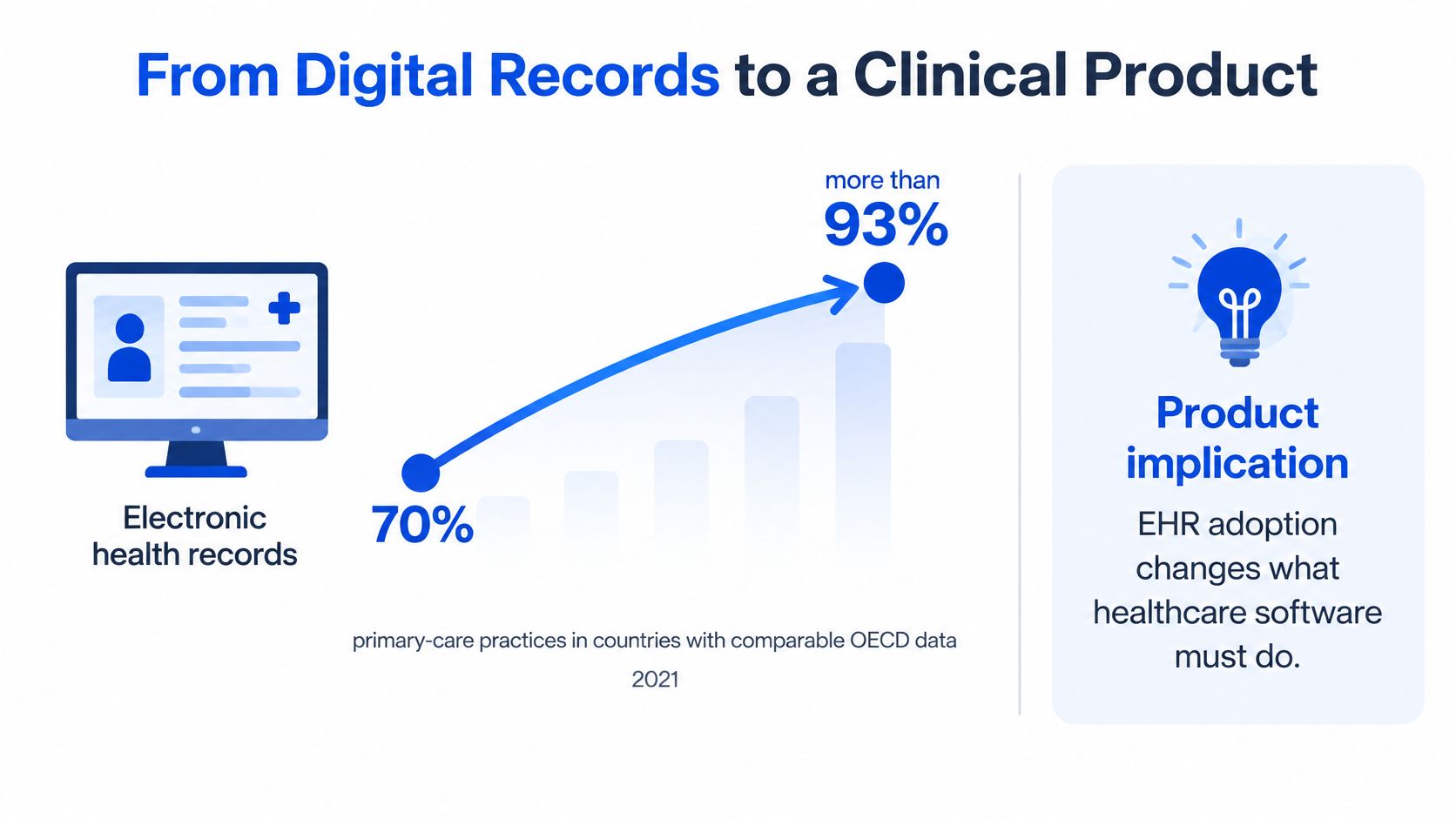
Electronic health records (EHRs) are established infrastructure rather than an emerging feature. The OECD's digital health chapter reports that average EHR use among primary-care practices in countries with comparable data increased from 70% in 2012 to more than 93% in 2021, over 23 percentage points in nine years; inpatient use rose by nearly 45% between 2012 and 2021, patients in 16 of 26 countries could access record information through online portals, and a separate survey of 27 countries found 15 with nationally unified EHR systems and 24 with minimum datasets.
Digitising a filing cabinet doesn't make every clinic, laboratory and insurer read the same chart. Consider a hypothetical patient moving between a clinic and an external laboratory. Both organisations may hold digital records, but still use different identifiers, test names and access arrangements.
Build for the whole record journey
A useful platform needs more than electronic storage:
- Provider integration connects the organisations involved in care.
- Common data definitions make exchanged information interpretable.
- Patient-facing access provides an appropriate route to record information.
- Governance assigns responsibility for access, corrections and ownership.
- Long-term interoperability keeps those connections usable as systems change.
A buyer should establish which capabilities already work and which remain assumptions. During legacy system migration, preserving the meaning and ownership of records matters as much as moving their contents.
The adoption figures don't measure the quality of any individual product. Implementation remains uneven across countries, and a widely used record system can still require substantial integration work. The product implication is narrower: digital records create dependencies that healthcare software must handle deliberately.
Privacy Starts with a Risk Analysis
Encryption isn't a substitute for understanding where patient information travels. In the United States, the Health Insurance Portability and Accountability Act (HIPAA) Security Rule requires regulated organisations to assess risks to the confidentiality, integrity and availability of electronic protected health information (ePHI). The HHS Security Rule overview explains that the assessment must be accurate and thorough, with safeguards that reduce risk to a reasonable and appropriate level.
The rule doesn't prescribe a single analysis method. Teams can fit the method to the system's complexity, but they still need to document reasonably anticipated threats. This is engineering work that informs design, not a certificate collected before launch.
Turn the assessment into owned work
- Inventory the data flows. List where identifiable health data is created, stored, processed and sent. Include exports, support access, analytics, logs and backup copies, not just the main application.
- Assign an owner. Every flow needs someone responsible for its purpose, access arrangements and retention. Shared infrastructure doesn't remove that responsibility.
- Record threats and consequences. Assess likelihood and impact alongside existing safeguards. A compromised service account and an unavailable clinical record create different response needs.
- Connect risk to verification. Link each material risk to a control, a test, a remediation owner and a completion date. Unverified intentions should remain open items.
- Reassess after material changes. New integrations and altered workflows can invalidate an otherwise useful assessment.
An unmapped flow creates a blind spot. That blind spot weakens the threat model, leaving a missed threat that could expose patient information or interrupt a clinical service.
Make safeguards observable
A practical baseline includes strong identity controls, least-privilege service accounts, encryption in transit and at rest, tamper-evident audit logs and secrets management. Tested backups need an agreed recovery objective, not just a successful backup notification.
The HHS risk-analysis guidance also identifies unpatched software as a risk to ePHI. Release pipelines should therefore include dependency scanning, infrastructure-as-code review, a patch service level and penetration testing for high-risk changes.
A backup is useful evidence only after a restore demonstrates that the required service and records can be recovered.
Evidence collection should follow these controls rather than become a parallel reporting exercise. ThreatExploit AI's resource on streamlining HIPAA evidence collection offers a useful reference for organising that work; automation doesn't replace the underlying assessment.
Other countries apply different privacy laws. A US risk analysis is a strong engineering pattern, not a global compliance certificate.
When Compliant Interfaces Still Fail Clinicians
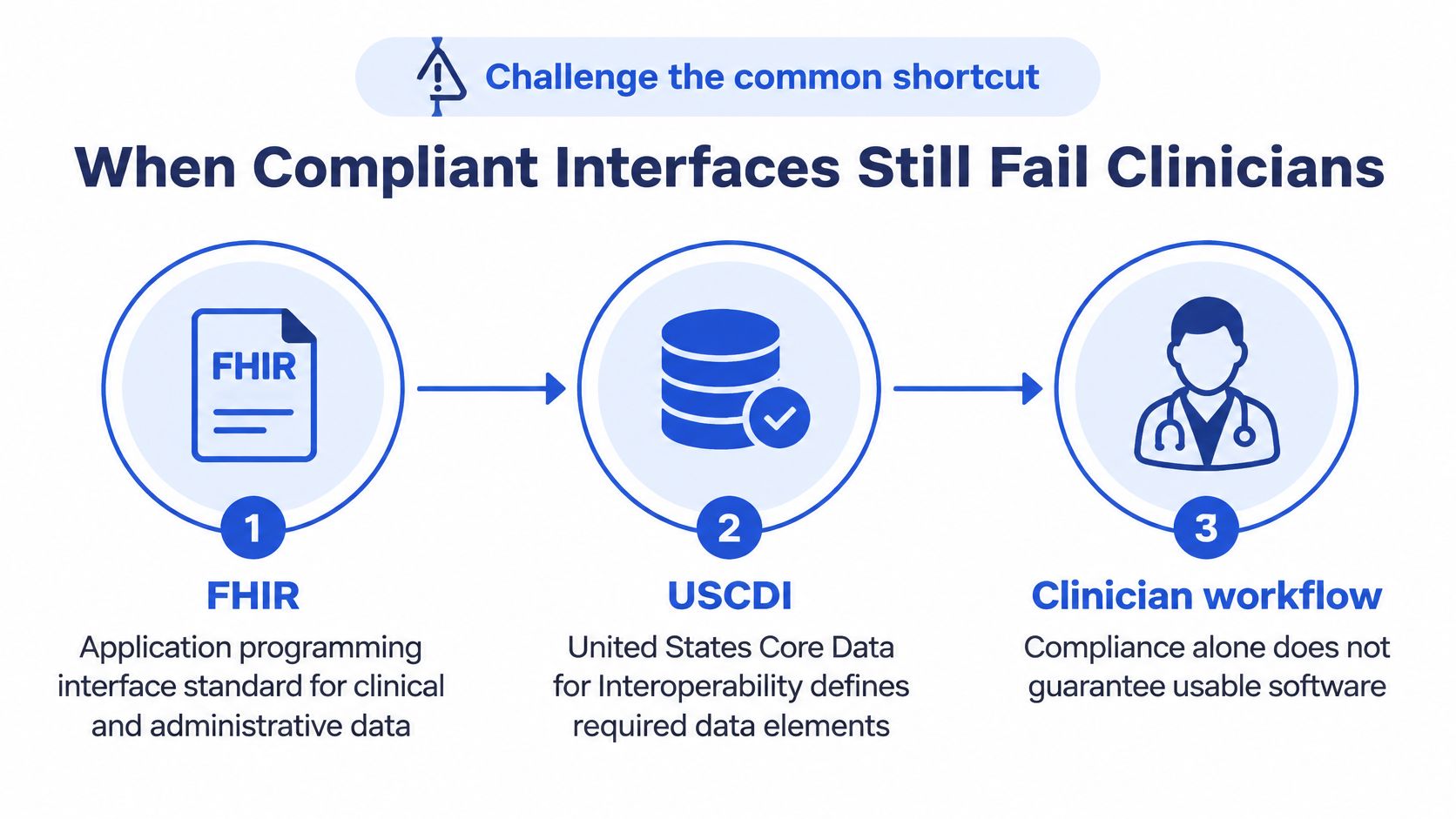
FHIR compatibility isn't the same as usable interoperability. Fast Healthcare Interoperability Resources (FHIR) is an API-focused standard for exchanging clinical and administrative data. The US health IT standards repository also describes the United States Core Data for Interoperability (USCDI), covering data classes such as clinical notes, allergies, laboratory results and medications.
A technically valid response can still arrive outside the clinician's normal screen, contain an unresolved patient match or use a local code nobody receiving it understands. Like a grammatically correct translation, the structure can be sound while the meaning is wrong.
The Australian Digital Health Agency's 2025 interoperability survey found that 50% of healthcare professionals considered lack of shared system adoption the leading barrier to smooth exchange. It also identified information that was available but not integrated into the clinical system.
Recover the workflow, not just the endpoint
- Map the actual care journey. Follow the record through referrals, external providers and manual hand-offs. Record where staff retype information or leave the clinical application.
- Translate meaning explicitly. Map local records to standard resources, coded values and identifiers. Preserve provenance so recipients can establish where information originated.
- Validate at ingestion. Check required fields and coded values before accepting data. Version mappings so changes do not unexpectedly alter historical interpretation.
- Define acceptance before features. A medication test should establish whether the receiving system can exchange, interpret and safely reconcile the record, not merely receive it.
- Measure operational use. Check whether staff use the information to make a decision or avoid duplicate entry. Successful delivery alone does not answer that question.
- Preserve a human fallback. When a feed fails or identity remains uncertain, route the work to a named person rather than accepting a guess without verification.
Treat adoption as reach, not fit
In 2024, 81% of US hospitals enabled patient access through apps configured to EHR API specifications, including 70% using FHIR-configured apps, according to the US Office of the National Coordinator for Health Information Technology. Separately, approximately 73% of surveyed digital-health companies reported current or previous production use of a standards-based EHR API in 2024, according to the peer-reviewed survey in the University of California repository.
Those figures demonstrate reach, not workflow fit. A patient-access capability and a medication reconciliation workflow solve different problems.
For software rescue, the early architecture review should find undocumented interfaces and identify canonical clinical entities. Lock migration mappings into version-controlled schemas and automated contract tests. Make failed deliveries, rejected records and unresolved matches visible to the people responsible for resolving them.
Safety After the Software Goes Live
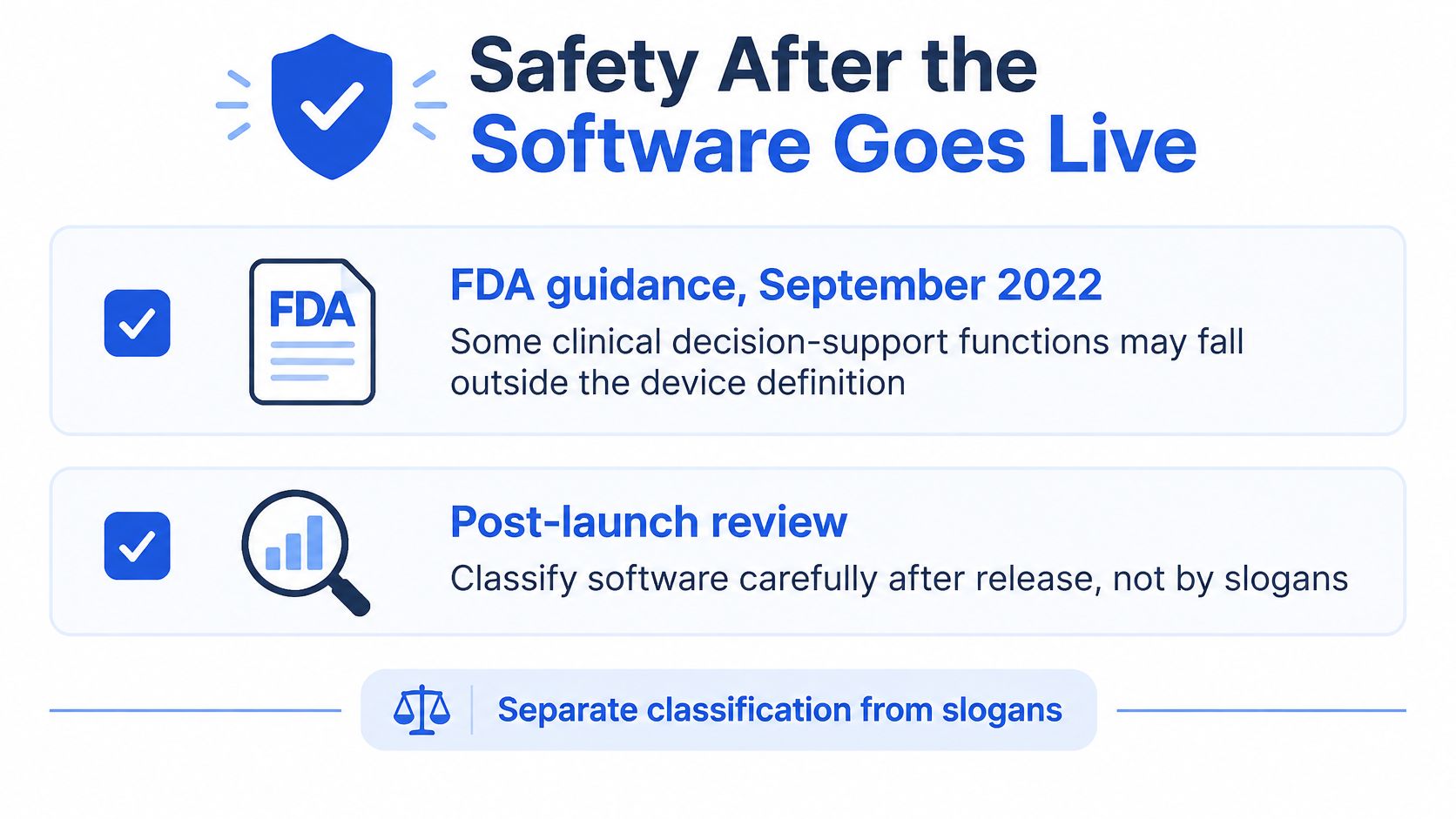
Calling software an assistant doesn't settle its regulatory classification. The US Food and Drug Administration's September 2022 clinical decision-support guidance explains that some functions may fall outside the medical-device definition, while device policies continue to apply to functions meeting that definition, including functions intended for patients or caregivers.
Before model training and architecture choices become difficult to reverse, document the intended user, intended use, inputs, outputs and clinical context. Establish whether a qualified professional can independently review the basis of a recommendation. Understandable information presented for review isn't equivalent to software that drives diagnosis or treatment.
Classify early and retain the decision history
An analysis of US medical-device authorisations examined 47,712 devices authorised between 2005 and 2024: 921, or 1.9%, were classified as software as a medical device, while software appeared as a keyword in documents for 13,390 devices, or 28.1%. These measures distinguish standalone software classification from broader software involvement; they don't classify a particular healthcare product.
After launch, an evidence trail should connect model versions, data provenance, validation results, overrides, approvals, incidents and subsequent performance. The operational governance described in MedicalResearch.com's healthcare technology analysis supports treating human review and monitoring as ongoing responsibilities rather than launch paperwork.
Set agreed stop conditions for accuracy, calibration, latency, data quality and drift. Crossing a threshold should trigger review, human routing or safe reversion. The thresholds need validation for the intended workflow, not generic values copied from another product.
Keep the consultation workable when automation fails
Grail Computer Labs' clinical copilot provides a concrete operating pattern:
- Clinical responsibility stays with the doctor. The model never diagnoses or prescribes, and the doctor checks and approves the final record.
- Regression tests use stable examples. GC Labs tests every clinical-workflow change against the same example consultations and correct records agreed on by doctors.
- Failures don't stop the consultation. If transcription, generation or saving fails, the doctor can finish the record manually while the product records which step failed.
This is a design pattern, not a regulatory determination. Human approval must be supported by a usable review process, not a button that encourages automatic acceptance.
Ongoing application management should retain these checks as models, integrations and dependencies change. Singapore, the UK, Europe, the United Arab Emirates and the US don't share a single rulebook; that list is a reminder to assess jurisdiction, not a legal map.
Dependable Delivery Needs One Release Path
Dependable delivery means an operator can trace an approved change into production and establish how to recover if it fails. A busy ticket board doesn't provide that assurance.
Build the release path around evidence
- Name an accountable owner. Cover the whole path from change request to production, including dependencies between teams.
- Block failed changes. Automate representative clinical and interface tests. A failed safety-critical case must prevent release rather than generate an optional warning.
- Keep environments representative. Match production closely enough for passed tests to mean something. Record changes in release notes, including migration and operational implications.
- Rehearse recovery. Restore data and reverse a release before an incident makes those procedures urgent. Check compatibility between restored data and application versions.
- Retain the approval record. Connect each change to its request, review, checks and approval.
AskYourQA's guidance on where security and performance tests run is useful when deciding pipeline placement. Those checks should complement clinical tests rather than displace them.
Include database changes in the same controls
According to Redgate's 2024 healthcare database survey, 92% of surveyed healthcare organisations had adopted Database DevOps or planned to within two years, and 63% were already practising it. It's a vendor survey, so it signals direction rather than implementation quality.
Schema changes need review, testing and recovery planning alongside application changes. An agentic software development life cycle still needs these release gates when agents perform implementation work.
Release discipline: More implementation capacity doesn't justify weaker approval or recovery controls.
When months of activity produce no trusted release, inspect this path before adding features or changing delivery partners. A sound release process lowers operational risk, but it doesn't replace clinical validation or qualified review.
Two Healthcare Builds That Had to Move
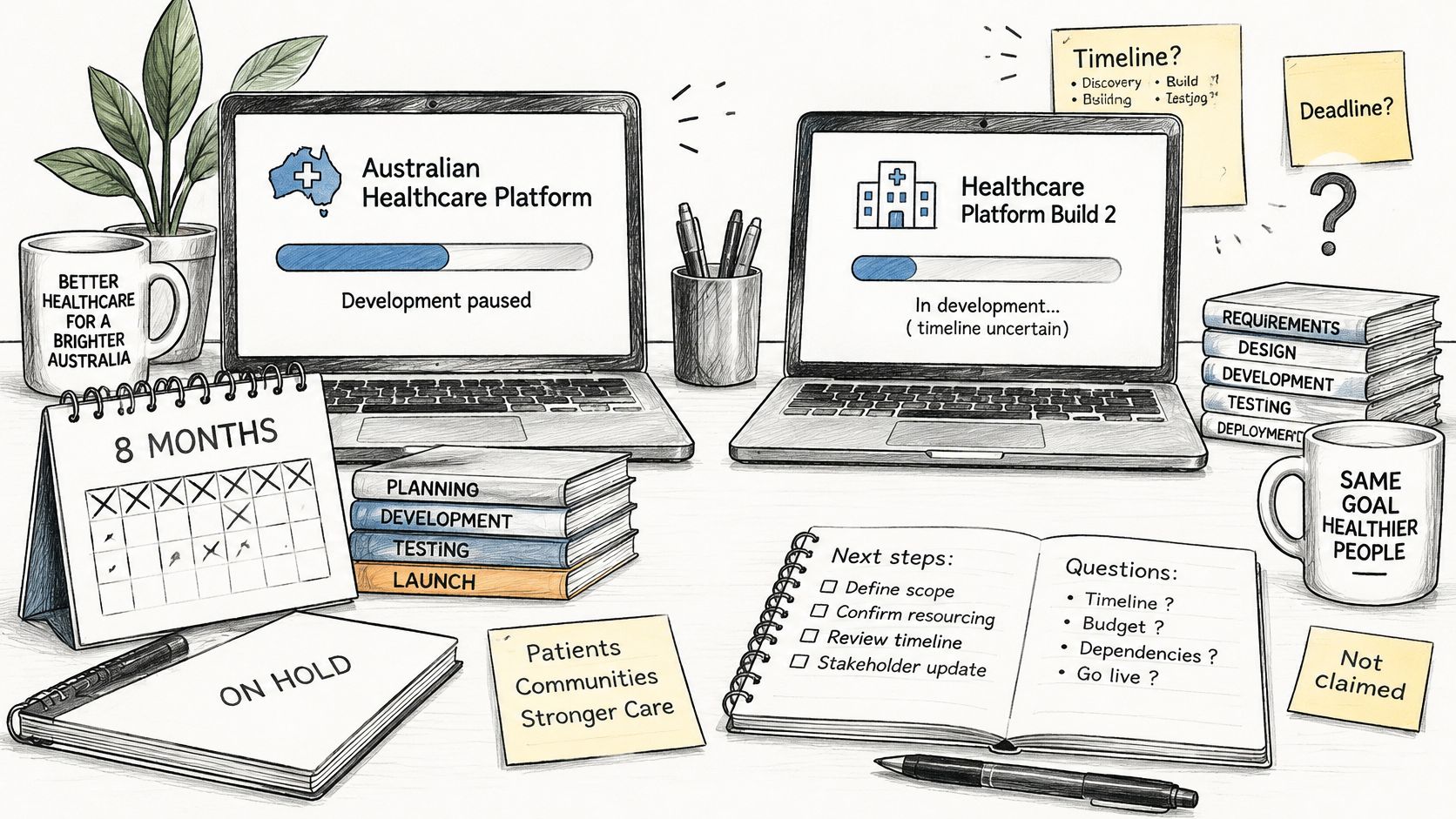
An Australian healthcare platform was stuck in development for 8 months with no clear deadline in sight; GC Labs took over from the previous vendor, rebuilt the platform and had it live in production within 30 days; by day 40, 100 business customers had been onboarded.
This describes one takeover, not a timing promise for every healthcare platform. It doesn't establish clinical effectiveness, regulatory approval or an equivalent result for another inherited system.
Separate the result from the inference
GC Labs audited the inherited platform and retained the business rules that mattered. After the rebuild, GC Labs stayed on as the technology partner for new features, infrastructure and production support.
A separate result comes from outside healthcare: For a Singapore-based neobank, a one-week build raised automated approvals from 44% to 90% in testing. Testing isn't production, and banking isn't clinical care. That result shouldn't be presented as evidence of healthcare safety or an expected production improvement.
Apply a recovery sequence without assuming the outcome
The useful recommendation is a sequence, not a deadline:
- Stop extending the stalled approach. Establish what prevents a usable release before approving more scope.
- Inspect what exists. Review code, data, infrastructure and product documents before deciding to rebuild.
- Retain valuable business rules. An ageing implementation doesn't make every embedded rule wrong.
- Assign end-to-end ownership. Someone must be accountable for the working product, not just completing implementation tasks.
These cases support a narrower conclusion than a universal delivery claim. A stalled project can merit intervention, but the scope and risk of that intervention must come from its own audit.
Decide Whether to Rescue or Keep Building
Score the opening tests as present, partial or missing. If privacy flows, clinical review, usable exchange and trusted releases are present, keep the current team and strengthen its weakest tests. A missing control alone doesn't justify replacing an otherwise functioning engineering organisation.
If the product matters but the current provider can't identify an owner, a credible release path or a date the business can use, treat it as a software rescue decision. GC Labs' takeover service assumes responsibility for the product, codebase, infrastructure, testing and production after reviewing what is worth keeping.
Choose the intervention that matches the problem
- Keep building when ownership works and the remaining gap is a specific control or capability.
- Rescue when a consequential product has stalled and nobody owns delivery end to end.
- Re-platform when business rules remain useful but the underlying stack creates material risk. Plan controlled stages rather than assuming a single cutover is safe.
An outcome engagement defines one pre-defined, measurable outcome, such as a platform ready for production, and targets delivery in 4–8 weeks. Qualified clients can use a 15-day trial and stop within the first 15 days without paying. These engagement terms aren't a universal completion promise.
Afterwards, continuous delivery means the same team keeps delivering like an in-house technology team. GC Labs' Software Factory is the AI software factory supporting that work: agents execute, GC Labs engineers make the decisions, and customers see progress. GC Labs also builds custom AI models and automates internal operations where those capabilities address the actual workflow.
Grail Computer Labs offers software rescue and legacy re-platforming for healthcare products that need an accountable route to production. Visit Grail Computer Labs to book a call about the stalled workflow, inherited platform or release risk that needs resolving.